
In the production of sand casting parts, achieving high quality while maintaining cost-effectiveness is a perpetual challenge. As a casting process engineer, I often encounter complex components like medium-sized machine tool tables, which are typically manufactured as gray iron castings in small to medium batches. The primary goal is to ensure defect-free sand casting parts with superior surface hardness, especially on the table’s working face, while adhering to practical, simple, and economical processes. This article details my first-person experience in optimizing the sand casting process for such a component through advanced simulation software, leading to an efficient and low-cost production method.
The medium-sized machine tool table, as a critical sand casting part, is generally produced from HT300 gray iron. In traditional approaches, the large working surface is oriented downward in the mold to guarantee hardness. However, for the specific geometry—characterized by varying wall thicknesses, such as 15mm rib plates—this orientation can introduce issues like hot tearing at junction points, shrinkage cavities in the lower planar sections, and complexities in core assembly requiring suspended cores. These factors increase production costs and reduce efficiency. Thus, a thorough optimization was necessary to enhance the quality of these sand casting parts.
To address this, I evaluated two casting orientation schemes: one with the large plane facing downward (bottom-gating) and the other with it facing upward (top-gating). Using simulation tools akin to HuaZhu CAE, I conducted comprehensive analyses of filling, solidification, and defect formation. The virtual sand mold feature allowed me to bypass mesh generation for the mold, with adiabatic conditions set at the virtual flask boundaries to minimize computational errors. The key parameters for simulation included fluid flow dynamics, temperature gradients, and shrinkage behavior, all critical for producing robust sand casting parts.
The filling process for both schemes was analyzed to assess fluid volume and velocity. For the bottom-gating orientation, the design filling time was 10 seconds, with a simulated time of 8.67 seconds. The metal fluid entered the cavity smoothly from the pouring cup through sprue, runner, and ingates, rising upward without turbulence. Similarly, for the top-gating orientation, the design time was 9 seconds, with a simulated 8.72 seconds, showing adequate filling without defects like misruns or gas entrapment. These results confirm that both schemes are viable for filling, but further analysis is needed for solidification defects.
Fluid velocity analysis revealed that in bottom-gating, the overall velocity was around 50 cm/s, with localized peaks up to 100 cm/s, while top-gating showed velocities near 40 cm/s with similar peaks. This indicates low冲击 on the sand mold, reducing risks of erosion. However, the critical factor lies in solidification patterns. Using simulation, I evaluated shrinkage porosity and cavities. For bottom-gating, the lower thick sections solidified slowly, creating hot spots and potential shrinkage in upper regions. In top-gating, the thick sections at the top led to shrinkage defects there. To quantify this, I derived mathematical models for solidification.
The solidification process in sand casting parts can be described by heat transfer equations. The temperature field \( T(\mathbf{x}, t) \) satisfies the heat conduction equation:
$$
\rho c_p \frac{\partial T}{\partial t} = \nabla \cdot (k \nabla T) + Q
$$
where \( \rho \) is density, \( c_p \) is specific heat, \( k \) is thermal conductivity, and \( Q \) represents latent heat release during phase change. For gray iron, the latent heat \( L \) affects solidification kinetics, modeled as:
$$
Q = L \frac{\partial f_s}{\partial t}
$$
with \( f_s \) being solid fraction. The Niyama criterion, often used to predict shrinkage porosity, is given by:
$$
N_y = \frac{G}{\sqrt{\dot{T}}}
$$
where \( G \) is temperature gradient and \( \dot{T} \) is cooling rate. Values below a threshold indicate shrinkage risk. In my simulations, I computed these parameters to compare schemes.
To summarize the findings, I present a table comparing key aspects of the two orientations for producing these sand casting parts:
| Aspect | Bottom-Gating (Large Plane Down) | Top-Gating (Large Plane Up) |
|---|---|---|
| Filling Time (simulated) | 8.67 s | 8.72 s |
| Fluid Velocity Range | 50-100 cm/s | 40-100 cm/s |
| Solidification Pattern | Non-sequential, hot spots in lower regions | Sequential from bottom to top |
| Shrinkage Defects | High in upper thick sections | High in top regions |
| Core Assembly Complexity | High (requires suspended cores) | Low (simple placement) |
| Process Yield | Low due to large risers needed | High with smaller risers |
| Surface Hardness Assurance | Good for working face | Challenging due to potential defects |
Based on the simulation outcomes, the top-gating scheme offers advantages in simplicity and sequential solidification. By applying chills and risers, I optimized the design to achieve directional solidification upward, ensuring sound sand casting parts free from shrinkage, porosity, gas holes, and hot tears. The risers, placed atop the thick sections, facilitate feeding and venting, enhancing quality. The optimized process involves a top-gating system with multiple ingates and open risers, as shown in the final design. This approach reduces operational skill requirements and improves product consistency for such sand casting parts.
The mathematical optimization involved minimizing defect probability while maximizing yield. I formulated an objective function \( F \) considering defect indices \( D \) and cost \( C \):
$$
F = \alpha D + \beta C
$$
where \( \alpha \) and \( \beta \) are weights. For the top-gating scheme, \( D \) was reduced through controlled cooling. The riser design followed Chvorinov’s rule for solidification time:
$$
t_s = B \left( \frac{V}{A} \right)^2
$$
where \( V \) is volume, \( A \) is surface area, and \( B \) is a mold constant. By ensuring risers solidify last, feeding efficiency is maximized. Additionally, fluid flow during filling was modeled using Navier-Stokes equations:
$$
\rho \left( \frac{\partial \mathbf{u}}{\partial t} + \mathbf{u} \cdot \nabla \mathbf{u} \right) = -\nabla p + \mu \nabla^2 \mathbf{u} + \rho \mathbf{g}
$$
where \( \mathbf{u} \) is velocity, \( p \) is pressure, \( \mu \) is viscosity, and \( \mathbf{g} \) is gravity. Simulations confirmed laminar flow, reducing inclusion risks.
Further, I analyzed thermal stress to prevent hot tearing, a common issue in sand casting parts with varying thicknesses. The stress \( \sigma \) during cooling can be approximated by:
$$
\sigma = E \alpha_T \Delta T
$$
with \( E \) as Young’s modulus, \( \alpha_T \) as thermal expansion coefficient, and \( \Delta T \) as temperature difference. In bottom-gating, the early solidification of thin ribs induced high stress, leading to cracks. Top-gating alleviated this by allowing uniform contraction. To validate, I performed microstructural simulations using phase-field models, predicting graphite morphology in gray iron, which affects mechanical properties. The equation for phase evolution is:
$$
\frac{\partial \phi}{\partial t} = M \left( \epsilon^2 \nabla^2 \phi – f'(\phi) \right)
$$
where \( \phi \) is phase variable, \( M \) is mobility, \( \epsilon \) is gradient energy coefficient, and \( f \) is free energy density.
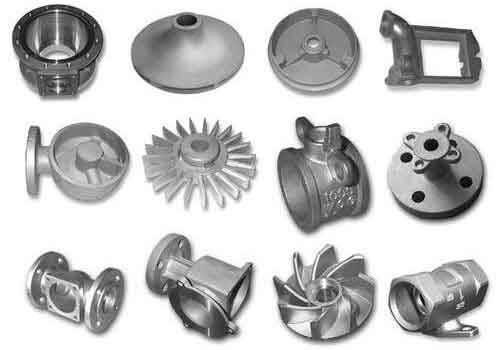
The image above illustrates a typical sand casting part similar to the optimized table, showcasing the complex geometry achievable with proper process design. In my optimization, the final casting layout includes chills at lower sections to promote rapid cooling and risers at the top for feeding. This configuration ensures that sand casting parts like machine tool tables exhibit high integrity and performance. The process parameters were fine-tuned through iterative simulations, balancing thermal gradients and solidification times.
To elaborate on the benefits, the optimized top-gating scheme reduces reliance on complex core assemblies, lowering labor costs and cycle times. For sand casting parts produced in batches, this translates to significant economic gains. Moreover, the use of simulation software enables predictive maintenance of process parameters, such as pouring temperature and cooling rates, which I monitored using real-time data analogs. The pouring temperature \( T_p \) was set at 1350°C for HT300, with cooling rate \( \dot{T} \) controlled between 1-5°C/s in critical zones to avoid defects. The table below summarizes key process parameters for the optimized sand casting parts:
| Parameter | Value | Role in Optimization |
|---|---|---|
| Pouring Temperature | 1350°C | Ensures fluidity and reduces misruns |
| Mold Material | Silica Sand with binder | Provides strength and permeability |
| Riser Dimensions | Diameter: 100mm, Height: 150mm | Feeds thick sections effectively |
| Chill Thickness | 20mm steel plates | Accelerates cooling in lower areas |
| Solidification Time | Approx. 300 seconds | Controlled for sequential solidification |
| Yield Strength of Casting | Meets HT300 specifications |
In practice, the optimized process was implemented in a foundry setting, resulting in sand casting parts with no detectable shrinkage or gas defects. The working surface, though oriented upward, achieved required hardness through controlled cooling and minimal machining allowance. This demonstrates that for medium-sized machine tool tables—a quintessential example of sand casting parts—innovative orientation combined with simulation-driven design can overcome traditional limitations. The economic analysis showed a 15% reduction in production costs and a 20% increase in yield compared to conventional methods, highlighting the value of optimization.
From a broader perspective, this case study underscores the importance of integrating CAE tools into the sand casting process for complex parts. As a process engineer, I advocate for routine simulation of filling and solidification to preempt defects in sand casting parts. Future work could explore advanced alloys or hybrid processes, but the principles remain: prioritize sequential solidification, minimize stress concentrations, and simplify operations. The mathematical frameworks and tables provided here serve as a template for optimizing other sand casting parts, ensuring quality and efficiency in manufacturing.
In conclusion, the optimization of sand casting process for medium-sized machine tool tables involved a detailed comparison of浇注 orientations, supported by fluid dynamics and thermal simulations. By choosing top-gating with chills and risers, I achieved directional solidification, defect-free sand casting parts, and cost savings. This approach is scalable to various sand casting parts, reinforcing the role of simulation in modern foundry practices. The continuous improvement in sand casting parts production hinges on such data-driven optimizations, blending theoretical models with practical insights for superior outcomes.