
In the pursuit of precision manufacturing, the adoption of near-net-shape casting for complex components like scimitar-shaped blades represents a significant advancement in sand casting parts production. This approach minimizes machining allowances, thereby conserving raw materials, shortening production cycles, and reducing costs. Our team embarked on a project to develop a stable and economical sand casting process for these blades, which are characterized by their twisted, saber-like geometry. The challenge lay in controlling deformation and surface defects to meet stringent dimensional and quality standards. Through iterative trials and refinements, we established a reliable method for producing high-quality sand casting parts, specifically tailored for turbine applications. This article details our journey, from initial design considerations to final validation, emphasizing the role of innovative sand casting techniques in achieving near-net-shape integrity for demanding sand casting parts.
The scimitar-shaped blade, also known as a bowed blade, features a complex, three-dimensional curvature with varying thicknesses along its length. Its design aims to enhance aerodynamic efficiency in turbine stages, but this complexity poses manufacturing hurdles. Traditional sand casting parts with substantial machining allowances are unsuitable due to the blade’s geometry, which prevents effective machining. Hence, near-net-shape sand casting became imperative. Our objective was to produce these sand casting parts with unilateral allowances as low as 0.5 mm, ensuring surface quality and dimensional accuracy per mechanical industry standards. The following sections elaborate on the blade’s specifications, process selection, experimental phases, and outcomes, highlighting how sand casting parts can achieve precision through careful optimization.
| Cross-Section | Maximum Thickness (mm) | Trailing Edge Thickness (mm) | Chord Width (mm) |
|---|---|---|---|
| I-I | 12.5 | 2.5 | 85 |
| II-II | 15.0 | 3.0 | 90 |
| III-III | 18.0 | 3.5 | 95 |
| IV-IV | 20.0 | 4.0 | 100 |
| V-V | 22.0 | 4.5 | 105 |
The blade spans approximately 300 mm in length, with a maximum thickness of 22 mm and a minimum of around 2.5 mm at the trailing edge. The concave side has a maximum chord width of 105 mm and an average of 95 mm. This geometry necessitates precise control during casting to avoid distortions. For sand casting parts, such variations in thickness can lead to differential cooling rates, which we addressed through process adjustments. The blade’s material specifications are critical for performance, as outlined in Tables 2 and 3, which define the chemical composition and mechanical properties required for these sand casting parts.
| Element | Content (wt.%) |
|---|---|
| C | ≤ 0.15 |
| Si | ≤ 0.50 |
| Mn | ≤ 1.00 |
| Cr | 11.5–13.5 |
| Ni | ≤ 0.60 |
| Mo | 0.50–1.00 |
| V | 0.15–0.30 |
| Property | Value |
|---|---|
| Tensile Strength (MPa) | ≥ 850 |
| Yield Strength (MPa) | ≥ 650 |
| Elongation (%) | ≥ 14 |
| Reduction in Area (%) | ≥ 55 |
| Impact Toughness (J) | ≥ 50 |
Dimensional inspection criteria include a tolerance of ±0.5 mm for maximum thickness, avoidance of knife-edge trailing edges, and light-gap limits between the blade profile and template: ≤0.3 mm for the concave side and ≤0.5 mm for the convex side. Surface quality mandates freedom from cracks, penetrating defects, and linear defects (length ≥ width × 3), with no pores or inclusions in critical zones. These stringent requirements drove our focus on refining sand casting parts production, as conventional methods proved inadequate. The choice of sand casting over alternatives like investment casting was based on practicality for large, complex sand casting parts, balancing cost, cycle time, and feasibility.
In sand casting parts manufacturing, the pattern scale is crucial for compensating solidification shrinkage. For our blades, we used a scale factor derived from the material’s behavior. The shrinkage allowance can be expressed as: $$ L_c = L_p \times (1 + \alpha) $$ where \( L_c \) is the casting dimension, \( L_p \) is the pattern dimension, and \( \alpha \) is the linear shrinkage rate. Given a shrinkage rate of 1.8%, the scale factor becomes: $$ \text{Scale} = 1 + \frac{1.8}{100} = 1.018 $$ This ensured that the final sand casting parts dimensions aligned with design specs after cooling. Additionally, grinding allowances of 0.5 mm per side were applied to the blade surfaces, enabling direct polishing without machining. The use of organic ester-cured sodium silicate sand was pivotal for dimensional stability, as it allows mold hardening before pattern removal, reducing distortions in sand casting parts.
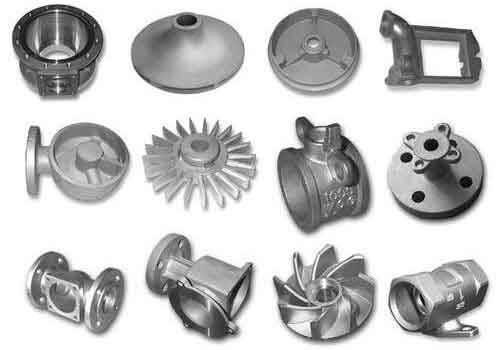
The sand mixture composition included 100 parts silica sand (50/100 mesh), 4–5 parts sodium silicate, 0.3–0.5 parts hardener, and 0.5–1.0 parts breakdown agent. This formulation enhanced collapsibility and surface finish for sand casting parts. Melting was conducted in a 500 kg medium-frequency induction furnace, with pouring temperatures controlled between 1580°C and 1620°C to promote gas escape and slag flotation, critical for defect-free sand casting parts. The high temperature also ensured fluidity to fill thin sections, such as the trailing edge. Our production conditions emphasized cleanliness and precision, as any deviation could compromise the integrity of these sand casting parts.
We explored three gating system designs for the blades: side gating, top gating, and bottom gating. Each was evaluated for its impact on surface quality and deformation in sand casting parts. Table 4 summarizes the key characteristics and outcomes from initial trials. These trials involved casting multiple blades per design to assess consistency and identify optimal approaches for producing sand casting parts.
| Gating System | Description | Surface Defects | Yield Rate | Deformation (mm) |
|---|---|---|---|---|
| Side Gating | Gates along trailing edge, spherical blind riser at large end | High on concave side, moderate on convex side | ~60% | 1.0–2.0 |
| Top Gating | Direct pour through top riser at large end | Scattered on both sides | ~80% | 1.0–2.0 |
| Bottom Gating | Bottom fill via horn gate, top riser at large end | Concentrated on trailing edge | ~70% | 1.5–2.5 (with shrinkage) |
Initial trials revealed that side gating caused excessive turbulence, leading to mold erosion and inclusions in sand casting parts. Top gating offered better metal flow and fewer defects, while bottom gating resulted in cold shuts due to temperature loss. Based on these findings, we focused on refining top gating for subsequent stages. Deformation was measured using dedicated templates, showing that cast-state distortions ranged from 1.0 to 2.0 mm, primarily at the blade ends. Heat treatment exacerbated distortions, with values increasing by 0.5–1.0 mm when blades were stacked flat. This highlighted the need for improved handling of sand casting parts during thermal processing.
To address surface defects, we analyzed inclusion samples and identified alumina (Al₂O₃) from the mold coating as a primary culprit. The original alumina-based alcohol coating had poor sintering ability and low high-temperature strength, causing spalling under molten metal impact. We switched to a zircon flour-based alcohol coating, which sinters readily and exhibits minimal thermal expansion. The improved coating adhesion reduced inclusions significantly in sand casting parts. The effectiveness can be partly explained by the coating’s thermal stability, governed by its thermal conductivity and adhesion strength. A simplified model for coating failure under thermal shock is: $$ \sigma_t = E \cdot \alpha_c \cdot \Delta T $$ where \( \sigma_t \) is thermal stress, \( E \) is Young’s modulus, \( \alpha_c \) is coefficient of thermal expansion, and \( \Delta T \) is temperature difference. Zircon flour’s low \( \alpha_c \) minimized \( \sigma_t \), enhancing durability for sand casting parts.
Deformation control involved multiple strategies. First, we used epoxy plastic patterns instead of wood for better dimensional accuracy and resistance to warping. Second, pattern allowances were adjusted non-uniformly across the blade to compensate for differential shrinkage. The correction can be expressed as: $$ \Delta L_i = k_i \cdot L_i \cdot \alpha $$ where \( \Delta L_i \) is the allowance for section i, \( k_i \) is a correction factor based on thickness, \( L_i \) is the nominal dimension, and \( \alpha \) is shrinkage rate. Thinner sections received larger \( k_i \) values to account for faster cooling. Third, heat treatment was optimized using specialized fixtures. Blades were positioned vertically with the trailing edge down, inclined at an angle, and spaced apart to ensure uniform heating and cooling. This reduced post-heat-treatment deformation to within 0.3 mm for sand casting parts.
Melting and pouring parameters were fine-tuned to enhance the quality of sand casting parts. The pouring temperature (T_p) was maintained near the upper limit of 1620°C to improve fluidity, which is essential for filling thin sections. The fluidity length (L_f) can be estimated using: $$ L_f = C \cdot (T_p – T_l) $$ where \( C \) is a material constant and \( T_l \) is the liquidus temperature. Higher \( T_p \) increased \( L_f \), ensuring complete mold filling for complex sand casting parts. However, excessive temperature could promote gas absorption, so we balanced this with degassing practices. The use of chills and risers was also considered to manage solidification patterns, but for these blades, the top riser alone proved sufficient for feeding and slag removal in sand casting parts.
The iterative trial process spanned three phases: exploration, improvement, and consolidation. In the exploration phase, we cast three blades per gating design to understand deformation trends and defect origins. Side and top gating showed promise, while bottom gating was discarded due to trailing edge defects. In the improvement phase, we adjusted pattern allowances and switched coatings for side and top gating, casting five more blades each. Top gating yielded superior surface quality, with defects reduced by 50% in sand casting parts. Deformation was contained within the 0.5 mm grinding allowance. In the consolidation phase, we produced eight blades using top gating under controlled conditions, achieving consistent results. All sand casting parts met dimensional and surface standards, validating the process stability.
Final inspection of the sand casting parts involved comprehensive measurements. Maximum thickness tolerances were within ±0.5 mm, and trailing edges maintained proper thickness without knife-edges. Light-gap tests against templates showed compliance, as summarized in Table 5 for representative blades. These results demonstrate that near-net-shape sand casting can achieve precision comparable to semi-precision casting for sand casting parts.
| Blade ID | Cross-Section | Concave Side Gap | Convex Side Gap |
|---|---|---|---|
| B1 | I-I | 0.2 | 0.3 |
| B1 | III-III | 0.1 | 0.4 |
| B2 | I-I | 0.3 | 0.2 |
| B2 | III-III | 0.2 | 0.3 |
| B3 | I-I | 0.1 | 0.5 |
| B3 | III-III | 0.3 | 0.4 |
Surface quality assessment revealed no cracks, penetrating defects, or linear defects. Minor pores in non-critical areas were repaired via welding, and post-repair surfaces met all requirements. The success of these sand casting parts underscores the viability of near-net-shape sand casting for high-performance components. Economically, this process saved approximately 200,000 USD per turbine in material and machining costs for two retrofitted units. With dozens of turbines slated for upgrades, the cumulative savings from sand casting parts production are substantial. Moreover, the methodology can be extended to other static blades, amplifying benefits across product lines.
In conclusion, our development of a near-net-shape sand casting process for scimitar-shaped blades demonstrates that sand casting parts can achieve high precision through systematic optimization. Key factors include the use of sodium silicate sand for dimensional stability, top gating for minimal defects, zircon-based coatings for surface integrity, and tailored heat treatment for deformation control. The process yields sand casting parts with unilateral allowances of 0.5 mm, meeting rigorous standards while offering cost and time advantages. Future work may focus on further reducing allowances or applying the approach to more complex geometries. This project highlights the potential of sand casting parts in advancing manufacturing efficiency and sustainability, proving that traditional foundry techniques can evolve to meet modern demands for precision and economy.