
In my extensive experience within the foundry industry, the production of medium-to-large, complex sand casting parts has consistently presented formidable challenges. The traditional trial-and-error approach is often characterized by protracted production cycles, exorbitant costs associated with physical prototyping, and significant difficulties in controlling every stage of the manufacturing process. This is particularly true for intricate sand casting parts where issues like shrinkage porosity, mold filling defects, and machining complexities for patterns and core boxes can lead to costly rework and delays. To remain competitive, a paradigm shift is necessary. I advocate for and have successfully implemented a unified methodology that seamlessly integrates Computer-Aided Design (CAD), Computer-Aided Engineering (CAE), and Computer-Aided Manufacturing (CAM). This digital thread, from initial concept to the final machined tooling, fundamentally transforms how we develop and produce high-quality sand casting parts.
The core of this integrated approach lies in creating a continuous digital workflow. CAD is used for the precise three-dimensional definition of both the final part and all necessary foundry tooling, such as patterns and core boxes. CAE employs numerical simulation to virtually analyze and optimize the casting process—predicting mold filling, solidification, and potential defects—before any metal is poured. Finally, CAM utilizes the digital models from CAD to generate efficient, error-free toolpaths for the CNC machining of the tooling. This synergy drastically reduces lead times, minimizes material waste, and elevates the quality and consistency of the final sand casting parts.
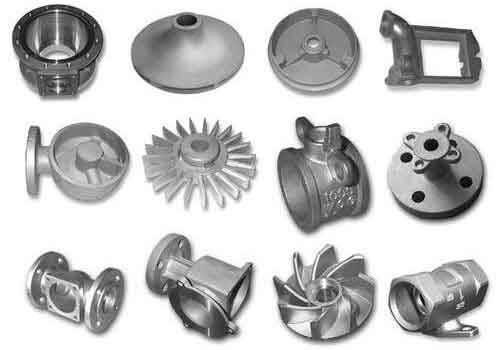
The journey begins with the digital genesis of the component. A 2D part drawing serves as the initial blueprint. Using advanced CAD software, such as CATIA V5, SolidWorks, or NX, a detailed 3D solid model of the sand casting part is constructed. This model is not merely a visual representation; it is a complete digital twin containing all geometric and topological data. For complex sand casting parts, this involves capturing intricate geometries, varying wall thicknesses, internal cavities, and draft angles essential for pattern extraction. The creation of this accurate 3D model is the foundational step upon which all subsequent analysis and manufacturing activities are built.
Once the part model is complete, the focus shifts to process design. The first task is generating the casting model, which includes the part geometry along with all necessary allowances: machining stock, shrinkage compensation (typically a linear scale factor, e.g., 10‰ or 1.010 for ductile iron), and draft angles. From this, the geometries of the mold cavity, cores, and ultimately the tooling—the pattern (or template) for the mold and the core box for the cores—are derived digitally. The design of the gating and risering system is initiated within this CAD environment. For instance, the initial sizing of sprue, runners, and gates can be based on empirical ratios like the gating ratio for pressurized systems (e.g., $A_{sprue}:A_{runner}:A_{gate} = 1:2:2$) or choke area calculations derived from the desired pouring time $t_p$:
$$ A_{choke} = \frac{W}{\rho \cdot \mu \cdot t_p \cdot \sqrt{2gH}} $$
where $W$ is the casting weight, $\rho$ is the metal density, $\mu$ is the discharge coefficient, $g$ is gravity, and $H$ is the effective metal head height.
This stage is where the inherent challenges of producing complex sand casting parts become apparent in the digital realm. Significant variations in wall thickness create isolated thermal masses or “hot spots,” which are prime candidates for shrinkage defects. Undercuts and complex internal geometries dictate the need for multi-part cores and sophisticated core box designs. The digital model allows us to identify and plan for these challenges proactively.
The true power of integration is realized with CAE simulation. The 3D models of the part, cores, and initial gating/risering system are exported to specialized casting simulation software. The process involves a critical pre-processing step: discretizing the geometry into a mesh of finite elements or volumes. The fidelity of this mesh directly impacts simulation accuracy and computational time. The governing equations solved during simulation include the Navier-Stokes equations for fluid flow during mold filling:
$$ \frac{\partial \vec{v}}{\partial t} + (\vec{v} \cdot \nabla) \vec{v} = -\frac{1}{\rho}\nabla p + \nu \nabla^2 \vec{v} + \vec{g} $$
and the energy equation for heat transfer during solidification:
$$ \rho c_p \frac{\partial T}{\partial t} = \nabla \cdot (k \nabla T) + \rho L \frac{\partial f_s}{\partial t} $$
where $\vec{v}$ is velocity, $p$ is pressure, $\nu$ is kinematic viscosity, $T$ is temperature, $k$ is thermal conductivity, $c_p$ is specific heat, $L$ is latent heat, and $f_s$ is solid fraction.
For sand casting parts, particularly those made from alloys with a mushy freezing range like ductile iron, predicting shrinkage is paramount. Advanced methods like the Dispersed Equilibrium Method for Contraction/Expansion (DEMC) or porous media models are used. These methods account for liquid contraction, graphite expansion (in cast irons), and the resistance offered by the mold wall strength to predict the final location and size of shrinkage porosity.
The simulation workflow is iterative. An initial run with just the part and a simple riser placement (often based on modulus calculations, $M = V/A$, where a riser’s modulus should exceed that of the region it feeds) identifies potential hot spots. The gating system is then analyzed for filling performance. Key metrics are evaluated:
- Filling Velocity: The metal velocity at the ingate must be controlled to avoid mold erosion. A critical velocity $v_{crit}$ often referenced for sand molds is around 0.5 m/s. The Reynolds number $Re = \rho v D / \mu$ indicates flow regime.
- Temperature Distribution: Ensuring minimal temperature gradients to prevent mistruns and cold shuts.
- Solidification Sequence: The goal is a directional solidification pattern toward the risers, which act as reservoirs of molten metal. The solidification time $t_s$ for a simple shape can be estimated by Chvorinov’s rule: $t_s = B \cdot (V/A)^n$, where $B$ is the mold constant.
Based on the simulation results—visualized as contour plots of temperature, solid fraction, or shrinkage propensity—the design is refined. Risers are resized or relocated, chills may be added digitally to accelerate cooling in thick sections, and the gating system is modified. For example, adding filters in the runner system can reduce turbulence and inclusion defects. This virtual optimization cycle is repeated until the simulation predicts a sound casting, free of major defects. This replaces multiple physical trial casts, saving enormous cost and time, especially for large sand casting parts.
| Aspect | Traditional Method | Integrated CAD/CAE/CAM Method |
|---|---|---|
| Design & Prototyping | 2D drawings; physical wooden/metal patternmaking; multiple trial casts. | 3D digital models; virtual prototyping via CAE simulation; minimal or no trial casts. |
| Process Optimization | Based on experience & empirical rules; adjustments made after defective castings are produced. | Based on physics-based numerical simulation; process is optimized digitally before manufacturing. |
| Tooling Manufacturing | Manual crafting or 2D-based CNC programming; high skill dependency; errors hard to correct. | Direct CNC toolpath generation from 3D CAD model; automated, precise, and repeatable. |
| Lead Time | Long (e.g., several months for complex parts). | Dramatically shortened (can be reduced by 50% or more). |
| Cost | High (material waste, rework, scrap castings). | Lower (reduced waste, fewer physical trials, optimal material use). |
| Quality & Consistency | Variable, highly dependent on craftsman skill. | High and consistent, locked in during digital phase. |
The final digital step is the transition to physical manufacturing via CAM. The validated 3D CAD models of the pattern and core box are used to program CNC machine tools. For complex sand casting parts, the core boxes often have intricate, multi-cavity geometries that are nearly impossible to machine efficiently using manual programming. CAM software automates this process. The workflow within a CAM module typically involves:
- Setup Planning: Defining the stock material and its orientation on the machine bed.
- Tool Selection: Choosing appropriate cutters (flat-end mills, ball-nose mills for surfaces) based on material (e.g., cast iron for tooling) and feature geometry.
- Toolpath Strategy Definition: Selecting operations like roughing (to remove bulk material), semi-finishing, and finishing. Strategies include contour parallel, radial, or spiral milling for surfaces.
- Cutting Parameter Calculation: Defining spindle speed ($N$), feed rate ($F$), and depth of cut. These are calculated using material-specific formulas:
$$ N = \frac{1000 \cdot V_c}{\pi \cdot D} $$
$$ F = N \cdot z \cdot f_z $$
where $V_c$ is the cutting speed (m/min), $D$ is the tool diameter (mm), $z$ is the number of teeth, and $f_z$ is the feed per tooth (mm/tooth). - Toolpath Generation & Simulation: The software calculates the precise tool movements. A vital step is the virtual simulation of the entire machining process within the software to detect and eliminate errors like tool collisions with the fixture or excessive material engagement that could break the tool.
- Post-Processing: Translating the generic toolpath data into machine-specific G-code (NC program) that controls the CNC machine.
This CAM process ensures that the complex geometries required for producing the sand casting parts are translated into the tooling with high precision and surface finish, directly from the optimized digital design. The integration is seamless; any modification in the CAD model, prompted by a CAE result, can be automatically propagated to an updated CAM program.
| Parameter | Symbol / Term | Typical Value / Material | Notes |
|---|---|---|---|
| Casting Material | – | Ductile Iron (QT450-10) | Thermo-physical properties (density, conductivity, enthalpy) are critical. |
| Pouring Temperature | $T_{pour}$ | 1370 – 1420 °C | Input for initial condition of the metal. |
| Mold Material | – | Silica Sand + Resin Binder | Defines mold density, specific heat, and thermal conductivity. |
| Core Material | – | Chromite Sand + Resin Binder | Often used for better chilling power in thick sections. |
| Interface Heat Transfer Coefficient (Metal-Mold) | $h_{mold}$ | 500 – 1000 W/(m²·K) | Depends on contact pressure, surface roughness. A key calibration parameter. |
| Interface Heat Transfer Coefficient (Metal-Core) | $h_{core}$ | 800 – 1200 W/(m²·K) | May be higher than mold interface. |
| Gravity | $g$ | 9.81 m/s² | Driving force for filling in gravity pouring. |
To illustrate the tangible benefits, consider the production of a large, complex ductile iron base as a representative sand casting part. The traditional timeline from order to shipment could span four months, involving patternmaking, trial casts, defect analysis, pattern modification, and final production. By employing the integrated CAD/CAE/CAM method, this timeline was effectively halved. The CAE simulation identified an optimal gating design with filters that reduced ingate velocity from a turbulent 2.0 m/s to a calm 0.5 m/s, minimizing mold erosion potential. Solidification analysis guided the placement and sizing of risers to ensure soundness in thick sections. Finally, the complex core box was machined directly from the 3D model using CAM-generated toolpaths, eliminating manual errors and ensuring a perfect fit for the cores. The first cast produced from the digitally engineered process was dimensionally accurate and free of major shrinkage defects, validating the entire digital workflow.
The mathematical and physical rigor behind this integration is substantial. Beyond the basic equations of fluid flow and heat transfer, optimization algorithms play a role. For instance, riser optimization can be framed as minimizing the riser volume $V_r$ subject to the constraint that its solidification time $t_{s,r}$ is greater than that of the casting section $t_{s,c}$ it feeds:
$$ \text{Minimize: } V_r $$
$$ \text{Subject to: } t_{s,r} \ge t_{s,c} + \Delta t $$
where $\Delta t$ is a safety margin. Similarly, in CAM, the material removal rate (MRR) is a key metric for efficiency:
$$ MRR = w \cdot d \cdot F $$
where $w$ is width of cut, $d$ is depth of cut, and $F$ is feed rate. The cutting force $F_c$ can be estimated to ensure machine capability and tool integrity:
$$ F_c = k_c \cdot A_c = k_c \cdot f_z \cdot d $$
where $k_c$ is the specific cutting force (N/mm²) and $A_c$ is the cross-sectional area of the cut.
| Operation | Tool Type | Cutting Speed $V_c$ (m/min) | Feed per Tooth $f_z$ (mm/tooth) | Depth of Cut $d$ (mm) |
|---|---|---|---|---|
| Roughing | Carbide Flat End Mill | 80 – 120 | 0.15 – 0.25 | 3.0 – 6.0 |
| Semi-Finishing | Carbide Ball End Mill | 100 – 150 | 0.10 – 0.20 | 0.5 – 1.5 |
| Finishing | Carbide Ball End Mill | 150 – 200 | 0.05 – 0.10 | 0.1 – 0.3 |
Looking forward, the integration is evolving towards even tighter synergy, often encapsulated in the concept of the Digital Thread or Product Lifecycle Management (PLM). Modern systems allow for associative links between the CAD geometry, CAE mesh and results, and CAM toolpaths. A change in the part design automatically triggers a cascade of updates through simulation setups and machining programs. Furthermore, the adoption of additive manufacturing (3D printing) for direct fabrication of sand molds and cores from CAD data—known as binder jetting—is a revolutionary extension of this digital process chain. It allows for the production of geometries for sand casting parts that are impossible with traditional core boxes, pushing the boundaries of design freedom.
In conclusion, the integration of CAD, CAE, and CAM into a cohesive workflow is no longer a luxury but a necessity for the economically viable and technically proficient production of complex sand casting parts. It replaces uncertainty with predictability, and lengthy physical iterations with rapid digital optimization. From the initial 3D model to the final NC code driving the tooling manufacture, this method ensures that quality is designed and simulated into the part long before the first mold is assembled. The result is a dramatic reduction in time-to-market, significant cost savings from reduced scrap and rework, and a consistent output of high-integrity sand casting parts that meet the ever-increasing demands of modern engineering applications. The foundry of the future is digital, and this integrated methodology is its core operating system.