
Modern aerospace components, such as transmission casings, present significant manufacturing challenges due to their intricate internal geometries, thin-walled sections, and stringent performance requirements under extreme operational conditions. Traditional sand casting methods for such complex sand casting parts often rely on manual mold assembly from multiple segments. This approach is not only time-consuming and labor-intensive but also prone to inconsistencies, leading to high scrap rates and prolonged development cycles. The inability to rapidly prototype and validate these critical sand casting parts stifles innovation and increases costs. This research explores an integrated methodology combining advanced numerical simulation with additive manufacturing, specifically 3D printed sand molds, to revolutionize the development and production of high-integrity sand casting parts. The primary objective is to establish a rapid, reliable, and defect-minimized process for the holistic gravity casting of a complex cartridge receiver, demonstrating a pathway from digital design to physical validation in a fraction of the conventional time.
Integrated Methodology: Simulation and Additive Manufacturing
The proposed methodology is a closed-loop process that seamlessly integrates digital design, simulation-based optimization, and additive manufacturing. The workflow is structured as follows:
- Digital Design and Process Planning: A three-dimensional model of the target sand casting part, including its complex internal channels, is created. Concurrently, an initial gating and feeding system (runners, gates, and risers) is designed around the part geometry using casting principles.
- Numerical Simulation and Optimization: The complete assembly (part and gating system) is imported into finite element-based casting simulation software (e.g., ProCAST). After defining material properties, boundary conditions, and process parameters, the virtual filling and solidification processes are simulated. The results are analyzed to identify potential defects like shrinkage porosity, cold shuts, or misruns. The gating system and cooling strategies (e.g., chills) are then iteratively optimized within the digital environment until the simulation predicts a sound casting.
- Additive Manufacturing of Sand Molds: The optimized digital model of the mold cavity (the negative of the part and gating system) is processed using slicing software and directly sent to a binder-jetting 3D sand printer. The printer fabricates the complete sand mold layer by layer, bypassing the need for patterns, cores, or manual assembly.
- Casting Trial and Physical Validation: The 3D-printed sand molds are assembled, and traditional gravity pouring is conducted using the parameters finalized in the simulation phase. The resulting sand casting part is then inspected using non-destructive testing (e.g., X-ray) and dimensional metrology to validate its quality against the simulation predictions and design specifications.
This synergy allows for the economic production of complex, high-quality sand casting parts in low volumes or for prototyping, drastically reducing lead times from months to weeks.
Numerical Simulation and Process Optimization
Pre-processing and Initial Simulation
The geometry of the target sand casting part was analyzed, revealing significant variation in wall thickness, which is a primary driver for solidification-related defects. An initial gating system was designed following the principles of pressurized systems and the “large hole outflow” theory to ensure smooth filling. The key relationship for the gating system cross-sectional areas is given by:
$$ A_{sprue} : A_{runner} : A_{gate} = 1 : (2 \sim 4) : (2 \sim 4) $$
The cross-sectional area of the ingate can be calculated using:
$$ A_{gate} = \frac{G_L}{\rho_L \cdot \mu \cdot t \sqrt{2g h_p}} $$
where \(G_L\) is the molten metal mass flow, \(\rho_L\) is the melt density, \(\mu\) is the flow loss coefficient, \(t\) is the pouring time, \(g\) is gravitational acceleration, and \(h_p\) is the pressure head at the ingate. For a four-unit gating system, \(h_p\) is calculated as:
$$ h_p = \frac{k_2^2 \cdot H_p}{1 + k_1^2 + k_2^2} $$
with \(k_1 = A_{sprue}/A_{runner}\), \(k_2 = A_{sprue}/A_{gate}\), and \(H_p = H_0 – 0.5h_c\) (where \(H_0\) is the total sprue height and \(h_c\) is the casting height).
| Component | Material | Boundary Condition / Parameter | Value / Type |
|---|---|---|---|
| Casting & Gating | ZL114A (Al-Si alloy) | Initial Pouring Temperature | 730 °C |
| Sand Mold | Furan Resin Sand | Interfacial Heat Transfer Coefficient (with metal) | 500 W/(m²·°C) |
| Chills | Gray Iron | Interfacial Heat Transfer Coefficient (with metal) | 2000 W/(m²·°C) |
| Process | – | Pouring Time | 6 s |
| Process | – | Cooling Method | Air Cooling |
The initial simulation revealed an acceptable filling pattern; however, the solidification analysis showed a significant problem. The complex regions of the sand casting part solidified at vastly different rates, creating isolated liquid pockets. This asynchronous solidification led to extensive shrinkage porosity in the simulation results, as the risers could not effectively feed these isolated hot spots. The fraction solid plot indicated that when the main body was fully solidified, the overall system solidification was already at 72.1%, meaning feeding was severely compromised.
Process Optimization Based on Simulation Results
The simulation results provided a clear directive for optimization. The goal was to promote more simultaneous solidification in the main body of the sand casting part and to enhance directional feeding towards the risers. The optimizations implemented were:
- Redesigned Chilling Strategy: Generic chills were replaced with conformal chills specifically designed to fit the complex internal cavities. This provided uniform and accelerated cooling in these critical, hard-to-feed areas, eliminating the conditions for isolated liquid zones and allowing for the removal of some secondary risers.
- Enhanced Riser Design: The main top risers were increased in size and height. This increased their thermal mass, delaying their solidification to remain “live” longer, thereby extending the feeding range and improving the feeding pressure for the entire sand casting part.
- Modified Gating and Pouring Parameters: The sprue diameter and height were increased to enhance the metallostatic pressure. The pouring temperature was lowered to 720°C, and the pouring time was extended to 8 seconds to achieve a quieter, more controlled fill.
The impact of these changes was profound. The optimized simulation showed a dramatically improved solidification sequence. The main body of the sand casting part now solidified much more uniformly. Crucially, when the main body was fully solidified, the overall system solidification was only at 45.9%, meaning the risers were still largely liquid and capable of effective feeding. The predicted shrinkage porosity was virtually eliminated from the critical sections of the sand casting part and confined mainly to the risers themselves.
| Metric | Original Process | Optimized Process | Improvement |
|---|---|---|---|
| Pouring Temperature | 730 °C | 720 °C | Reduced turbulence, better grain structure |
| Pouring Time | 6 s | 8 s | Smoother filling |
| Main Body Solidification Time | 335 s | 233 s | ~30% faster |
| Overall Solidification at Main Body Completion | 72.1% | 45.9% | Greatly improved feeding potential |
| Predicted Shrinkage in Critical Areas | Extensive | Negligible | Major quality enhancement for the sand casting part |
3D Printing of Sand Molds and Casting Trial
With the process digitally validated, the optimized mold model was manufactured using binder jetting additive manufacturing. The process involved spreading a thin layer (0.3 mm) of foundry sand (70-140 mesh) and selectively depositing a furan resin binder according to the cross-sectional data from the digital model. This layer-by-layer process built the complete sand mold, including integrated core geometries, in a single automated operation without any patterns or core boxes. This step is transformative for complex sand casting parts, as it allows for the creation of internal features that would be impossible or prohibitively expensive to core using traditional methods.
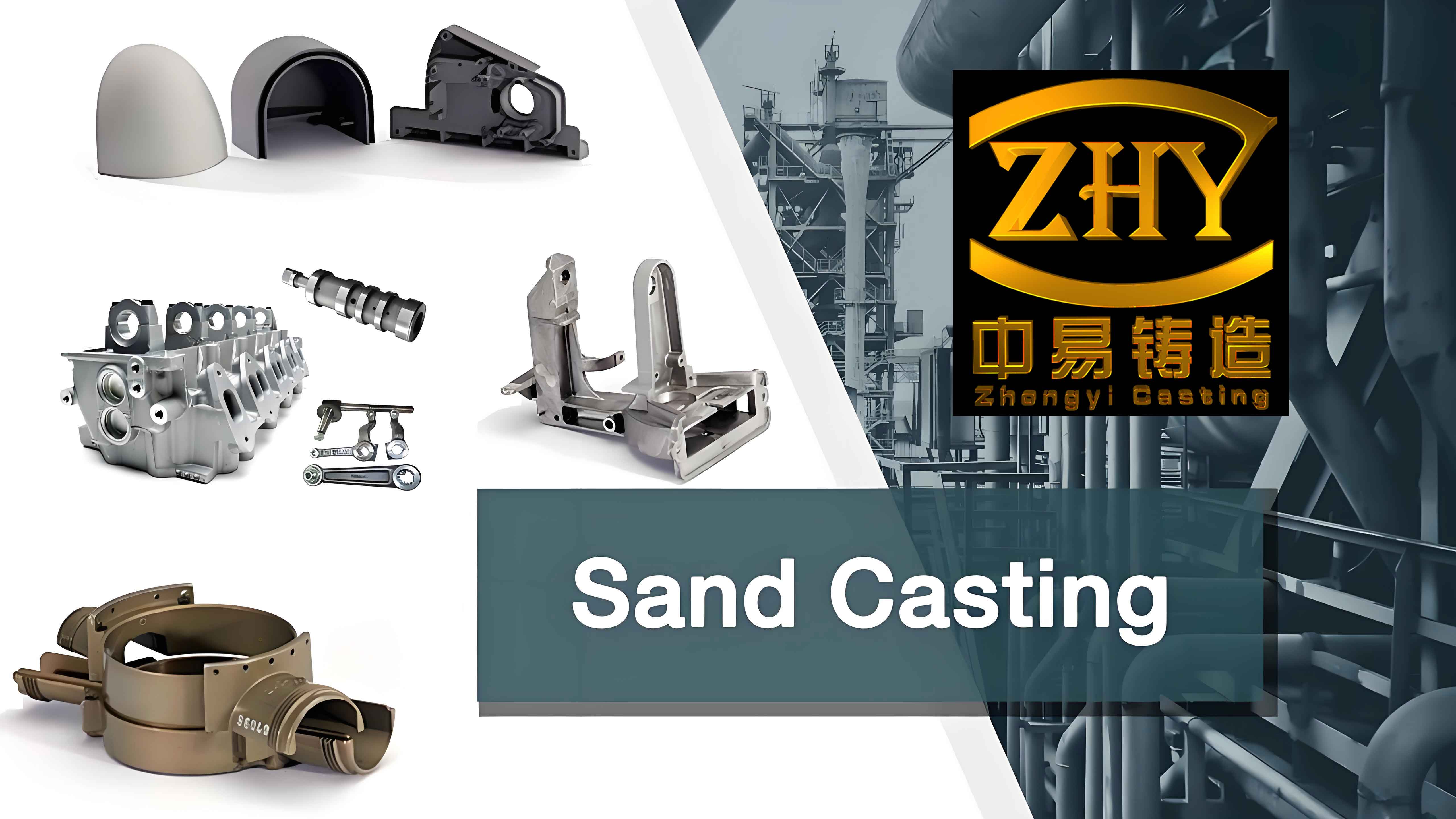
The printed molds were post-processed, assembled, and prepared for pouring. The gravity casting trial was conducted strictly adhering to the optimized parameters: a pouring temperature of 720°C and a pouring time of approximately 8 seconds. After cooling and shakeout, the sand casting part was extracted from the mold assembly. The physical trial’s lead time, from finalized digital model to finished casting, was reduced to approximately one-quarter of the time required for conventional tooling and mold-making approaches.
Casting Evaluation and Discussion
The as-cast sand casting part was visually inspected, revealing a complete shape with clear contours and good surface finish, free from obvious defects like cold shuts or major surface porosity. To validate internal quality, X-ray radiography was performed on critical sections, such as oil ports and mounting holes. The results confirmed the absence of internal shrinkage cavities or gas pores in these high-integrity zones. Dimensional inspection further verified that the casting met all specified tolerances.
| Inspection Method | Target Criteria | Result | Conclusion |
|---|---|---|---|
| Visual Inspection | Complete filling, no major surface defects | Pass | Good surface integrity and form completion |
| X-Ray Inspection (Critical Zones) | No internal shrinkage or gas porosity | Pass | Sound internal structure in high-stress areas |
| Dimensional Metrology | Within specified drawing tolerances | Pass | Geometric accuracy符合标准 |
| Process Lead Time | Comparison to traditional method | Reduced by ~75% | Dramatic acceleration in development cycle |
The excellent correlation between the physical casting quality and the optimized simulation predictions underscores the reliability of the integrated approach. The simulation accurately identified problem areas and guided effective countermeasures, which were then faithfully executed through the flexibility of 3D printed sand molds. This synergy effectively breaks the traditional compromise between complexity, quality, and lead time for sand casting parts.
Conclusion
This study successfully demonstrates a robust framework for the rapid development and production of highly complex sand casting parts. By integrating high-fidelity numerical simulation with the design freedom of sand mold 3D printing, the following key outcomes were achieved:
- Defect Minimization through Digital Optimization: Proactive identification and elimination of solidification defects in the virtual environment led to a casting process that produced a sound sand casting part on the first physical trial. The optimized parameters (720°C pour over 8 seconds) resulted in smooth filling and controlled, feedable solidification.
- Validation of Simulation Accuracy: The close agreement between the simulated predictions and the actual casting quality (both internal and external) validates the numerical models and provides high confidence for future process development using this digital twin approach.
- Radical Reduction in Lead Time: The amalgamation of these technologies compressed the traditional prototyping cycle for such a complex sand casting part to a fraction of its original duration, enabling faster design iterations and performance validation.
- Enabling Design Innovation: This methodology fundamentally shifts the paradigm for designing sand casting parts. Engineers are no longer constrained by traditional manufacturability rules related to core assembly and draft angles. The focus can shift decisively towards functional integration, part consolidation, and lightweighting, knowing that the manufacturing process can accommodate extreme complexity through digital design and additive tooling.
The integrated simulation and 3D printing sand casting process represents a significant advancement for low-volume, high-complexity manufacturing sectors like aerospace, defense, and high-performance automotive. It provides a viable and efficient pathway to produce robust, high-integrity sand casting parts that meet the demanding standards of modern engineering applications.