
In the realm of manufacturing, sand casting remains a pivotal process for producing complex metal components, widely used in industries such as automotive, aerospace, and machinery. The quality and efficiency of sand casting parts heavily depend on the molds used, particularly metallic patterns that shape the sand molds. Traditionally, these molds are fabricated through casting or machining, but these methods often involve long lead times, high costs, and limitations in creating intricate geometries. As a researcher in advanced manufacturing technologies, I have explored laser direct manufacturing (LDM) as a transformative approach for producing metallic patterns for sand casting parts. This technique, based on laser cladding and rapid prototyping principles, offers a direct path to fabricate molds with enhanced performance, reduced costs, and greater design freedom. In this article, I will delve into the intricacies of LDM for sand casting parts, highlighting its advantages, technical aspects, and potential improvements, while emphasizing the recurring theme of optimizing sand casting parts production.
Sand casting parts are typically created by pouring molten metal into a sand mold cavity formed by a pattern. The pattern, often made of metal for durability, must possess features like draft angles, filleted corners, and smooth transitions to facilitate mold release and prevent defects. Traditional manufacturing methods, such as wood pattern casting followed by machining or numerical control (NC) machining directly from steel, struggle with these requirements due to complexity and time constraints. For instance, achieving seamless transitions between the pattern and gating system often requires manual patching, which can compromise precision. Moreover, the demand for high-performance sand casting parts in critical applications necessitates molds with localized material properties, such as wear resistance in areas subjected to sand abrasion. This is where laser direct manufacturing shines, as it enables the fabrication of molds with tailored material gradients and complex shapes in a single process.
Laser direct manufacturing, also known as laser engineered net shaping (LENS) or directed light fabrication, operates on a layer-by-layer additive principle. A high-power laser beam is focused onto a substrate, creating a melt pool into which metal powder is delivered through a nozzle. By moving the laser beam or workpiece according to a computer-aided design (CAD) model, successive layers are deposited and fused, ultimately forming a three-dimensional metal object. The process parameters, including laser power $P$, scan speed $v$, powder feed rate $f$, and beam diameter $d$, critically influence the melt pool dynamics and final part quality. The melt pool depth $h$ and width $w$ can be approximated by empirical relations, such as:
$$ h \propto \frac{P}{v \cdot d} $$
$$ w \propto \sqrt{\frac{P}{v}} $$
These formulas underscore the need for precise control to achieve desired dimensional accuracy and surface finish for sand casting parts molds. Compared to conventional methods, LDM reduces material waste and allows for on-the-fly material composition changes, enabling functional gradients. For example, by switching powder feedstocks, one can deposit a wear-resistant layer on the mold surface while maintaining a ductile core, enhancing the longevity of molds used for producing sand casting parts.
The suitability of LDM for sand casting parts molds stems from the inherent design features of these molds. Draft angles, which are essential for easy pattern removal, align well with the layer-wise deposition process, as the melt pool flow can naturally smooth out stair-stepping effects. Similarly, filleted corners required to avoid stress concentrations in sand casting parts are inherently formed due to the finite size of the laser spot and melt pool. Additionally, the use of loose pieces and cores in mold design avoids overhanging structures that might be challenging for LDM, though advancements in multi-axis systems are mitigating this. To illustrate the benefits, consider the following table comparing traditional and LDM-based manufacturing for sand casting parts molds:
| Aspect | Traditional Manufacturing (Casting/Machining) | Laser Direct Manufacturing (LDM) |
|---|---|---|
| Lead Time | Weeks to months | Days to weeks |
| Cost | High due to tooling and waste | Lower due to reduced material use and no dedicated tooling |
| Design Complexity | Limited by machining feasibility | High, enabling intricate geometries for sand casting parts |
| Material Efficiency | Low (e.g., <20% for casting) | High (e.g., >60%) |
| Customization | Difficult and expensive | Easy, with gradient material properties |
This table highlights how LDM accelerates the production of molds for sand casting parts while offering economic and functional advantages. Furthermore, the ability to integrate non-standard gating systems and risers directly into the mold pattern eliminates assembly steps and improves mold integrity, which is crucial for high-quality sand casting parts.
One of the key strengths of LDM is its capacity to produce material gradients, addressing the diverse performance requirements of sand casting parts molds. For instance, the mold surface in contact with sand during casting experiences abrasive wear, necessitating high hardness and fatigue resistance. By modulating powder composition during deposition, LDM can create a composite structure with a hardened surface layer and a tough interior. The mechanical properties of LDM-fabricated parts often surpass those of cast counterparts due to rapid solidification, which refines microstructures. As an example, for titanium alloys used in aerospace sand casting parts, LDM can achieve yield strengths exceeding 900 MPa and elongations over 10%, comparable to forged materials. The following table summarizes typical properties:
| Material | Process | Yield Strength (MPa) | Tensile Strength (MPa) | Elongation (%) |
|---|---|---|---|---|
| Ti6Al4V | LDM | 830–900 | 900–1000 | 9–12 |
| Ti6Al4V | Forging | 830–860 | 900–950 | 10 |
| 316 Stainless Steel | LDM | 448 | 792 | 66 |
| 316 Stainless Steel | Annealed | 241 | 586 | 50 |
Such performance enhancements directly translate to longer mold life and better consistency in producing sand casting parts. Additionally, LDM’s flexibility allows for the use of lightweight metals like aluminum alloys, which are increasingly favored for sand casting parts to reduce weight in automotive applications. Although aluminum has high reflectivity to common CO2 lasers, optimizing powder additives can improve laser absorption, making LDM viable for these materials.
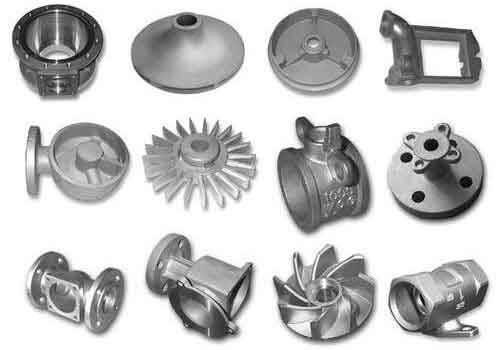
To further improve LDM for sand casting parts molds, several technical advancements are underway. Efficiency and surface quality are critical concerns; increasing deposition rates without sacrificing precision requires optimizing parameter synergies. Real-time monitoring of melt pool characteristics using acoustic or optical sensors can provide feedback for adaptive control, adjusting $P$, $v$, and $f$ to maintain consistent layer dimensions. The relationship between these parameters and clad geometry can be modeled using energy balance equations, such as:
$$ E = \frac{P}{v \cdot w} $$
where $E$ represents the energy density. By minimizing $E$ while ensuring full powder melting, throughput can be enhanced for large sand casting parts molds. Another area of improvement is weight reduction: molds often have bulky sections that increase material consumption and handling difficulty. LDM enables the creation of hollow structures with internal cavities, significantly reducing volume. For example, a mold backside can be designed with lattice supports or air gaps, cutting weight by up to 50% while maintaining stiffness. However, this introduces overhangs that challenge deposition; solutions include using sacrificial supports or multi-axis robotic systems to reorient the workpiece during building. The economic impact is substantial, as lighter molds lower shipping costs and improve ergonomics for operators handling sand casting parts production.
In terms of material science, LDM facilitates the development of novel alloys tailored for sand casting parts molds. For instance, incorporating ceramic particles like chromium oxide (Cr2O3) into metal matrices can boost abrasion resistance. The composition can be varied spatially according to a gradient function, expressed as:
$$ C(x,y,z) = C_0 + \Delta C \cdot f(x,y,z) $$
where $C$ is the concentration of reinforcing phase, $C_0$ is the base concentration, and $f$ is a spatial distribution function. This allows for customized properties in critical zones, such as higher hardness near the mold surface. Moreover, LDM’s rapid cooling rates, often exceeding $10^3$ K/s, suppress deleterious phase formations and promote fine precipitates, enhancing mechanical performance. For sand casting parts requiring high dimensional accuracy, such as engine blocks or turbine blades, these material advantages ensure mold durability over thousands of cycles.
The integration of LDM into the sand casting parts ecosystem also promotes sustainability. Traditional mold making generates significant scrap, especially in machining, whereas LDM’s additive nature minimizes waste. Powder recycling systems can capture unused material, further reducing environmental impact. Additionally, the digital thread from CAD to finished mold streamlines supply chains, enabling on-demand production of molds for custom sand casting parts. This is particularly beneficial for low-volume or prototype runs, where traditional tooling costs are prohibitive. As industries shift toward mass customization, LDM offers a scalable solution for rapid mold fabrication.
Looking ahead, challenges remain in standardizing LDM processes for sand casting parts molds. Parameter optimization for different materials requires extensive experimentation, but machine learning algorithms can accelerate this by analyzing historical data to predict optimal settings. Hybrid approaches combining LDM with subtractive machining, such as in-situ milling of deposited layers, can achieve tight tolerances and smooth surfaces essential for precision sand casting parts. The convergence of LDM with other Industry 4.0 technologies, like digital twins and IoT sensors, will enable smart mold systems that monitor wear and schedule maintenance proactively, reducing downtime in sand casting parts foundries.
In conclusion, laser direct manufacturing represents a paradigm shift in producing metallic patterns for sand casting parts. Its ability to create complex geometries, material gradients, and lightweight structures aligns perfectly with the demands of modern sand casting. By reducing lead times, costs, and environmental footprint, LDM not only enhances mold performance but also drives innovation in sand casting parts design. As research continues to address efficiency and quality hurdles, I anticipate widespread adoption of LDM in foundries, ultimately leading to higher-quality sand casting parts and more agile manufacturing systems. The future of sand casting parts production is bright, with LDM paving the way for smarter, more sustainable molds.