
In the field of metal component manufacturing, the production of complex, high-integrity sand casting parts remains a cornerstone, especially for critical applications in industries such as energy, automotive, and heavy machinery. The inherent flexibility and cost-effectiveness of sand casting make it ideal for producing medium to large components with intricate geometries. However, this very complexity often leads to significant challenges during the solidification phase. Defects like shrinkage porosity, hot tears, and misruns are common and can compromise the structural integrity and pressure-retaining capabilities of the final part. Traditional methods for optimizing the casting process rely heavily on trial-and-error, which is not only time-consuming and expensive but also environmentally wasteful due to the scrap produced.
My extensive experience in foundry engineering has led me to deeply appreciate the transformative power of numerical simulation. Advanced simulation tools have revolutionized the approach to designing sand casting parts. By creating a virtual prototype of the entire casting process—from mold filling to final solidification and cooling—we can predict the formation of defects with remarkable accuracy before a single mold is made. This digital foundry approach allows for rapid iteration of gating and risering systems, leading to a first-time-right manufacturing strategy that dramatically improves yield, reduces costs, and accelerates time-to-market.
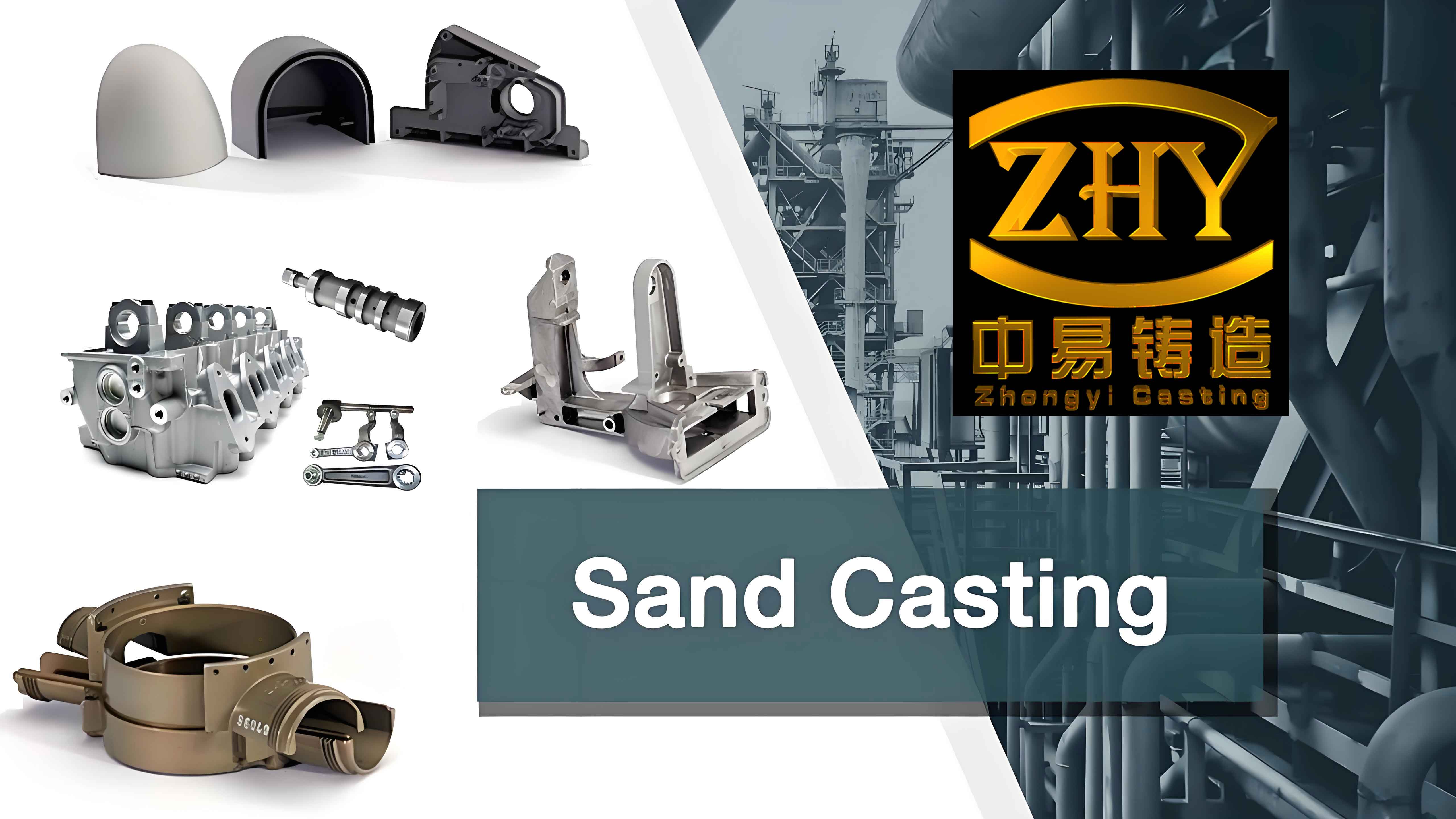
The primary challenge in creating sound sand casting parts lies in managing the thermal history of the metal. As molten metal cools and transitions from liquid to solid, it undergoes volumetric contraction. If this contraction is not continuously fed by liquid metal from a properly designed riser (or feeder), internal voids—shrinkage defects—will form. The goal of a good casting process is to establish a directional solidification pattern, where the farthest points from the feeders solidify first and the feeders themselves solidify last, acting as a reservoir of liquid metal. For complex castings with varying wall thicknesses, achieving this ideal thermal gradient is non-trivial.
Theoretical Foundations of Casting Simulation
The physics governing the casting process is described by a set of coupled partial differential equations encompassing fluid flow, heat transfer, and phase change. Accurately solving these equations is the core of any reliable simulation software used for analyzing sand casting parts.
The flow of the molten metal is treated as an incompressible, viscous, transient flow with a free surface. The governing equations are:
1. Continuity Equation (Conservation of Mass):
This equation states that mass is neither created nor destroyed within the fluid domain. For an incompressible fluid, it simplifies to the condition that the velocity field is divergence-free.
$$
\nabla \cdot \vec{u} = 0
$$
Where $\vec{u}$ is the velocity vector.
2. Navier-Stokes Equations (Conservation of Momentum):
These equations describe the motion of the fluid under the influence of inertial, pressure, viscous, and body forces (like gravity).
$$
\rho \left( \frac{\partial \vec{u}}{\partial t} + (\vec{u} \cdot \nabla) \vec{u} \right) = -\nabla p + \rho \vec{g} + \mu \nabla^2 \vec{u}
$$
Where $\rho$ is the fluid density, $t$ is time, $p$ is pressure, $\vec{g}$ is the gravitational acceleration vector, and $\mu$ is the dynamic viscosity.
3. Energy Conservation Equation:
This equation tracks the temperature distribution throughout the casting and mold, accounting for heat transfer via conduction, convection (due to fluid flow), and the latent heat released during phase change.
$$
\rho c_p \left( \frac{\partial T}{\partial t} + \vec{u} \cdot \nabla T \right) = \nabla \cdot (k \nabla T) + Q_L
$$
Where $c_p$ is the specific heat capacity, $T$ is temperature, $k$ is the thermal conductivity, and $Q_L$ is the latent heat source term associated with the liquid-solid phase transformation. Modeling $Q_L$ accurately is crucial for predicting the solidification pattern of sand casting parts.
4. Free Surface Tracking (Volume of Fluid – VOF):
To model the advancing melt front during mold filling, a scalar function $F$ is used, representing the volume fraction of fluid in a computational cell.
$$
\frac{\partial F}{\partial t} + \nabla \cdot (F \vec{u}) = 0
$$
A cell with $F=1$ is full of liquid metal, $F=0$ is empty (air/mold), and $0 < F < 1$ contains the free surface.
Numerical Simulation Workflow for Sand Casting
The process of simulating sand casting parts follows a systematic digital workflow, which I have found to be essential for obtaining reliable results.
1. Geometric Modeling and Assembly: The process begins with a detailed 3D CAD model of the desired casting. Subsequently, the virtual foundry is built around it. This includes designing the gating system (pouring cup, sprue, runners, and gates), risers (feeders), and the mold itself. The importance of accurately representing the mold and cores cannot be overstated, as they are the primary heat sinks.
2. Mesh Generation: The assembled geometry is discretized into a finite element or finite volume mesh. This step is critical. The mesh must be fine enough in areas of thin sections and complex geometry to capture thermal gradients and fluid flow details, but coarse enough in bulky mold regions to keep computational time manageable. A non-conformal mesh is often used, where the casting and mold are meshed separately with different resolutions and then coupled at their interfaces.
3. Material Property Assignment and Boundary Condition Definition: Every material in the system must be assigned accurate temperature-dependent thermophysical properties.
| Material Property | Importance in Simulation |
|---|---|
| Density ($\rho$) | Affects fluid inertia, buoyancy-driven flow (natural convection), and thermal buoyancy. |
| Thermal Conductivity ($k$) | Dictates the rate of heat extraction from the casting into the mold. Crucial for predicting solidification fronts. |
| Specific Heat ($c_p$) | Determines the sensible heat capacity of the material. |
| Latent Heat of Fusion ($L$) | The energy released during solidification; its accurate modeling is key to predicting shrinkage timing and location. |
| Viscosity ($\mu$) | Influences the flow behavior during filling; often modeled as temperature-dependent. |
Boundary conditions include the initial temperature of the mold and cores, the pouring temperature and velocity profile of the metal, and the interfacial heat transfer coefficient (IHTC) between the casting and the mold. The IHTC is complex, varying with time, temperature, and the formation of an air gap due to casting contraction.
4. Solver Execution and Post-Processing: The configured model is solved iteratively over time. Post-processing involves analyzing the results through temperature field animations, solidification fraction plots, and defect prediction criteria. The most common criteria for predicting shrinkage porosity in sand casting parts are the Niyama criterion and the thermal gradient-based porosity models. These algorithms identify regions where the local thermal conditions are favorable for pore nucleation and growth.
Material Properties and Process Parameters: A Data-Driven Approach
The accuracy of a simulation is only as good as the input data. For sand casting parts, a comprehensive database is required. Below is a summary table of typical material properties and process parameters used in simulations for steel and iron castings.
| Category | Parameter / Material | Typical Value / Type | Notes |
|---|---|---|---|
| Casting Alloy | Carbon Steel (e.g., AISI 1020) | Liquidus: ~1510°C, Solidus: ~1490°C | Properties are highly temperature-dependent. Latent heat ~270 kJ/kg. |
| Gray Cast Iron (Class 40) | Liquidus: ~1200°C, Eutectic: ~1150°C | Solidification involves graphite expansion, requiring different shrinkage models. | |
| Ductile Iron (65-45-12) | Liquidus: ~1170°C, Eutectic: ~1120°C | Similar to gray iron but with pronounced post-eutectic expansion. | |
| Mold Material | Quartz Sand (Dry) | $k \approx 0.5 – 1.0 \, \text{W/m·K}$ | Low thermal conductivity promotes slower cooling. Density ~1500 kg/m³. |
| Chill (Copper) | $k \approx 350 – 400 \, \text{W/m·K}$ | Used locally to accelerate solidification in hot spots. | |
| Process Parameters | Pouring Temperature | Liquidus + 50°C to 150°C | Higher temperature improves fluidity but increases total shrinkage and grain size. |
| Mold Initial Temperature | 25°C (Ambient) to 200°C+ | Preheated molds reduce thermal shock and can influence filling behavior. | |
| Interfacial Heat Transfer Coefficient | 500 – 3000 W/m²·K | High at first (metal-mold contact), drops significantly as air gap forms. | |
| Gravity (Body Force) | 9.81 m/s² | The primary driving force for filling in gravity sand casting. |
Case Study: Optimizing a Complex Valve Body Casting
To illustrate the practical application, let’s consider the development of a high-pressure valve body, a classic example of challenging sand casting parts. The component features varying wall thicknesses, flanges, mounting bosses, and internal passages, creating multiple thermal centers or “hot spots.”
Initial Design and Simulation: The first design employed a traditional bottom-gating system with risers placed on the top flanges. Simulation of this initial layout revealed several critical issues:
- Filling Imbalances: The metal flow through the gates was not uniform, leading to asymmetric temperature distribution at the end of fill.
- Poor Solidification Sequence: The temperature field analysis (isotherms) showed that isolated heavy sections, like the side bosses, were solidifying last, disconnected from the liquid feed paths provided by the risers. These areas were flagged as high-probability locations for macro-shrinkage.
- Ineffective Risers: The simulation’s Niyama criterion output clearly indicated that the risers themselves were not functioning optimally. Some solidified before the critical sections of the casting, ceasing their feeding action prematurely.
The mathematical basis for the Niyama criterion $N_y$ is given by:
$$
N_y = \frac{G}{\sqrt{\dot{T}}}
$$
where $G$ is the local temperature gradient (°C/m) and $\dot{T}$ is the local cooling rate (°C/s). Regions where $N_y$ falls below a critical threshold (e.g., 1.0 °C¹/²·s¹/²·mm⁻¹ for steel) are predicted to contain shrinkage porosity. The simulation map for the initial design showed large zones, particularly in the side walls and under the flanges, with $N_y$ values below this threshold.
Optimized Design Based on Simulation Insights: Based on the virtual findings, the process was systematically redesigned:
| Design Element | Initial Design Issue | Optimization Action | Intended Effect |
|---|---|---|---|
| Gating System | Bottom gating caused thermal asymmetry and dross entrapment risk. | Changed to a controlled pressurized side-gating system with flow-off filters. | Promotes quiescent, uniform filling and cleaner metal entry. |
| Riser Design & Placement | Small, top-mounted risers solidified early. | Increased riser size (modulus), relocated them to feed directly into the side hot spots, and applied insulating sleeves. | Ensures risers remain liquid longest, creating effective feeding pressure over the critical sections. |
| Auxiliary Cooling | Heavy side walls created isolated thermal centers. | Strategic placement of copper chills on the mold core adjacent to the thick sections. | Accelerates solidification in hot spots, linking them to the solidifying front from the thinner walls. |
| Pouring Parameters | Standard superheat. | Reduced pouring temperature to just above the liquidus while ensuring fluidity. | Minimizes total liquid contraction volume and promotes finer as-cast grain structure. |
Results of Optimization: Simulating the revised design showed a dramatic improvement. The solidification sequence became markedly more directional, progressing from the extremities and thin walls toward the now-adequately sized risers. The Niyama criterion map showed the previously critical zones now displayed values well above the defect threshold. The only remaining areas of concern were within the riser bodies themselves, which is the intended function—to concentrate the final shrinkage in the feeder, not the casting. The production of physical sand casting parts using this optimized design confirmed the simulation predictions, yielding a scrap rate reduction of over 70% and eliminating the need for extensive weld repair.
Advanced Considerations and Summary of Optimization Strategies
The successful simulation and optimization of sand casting parts extend beyond basic thermal analysis. Advanced considerations include:
- Microstructure and Mechanical Property Prediction: Models like Cellular Automaton (CA) or Phase Field can be coupled with thermal analysis to predict grain size, morphology (e.g., columnar vs. equiaxed), and secondary dendrite arm spacing (SDAS), which directly correlate to yield strength and ductility.
- Stress and Distortion Analysis: Thermomechanical simulations can predict residual stresses and warpage caused by non-uniform cooling and the phase change itself. This is vital for castings requiring precise dimensional tolerances.
- Modeling of Mold-Sand Interactions: High-fidelity models account for the humidity of green sand, which affects the heat transfer coefficient and can lead to gas-related defects (pinholes, blows).
Based on cumulative experience, I can summarize a robust strategy for optimizing sand casting parts through simulation:
1. Principle of Directional Solidification: The paramount goal. Use simulation to visualize the progress of the solidus isotherm (the “solidification front”). It must move continuously from the most remote, thinner sections of the casting toward the risers. Chills are used to “pull” the front, and risers are placed to “feed” it.
2. Riser Efficacy Calculation: Employ Chvorinov’s rule as a first-order design check. The solidification time $t$ of a section is proportional to the square of its volume-to-surface-area ratio (modulus, $M$) and a mold constant $C_m$.
$$
t = C_m \cdot \left( \frac{V}{A} \right)^2 = C_m \cdot M^2
$$
A riser must have a larger modulus than the casting region it feeds ($M_{riser} > 1.2 \times M_{casting}$) and must be placed so that a “feeding path” remains liquid until the riser itself solidifies. Simulation validates this geometrically derived rule under actual process conditions.
3. Controlled Filling: The filling pattern sets the initial temperature distribution. Aim for a smooth, non-turbulent fill that avoids cold shuts and minimizes temperature gradients before solidification begins. Simulation of velocity vectors and temperature at the end of fill is essential for this step.
4. Iterative Design Loop: The process is inherently iterative. A preliminary design is simulated, the results (filling patterns, thermal gradients, Niyama maps) are analyzed, the design is modified, and the simulation is run again. This loop continues until the predicted defect metrics fall within acceptable limits for the specific application of the sand casting parts.
Conclusion
The numerical simulation of the sand casting process represents a fundamental shift from art to science in foundry operations. For complex, high-value components, it is an indispensable tool that provides deep insight into the otherwise invisible phenomena of mold filling and solidification. By faithfully solving the governing equations of fluid dynamics and heat transfer, these tools allow engineers to predict and eliminate defects in sand casting parts virtually, transforming the traditional trial-and-error methodology into a precise, predictive engineering discipline. The benefits are quantifiable: drastic reductions in scrap and rework, shortened product development cycles, improved material utilization, and ultimately, the production of more reliable and higher-performance cast components. As computational power increases and material databases become more refined, the role of simulation will only grow, further solidifying its place as the cornerstone of modern, competitive foundry practice.