
In the realm of manufacturing, sand casting remains a pivotal and cost-effective method for producing complex metal parts, especially for components like cooling fins used in electronic devices. As a researcher focused on advancing foundry processes, I have extensively studied the numerical simulation of sand casting parts to optimize production and minimize defects. This article delves into a comprehensive analysis of the sand casting process for aluminum alloy cooling fins, employing numerical simulation to visualize filling and solidification, predict defects, and refine工艺 parameters. The goal is to achieve high-quality sand casting parts through systematic design and simulation, ensuring structural integrity and performance. Throughout this discussion, I will emphasize the importance of simulation in enhancing the reliability of sand casting parts, using formulas, tables, and empirical data to substantiate the findings. The integration of numerical tools like ProCAST allows for a deeper understanding of fluid dynamics and thermal behavior, which is critical for producing defect-free sand casting parts in industrial applications.
The production of aluminum alloy cooling fins via sand casting involves intricate design considerations due to the thin sections and high surface-area-to-volume ratio. These sand casting parts are essential for heat dissipation in CPUs, where efficient cooling is paramount. In my study, I focused on a specific cooling fin design with a base plate measuring 100 mm in length and width, a rib base thickness of 7 mm, rib height of 30 mm, and rib spacing of 5 mm. To ensure successful casting, I employed vacuum negative pressure technology, which enhances metal flow and reduces porosity in sand casting parts. The initial step involved designing the gating system and risers based on established principles, which I will detail below. By leveraging numerical simulation, I aimed to predict potential issues such as shrinkage porosity and optimize the process for robust sand casting parts.
Designing the gating system is crucial for controlling metal flow and minimizing turbulence in sand casting parts. I used the Oszan equation to calculate the choke area, which serves as the restrictive cross-section in the gating system. The formula is given as:
$$ F_c = \frac{G}{\mu t \sqrt{H_p}} $$
where \( F_c \) is the choke area in m², \( G \) is the total mass of aluminum in the mold (taken as 1.8 times the casting mass, with the casting mass \( G_{cast} = 0.54 \, \text{kg} \)), \( \mu \) is the flow coefficient (assumed as 0.6), \( t \) is the pouring time (calculated as \( t = S \sqrt[3]{G} \approx 3 \, \text{s} \) with \( S = 3 \)), and \( H_p \) is the average pressure head. For minimum \( H_p = 23.4 \, \text{mm} \), the choke area was approximately 3 cm². The gating ratio was set as \( \sum F_c : \sum F_{cross} : \sum F_{inner} = 1 : 1.6 : 1.1 \), leading to cross-sectional areas of 4.8 cm² for the runner and 3.3 cm² for the ingate. This design promotes laminar flow, reducing air entrapment and ensuring smooth filling for sand casting parts. To illustrate the parameters, I summarize the gating system calculations in Table 1.
| Parameter | Symbol | Value | Unit |
|---|---|---|---|
| Total Aluminum Mass | \( G \) | 0.972 | kg |
| Flow Coefficient | \( \mu \) | 0.6 | – |
| Pouring Time | \( t \) | 3 | s |
| Average Pressure Head | \( H_p \) | 23.4 (min), 30, 40 | mm |
| Choke Area | \( F_c \) | 3 | cm² |
| Runner Area | \( \sum F_{cross} \) | 4.8 | cm² |
| Ingate Area | \( \sum F_{inner} \) | 3.3 | cm² |
Riser design is equally vital for compensating shrinkage in sand casting parts during solidification. Based on the hot spot circle principle, I treated the thermal junction as a plate with a thickness equal to the hot spot diameter. For the cooling fin base plate thickness of 7 mm, the hot spot diameter \( D_r \) was 7 mm. The riser dimensions were derived as follows: casting modulus \( M_f = D_r / 2 \), riser modulus \( M_m = 1.2 M_f \), riser root diameter \( D_R = 1.2 D_r \), riser height \( H_R = (1.2 \text{ to } 1.5) D_R \), and effective feeding distance \( L = 2a \), where \( a \) is the casting thickness. This yielded a riser root diameter of 10 mm, height of 30 mm, and effective feeding distance of 14 mm. Given the cooling fin’s dimensions, I determined that nine risers were necessary to adequately cover the casting area, as shown in the initial design. This riser configuration aims to facilitate directional solidification and mitigate defects in sand casting parts. The calculations are consolidated in Table 2.
| Parameter | Symbol | Value | Unit |
|---|---|---|---|
| Hot Spot Diameter | \( D_r \) | 7 | mm |
| Casting Modulus | \( M_f \) | 3.5 | mm |
| Riser Modulus | \( M_m \) | 4.2 | mm |
| Riser Root Diameter | \( D_R \) | 10 | mm |
| Riser Height | \( H_R \) | 30 (initial), 40 (optimized) | mm |
| Effective Feeding Distance | \( L \) | 14 | mm |
| Number of Risers | – | 9 | – |
With the gating and riser designs established, I proceeded to numerical simulation using ProCAST software. The simulation parameters included a pouring temperature of 740°C, mold temperature of 25°C, and pouring time of 3 s. I set the static head height to 30 mm initially to analyze the filling and solidification processes. The simulation visualized the metal flow from the pouring cup through the gating system into the mold cavity, ultimately filling the risers. The filling process was observed to be smooth and laminar, with no significant turbulence or gas entrapment, which is essential for producing high-quality sand casting parts. This aligns with the gating design objectives, ensuring that the molten aluminum fills the mold progressively from the bottom upward, minimizing oxidation and defect formation in sand casting parts.
During solidification, I monitored the solid fraction distribution to assess directional solidification. For a static head of 30 mm, at 131 seconds after pouring, the solid fraction云图 indicated that the risers had fully solidified, while portions of the base plate remained below the critical solid fraction of 60%. This suggested inadequate feeding, as the risers were unable to compensate for shrinkage in the last-to-freeze regions. Cross-sectional views at specific locations (labeled 1-1 and 2-2) revealed areas with low solid fractions surrounded by solidified material, predicting potential shrinkage porosity in the sand casting parts. To quantify this, I applied the Niyama criterion, which relates thermal gradients and cooling rates to defect prediction. The Niyama criterion is expressed as:
$$ N_y = \frac{G}{\sqrt{\dot{T}}} $$
where \( G \) is the temperature gradient and \( \dot{T} \) is the cooling rate. Regions with \( N_y \) values below a threshold indicate susceptibility to microporosity in sand casting parts. The simulation results confirmed shrinkage defects in the base plate near the risers, highlighting the need for process optimization to enhance the integrity of sand casting parts.
To address these defects, I optimized the工艺 parameters by increasing the static head height to 40 mm. This adjustment enhances the metallostatic pressure, improving feeding capability during solidification. I also modified the riser height to 40 mm to increase their volume and prolong liquid availability. The simulation under these conditions showed a marked improvement. The filling process remained平稳, and the solidification pattern shifted to a more pronounced directional sequence, with the risers solidifying last. Cross-sectional analysis at 131 and 135 seconds demonstrated that the critical solid fraction was achieved progressively from the ribs to the base plate and finally to the risers, ensuring adequate feeding for sand casting parts. The defect prediction using the Niyama criterion indicated that shrinkage porosity was now confined to the risers, with no defects in the casting itself. This optimization effectively transfers defects to the risers, which are later removed, resulting in sound sand casting parts. The comparison of simulation outcomes is summarized in Table 3.
| Parameter | Static Head 30 mm | Static Head 40 mm |
|---|---|---|
| Filling Behavior | Smooth, laminar flow | Smooth, laminar flow |
| Solidification Pattern | Partial directional solidification; risers solidify early | Complete directional solidification; risers solidify last |
| Defect Prediction | Shrinkage porosity in base plate near risers | Defects confined to risers; no defects in casting |
| Riser Effectiveness | Inadequate feeding due to small size | Effective feeding with enlarged risers |
| Overall Quality | Potential defects in sand casting parts | High-quality, defect-free sand casting parts |
The optimized process parameters were validated through actual production using vacuum negative pressure casting. With a static head of 40 mm, nine risers of 10 mm diameter, and the same pouring conditions, I successfully produced aluminum alloy cooling fin castings. The resulting sand casting parts exhibited excellent surface finish and structural integrity, with no visible defects such as shrinkage holes or porosity. This practical verification underscores the efficacy of numerical simulation in refining sand casting processes for complex parts. The image below illustrates a typical sand casting part produced under these optimized conditions, showcasing its smooth appearance and dimensional accuracy.
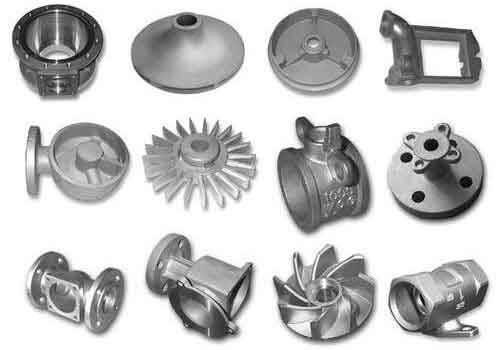
Further analysis involved evaluating the thermal behavior during solidification. I computed the temperature distribution and cooling rates across the sand casting parts to identify critical zones. The heat transfer equation governing solidification in sand casting can be expressed as:
$$ \rho c_p \frac{\partial T}{\partial t} = \nabla \cdot (k \nabla T) + L_f \frac{\partial f_s}{\partial t} $$
where \( \rho \) is density, \( c_p \) is specific heat, \( T \) is temperature, \( t \) is time, \( k \) is thermal conductivity, \( L_f \) is latent heat of fusion, and \( f_s \) is solid fraction. This equation highlights the complex interplay between conduction and phase change in sand casting parts. By simulating this, I could pinpoint areas with low thermal gradients that are prone to defects, allowing for targeted design modifications. For instance, increasing the riser size enhances the thermal mass, delaying solidification and improving feeding in adjacent regions of sand casting parts.
In addition to thermal analysis, I examined the fluid flow dynamics during filling. The Navier-Stokes equations describe the motion of molten aluminum in the mold cavity:
$$ \rho \left( \frac{\partial \mathbf{u}}{\partial t} + \mathbf{u} \cdot \nabla \mathbf{u} \right) = -\nabla p + \mu \nabla^2 \mathbf{u} + \rho \mathbf{g} $$
where \( \mathbf{u} \) is velocity vector, \( p \) is pressure, \( \mu \) is dynamic viscosity, and \( \mathbf{g} \) is gravitational acceleration. Simulation of these equations revealed that the gating design minimized velocity fluctuations, preventing mold erosion and gas entrapment in sand casting parts. This is crucial for maintaining the dimensional stability and surface quality of sand casting parts, especially for thin-walled components like cooling fins.
To provide a holistic view, I compiled the key工艺 parameters and their effects on sand casting parts quality in Table 4. This table serves as a guideline for optimizing sand casting processes for similar components.
| Parameter | Optimized Value | Impact on Sand Casting Parts |
|---|---|---|
| Pouring Temperature | 740°C | Ensures adequate fluidity without excessive overheating |
| Pouring Time | 3 s | Balances filling speed to reduce turbulence |
| Static Head Height | 40 mm | Enhances metallostatic pressure for better feeding |
| Riser Diameter | 10 mm | Provides sufficient volume for shrinkage compensation |
| Riser Height | 40 mm | Prolongs liquid availability during solidification |
| Number of Risers | 9 | Covers effective feeding distance across casting |
| Mold Temperature | 25°C | Standard initial condition for sand molds |
| Gating Ratio | 1:1.6:1.1 | Promotes laminar flow and reduces defects |
The economic implications of this optimization are significant for industries producing sand casting parts. By reducing defect rates and minimizing scrap, manufacturers can achieve higher yield and lower costs. Numerical simulation acts as a virtual testing ground, allowing for iterative design improvements without physical trials, which saves time and resources. For sand casting parts like cooling fins, where precision and reliability are critical, such simulations are indispensable. Moreover, the ability to predict and eliminate defects enhances the performance and longevity of the final products, contributing to sustainability through reduced material waste.
In conclusion, my study demonstrates the power of numerical simulation in optimizing the sand casting process for aluminum alloy cooling fins. Through careful design of the gating system and risers, combined with simulation-based analysis, I identified and mitigated shrinkage defects in sand casting parts. The optimized parameters—pouring time of 3 s, pouring temperature of 740°C, static head height of 40 mm, and nine risers of 10 mm diameter—result in smooth filling, directional solidification, and defect-free sand casting parts. This approach not only improves product quality but also underscores the importance of advanced modeling techniques in modern foundry practices. As demand for efficient thermal management grows, the insights gained here can be extended to other complex sand casting parts, fostering innovation and excellence in manufacturing.
Future work could explore further refinements, such as varying alloy compositions or incorporating advanced cooling techniques in the mold. Additionally, machine learning algorithms could be integrated with simulation data to predict defects more accurately and automate process optimization for sand casting parts. By continuing to leverage numerical tools, the foundry industry can enhance the production of sand casting parts, meeting evolving technological demands while maintaining cost-effectiveness and quality standards.