
In the manufacturing industry, sand casting remains a pivotal process for producing complex metal parts, especially for applications in automotive, agricultural machinery, and industrial equipment. The production of high-quality sand casting parts heavily relies on the efficiency and precision of molding lines. Traditional methods often involve manual labor, leading to inconsistencies, high labor intensity, and suboptimal resource utilization. To address these challenges, we have developed a fully automated horizontal parting molding line tailored for sand casting parts. This system integrates advanced mechanical design with programmable logic controller (PLC)-based automation to enhance productivity, reduce human intervention, and improve the overall quality of sand casting parts. In this article, we present the comprehensive design, key mechanisms, control system, and practical application of this molding line, emphasizing its role in streamlining the production of sand casting parts.
The design was driven by the need to overcome common issues in existing sand casting production lines, such as unstable mold transportation, low recycling of auxiliary equipment like flasks and weights, inefficient production rates, and excessive manpower. Our goal was to create a system that not only automates the entire process—from molding and pouring to shakeout—but also optimizes space utilization and minimizes environmental impact. By focusing on sand casting parts, we ensured that the line can handle varying mold sizes and complexities, making it versatile for different industrial needs. Below, we detail our approach, starting with the design objectives and progressing through each component of the system.
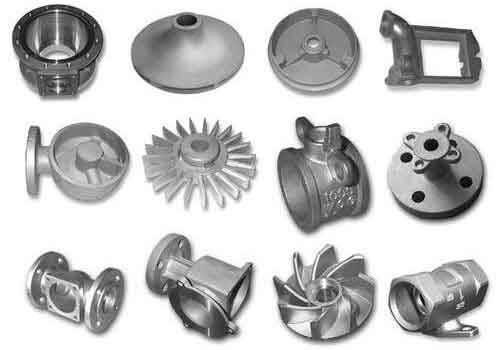
Our design task centered on a casting workshop with specific dimensions and production requirements for sand casting parts, such as automotive hubs and clutches made from HT250 cast iron. The key performance indicators included achieving a product yield of over 90%, adjustable mold height for different flask sizes, and an annual production capacity of 12,000 tons (equivalent to 440,000 molds per year). We adopted a two-shift, 8-hour workday schedule over 300 days annually. The overall planning involved layout design, equipment zoning, and auxiliary area optimization, prioritizing principles of high quality, low consumption, efficiency, and minimal pollution. The layout was crafted to ensure smooth material flow and integration of all subsystems, which is critical for mass-producing sand casting parts.
The fully automated horizontal parting molding line features a strategic layout with four main conveyor lines: the pouring conveyor (Line 1), the mold ejection transition conveyor (Line 2), and two cooling conveyors (Lines 3 and 4). This arrangement facilitates a continuous workflow for sand casting parts. Sand handling is managed via belt conveyors and bucket elevators that transport raw and reclaimed sand to storage silos, feeding the molding system on demand. The molding system, comprising two horizontal parting molding machines, shapes the sand and ejects molds onto Line 1. Key mechanisms, such as the bottom plate clamping device, flask-weight conversion device, and bottom plate conversion device, then coordinate to secure molds with flasks and weights for pouring. After pouring, the molds cool on Lines 3 and 4 before being processed for shakeout. A sand recovery system in underground pits collects spilled sand for recycling, enhancing sustainability in producing sand casting parts.
The workflow of our molding line is designed for seamless automation. It begins with the molding system initiating a sand supply signal, followed by horizontal parting and molding. Once a mold is ejected onto Line 1, the bottom plate clamping device positions it precisely. The flask-weight conversion device transfers flasks and weights from Line 2 to Line 1, encapsulating the mold for pouring. The bottom plate conversion device then moves the mold to the pouring platform, where an automatic pouring machine completes the浇注. After cooling, the flask-weight conversion device removes the flasks and weights, and the mold is pushed into a vibratory conveyor for shakeout. The cast sand casting parts are separated, cleaned, and output via a drag chain conveyor. This cycle repeats continuously, ensuring high throughput for sand casting parts. The table below summarizes the key steps in the workflow:
| Step | Action | Key Component Involved |
|---|---|---|
| 1 | Molding system starts and signals for sand | Molding machine, sand silo |
| 2 | Mold ejection to Line 1 | Ejection device |
| 3 | Bottom plate clamping and positioning | Clamping device |
| 4 | Flask-weight conversion for encapsulation | Flask-weight conversion device |
| 5 | Transport to pouring platform | Bottom plate conversion device |
| 6 | Automatic pouring | Pouring machine |
| 7 | Cooling on Lines 3 and 4 | Cooling conveyors |
| 8 | Flask-weight removal and mold shakeout | Flask-weight conversion device, vibratory conveyor |
| 9 | Cast part output and sand recycling | Drag chain conveyor, sand recovery line |
To achieve this workflow, we designed several critical mechanisms that ensure stability and efficiency in producing sand casting parts. The molding system itself is a core component, utilizing compressed air to shoot sand into flasks for filling and pre-compaction, followed by supplementary compaction. It includes upper and lower molding modules, pushing mechanisms, and sand cylinders, all controlled via hydraulic and pneumatic systems. The system allows manual adjustment of casting parameters through configuration software, accommodating different mold geometries and sand thicknesses for diverse sand casting parts. The hydraulic system consists of six circuits for operations like frame lifting and mold pushing, driven by servo motors and gear pumps. The pneumatic system involves cylinders and valves for tasks such as sand shooting and mold release, with sensors ensuring precise limit control.
The flask-weight conversion device is pivotal for reusing flasks and weights, reducing waste in sand casting parts production. It employs two lifting cylinders, brakes, and a roller chain driven by a servo motor. When activated, the cylinders descend to grip flasks and weights from Line 2, then transport them to Line 1 for placement on molds. Positioning pins and displacement sensors ensure accurate alignment, minimizing errors during encapsulation. This mechanism enhances the recycling rate of auxiliary equipment, which is economical for high-volume sand casting parts manufacturing. The bottom plate clamping device uses a gear-driven system with four clamping arms to secure bottom plates during transport. A drive cylinder rotates shafts via a linkage, allowing adjustable clamping angles to accommodate different plate sizes. This stability is crucial to prevent mold cracking or sand脱落 during handling of sand casting parts.
Automated transport units form the backbone of the line, consisting of welded steel rail tracks, bottom plate carts, conversion devices, and ejection mechanisms. The bottom plate conversion device transfers plates between conveyor lines using气缸 and servo motors, with limit switches and dampers ensuring smooth movement. It employs a roller chain conveyor and sliding seats to guide plates along predetermined paths, reducing the risk of jams. The mold ejection device pushes cooled molds into the vibratory conveyor for shakeout, using chain drives and photoelectric switches for positioning. The sand recovery conveyor, a belt-driven system, collects and transports spilled sand from various points back to the processing line, promoting a closed-loop system for sand casting parts production. The efficiency of these mechanisms can be expressed through a formula for production rate: $$P = \frac{N}{T}$$ where \(P\) is the production rate (molds per hour), \(N\) is the number of sand casting parts produced per cycle, and \(T\) is the cycle time. For our line, optimizing \(T\) through synchronized mechanisms boosts \(P\) significantly.
The control system is based on a PLC central processor, specifically a Mitsubishi FX5U series, integrated with a Weintek touchscreen for human-machine interface. Communication is established via N:N network configuration and RS-485 bus, linking the main station to subordinate devices like the molding system. Remote I/O modules connect input devices (e.g., buttons, sensors) and output devices (e.g., servo drives, motors, valves). The system enables both manual and automatic modes, with interlocks between工序 to ensure safety and precision. The hydraulic and pneumatic systems are controlled through电磁阀 and cylinders, with timers and limit switches managing operations such as sand shooting and mold pushing. The control logic can be modeled using Boolean algebra: for instance, the molding start signal \(S\) is given by $$S = (X0 \land \neg X4) \lor (X3 \land Y54)$$ where \(X0\) is the manual/auto switch, \(X4\) is the emergency stop, \(X3\) is the单独/联动 mode, and \(Y54\) is the molding permit signal. This ensures reliable automation for sand casting parts.
In practice, the control flow begins with the clamping device gripping a bottom plate, followed by mold ejection onto Line 1. The bottom plate conversion device then moves the mold to the flask-weight conversion station, where flasks and weights are attached. After pouring and cooling, the mold is transferred back for shakeout. The entire process is monitored via sensors, with the PLC coordinating all movements to minimize downtime. The table below outlines part of the PLC I/O address allocation for key functions:
| Input Address | Function Description | Output Address | Function Description |
|---|---|---|---|
| X0 | Manual/Auto Mode | Y10 | Mold Ejection Forward |
| X3 | Single/Linkage Mode | Y20 | Flask-Weight Advance |
| X4 | Emergency Stop | Y24 | Flask-Weight Brake |
| X11 | Sand Shakeout Belt Monitor | Y37 | Sand Shakeout Belt 1 |
| X26 | Mold Ejection Monitor | Y42 | Bottom Plate Conversion Push |
| X36 | Sand Recovery Operation | Y46 | Sand Shakeout Belt 2 |
Our fully automated horizontal parting molding line has been implemented in a production environment, focusing on sand casting parts like automotive hubs and clutches. The system includes all designed mechanisms—molding systems, conveyors, conversion devices, pouring machines, and sand recovery lines—working in harmony. During testing, we observed that the line achieved a product yield of approximately 99.4%, surpassing the target of 90%. The adjustable mold height feature allowed seamless switching between different flask sizes, catering to varied sand casting parts. The annual production capacity reached 12,000 tons, equivalent to 440,000 molds, meeting our design goals. Compared to traditional manual-mechanical methods, the automated line significantly reduced labor requirements: from 32 workers to just 4 per shift, while increasing daily output by about 61.11%. Furthermore, the production area footprint decreased by 22.1%, and the sand recovery system improved workplace cleanliness. The table below contrasts the performance before and after implementation:
| Aspect | Traditional Manual-Mechanical Production | Our Automated Molding Line |
|---|---|---|
| Workforce Required | 32 workers per day | 4 workers per day (2 shifts) |
| Production Area Usage | 87.3% of workshop space | 65.2% of workshop space |
| Daily Production Capacity | 28.8 tons (estimated) | 46.4 tons (achieved) |
| Product Yield for Sand Casting Parts | Around 90% | Approximately 99.4% |
| Environmental Impact | High sand spillage and dust | Low spillage due to enclosed recovery |
The success of this line can be attributed to the integration of robust mechanical design with intelligent control. For example, the synchronization between the bottom plate conversion device and the flask-weight conversion device ensures minimal delay, optimizing the cycle time for sand casting parts. The use of servo motors and sensors enhances positioning accuracy, reducing defects like misalignment or sand脱落. The sand recovery system not only cuts material costs but also aligns with sustainable manufacturing practices. In terms of economic impact, the reduction in labor and space translates to lower operational costs, making the production of sand casting parts more competitive. The line’s adaptability to different mold sizes further extends its applicability across industries, from automotive to agriculture, where sand casting parts are prevalent.
In conclusion, we have designed and applied a fully automated horizontal parting molding line that revolutionizes the production of sand casting parts. By addressing key challenges such as unstable transport, low equipment recycling, and high labor intensity, our system achieves high efficiency, precision, and environmental friendliness. The innovative mechanisms—including the molding system, clamping devices, conversion units, and transport systems—work seamlessly under PLC control to automate the entire casting process. Practical results demonstrate significant improvements in yield, capacity, and resource utilization, with a notable reduction in human intervention. This line not only meets the growing demand for high-quality sand casting parts but also sets a benchmark for automated foundry solutions. Future work could focus on integrating IoT technologies for real-time monitoring and predictive maintenance, further enhancing the production of sand casting parts. Overall, our contribution underscores the potential of automation in transforming traditional sand casting into a modern, efficient, and sustainable manufacturing process.