
In the modern industrial landscape, valves serve as critical components across sectors such as petroleum, chemical, metallurgy, nuclear power, and construction. These devices operate under extreme conditions, with pressures ranging from $1.3 \times 10^{-3}$ MPa to $10^3$ MPa and temperatures from $-269^\circ$C to $1,430^\circ$C. Consequently, valve bodies and covers, typically made from cast steel or iron, must exhibit superior strength, rigidity, corrosion resistance, and airtightness. Traditional manufacturing methods include sand casting, silica sol investment casting, sodium silicate (water glass) investment casting, shell molding, and lost foam casting. However, for large-diameter gate valves—specifically those with dimensions like 16″-150LB—conventional techniques like sodium silicate precision casting or sand casting often lead to issues such as dimensional inaccuracy, poor surface quality, internal shrinkage, and inconsistent delivery cycles. To address these challenges, we embarked on developing an innovative prototype investment casting process, leveraging computer simulation and a composite shell system to enhance quality and efficiency.
Our focus was on a large-diameter gate valve body, measuring approximately 750 mm × 420 mm × 600 mm, with a main wall thickness of 17.5 mm. The valve body, made from WCB carbon steel, features flanges with bolt holes that are often prone to turbulence during pouring. Through prototype investment casting, we aimed to achieve high dimensional precision, excellent surface finish, and internal integrity. This approach is particularly suited for thin-walled, complex geometries, as it involves creating a monolithic wax pattern coated with refractory materials to form a robust shell, which is then fired and filled with molten metal. The prototype investment casting method offers advantages like better fluidity, reduced oxidation, and improved feeding, making it ideal for large-scale valve production.
We first evaluated various casting methods. Sand casting, while cost-effective for large parts, tends to cause defects like misalignment, insufficient feeding, and surface inclusions due to lower mold strength and faster heat dissipation. In contrast, investment casting provides a unified mold cavity with high thermal resistance and冲刷 resistance, promoting sequential solidification. Given the high pouring temperatures required for WCB steel (around $1,580^\circ$C), a standard sodium silicate shell might lead to sand burning, whereas a pure silica sol shell would be prohibitively expensive. Therefore, we opted for a hybrid prototype investment casting process combining silica sol for the face layers and sodium silicate for the reinforcement layers. This composite technique balances cost, shell strength, and surface quality, enabling efficient production of large valve bodies through prototype investment casting.
The工艺设计 commenced with a detailed analysis of the valve body geometry. Using CAD models, we identified thermal hotspots at the three flanges and the central valve seat region. To ensure sound casting, we applied a shrinkage allowance of 2.5% and added machining allowances of 1.5 mm on flanges and 2 mm on valve seats. The gating and riser system was designed based on top-feeding principles to establish a favorable temperature gradient. By positioning the risers above the hotspots and incorporating chills or pads, we aimed to direct solidification from the casting toward the risers. The design utilized the hot-spot circle method to determine pad dimensions, ensuring open feeding channels. For instance, the pad slope was calculated using a ratio of 1:1.1, expressed as:
$$ \theta = \arctan\left(\frac{1}{1.1}\right) $$
where $\theta$ represents the pad angle. The riser system comprised four risers placed on the flanges and valve seat, with a total weight of 85 kg, leading to a yield of 78% (casting weight: 300 kg, total metal required: 385 kg). Pouring was planned to start from one side-flange riser to maintain laminar flow, followed by sequential feeding from other risers to keep the riser metal hotter than the casting.
Computer-aided engineering (CAE) simulation played a pivotal role in validating the prototype investment casting process. Using software tools, we modeled fluid flow and solidification patterns. The simulation revealed that pouring from the central flange riser caused dispersed metal flow, risking oxide entrapment, whereas side-flange pouring produced a stable, top-down stream. Temperature distribution plots confirmed a gradient from risers to casting, satisfying the sequential solidification criterion. The solidification time $t_s$ for different sections was estimated using Chvorinov’s rule:
$$ t_s = k \left( \frac{V}{A} \right)^n $$
where $V$ is volume, $A$ is surface area, $k$ is a mold constant, and $n$ is an exponent. Results indicated that risers solidified last, ensuring effective feeding. This simulation-guided approach is integral to optimizing prototype investment casting for complex geometries.
| Element | ASTM A216 Standard | Internal Control |
|---|---|---|
| C | ≤0.30 | 0.18–0.21 |
| Si | ≤0.60 | 0.35–0.55 |
| Mn | ≤1.00 | 0.8–1.0 |
| P | ≤0.04 | ≤0.035 |
| S | ≤0.045 | ≤0.030 |
The shell-making process for prototype investment casting involved a composite approach. The face layers utilized silica sol binder with fused silica flour and sand, chosen for high SiO₂ purity, low thermal expansion, and excellent refractoriness. Transition layers employed silica sol with mulite sand, while reinforcement layers used sodium silicate with high-alumina sand. This stratification reduced costs and shortened production cycles compared to full silica sol systems. The hardening solution for sodium silicate layers was crystallized aluminum chloride. Key parameters are summarized in Table 2.
| Layer | Binder | Slurry Viscosity (s) | Stucco Material | Stucco Mesh Size | Number of Layers |
|---|---|---|---|---|---|
| Face | Silica Sol | 55–65 | Fused Silica Sand | 50–100 | 2 |
| Transition | Silica Sol | 60–70 | Mulite Sand | 30–60 | 2 |
| Reinforcement | Sodium Silicate | 50–60 | High-Alumina Sand | 10–20 | 4 |
After shell building, dewaxing was conducted in a hot water bath at 90–98°C to melt the low-temperature wax pattern. The shells were then fired in a furnace to remove residual moisture and organics, enhancing permeability and strength. This step is crucial in prototype investment casting to prevent defects like gas holes or shell cracking during pouring.
Melting and pouring operations were carried out in a 1-ton medium-frequency induction furnace. The charge consisted of 70% returns plus scrap steel and alloying elements. Deoxidation involved preliminary additions of ferrosilicon and ferromanganese, followed by final deoxidation with aluminum wire at $1,600^\circ$C ± $10^\circ$C. Ladle treatment included adding 0.01% aluminum wire to minimize gas porosity. The pouring temperature was controlled at $1,580^\circ$C. Pouring commenced slowly from the side-flange riser to avoid turbulence, then accelerated to fill the mold rapidly. Once the metal reached one-third of the riser height, pouring paused to allow surface solidification, after which the risers were topped up sequentially to maintain thermal superiority. This strategy maximizes feeding efficiency in prototype investment casting by preserving a temperature gradient, described as:
$$ \frac{dT}{dz} > 0 $$
where $T$ is temperature and $z$ is the vertical coordinate from riser to casting.
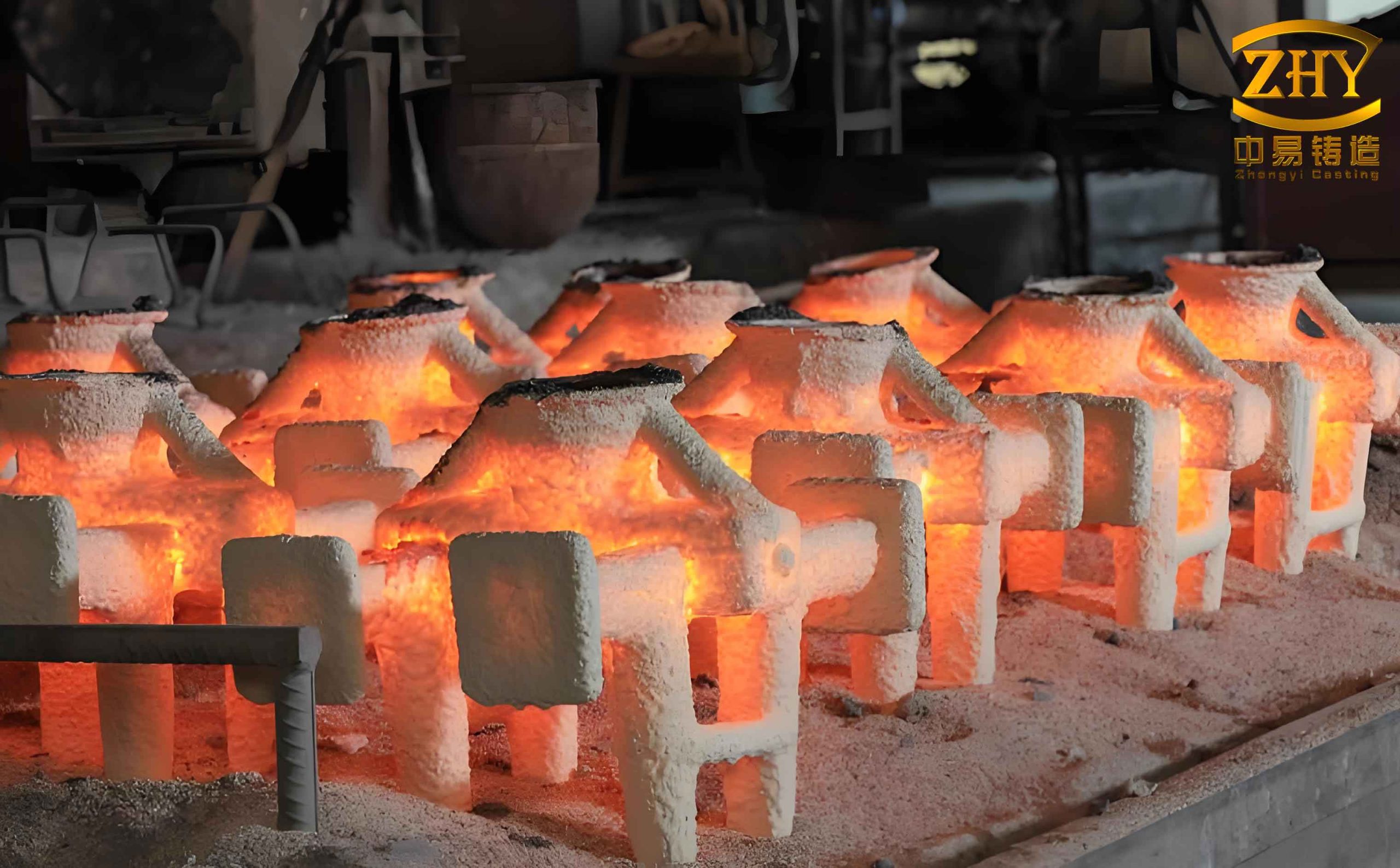
Heat treatment was essential to refine the as-cast microstructure, reduce residual stresses, and improve machinability. A normalizing process was applied: heating to above the Ac₃ temperature (approximately $900^\circ$C for WCB steel), holding for sufficient time, and air cooling. This yielded a uniform pearlitic structure with enhanced mechanical properties. Tensile tests on accompanying coupons met ASTM A216 standards, as shown in Table 3.
| Property | Standard Requirement | Average Measured Value |
|---|---|---|
| Tensile Strength, $\sigma_b$ (MPa) | 485–655 | 512 |
| Yield Strength, $\sigma_{0.2}$ (MPa) | ≥250 | 324 |
| Elongation, $A$ (%) | ≥22 | 42 |
| Reduction of Area, $Z$ (%) | ≥35 | 51 |
The success of this prototype investment casting process is evident in the high-quality valve bodies produced. Dimensional inspections, surface evaluations, and magnetic particle testing confirmed compliance with design specifications. The composite shell approach reduced costs by 20–30% compared to full silica sol systems, while maintaining shell integrity at high temperatures. Furthermore, the use of computer simulation minimized trial-and-error, shortening development time. This prototype investment casting methodology has enabled batch production of 16″-150LB valve bodies, ensuring timely delivery and consistent quality.
Looking forward, the principles established here can be extended to other large-scale castings in the valve industry. For instance, the composite shell technique can be adapted for different alloys or geometries by adjusting layer compositions. The feeding design can be optimized using advanced simulation software that incorporates phase transformation models. Additionally, the prototype investment casting process can be integrated with additive manufacturing for wax pattern production, further enhancing precision and reducing lead times. As market demands evolve, continuous improvement in prototype investment casting will focus on sustainability, such as recycling shell materials and reducing energy consumption during firing.
In conclusion, the development of a composite precision casting process for large-diameter gate valve bodies demonstrates the efficacy of prototype investment casting in overcoming traditional manufacturing limitations. By combining silica sol and sodium silicate shells, alongside CAE simulation, we achieved superior铸件 quality, cost efficiency, and production reliability. This案例 underscores the potential of prototype investment casting to revolutionize the production of complex, thin-walled components across heavy industries. Future work will explore automation in shell building and real-time monitoring of pouring parameters to further refine the prototype investment casting paradigm.