
As a foundry engineer specializing in automotive components, I have spent considerable time refining the process of manufacturing crankshafts via green sand casting. The crankshaft is unequivocally the heart of an internal combustion engine, tasked with converting the linear motion of pistons into rotational torque. This function subjects it to complex, multi-axial fatigue loads—primarily bending and torsion—coupled with shock loads from the connecting rods. The paramount objective in casting such a critical component is to achieve a microstructure that delivers exceptional static and dynamic mechanical properties while minimizing all internal and superficial flaws that act as stress concentrators and potential initiation sites for catastrophic failure. Wet sand casting, particularly for ductile iron (QT900-2), offers a compelling balance of performance, cost-effectiveness, and production efficiency for high-volume manufacturing. This article delves into a detailed, first-person perspective on the entire process chain, with a particular focus on the systematic identification, analysis, and mitigation of pervasive sand casting defects.
The Case for Wet Sand Casting in Crankshaft Production
The selection of green sand molding for ductile iron crankshafts is driven by several synergistic factors. Compared to shell molding or investment casting, green sand systems offer significantly lower pattern and mold material costs, which is decisive for large-series production. The process is highly adaptable, allowing for the integration of sophisticated gating, risering, and chilling systems directly within the mold. The key challenge, which becomes the central theme of process optimization, is managing the inherent variability of the sand mold itself—its strength, permeability, and moisture content—to consistently produce sound castings. The defects we combat are not random; they are direct consequences of the interplay between mold properties, metal chemistry, and thermal dynamics during pouring and solidification.
Foundational Elements: Sand System and Metallurgy
Sand Preparation and Control
The foundation of any sand casting process is, unsurprisingly, the sand. A stable and consistent sand system is the first line of defense against defects. For crankshaft production, we typically employ a high-quality silica sand bonded with a blend of Western bentonite, coal dust (or modern alternatives), and water. The system is predominantly a closed-loop one, with a high percentage of reclaimed sand. A typical formulation might be:
| Component | Mass Percentage (%) | Primary Function |
|---|---|---|
| Reclaimed System Sand | 90-95 | Base aggregate, provides thermal stability. |
| Fresh Silica Sand | 5-10 | Maintains grain distribution and reduces dead clay buildup. |
| Bentonite Clay | 8-12 | Provides bonding strength (green and dry). |
| Carbonaceous Additives | 2-5 | Improves surface finish, minimizes burn-on, and reduces sand casting defect formation like penetration. |
| Water | 2.5-4.0 | Activates clay bonds; critical control parameter. |
The properties of this mixture are non-negotiable. The green compressive strength (GCS) must be high enough to resist metal static pressure and erosion but not so high as to hinder collapsibility. Permeability must be sufficient to allow gases generated at the metal-mold interface to escape rapidly. The most critical parameter is the compactability or moisture content, often controlled via an automated mulling station to a target of 3.2% ± 0.2%. Deviations here are a primary root cause for a range of sand casting defects, notably blows, scabs, and expansion-related issues.
Metallurgy of Ductile Iron for Crankshafts: QT900-2
The material of choice is ductile iron, specifically grade QT900-2, as it provides an excellent combination of high strength (900 MPa tensile), good elongation (2%), and superior fatigue resistance compared to forged steels at a lower cost. The metallurgical goal is to achieve a fully pearlitic matrix with a high nodule count of small, well-formed, and evenly distributed graphite spheroids. The chemistry is tightly controlled:
| Element | Target Range (wt.%) | Rationale |
|---|---|---|
| Carbon (C) | 3.6 – 3.9 | High carbon ensures good fluidity and promotes graphite expansion for feeding. |
| Silicon (Si) | 1.8 – 2.2 | Promotes graphitization, strengthens ferrite. Si/C ratio is critical for matrix control. |
| Carbon Equivalent (CE) | 4.2 – 4.6 | CE = %C + (%Si/3). High CE favors a sound casting but must be balanced against graphite flotation. |
| Manganese (Mn) | 0.2 – 0.4 | Stabilizes pearlite; kept low to minimize segregation at cell boundaries. |
| Copper (Cu) | 0.4 – 0.7 | Strong pearlite promoter, improves hardenability and strength uniformly. |
| Magnesium (Mg)res | 0.03 – 0.05 | Residual from nodularizing treatment. Essential for spheroidization; excess leads to dross and shrinkage. |
The treatment process involves a sandwich method in a pouring ladle: first, a rare-earth magnesium ferrosilicon alloy (e.g., 5% Mg) is placed at the bottom, covered with steel punchings, then base iron is poured over it. Post-inoculation with a ferrosilicon-based inoculant (75% Si) is performed during transfer to the casting ladle to enhance nodule count and prevent chilling. Precise control of the Mg residual is vital; high residuals increase the tendency for a specific and problematic sand casting defect: pinhole porosity due to reaction with moisture in the mold.
Casting Process Design: Achieving Directional Solidification
The gating and risering design is paramount to ensure soundness. For a crankshaft, the goal is to achieve directional solidification from the farthest points (crankpins and journals) back toward the risers (feeders). This is accomplished by a combination of strategic chill placement and a properly sized riser neck. We often use a vertical gating system with filters and a top riser.
The thermal gradient driving solidification can be conceptualized using Chvorinov’s Rule, which states the solidification time for a simple shape is proportional to the square of its volume-to-surface area ratio:
$$ t = k \left( \frac{V}{A} \right)^^2 $$
where \( t \) is solidification time, \( V \) is volume, \( A \) is surface area, and \( k \) is the mold constant. Crankshaft sections have vastly different \( V/A \) ratios (moduli). The modulus of a cylindrical section like a journal is \( M_{journal} = \frac{D}{4} \) for an indefinitely long cylinder, where D is the diameter. A spherical junction (a hot spot) has a higher modulus. The riser must have a modulus greater than that of the section it feeds and be placed to create a thermal gradient toward it. The required riser volume can be estimated from the feeding demand of the casting section:
$$ V_{riser} \ge \frac{V_{casting} \cdot (\alpha_{liquid-solid} + \alpha_{graphite})}{\eta} $$
where \( \alpha_{liquid-solid} \) is the volumetric contraction of iron from pouring to solidus (~4% for ductile iron), \( \alpha_{graphite} \) is the expansion due to graphite precipitation (~2.4%), and \( \eta \) is the feeding efficiency of the riser (typically 10-30%). The net contraction is therefore around 1.6%, but the expansion phase is critical and must be contained by a rigid mold.
Systematic Analysis and Control of Sand Casting Defects
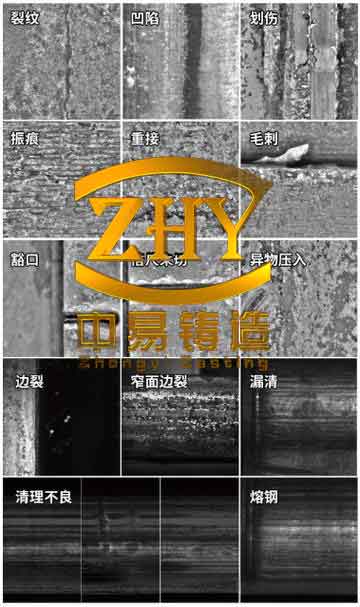
In practice, the battle for quality is fought on the front lines of defect prevention. Below is a detailed breakdown of the most common sand casting defects encountered in crankshaft production, their root causes, and the integrated control measures we implement.
1. Sand Inclusions and Sand Burning (A Type of Sand Casting Defect)
This category of sand casting defect manifests as rough surface patches, embedded sand clusters, or erosion scars on the casting. It occurs when the mold surface is mechanically eroded by the incoming metal stream or when the sand undergoes severe thermal shock and cracks.
Root Causes:
- Inadequate Mold Hardness/Strength: Low green strength sand is vulnerable to erosion, especially at the gating system entry points.
- Turbulent Metal Flow: A poorly designed downsprue or gate that does not establish a laminar flow front will scour the mold walls.
- Low Carbonaceous Additives: Insufficient “cushioning” material leads to sand burning-on, where the sand fuses to the casting surface.
- High Moisture (Steam Explosion): Localized high moisture can cause rapid steam generation, blowing sand grains into the metal.
Control Strategies:
- Optimize Gating Design: Use a tapered sprue, properly sized runners with flow diffusers (like a vortex gate), and multiple ingates to reduce metal velocity. The critical velocity for sand erosion should not be exceeded. A simplified Bernoulli-based check can be used:
$$ v = \sqrt{2gh} $$
where \( v \) is velocity at gate, \( g \) is gravity, \( h \) is effective sprue height. We aim for \( v < 0.5 \) m/s in the mold cavity. - Employ Filters: Ceramic foam filters placed in the runner system trap slag and eroded sand particles, drastically reducing this sand casting defect.
- Sand Property Rigor: Maintain strict control over compactability, GCS, and active clay levels. Increase mulling time if needed to develop full clay bonding.
- Mold Coating: Apply a refractory zircon-based wash to mold cavities to create a thermal barrier, preventing burning-on and improving surface finish.
2. Gas Porosity (A Prevalent Sand Casting Defect)
Gas holes appear as spherical or elongated smooth-walled cavities, often located just beneath the skin or near hot spots. They originate from gases entrapped during filling or precipitated during solidification.
Root Causes:
- Nitrogen Pinholes: A classic sand casting defect in ductile iron. Sources include high-N₂ charge materials (e.g., steel scrap), high-N₂ resins in core binders, or nitrogen-forming inoculants. Nitrogen solubility drops sharply during solidification (\( \Delta S_{N_2} \)), causing bubble nucleation:
$$ [N]_liquid \rightarrow [N]_solid + N_{2(gas)} $$ - Mold/Gas Evolution: Excessive moisture in the sand (above 4.5%) leads to H₂ generation: \( Fe + H_2O \rightarrow FeO + 2H \). Hydrogen dissolves in the liquid iron and reprecipitates as pores.
- Core Gas: Insufficiently baked or vented cores release large volumes of gas.
- Entrapped Air: Poor venting of the mold cavity leads to air being trapped by the advancing metal front.
Control Strategies:
- Source Control: Use low-nitrogen steel scrap (< 100 ppm) and low-N₂ inoculants (e.g., Ca-Ba-Si instead of Ca-Si).
- Sand Moisture Control: Keep molding sand moisture at the lower end of the specification (3.0-3.5%).
- Aggressive Venting: Install vent wires/channels from mold cavity high points and from deep pockets. The required vent area \( A_v \) can be approximated as a percentage of the ingate area \( A_g \): \( A_v \approx 0.2 \times A_g \).
- Pouring Temperature: Avoid excessively high pouring temperatures which superheat the mold and increase gas generation rates.
- Degassing Practice: For the base iron, a late argon purging can reduce hydrogen content.
3. Shrinkage Porosity and Cavities (The Critical Sand Casting Defect)
This is arguably the most detrimental sand casting defect for a dynamically loaded part like a crankshaft. It appears as irregular, dendritic cavities (macroshrinkage) or as fine, interconnected pores (microshrinkage) in thermal centers and hot spots.
Root Causes:
The fundamental cause is inadequate liquid metal feeding to compensate for volumetric contraction during solidification. In ductile iron, the process is complex due to graphitic expansion.
- Poor Feeding Design: Risers that are too small, have necks that freeze too early, or are incorrectly placed.
- Low Mold Rigidity: This is the cardinal sin in ductile iron casting. A soft, yielding mold wall cannot contain the internal graphite expansion pressure (\( P_{graphite} \)). The expansion, instead of compressing the liquid to feed shrinkage elsewhere, simply pushes the mold walls outward, creating internal voids. The required mold wall pressure resistance can be conceptually high.
- Incorrect Metallurgy: High Mg residual increases shrinkage tendency. Low Carbon Equivalent reduces the beneficial expansion effect.
Control Strategies:
- Maximize Mold Rigidity: Use high-pressure molding machines (squeeze pressure > 1.5 MPa) to achieve a very dense, hard mold (e.g., 90+ on a B-scale hardness tester). This is the single most effective action against this sand casting defect for ductile iron.
- Scientific Riser and Chill Design: Use modulus calculations to size risers. Place chills (internal or external) strategically on heavy sections (like crankpin webs) to eliminate isolated hot spots and create directional solidification paths. A chill’s effectiveness is its ability to extract heat rapidly, governed by the heat transfer coefficient at the metal-chill interface and the chill’s thermal diffusivity \( \alpha = k/(\rho C_p) \), where \( k \) is thermal conductivity, \( \rho \) is density, and \( C_p \) is heat capacity. Copper chills are often used for their high \( \alpha \).
- Optimal Chemistry: Target the upper end of the CE range (4.5-4.6) to maximize graphite expansion, coupled with low Mg residual (0.03-0.04%).
- Controlled Solidification: The use of a “hypereutectic” composition with controlled inoculation promotes a copious, early formation of graphite nodules, initiating the expansion phase earlier in the solidification sequence to better counteract shrinkage.
| Defect Type | Primary Manifestation | Key Root Causes | Primary Control Measures |
|---|---|---|---|
| Sand Inclusions/Burn-on | Surface roughness, embedded sand | Low mold strength, turbulent flow, low carbonaceous additives | High-pressure molding, optimized gating with filters, refractory coating, sand property control |
| Gas Porosity (Blows/Pinholes) | Smooth-walled subsurface cavities | High N₂/H₂ in metal, high sand moisture, poor venting | Low-N₂ charge materials, control sand moisture (<3.5%), aggressive mold/core venting |
| Shrinkage Porosity/Cavities | Irregular internal cavities in hot spots | Low mold rigidity, poor feeding design, high Mg, low CE | Maximize mold hardness/rigidity, scientific use of risers/chills, optimal CE (4.2-4.6), low Mg residual |
Integrated Quality Assurance and Process Monitoring
Preventing these sand casting defects is not a one-time setup but requires continuous monitoring. We implement Statistical Process Control (SPC) on key parameters: sand properties (moisture, GCS, permeability every 30 min), pouring temperature (thermocouple in stream), and chemical analysis (spectrometry for every heat). Every casting from a new pattern or after a significant process change is subjected to non-destructive testing (NDT) like ultrasonic testing to map internal soundness, and magnetic particle inspection for surface cracks. Destructive testing (sawing through suspected hot spots) is periodically conducted for validation. The feedback loop from these inspections directly informs adjustments in sand mulling, pouring practice, or riser design.
Conclusion
The successful wet sand casting of high-integrity ductile iron crankshafts is a testament to systems engineering in manufacturing. It hinges on the precise control of three interdependent pillars: mold system stability, metallurgical consistency, and thermally optimized casting design. The pervasive challenge of sand casting defects—from sand inclusions and gas holes to the more insidious shrinkage porosity—is not merely an inconvenience but the central obstacle to achieving the required fatigue performance. By understanding the root cause mechanisms, whether it’s the fluid dynamics of mold filling, the gas solubility limits during solidification, or the critical balance between metallurgical expansion and mold wall yield, we can implement targeted, effective countermeasures. The adoption of high-rigidity molds, scientifically designed feeding systems with chills, tight control over chemistry (particularly CE and Mg), and stringent sand system management forms a robust defense. This integrated approach transforms the wet sand casting process from a potential source of variability into a reliable, high-quality, and cost-effective production route for one of the automotive engine’s most critical components.