
In my experience with lost foam casting technology, I have observed its widespread adoption due to advantages such as low investment, reduced energy consumption, improved working conditions, high production efficiency, and minimal pollution emissions. This method is particularly effective for mass production of high-precision, complex castings. However, like other casting techniques, it has inherent limitations, and the slag inclusion defect has long been a persistent challenge in lost foam production. During the production of brake shell castings using lost foam, we encountered severe slag inclusion defects, leading to a scrap rate as high as 40%, which significantly impacted production schedules and increased costs. Therefore, preventing the slag inclusion defect in batch production is crucial for cost reduction and quality assurance.
The brake shell casting, with a simple structure and high demand, is made of HT250 material and weighs 14.5 kg. Its upper and lower surfaces and inner cylindrical walls require full machining, with no tolerance for defects like slag inclusion or gas pores. After transitioning to lost foam production, frequent slag inclusion defects appeared on these surfaces, causing high rejection rates. The slag inclusion defect typically manifests as irregular shapes with embedded foreign materials, depths around 2 mm, and is distributed across critical machining areas. Understanding the root cause of this slag inclusion defect became imperative for process optimization.
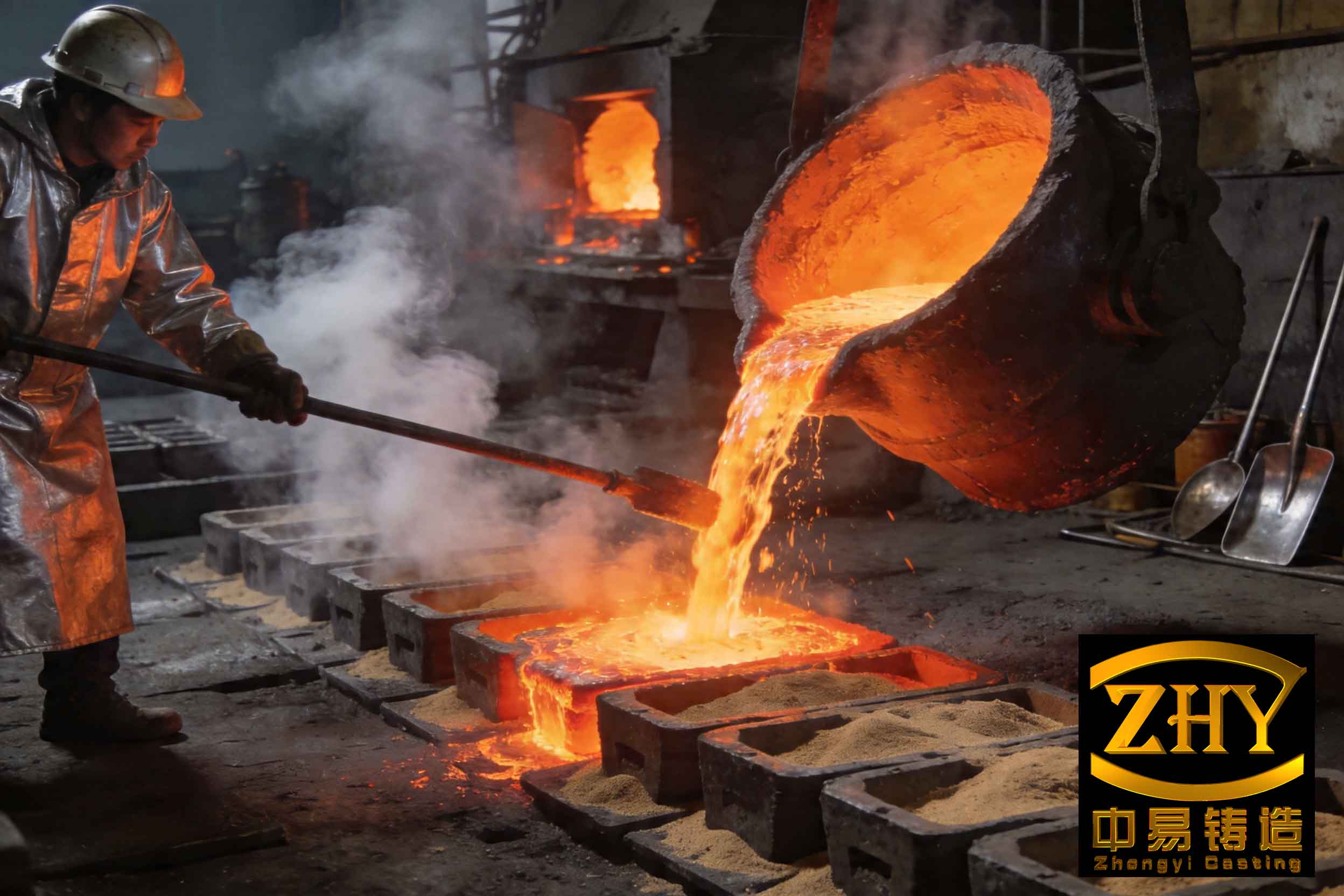
To address this slag inclusion defect, we conducted a comprehensive analysis. The existing process involved using STMMA foam with a density of 22–24 g/L, a gating system with an ingate cross-section of 8 mm × 40 mm, a runner of 30 mm × 45 mm, and a sprue of Ø40 mm × 400 mm. The pouring temperature ranged from 1480°C to 1510°C, with a slag trap mesh in the gating system. A water-based high-alumina coating was applied in three layers, achieving a thickness of 1.2–1.5 mm. Despite these measures, the slag inclusion defect persisted, prompting us to investigate further through microscopic examination.
We sampled defect sites from various batches and locations for scanning electron microscopy (SEM) and energy-dispersive X-ray spectroscopy (EDAX). The results revealed elevated levels of silicon, aluminum, and manganese at the defect sites, with aluminum content reaching up to 32.36%, indicating the presence of aluminum compounds. Spherical particles approximately 40–60 μm in diameter were observed, closely matching the grain size of the coating’s aggregate (40–75 μm). This led us to hypothesize that the slag inclusion defect originated from the coating material, likely due to insufficient refractoriness or strength under high-temperature conditions.
The formation of slag inclusion defects in lost foam casting can be modeled using thermodynamic and fluid dynamics principles. For instance, the likelihood of coating erosion contributing to slag inclusion defect can be expressed as:
$$ P_{slag} = f(T_p, \tau, \rho_c, k) $$
where \( P_{slag} \) is the probability of slag inclusion defect occurrence, \( T_p \) is the pouring temperature, \( \tau \) is the exposure time to molten metal, \( \rho_c \) is the coating density, and \( k \) is the coating’s thermal conductivity. Higher pouring temperatures increase thermal shock, potentially leading to coating breakdown and slag inclusion defect formation. Additionally, the Stokes’ law can describe the settling of particulate matter that causes slag inclusion defect:
$$ v = \frac{2r^2(\rho_p – \rho_m)g}{9\eta} $$
where \( v \) is the settling velocity, \( r \) is the particle radius, \( \rho_p \) is the particle density, \( \rho_m \) is the molten metal density, \( g \) is gravity, and \( \eta \) is the metal viscosity. Particles from coating erosion may become entrapped, leading to slag inclusion defect if not properly filtered.
To validate our hypothesis, we designed experimental trials. We divided the trials into Group A and Group B, both using the same molding and gating design. Group A employed a new iron casting coating from a different supplier, while Group B retained the original coating. All other parameters were identical: pouring start temperature of 1490°C, pouring time of 20–23 seconds, vacuum level of -0.05 MPa, and holding time of 10 minutes. The results are summarized in the table below.
| Group | Coating Type | Number of Castings | Slag Inclusion Defect Count | Defect Rate |
|---|---|---|---|---|
| A | New Coating | 18 | 3 | 16.7% |
| B | Original Coating | 12 | 6 | 50.0% |
In Group A, one defect was attributed to residual coating in the gating area during molding, while the others were minor slag inclusion defects. This indicated that the original coating was more susceptible to causing slag inclusion defect. However, to further isolate variables, we adjusted the pouring temperature. We conducted another experiment with a reduced pouring temperature of 1420°C ± 10°C, maintaining the same group structure. The outcomes are shown in the following table.
| Group | Coating Type | Pouring Temperature | Number of Castings | Slag Inclusion Defect Count | Defect Rate |
|---|---|---|---|---|---|
| A | New Coating | 1420°C ± 10°C | 18 | 0 | 0% |
| B | Original Coating | 1420°C ± 10°C | 18 | 1 | 5.6% |
These results confirmed that the primary cause of the slag inclusion defect was the low refractoriness of the original coating, which could not withstand the high-temperature冲刷 at 1490–1510°C. Lowering the pouring temperature mitigated the thermal stress on the coating, reducing the incidence of slag inclusion defect. The relationship between pouring temperature and coating failure can be expressed as:
$$ T_{max} = T_m – \Delta T_{safe} $$
where \( T_{max} \) is the maximum safe pouring temperature to avoid slag inclusion defect, \( T_m \) is the melting point of the coating aggregate, and \( \Delta T_{safe} \) is a safety margin. For aluminum-based coatings, \( T_m \) is around 2000°C, but impurities can lower it, making them prone to degradation and contributing to slag inclusion defect.
Beyond coating refractoriness, other factors influence slag inclusion defect formation. The foam density plays a role in coating penetration; higher density foams have smaller interbead gaps, reducing coating infiltration. The coating thickness and permeability also affect slag inclusion defect risk. We can model the coating integrity under thermal load using the following equation:
$$ \sigma_c = E_c \cdot \alpha_c \cdot \Delta T $$
where \( \sigma_c \) is the thermal stress in the coating, \( E_c \) is the Young’s modulus, \( \alpha_c \) is the coefficient of thermal expansion, and \( \Delta T \) is the temperature difference. If \( \sigma_c \) exceeds the coating’s tensile strength, cracking occurs, releasing particles into the molten metal and causing slag inclusion defect.
To comprehensively address the slag inclusion defect, we implemented several improvements. First, we optimized the pouring temperature to 1420°C ± 10°C, which reduced thermal冲击 on the coating. Second, we switched to a high-quality lost foam coating with better refractoriness and adhesion properties. Third, we increased the foam bead density to 24–26 g/L, enhancing surface smoothness and minimizing coating seepage. These measures collectively lowered the slag inclusion defect rate to below 5%, ensuring reliable batch production.
The economic impact of mitigating slag inclusion defect is significant. By reducing the scrap rate from 40% to 5%, we achieved substantial cost savings. The cost function can be represented as:
$$ C_{total} = C_{production} + C_{scrap} \cdot R_{slag} $$
where \( C_{total} \) is the total cost, \( C_{production} \) is the base production cost, \( C_{scrap} \) is the cost per scrapped casting, and \( R_{slag} \) is the slag inclusion defect rate. Lowering \( R_{slag} \) directly decreases \( C_{total} \), highlighting the importance of defect prevention.
In conclusion, the slag inclusion defect in lost foam casting of brake shells was primarily due to inadequate coating refractoriness. Through systematic analysis and experimentation, we identified that high pouring temperatures exacerbated coating erosion, leading to slag inclusion defect. By adjusting process parameters and material selection, we effectively controlled the slag inclusion defect. Future work could explore advanced coating formulations or real-time monitoring to further minimize slag inclusion defect risks. This case underscores the need for rigorous quality control in lost foam processes to prevent costly defects like slag inclusion.
Expanding on the technical aspects, the slag inclusion defect mechanism involves multiple phases: foam decomposition, metal front advancement, and coating interaction. The pyrolysis of foam generates gaseous products that can carry coating particles into the metal, contributing to slag inclusion defect. The velocity of metal flow, \( v_m \), influences particle entrapment; higher velocities increase turbulent flow, raising slag inclusion defect probability. This can be described by the Reynolds number:
$$ Re = \frac{\rho_m v_m D}{\eta} $$
where \( D \) is the characteristic diameter. For \( Re > 2300 \), turbulent flow dominates, enhancing particle suspension and slag inclusion defect formation. Therefore, optimizing gating design to maintain laminar flow is crucial to reduce slag inclusion defect.
Additionally, the composition of coatings affects their performance. Typical coatings include refractories like alumina, zirconia, or silica, binders, and additives. A comparison of coating properties relevant to slag inclusion defect prevention is shown below.
| Coating Component | Refractoriness (°C) | Thermal Expansion Coefficient (×10⁻⁶/K) | Impact on Slag Inclusion Defect |
|---|---|---|---|
| Alumina (Al₂O₃) | ~2000 | 8.1 | High refractoriness reduces slag inclusion defect risk |
| Zirconia (ZrO₂) | ~2700 | 10.5 | Excellent resistance to thermal shock, minimizes slag inclusion defect |
| Silica (SiO₂) | ~1700 | 0.5 | Lower refractoriness may increase slag inclusion defect |
| Binder (e.g., latex) | N/A | Variable | Affects cohesion; poor binders can lead to coating loss and slag inclusion defect |
To quantify the slag inclusion defect severity, we can define a defect index \( I_{slag} \):
$$ I_{slag} = \sum_{i=1}^{n} w_i \cdot d_i $$
where \( w_i \) is the weight factor for defect type \( i \), and \( d_i \) is the defect density. For slag inclusion defect, \( d_i \) correlates with coating particle concentration in the metal. Preventive measures should aim to minimize \( I_{slag} \) through process control.
In practice, regular inspection and statistical process control (SPC) are vital for managing slag inclusion defect. We implemented SPC charts to monitor pouring temperature and coating thickness, ensuring they remain within specified limits. The control limits for pouring temperature to avoid slag inclusion defect are set as:
$$ LCL = T_{target} – 3\sigma_T, \quad UCL = T_{target} + 3\sigma_T $$
where \( LCL \) and \( UCL \) are the lower and upper control limits, \( T_{target} \) is 1420°C, and \( \sigma_T \) is the standard deviation. This proactive approach helps detect deviations early, preventing large-scale slag inclusion defect occurrences.
Furthermore, the role of vacuum pressure in lost foam casting cannot be overlooked. Proper vacuum levels assist in removing decomposition gases, but excessive vacuum might draw coating particles into the mold, aggravating slag inclusion defect. The optimal vacuum pressure \( P_{vac} \) can be derived from:
$$ P_{vac} = P_{atm} – \Delta P_{flow} – \Delta P_{coating} $$
where \( P_{atm} \) is atmospheric pressure, \( \Delta P_{flow} \) is the pressure drop due to metal flow, and \( \Delta P_{coating} \) is the resistance from the coating. Balancing these factors is key to mitigating slag inclusion defect.
In summary, the slag inclusion defect in lost foam casting is a multifaceted issue influenced by material properties, process parameters, and design considerations. Our investigation demonstrates that coating refractoriness is a critical factor; by enhancing it and optimizing pouring conditions, we significantly reduced the slag inclusion defect rate. Continuous improvement and adherence to best practices are essential to eliminate slag inclusion defect and achieve high-quality castings. This experience reinforces the importance of systematic problem-solving in manufacturing, particularly for defects like slag inclusion that impact productivity and cost.