
In the field of modern manufacturing, the sand casting foundry plays an indispensable role in producing complex and heavy components, especially for gray iron castings used in machine tools and engineering machinery. The upper rotary disc, made of HT300 gray iron, is a critical part that bears static and dynamic loads, requiring high strength, stability, and wear resistance. However, its complex structure with variable wall thickness and multiple holes often leads to shrinkage porosity and other defects during solidification. Traditional trial-and-error methods are time-consuming and costly. Therefore, we adopted numerical simulation using ProCAST software to analyze and optimize the sand casting foundry process for this component. This paper presents a systematic study based on our first-hand experience in designing and simulating the casting process, aiming to minimize defects and improve yield.
Casting Geometry and Technical Requirements
The upper rotary disc we investigated has an outer dimension of 1281 mm × 1269.7 mm × 101 mm, with a mass of approximately 502.41 kg. The material is HT300, a gray cast iron with a density of 7.3 g/cm³. The part features a thin-walled large bottom plane, a central hub, and multiple radial ribs, resulting in a maximum wall thickness of 113 mm and a minimum of 15 mm. The casting contains several bores, the largest being 350 mm in diameter. Threaded and reamed holes smaller than 12 mm are not cast directly. The key technical requirements include: no sand holes or blowholes on the large flat surface, minimal internal shrinkage porosity, and a casting radius of R5 mm. All castings must undergo heat treatment before machining.
Initial Sand Casting Foundry Process Design
Based on the structural analysis, we initially designed a bottom-gating closed pouring system for the sand casting foundry process. The bottom-gating approach ensures smooth and rapid filling, reducing turbulence and oxidation. The system consisted of one sprue, two runners, and seven ingates. The cross-sectional areas were set with a ratio of sprue : runner : ingate = 1.15 : 1.1 : 1. The actual areas were 8.67 cm², 8.29 cm², and 7.54 cm² respectively, with a pouring time of 47 seconds. The sand molds and cores were made of furan resin-bonded sand, suitable for medium-to-large castings. The initial design did not include risers, as we wanted first to observe the natural solidification pattern.
Table 1 summarizes the key parameters of the initial pouring system.
| Component | Area (cm²) | Number | Ratio |
|---|---|---|---|
| Sprue | 8.67 | 1 | 1.15 |
| Runner | 8.29 | 2 | 1.1 |
| Ingate | 7.54 | 7 | 1 |
Numerical Simulation Setup
We used ProCAST’s gravity casting module for both mold filling and solidification simulation. The material properties of HT300 were defined, including thermal conductivity, specific heat, latent heat, and density as functions of temperature. Key simulation parameters are listed in Table 2.
| Parameter | Value |
|---|---|
| Pouring temperature | 1370 °C |
| Pouring time | 47 s |
| Mold material | Furan resin sand |
| Heat transfer coefficient (metal-sand) | 500 W/(m²·K) |
| Heat transfer coefficient (metal-chill) | 2000 W/(m²·K) |
| Sand-chill heat transfer coefficient | 500 W/(m²·K) |
| Virtual mold size (X/Y/Z) | 1500×1500×500 mm |
The finite element mesh was generated with 25,636 2D elements and 311,860 3D elements. We used ProCAST’s automatic virtual mold feature to simplify the mold geometry, ensuring the virtual mold boundaries were far enough from the casting to avoid heat loss errors.
Results of Initial Simulation
Mold Filling Behavior
The simulated filling time was 45 seconds, close to our design value of 47 s. The liquid metal entered the cavity from the bottom ingates and rose steadily. At 25% fill, the metal spread across the bottom without significant impact. At 50% fill, the flow reached the central area. At 75%, the bottom was completely covered and metal began rising into the upper ribs. No cold shuts or misruns were observed. However, the long flow distance meant the entire casting did not solidify simultaneously, leading to isolated hot spots.
Solidification Defects
The shrinkage porosity results from the initial simulation (Figure not referenced) showed that defects concentrated in the thickest regions: the top surface around the central hub, the base flange, and the bearing support area. The maximum wall thickness of 113 mm created a thermal center that remained liquid after the surrounding areas had solidified. The isolated liquid pools could not be fed, resulting in porosity. The defect volume was calculated to be approximately 2.8% of the casting volume, which violates the technical requirement.
Optimized Sand Casting Foundry Process
To eliminate shrinkage defects, we added risers at the hot spots and modified the gating system. Based on the modulus calculation for the thickest section, we designed five top-neck risers and five blind risers. The riser dimensions were determined using the conventional empirical formulas for machine tool castings from the standard handbook. The modulus of the casting hot spot was computed as:
$$M_{\text{c}} = \frac{V_{\text{c}}}{A_{\text{c}}} = \frac{113 \times 100 \times 100}{2(113 \times 100 + 113 \times 100 + 100 \times 100)} \approx 2.6\ \text{cm}$$
For a gray iron riser, we applied a safety factor of 1.2, so the required riser modulus was:
$$M_{\text{r}} = 1.2 \times M_{\text{c}} = 3.12\ \text{cm}$$
The actual riser dimensions are given in Table 3.
| Riser type | Top diameter (mm) | Neck diameter (mm) | Height (mm) | Number |
|---|---|---|---|---|
| Top-neck riser | 180 | 90 | 300 | 5 |
| Blind riser | 80 (diameter) | – | 180 (height) | 5 |
Furthermore, we changed the gating system from bottom-gating to top-gating to facilitate directional solidification. The new system had one sprue, one runner, and four ingates, with a cross-sectional area ratio of sprue : runner : ingate = 1.21 : 1.04 : 1. The actual areas were 38.5 cm², 33.0 cm², and 31.7 cm² respectively, and the pouring time was reduced to 35 seconds. The top-gating arrangement allowed the hot metal to enter near the risers, promoting a thermal gradient that favored riser feeding. Table 4 compares the initial and optimized pouring systems.
| Parameter | Initial (bottom-gating) | Optimized (top-gating) |
|---|---|---|
| Number of ingates | 7 | 4 |
| Sprue area (cm²) | 8.67 | 38.5 |
| Runner area (cm²) | 8.29 | 33.0 |
| Ingate area (cm²) | 7.54 | 31.7 |
| Pouring time (s) | 47 | 35 |
| Gating ratio | 1.15:1.1:1 | 1.21:1.04:1 |
Results of Optimized Sand Casting Foundry Simulation
Filling and Solidification
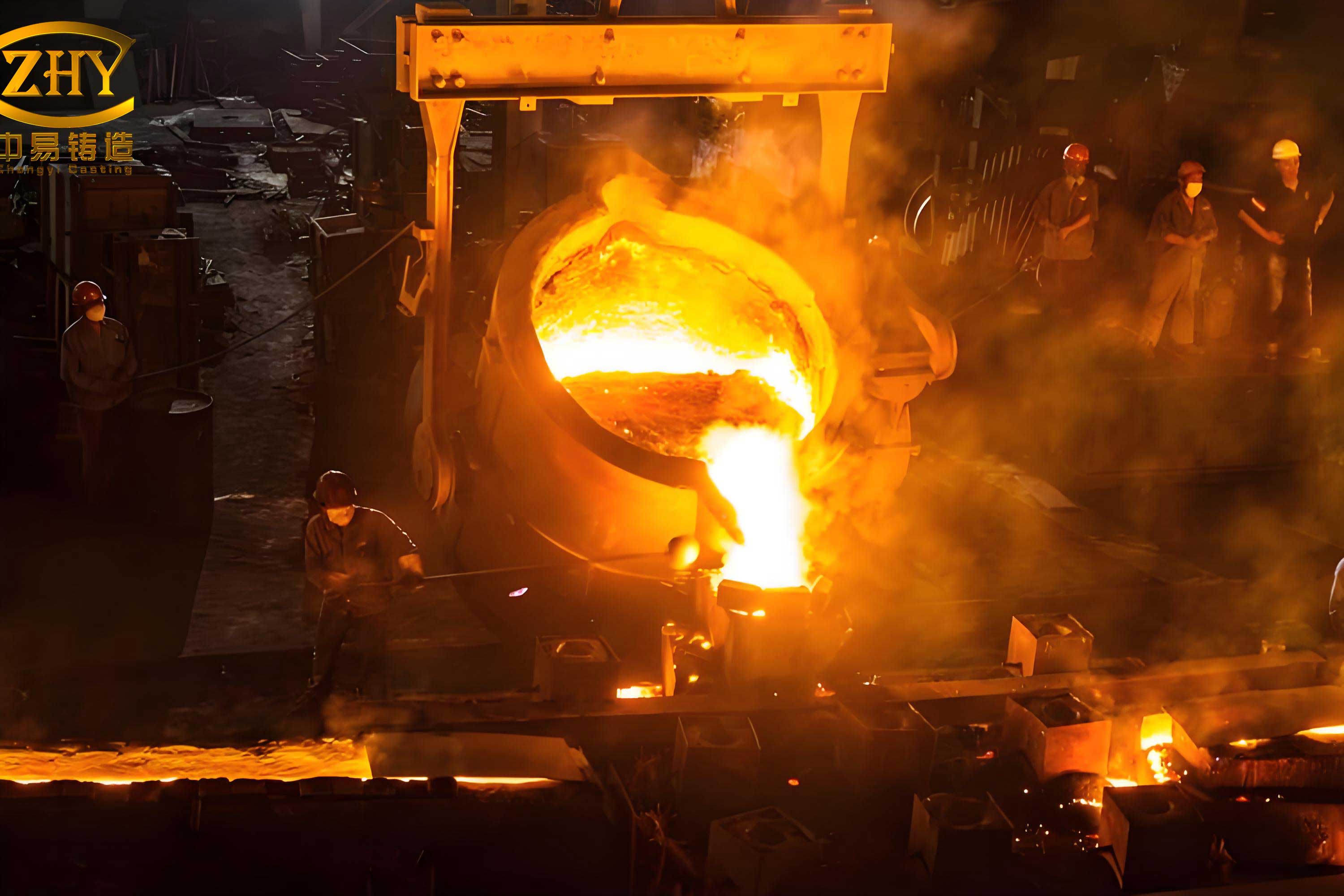
The optimized process showed smooth filling with no splashing or cold shuts. The solidification sequence changed dramatically. The thin walls solidified first, followed by the thicker sections near the risers. The last solidified region was entirely within the risers, as evidenced by the solid fraction progression. The risers successfully delayed solidification at the hot spots, providing liquid feed to the casting until complete solidification. Figure (inserted earlier) demonstrates typical sand casting foundry components; our simulation confirmed that the riser design effectively shifted the defects.
Defect Elimination
The post-optimization shrinkage porosity analysis revealed that virtually all internal porosity was transferred into the risers. The casting itself showed only one minor pore with a diameter less than 1 mm, which is acceptable for the intended application. The defect volume within the casting was reduced to 0.02%, a 99% improvement over the initial design. Table 5 summarizes the defect statistics.
| Process | Defect volume in casting (%) | Maximum defect size (mm) | Location |
|---|---|---|---|
| Initial | 2.8 | 15 | Hub, base, bearing area |
| Optimized | 0.02 | <1 | Negligible |
Discussion
The success of the optimized sand casting foundry process lies in the proper placement of risers and the change to top-gating. The modulus calculation using Chvorinov’s rule was critical for riser sizing. The theoretical solidification time according to Chvorinov’s rule is:
$$t = K \left( \frac{V}{A} \right)^2$$
where \(K\) is a constant depending on mold material and pouring conditions. For the casting hot spot, the modulus was 2.6 cm, leading to a solidification time of approximately 18 minutes. The riser modulus of 3.12 cm ensured the riser solidified after the casting, guaranteeing feeding. The top-gating also helped to establish a favorable temperature gradient from bottom to top, which is essential for directional solidification in sand casting foundry operations.
Furthermore, the simulation allowed us to visualize the flow pattern and identify potential turbulence. The initial bottom-gating caused a long flow path and premature solidification near the ingates, which contributed to the formation of isolated liquid pockets. The optimized top-gating reduced the flow distance and provided hot metal directly to the riser zone. This case study demonstrates the power of numerical simulation in modern sand casting foundry engineering, where trial-and-error can be replaced by computational optimization.
Conclusion
In this work, we systematically optimized the sand casting foundry process for a gray iron upper rotary disc using ProCAST numerical simulation. The initial design exhibited significant shrinkage porosity due to improper gating and lack of risers. By adding five top-neck risers and five blind risers, and changing the gating system to top-gating, we successfully eliminated internal defects. The optimized process reduced the defect volume from 2.8% to 0.02%, meeting the strict quality requirements. The simulation also confirmed stable filling and directional solidification. This methodology provides a reliable reference for similar complex gray iron castings in the sand casting foundry industry, reducing development time and cost while ensuring high quality.