
Our research team has developed a new sand casting foundry process that significantly enhances the quality of fused cast refractory products. This innovative approach combines vacuum-sealed sand molding with negative-pressure pouring, replacing the conventional resin-bonded sand casting foundry techniques. Throughout our industrial trials, we observed that the new sand casting foundry process not only improves the internal and external quality of the castings but also enables near-net-shape forming, thereby reducing or eliminating the need for subsequent cold machining. In this paper, we present a comprehensive study of this novel sand casting foundry technology, emphasizing its advantages in terms of dimensional accuracy, environmental friendliness, and cost efficiency.
Fused cast refractories are widely used in glass furnace linings due to their excellent resistance to molten glass corrosion. The conventional sand casting foundry process for these materials involves resin-bonded silica sand molds, which often lead to defects such as gas porosity, surface contamination, and dimensional inaccuracies. The resin binder burns off during pouring, causing strength degradation, mold distortion, and emission of harmful gases. To overcome these limitations, we introduced a physical molding method that uses vacuum sealing to consolidate unbonded silica sand, eliminating the need for chemical binders entirely. This novel sand casting foundry approach, coupled with negative-pressure pouring, allows for superior mold rigidity, precise cavity geometry, and improved melt filling capability.
In our experiments, two types of molds were prepared: conventional resin-bonded sand molds (made with silica sand, phenolic resin, and a hardener) and the new vacuum-sealed sand molds (using only dry silica sand with a plastic film and refractory coating, evacuated to a vacuum level). The pouring temperature for both was maintained between 1810 °C and 1860 °C. The conventional sand casting foundry method employed gravity pouring in air, while the new process utilized negative-pressure pouring with a controlled vacuum cycle. The schematic of the vacuum-sealed sand casting foundry mold is represented conceptually, where the mold cavity is surrounded by the plastic film and refractory coating, and the sand is held together by the pressure differential created by the vacuum pump.
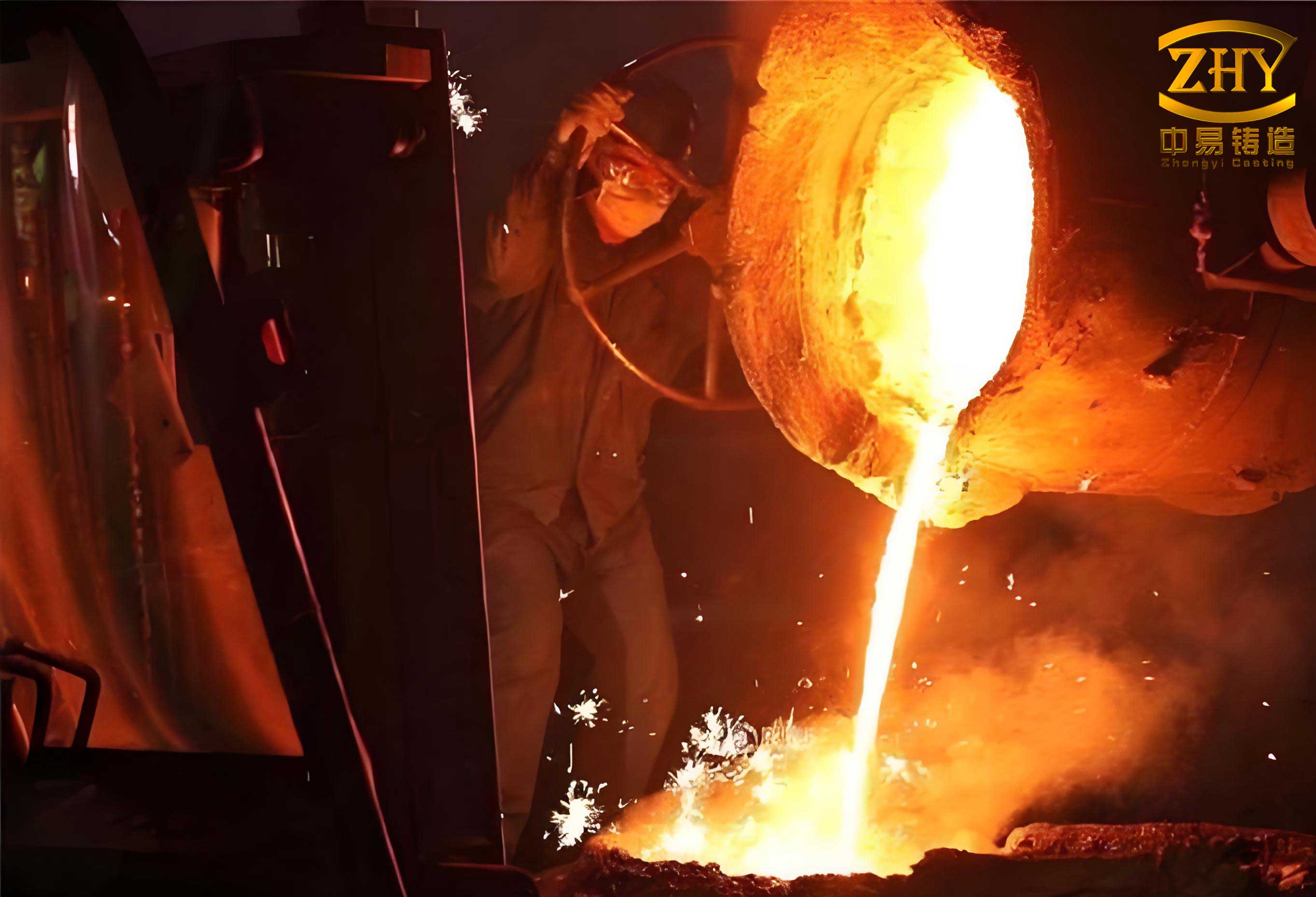
The key physical principle behind the new sand casting foundry mold is that the shear strength of the compacted sand increases linearly with the pressure difference across the mold walls. The relationship is given by:
$$ \tau = k \cdot \Delta P $$
where τ is the shear strength (in kPa), ΔP is the pressure difference between the internal sand and the external atmosphere (in kPa), and k is a proportionality constant dependent on sand grain characteristics and compaction density. During our experiments, we measured the mold surface hardness using a standard sand hardness tester. The hardness value stabilized at 90–95 (equivalent to 900–950 kPa) after a specific vacuum flow rate and duration. The evolution of hardness and vacuum flow rate with time is summarized in the following table from our data.
| Time (s) | Vacuum Flow Rate (m³/h) | Mold Hardness (units) |
|---|---|---|
| 0 | 0 | 0 |
| 10 | 5.2 | 35 |
| 20 | 8.7 | 72 |
| 30 | 11.3 | 90 |
| 40 | 11.5 | 93 |
| 50 | 11.6 | 95 |
Once the mold hardness stabilized, we maintained the vacuum to complete the molding process. The negative-pressure pouring for the new sand casting foundry was carried out with a controlled vacuum profile. The vacuum level in the mold cavity during pouring is shown in the following representative data.
| Time (min) | Negative Pressure (kPa) |
|---|---|
| 0 | -60 |
| 1 | -58 |
| 2 | -55 |
| 3 | -50 |
| 4 | -45 |
| 5 | -30 |
| 6 | -10 |
| 7 | 0 |
The comparative performance of the two sand casting foundry processes is summarized in the following table. The new process exhibits superior dimensional accuracy, higher sand reclamation rate (95% without regeneration vs. 50% with regeneration for conventional), and negligible casting defects.
| Parameter | Novel Process | Conventional Process |
|---|---|---|
| Molding method | Physical (vacuum sealing) | Chemical (resin bonding) |
| Sand hardening | Negative pressure | Self-setting at room temperature |
| Binder usage | None | Resin + hardener |
| Silica sand reclamation rate | 95% (no regeneration needed) | ~50% (requires regeneration) |
| Mold dimensional deviation (mm) | 0.5 – 1.2 | 1.0 – 2.0 |
| Pouring method | Negative-pressure pouring | Gravity pouring |
| Cast surface quality | Excellent | Moderate |
| Cast dimensional deviation (mm) | 0.5 – 1.6 | 2.0 – 3.5 |
| Cold machining allowance | None or minimal | Significant |
The shear strength of the new sand casting foundry mold was measured as a function of the pressure difference. The linear relationship is evident from our test results, as shown in the following data points.
| Pressure Difference ΔP (kPa) | Shear Strength τ (kPa) |
|---|---|
| 0 | 0 |
| 20 | 45 |
| 40 | 90 |
| 60 | 135 |
| 80 | 180 |
| 100 | 225 |
The best-fit line through these points yields the empirical formula:
$$ \tau = 2.25 \cdot \Delta P $$
This linear behavior is a key advantage of the new sand casting foundry process: because there is no binder to burn off, the mold retains its strength throughout the entire pouring and solidification stage. The refractory coating applied on the plastic film undergoes instantaneous solid-phase sintering at high temperature, effectively preventing the molten refractory from reacting with the silica sand. This eliminates the problem of sand fusion and reduces surface defects such as pinholes and sand adhesion.
For evaluating the internal quality of the castings, we conducted nondestructive ultrasonic testing on fused cast AZS (alumina-zirconia-silica) blocks produced by both processes. The novel sand casting foundry process yielded a more homogeneous and denser internal structure. The bulk density and apparent density measured on samples cut from the same location are listed below.
| Property | Novel Process | Conventional Process |
|---|---|---|
| Bulk density (g/cm³) | 3.75 | 3.73 |
| Apparent density (kg/m³) | 3740 | 3720 |
| Glass exudation temperature (°C) | 1400 | 1400 |
| Bubble evolution rate (%) (1300 °C, 10 h, soda-lime glass) | 0.8 | 1.0 |
| Corrosion rate (mm/day) (1500 °C, 36 h, soda-lime glass) | 1.40 | 1.58 |
The improved density and structural integrity of the castings from the new sand casting foundry process can be attributed to several factors. First, the negative-pressure pouring reduces the back-pressure of gases in the mold cavity, allowing the molten refractory to fill the cavity more completely and with less turbulence, thus minimizing entrapped gas pores. Second, since the sand casting foundry mold has no organic binder, there is no evolution of carbon monoxide, hydrogen, or other gases that could cause subsurface porosity or carbon pick-up on the casting surface. Third, the rigid mold, maintained under vacuum during solidification, prevents the mold walls from distorting, maintaining the near-net shape with tight tolerances.
Additionally, the environmental benefits of this novel sand casting foundry approach are substantial. The silica sand can be reused directly after a simple sieving process, without any chemical regeneration, reducing waste sand disposal by over 90%. The absence of resin binders eliminates the emission of volatile organic compounds and nitrogen oxides during pouring, making the foundry environment safer and more sustainable. This aligns with the principles of green manufacturing in the refractory industry.
In summary, the novel sand casting foundry process that combines vacuum-sealed sand molding with negative-pressure pouring represents a significant advancement over conventional resin-bonded sand casting foundry techniques for fused cast refractories. Our industrial trials demonstrated that this technology produces castings with superior dimensional accuracy, reduced cold machining requirements, enhanced physical properties, and lower environmental impact. The sand casting foundry process is also more economical in the long run due to sand reclamation and reduced finishing costs. We believe that this novel sand casting foundry approach is the future development direction for the fused cast refractory industry, enabling truly near-net-shape manufacturing while promoting sustainable production.
Further research is ongoing to optimize the vacuum parameters for larger and more complex casting geometries, as well as to evaluate the performance of the refractory coating materials for different types of fused cast compositions. Nevertheless, the results presented here already confirm that the new sand casting foundry process is a robust and viable alternative to conventional methods. By adopting this technology, foundries can achieve higher product quality, lower costs, and reduced ecological footprint. The sand casting foundry industry should consider this breakthrough as a key step towards modernization and environmental responsibility.
To summarize the mathematical relationships observed in our study, the shear strength of the novel sand casting foundry mold is linearly dependent on the applied vacuum differential, and the mold hardness follows a saturation curve with respect to evacuation time. The empirical models derived from our experiments are:
$$ \tau = k_{\tau} \cdot \Delta P \quad \text{with } k_{\tau} \approx 2.25 , \text{kPa/kPa} $$
$$ H(t) = H_{\text{max}} \left(1 – e^{-t/\tau_H}\right) $$
where H(t) is the mold hardness at time t, Hmax is the steady-state hardness (~95 units), and τH is the time constant (~15 s in our setup). These equations provide a basis for designing the vacuum system and process parameters for any sand casting foundry adopting this technology.
In conclusion, the novel sand casting foundry process we have developed stands as a testament to how innovative molding and pouring techniques can revolutionize the production of high-performance fused cast refractories. The combination of vacuum-sealed sand casting foundry molds and negative-pressure pouring not only improves product quality but also meets the growing demand for clean and efficient manufacturing. We are confident that this sand casting foundry process will gain widespread adoption in the near future.