
In our sand casting foundry, we have undertaken several orders for thin-walled cast iron irregular tubes from overseas clients. The contract stipulated strict adherence to industrial standards, requiring the design of dedicated metal pattern plates and core boxes. Through extensive practice, we identified two critical process allowances that directly determine the quality of the castings, particularly ensuring the inner diameter deviation and wall thickness uniformity of these irregular tubes. This article summarizes our findings based on real production experiences in a typical sand casting foundry.
Characteristics of Thin-Walled Irregular Tubes
These cast iron irregular tubes differ significantly from domestic counterparts. The primary characteristics are:
- Uniform thin wall: Regardless of the nominal diameter, the wall thickness is consistently around 3 mm, whereas domestic similar tubes typically have walls of 5–6 mm.
- High dimensional requirements: In addition to material, appearance, and testing standards, the inner diameter must be checked with plug gauges after casting. The permissible deviation is strictly limited.
- Light weight: For example, the smallest 1-inch elbow weighs only 0.4 lb (0.18 kg), while the domestic minimum is 0.8 kg. For the largest 4-inch cross, the weight is 4.6 lb (2.1 kg) compared to 3.5 kg for domestic counterparts.
Table 1 provides a comparison of key dimensions and weights between the foreign and domestic irregular tubes.
| Type | Nominal Diameter | Foreign Wall Thickness | Domestic Wall Thickness | Foreign Weight | Domestic Weight |
|---|---|---|---|---|---|
| 90° Elbow | 25.4 mm (1″) | 3.0 | 5.5 | 0.18 | 0.80 |
| 90° Elbow | 50.8 mm (2″) | 3.0 | 6.0 | 0.45 | 1.20 |
| Cross | 76.2 mm (3″) | 3.0 | 6.5 | 1.10 | 2.50 |
| Cross | 101.6 mm (4″) | 3.0 | 7.0 | 2.10 | 3.50 |
Initial Process Trial Results
To understand the process parameters for green sand molding and green sand core making in our sand casting foundry, we first used wooden patterns and wooden core boxes to produce a trial batch of tubes. The results were unsatisfactory:
- The wall thickness non-uniformity exceeded 1.2 mm, well above the customer’s required tolerance of 0.5 mm.
- The actual inner diameter of the cast tubes was consistently smaller than the theoretical value by about 1 mm, even after applying the conventional casting shrinkage rate of 1.0% for cast iron.
These issues made it clear that conventional tooling design practices were insufficient for such thin-walled castings.
Two Key Process Allowances
After repeated observations and experiments in our sand casting foundry, we developed two crucial process allowances to guarantee the inner diameter tolerance and wall thickness uniformity of thin-walled irregular tubes.
1. Inner Diameter Process Allowance
For the outer diameter of the tube cavity on the metal pattern plate, we apply the standard casting shrinkage rate measured from actual castings. However, for the inner diameter (core diameter) in the aluminum core box, we must use a corrected formula. The conventional approach would set the core box inner diameter equal to the nominal tube inner diameter plus the shrinkage allowance. But this leads to undersized bores due to the core deformation during ramming and stripping.
We determined that the core box inner diameter should be calculated as:
$$ D_{core\;box} = D_{nominal} + \Delta_{ID} $$
where:
- \(D_{core\;box}\) = inner diameter of the core box (mm)
- \(D_{nominal}\) = nominal inner diameter of the tube (mm)
- \(\Delta_{ID}\) = process allowance for inner diameter, determined to be 0.5 mm based on empirical data
And for the pattern plate (outer shape), the outer diameter of the pattern is:
$$ D_{pattern} = D_{tube\;outer} \times (1 + \varepsilon) $$
where \(\varepsilon\) is the actual casting shrinkage rate (typically 1.0% for gray iron).
The reason for this additional allowance lies in the manual core making operation. In a typical sand casting foundry, the core maker must tap the core box on all sides to facilitate core removal. This tapping causes the soft green sand core to expand slightly in the direction of the taps. For thin-walled tubes, even a 0.2 mm expansion in core diameter leads to a significant reduction in the cast inner diameter. In contrast, thick-walled tubes are less sensitive to this effect. Table 2 summarizes the recommended allowance values.
| Nominal Tube Diameter Range | Allowance \(\Delta_{ID}\) |
|---|---|
| Up to 50 mm (2″) | 0.5 mm |
| 50 – 100 mm (2″–4″) | 0.6 mm |
| Above 100 mm (4″) | 0.7 mm |
We also derived a more general formula based on regression analysis of production data:
$$ \Delta_{ID} = 0.3 + 0.004 \times D_{nominal} \quad \text{(in mm)} $$
This linear relationship reflects the increasing effect of tapping as core diameter grows.
2. Core Box Parting Line Allowance
During the trial phase, we observed that even though the two halves of the split core box were machined to a perfectly circular contour (checked while clamped), the resulting green sand cores were elliptical. This led to wall thickness non-uniformity exceeding 0.5 mm in the cast tubes. The cause was traced to the inevitable difference in tapping forces applied to the core box halves during core stripping.
In the manual operation typical of a sand casting foundry, the core box is struck in the direction perpendicular to the parting line more frequently and with greater force than in the parallel direction. This anisotropic load causes the core to deform preferentially in one axis.
We introduced a second process allowance: a deliberate oversize along the parting line of the core box. The principle is shown conceptually (without a figure): for a split core box, the cavity width measured in the direction parallel to the parting line must be increased by a small value \(\Delta_{part}\). After many trials, we established the values listed in Table 3.
| Nominal Tube Diameter | Allowance \(\Delta_{part}\) (per side) |
|---|---|
| 25 mm (1″) | 0.3 mm |
| 38 mm (1½”) | 0.35 mm |
| 50 mm (2″) | 0.40 mm |
| 76 mm (3″) | 0.45 mm |
| 102 mm (4″) | 0.50 mm |
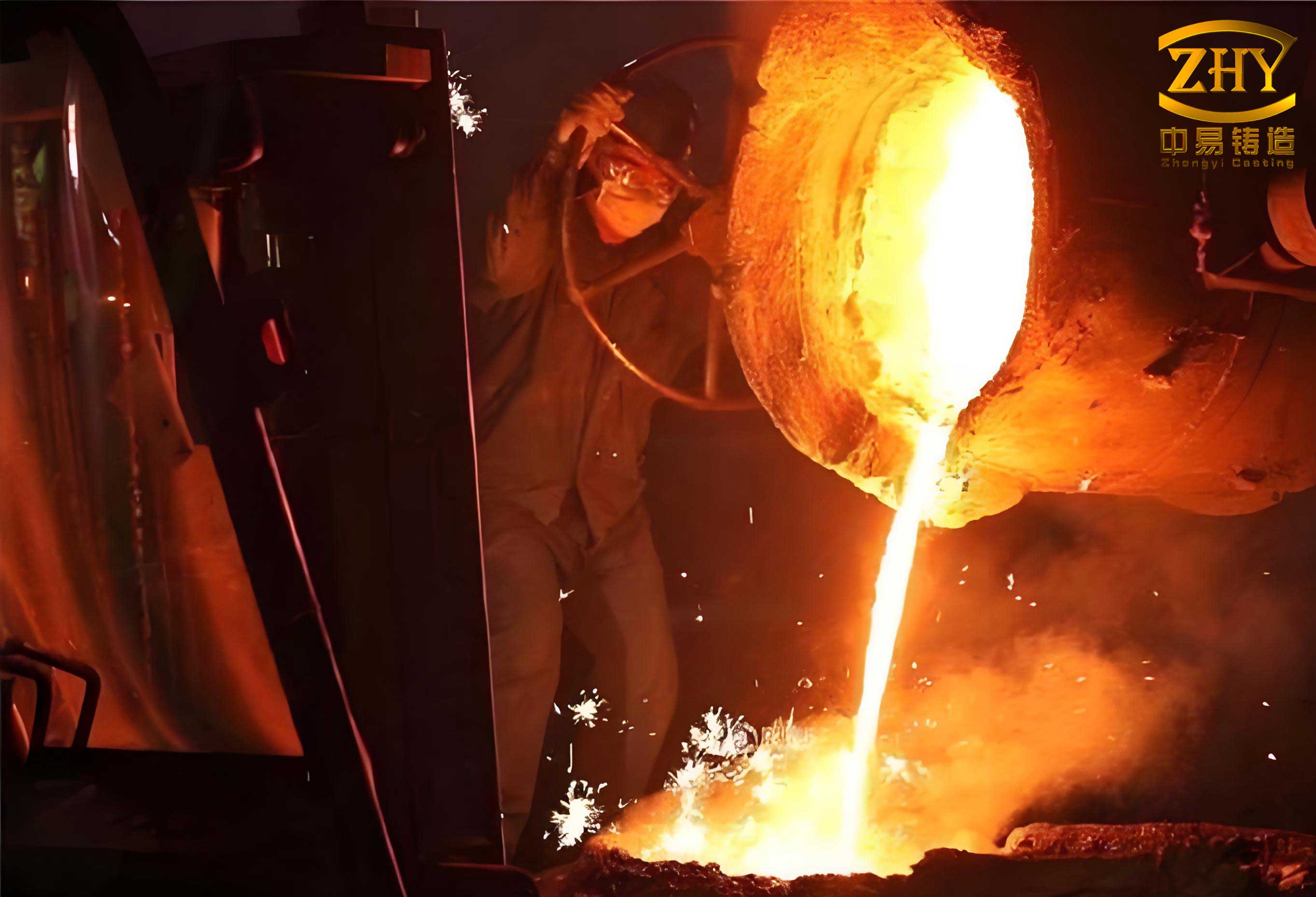
The effect of this allowance can be explained by the resulting core cross-section. Figure 1 (inserted below) shows a typical core box cross-section with the parting line highlighted. The core box cavity is elongated along the parting line to compensate for the greater tapping forces in the perpendicular direction.
Mathematically, if we denote the intended circular core radius as \(R\), the core box cavity radius in the direction perpendicular to the parting line is kept at \(R\), while in the direction parallel to the parting line it is increased to \(R + \Delta_{part}\). After tapping, the core ‘returns’ to a nearly circular shape because the extra material in the parallel direction compensates for the excess compaction in the perpendicular direction. The optimal value of \(\Delta_{part}\) was found to be a function of the core diameter and the average tapping force \(F_{tap}\). A simplified model gives:
$$ \Delta_{part} = k \cdot \frac{F_{tap} \cdot D_{nominal}}{E_{green\;sand}} $$
where \(k\) is an empirical coefficient (≈ 0.02–0.04), and \(E_{green\;sand}\) is the elastic modulus of the green sand core (typically 10–20 MPa). For practical purposes, we use the tabulated values which have been validated across thousands of castings.
Application and Results
By applying both allowances simultaneously, we achieved consistent results in our sand casting foundry:
- Inner diameter deviation: within ±0.2 mm for 90% of castings, satisfying the plug gauge requirements.
- Wall thickness non-uniformity: consistently below 0.5 mm.
Table 4 summarizes the measured improvements compared to the initial trial.
| Parameter | Initial Trial (No Allowances) | After Applying Allowances | Customer Requirement |
|---|---|---|---|
| Max. ID deviation (mm) | −1.0 | +0.2 / −0.1 | ±0.3 |
| Wall thickness non-uniformity (mm) | 1.2 | 0.35 | ≤0.5 |
| Rejection rate due to dimensional defects | 35% | 2% | <5% |
Conclusion
Through extensive practice in our sand casting foundry, we have identified two essential process allowances for the tooling design of thin-walled irregular cast iron tubes:
- Inner diameter allowance \(\Delta_{ID}\) applied to the core box inner diameter to compensate for core expansion during stripping.
- Parting line allowance \(\Delta_{part}\) applied to the core box cavity along the parting line to counteract elliptical deformation caused by anisotropic tapping forces.
These allowances are critical for achieving the required dimensional accuracy and wall thickness uniformity. While domestic foundries producing thicker tubes may not need such adjustments, any sand casting foundry working with thin-walled castings (wall thickness ≤ 3 mm) should consider similar measures. The formulas and tables provided here serve as a practical reference for engineers in the global sand casting foundry industry. Our findings have been successfully applied to produce thousands of high-quality irregular tubes that meet rigorous international standards.
We hope these insights contribute to the broader knowledge base of the sand casting foundry community, especially for those facing challenges with thin-wall sections.