
In the current manufacturing landscape of excavator bucket teeth in China, three primary processes dominate: sand casting, forging, and investment casting. Among these, investment casting has become the mainstream method due to its low cost, good surface finish, dimensional accuracy, and moderate overall expense. However, sand casting remains widely demanded because it offers the lowest production cost. The most common material for bucket teeth is ZGMn18, a high-manganese cast steel that, after water toughening treatment, can generally meet service requirements. In our facility, we have consistently used ordinary sand casting to produce wear-resistant low-alloy steel bucket teeth. During the cleaning process, we discovered severe sand casting defect — namely burned-on sand or “sticky sand” — which necessitated an urgent solution.
Sticky sand, or sand casting defect, refers to a layer of sintered mixture composed of metal or metal oxides combined with molding materials that adheres to the casting surface, making it rough and difficult to clean. For low-alloy steel bucket teeth produced by sand casting, this sand casting defect is a common issue, varying only in severity and ease of removal. Bucket teeth are geometrically simple but relatively thin for alloy steel castings. At low pouring temperatures, the molten metal fails to fill the mold completely; at excessively high temperatures, the sand casting defect of sticky sand becomes pronounced.
1. Classification of Sand Casting Defect — Sticky Sand
Based on our shop-floor observations, the sticky sand defect on bucket teeth appeared as a wedge-shaped cross-section — thinner at the top and thicker at the bottom. This morphology suggests that the defect results from a combination of chemical reaction and mechanical penetration. Liquid FeO in the molten steel infiltrates the interstices between sand grains and reacts with SiO₂ in the molding sand, forming a sintered layer. Thus, we classify this sand casting defect as a simultaneous occurrence of chemical sticky sand and mechanical penetration sticky sand. Additionally, the upper sand core, fully surrounded by high-temperature steel, is prone to overheating and erosion, leading to fused sticky sand. In severe cases, molten steel penetrates deep into the core. Because conventional silica sand has a low melting point and low thermal diffusivity, it is easily eroded. When we replaced silica sand with zircon sand (a non-silica system) under identical conditions, the occurrence of this sand casting defect dropped to about 3%, confirming the diagnosis. Based on these experiments, we systematically analyzed the root causes of sticky sand in low-alloy steel bucket teeth.
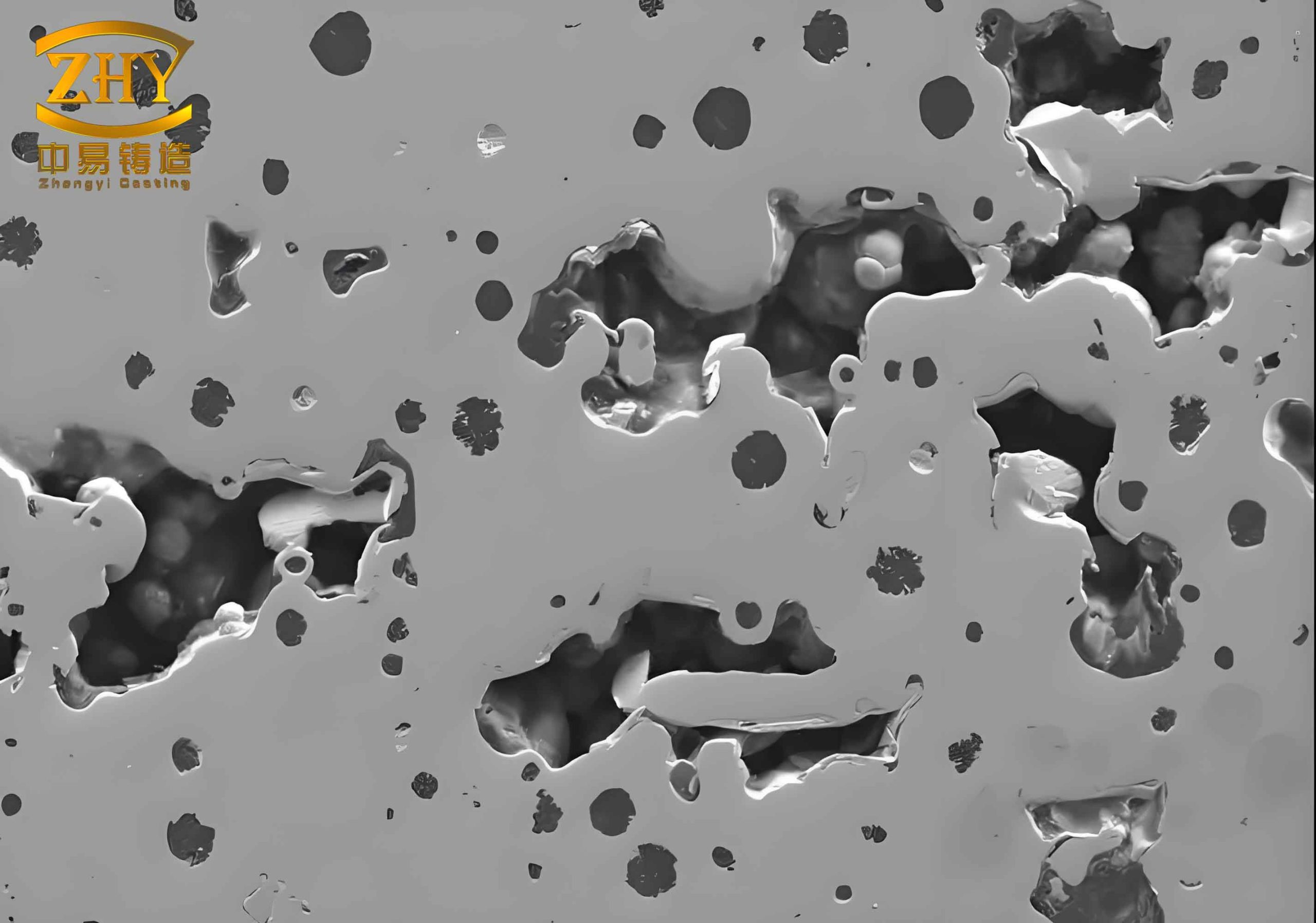
2. Causes and Countermeasures of Sand Casting Defect
Compared to cast iron, steel casting requires much higher pouring temperatures — typically 1560–1620°C or above — to avoid cold shuts. However, this high temperature prolongs the thermal interaction between the molten metal and the sand mold, increases the erosive force of the metal stream, and promotes oxidation of the steel, generating FeO. FeO readily reacts with silica, leading to severe sand casting defect. The following subsections detail specific causes and corresponding measures.
2.1 Grain Size of Base Sand
To achieve a smooth casting surface, fine base sand is preferable. If a single sand system is used, the clay content in the molding sand must be strictly controlled within the specified limit. Since the sand contains no coal dust and has low clay content, its permeability tends to be high. For a single sand system, the permeability should not exceed 120; facing sand should have even lower permeability to produce castings free from mechanical penetration sticky sand. We recommend using base sand with a grain size of 75–150 mesh (or 55–100 mesh) and preferably high-purity quartz sand, avoiding 45–75 mesh coarse quartz sand.
2.2 Silica Content and Reclaimed Sand
To prevent chemical sticky sand, the SiO₂ content in the base sand for high-pouring-temperature steel castings should exceed 96%. However, high SiO₂ content, combined with the absence of buffering materials like coal dust, increases the tendency toward sand expansion defects such as scabs and buckles. Moreover, reclaimed sand contains fine crushed grains, dust, and burnt clay, which lower the sintering temperature of the sand mixture. Therefore, the proportion of reclaimed sand must be limited, and fresh sand should be added regularly.
2.3 Binders and Surface Strength
To improve the surface dry strength and toughness of the sand mold and prevent erosion that leads to sand inclusion, we add starchy materials (e.g., dextrin, α-starch, calcium lignosulfonate, or diluted sodium silicate solution) or phenolic resin alcohol solution. Alternatively, spraying a surface-strengthening agent on the mold surface can enhance resistance to erosion and reduce the risk of sand casting defect.
2.4 Compactness and Uniformity of the Mold
Areas where sticky sand appears are often insufficiently compacted. We must ensure high and uniform mold hardness, typically ≥85, to minimize intergranular voids. Special attention should be given to corners and difficult-to-compact regions. Damaged mold surfaces must be repaired thoroughly; otherwise, local looseness will promote metal penetration, causing sand casting defect.
2.5 Application of Anti-Stick Coatings
Using a suitable anti-stick coating is an extremely effective measure. We apply the coating uniformly on areas prone to sticky sand, particularly on the upper core and other hot spots. For severely affected regions, the coating thickness is increased to 0.75–1.0 mm, applied in multiple thin layers (about 0.3 mm per layer) to ensure proper dry thickness. This coating alters the interfacial tension between the metal and the mold, reducing mechanical penetration and effectively eliminating the sand casting defect.
2.6 Gating and Riser Design
The gating system and risers should be designed to avoid local overheating of the casting or the mold. In particular, ingates must not directly impinge on the mold wall. A well-designed system distributes the thermal load evenly, minimizing the conditions that lead to sand casting defect.
2.7 Pouring Temperature, Speed, and Height
Appropriately reducing the pouring temperature, pouring speed, and pouring height — while still ensuring complete filling — diminishes the thermal and mechanical impact of the molten metal on the sand mold. Lowering the pouring height decreases the dynamic pressure, static pressure, and thermal shock. Although bucket teeth are not thick, the high pouring temperature prolongs the contact time between steel and mold surface, creating favorable conditions for mechanical penetration sticky sand. Thus, careful control of these parameters is essential to mitigate sand casting defect.
3. Summary of Causes and Preventive Measures
To provide a clear overview, we have summarized the key causes and corresponding countermeasures in the tables below.
| Root Cause Category | Specific Cause | Countermeasure |
|---|---|---|
| Base sand characteristics | Coarse sand grains enlarge intergranular voids | Use 75–150 mesh high-purity quartz sand (SiO₂ > 96%) |
| Chemical reaction | Reaction between FeO and SiO₂ | Reduce FeO formation by controlling pouring temperature and atmosphere; use high-silica sand (>96%) and apply anti-stick coating |
| Reclaimed sand quality | Fines and burnt clay reduce sintering temperature | Limit reclaimed sand proportion, add fresh sand regularly |
| Mold compactness | Insufficient or uneven compaction | Ensure mold hardness ≥85, especially in corners; repair damaged areas thoroughly |
| Coating | No coating or insufficient thickness | Apply anti-stick coating (multi-layer, total dry thickness 0.75–1.0 mm) on hot spots |
| Gating/riser design | Local overheating due to direct impingement | Avoid ingates directly facing mold walls; distribute heat evenly |
| Pouring parameters | Excessive temperature, speed, or height | Reduce pouring temperature, speed, and height while maintaining fillability |
| Sand core material | Silica sand core melts under high temperature | Replace with zircon sand or other high-refractoriness core sands |
In addition, we can model the chemical reaction that contributes to the sand casting defect:
$$ \text{FeO} + \text{SiO}_2 \rightarrow \text{FeSiO}_3 $$
This reaction product (iron silicate) has a low melting point and forms a liquid phase that bonds sand grains, creating the characteristic sintered layer. The rate of this reaction increases exponentially with temperature. The penetration depth of the molten metal into the sand can be estimated by the following capillary pressure equation:
$$ P = \frac{2\gamma \cos\theta}{r} $$
where \( P \) is the capillary pressure required for metal to penetrate, \( \gamma \) is the surface tension of the molten steel, \( \theta \) is the contact angle between metal and sand (affected by coatings), and \( r \) is the effective radius of intergranular pores. To prevent mechanical penetration, we need to reduce \( r \) (by increasing compactness) or increase \( \theta \) (by applying coating). A practical target is that the pore radius should be less than the critical value given by:
$$ r_{\text{crit}} = \frac{2\gamma \cos\theta}{P_{\text{metal}}} $$
where \( P_{\text{metal}} \) is the metallostatic pressure plus dynamic pressure. For our bucket teeth, typical values are:
| Parameter | Typical Range |
|---|---|
| Surface tension of steel (γ) | 1.5–1.8 N/m |
| Contact angle without coating (θ) | 80–100° |
| Contact angle with coating (θ) | 110–130° |
| Metallostatic pressure (P_metal) | 5–15 kPa |
| Critical pore radius (r_crit) without coating | ~50 μm |
| Critical pore radius (r_crit) with coating | ~15 μm |
These calculations demonstrate that applying a coating significantly reduces the allowable pore size for penetration, making it much easier to achieve a defect-free casting. Combining high compactness (reducing pore radius to below 10 μm) with proper coating virtually eliminates mechanical penetration sticky sand.
For the chemical reaction component, the rate of FeO generation can be expressed as:
$$ \frac{d[\text{FeO}]}{dt} = k \cdot A \cdot e^{-E_a/(RT)} $$
where \( k \) is a constant, \( A \) is the surface area of the metal exposed to oxygen, \( E_a \) is the activation energy, \( R \) is the gas constant, and \( T \) is the absolute temperature. Lowering the pouring temperature reduces the exponential term, thereby decreasing FeO formation and mitigating chemical sticky sand.
4. Conclusion and Recommendations
Through systematic investigation and experimentation, we have identified the primary factors contributing to the sand casting defect of sticky sand in sand-cast low-alloy steel excavator bucket teeth. The most effective corrective actions include:
- Using high-purity silica sand with SiO₂ content >96% and appropriate grain size (75–150 mesh).
- Maintaining mold compactness ≥85 with excellent uniformity, especially at corners and cores.
- Applying a multi-layer anti-stick coating (total dry thickness 0.75–1.0 mm) on all critical surfaces, particularly around the sand core and hot spots.
- Optimizing the gating system to avoid direct impingement and localized overheating.
- Controlling pouring temperature, speed, and height to minimize thermal and mechanical attack on the mold.
- Replacing silica sand cores with zircon sand cores for parts that are fully surrounded by molten steel.
By implementing these measures, we have successfully reduced the incidence of this sand casting defect from over 20% to less than 3%, achieving castings with smooth surfaces and consistent quality. We recommend that foundries facing similar challenges adopt these strategies as a standard practice for producing low-alloy steel bucket teeth or other thin-section steel castings by sand casting.
In conclusion, the sand casting defect of sticky sand is a multifaceted problem that requires a holistic approach. A combination of raw material selection, mold preparation, coating technology, and process parameter control is essential to produce defect-free, high-quality steel castings economically.