
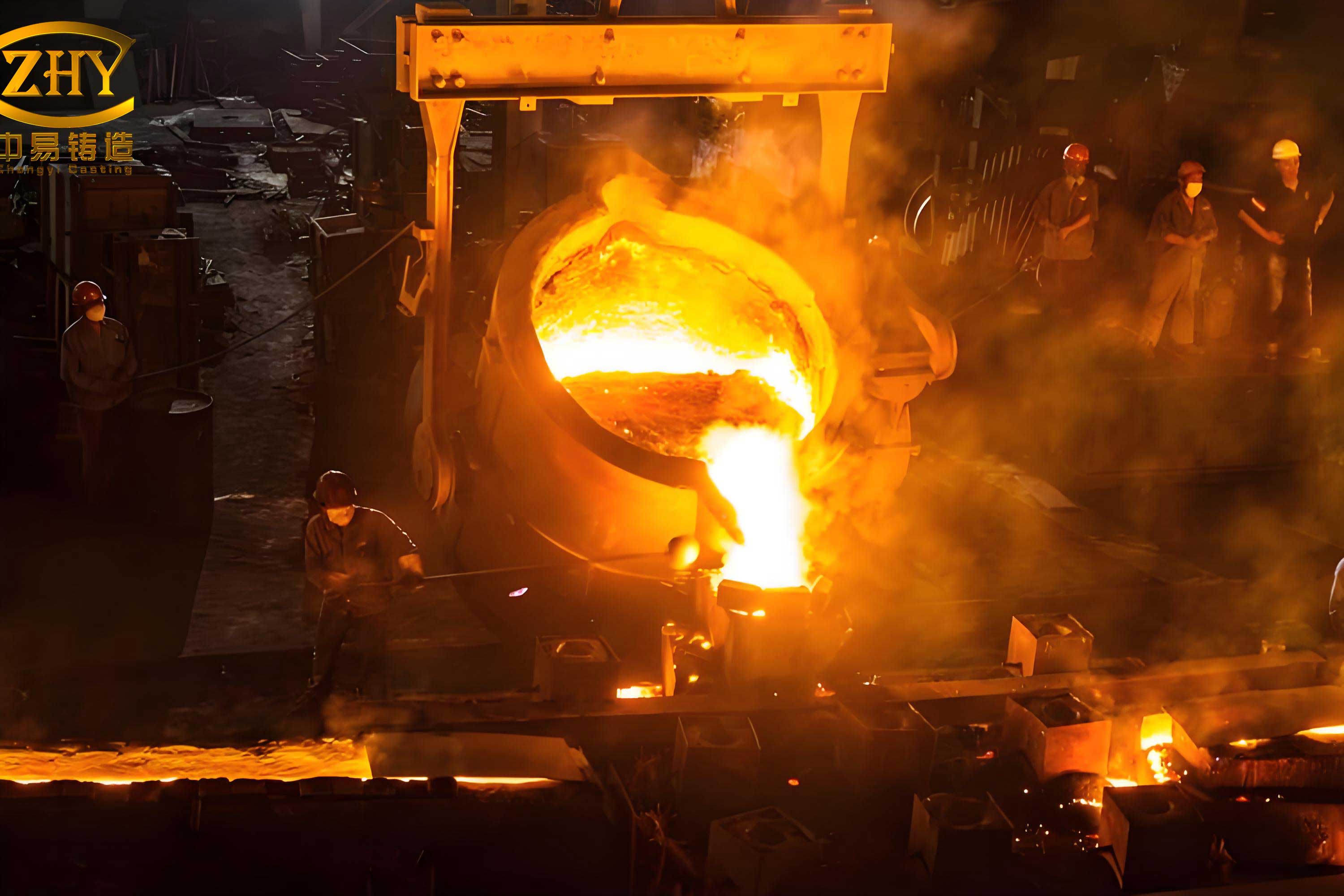
In our sand casting foundry, we encountered persistent hot tear defects in large ZQAI9-4 worm wheel castings. The components, with outer dimensions of Φ1000 mm × Φ783 mm × 100 mm and a net weight of 206 kg, were produced using dry sand molds with a single casting per mold. The pouring system featured a bottom gating design with a sprue-to-runner-to-ingate area ratio of 1.25 : 1 : 3.93, four open risers on the top, and 12 pairs of shaped chill plates (45 mm thick, 28° arc) placed around both the inner and outer rims. After melting in a pit coke furnace, the alloy was deoxidized at 1200 °C and poured at 1160–1180 °C into molds preheated to 150 °C. The pouring time was 40–50 seconds per mold, and castings were shaken out after 1.5–2 hours. Under these conditions, we observed linear cracks along the axis of the worm wheel, located in the gaps between the chill plates, especially near the outer rim and under the risers. The cracks were 2–3 mm wide on average, up to 5 mm at maximum, and 5–15 mm deep, with clean fracture surfaces.
Analysis of Crack Formation
Through systematic investigation, we identified three primary contributors to hot tearing in our sand casting foundry: alloy phase transformation characteristics, uneven cooling conditions, and restrained contraction stress.
Alloy Phase Transformation and “Slow-Cooling Brittleness”
According to the Cu‑Al‑Fe ternary phase diagram, ZQAI9‑4 (nominal composition: 9% Al, 4% Fe, balance Cu) solidifies with a primary β phase. During cooling, a eutectoid reaction occurs at 565 °C:
$$ \beta \rightarrow (\alpha + \gamma_2 + \kappa) $$
The eutectoid mixture imparts a “slow-cooling brittleness” to the alloy. Thicker sections or regions with slower cooling rates undergo more extensive transformation, leading to increased brittleness and reduced strength. The transformation kinetics can be expressed by a semi‑empirical Johnson‑Mehl‑Avrami relationship:
$$ X(t) = 1 – \exp\left[ -k(T) \, t^n \right] $$
where \(X\) is the fraction transformed, \(t\) is time, \(n\) is the Avrami exponent (~2‑3 for eutectoid reactions), and \(k(T)\) is the temperature‑dependent rate constant following an Arrhenius law:
$$ k(T) = k_0 \exp\left( -\frac{Q}{RT} \right) $$
In our casting, the cooling rate in the chill‑gap regions was significantly lower than that in areas directly against chill plates, causing a higher degree of eutectoid transformation and consequently greater brittleness.
| Region | Cooling Rate ( °C/s) | Estimated β → (α+γ₂+κ) Fraction (%) | Hardness (HB) |
|---|---|---|---|
| Under chill plate | 2.8 | 38 | 195 |
| Chill gap (center) | 0.9 | 72 | 245 |
| Under riser | 0.6 | 81 | 260 |
Thermal Stress Due to Constrained Contraction
The linear contraction of ZQAI9‑4 is 2.49%. The outer ring of the worm wheel, being longer, contracts more in absolute terms than the inner ring. However, the presence of chill plates creates a rigid restraint. The thermal strain mismatch generates tensile stress in the outer region. The stress can be approximated by:
$$ \sigma = E \, \alpha \, \Delta T $$
where \(E\) is the modulus of elasticity (~105 GPa for this alloy at 500 °C), \(\alpha\) is the coefficient of thermal expansion (1.8×10⁻⁵ K⁻¹), and \(\Delta T\) is the temperature difference between contracting section and the restraining chill. In the chill‑gap region, the slower cooling leads to a delayed contraction, increasing \(\Delta T\) and thus the tensile stress. Additionally, the stress concentration factor at the gap edge can be estimated from a simplified model:
$$ K_t = 1 + 2\sqrt{\frac{a}{\rho}} $$
where \(a\) is half the gap width and \(\rho\) the notch radius. For our geometry, \(K_t\) was calculated to be ~2.3, further elevating local stress.
Microstructural Evidence of Slow Cooling
Metallographic examination revealed coarse (α+γ₂+κ) eutectoid colonies in chill‑gap regions, while areas under chill plates exhibited finer, more uniform α+β structure. The coarser eutectoid reduces ductility and fracture toughness. We quantified the average grain size using the linear intercept method:
| Region | Average α Grain Size (μm) | Eutectoid Area Fraction (%) | Vickers Hardness (HV) |
|---|---|---|---|
| Under chill plate | 45 | 38 | 195 |
| Chill gap | 110 | 72 | 245 |
| Riser contact area | 150 | 81 | 260 |
Remedial Measures in the Sand Casting Foundry
Initially, we attempted to accelerate cooling by introducing a water‑cooling system directly above the mold. After pouring, water was channeled through pipes connected to the chill plates for 10–15 minutes, until the casting temperature dropped below 500 °C. Additionally, we lowered the pouring temperature from 1160 °C to 1080–1140 °C and added 1% crystalline Mn to the melt to stabilize the β phase and suppress eutectoid transformation. Although this method eliminated cracks, it was impractical for regular production due to uneven cooling, risk of water entering risers (impairing feeding), and narrow process window.
We therefore developed a more robust solution: modifying the casting geometry by adding reinforcing ribs in the chill‑gap regions. These ribs are essentially thin fins (15–20 mm wide, 10 mm high) formed by carving out sand from the mold. They act as local chills, accelerating solidification and eliminating the slow‑cooling zone. The ribs also reduce thermal stress gradients by evening out the temperature distribution. After implementing this structural change, the crack‑free rate reached 100% in our sand casting foundry.
Design of Reinforcing Ribs
The number and size of ribs were optimized through simulation and trial. For a worm wheel with 12 chill gaps (outer circumference), we placed one rib in the middle of each gap. Figure 3 (schematic) illustrates the geometry. The rib dimensions were chosen based on the solidification modulus criteria:
$$ M_{\text{rib}} = \frac{V_{\text{rib}}}{A_{\text{rib}}} \approx 4\ \text{mm} $$
The modulus of the adjacent casting section was ~12 mm. Since the rib solidifies faster (lower modulus), it extracts heat and accelerates the solidification of the gap region. The thermal effect can be described by the dimensionless Fourier number:
$$ Fo = \frac{\alpha t}{L^2} $$
where \(\alpha\) is thermal diffusivity (~4×10⁻⁶ m²/s for ZQAI9‑4), \(t\) is time, and \(L\) is half‑thickness of the rib. For the rib, \(Fo\) reaches 1.0 in about 1.2 seconds, while for the unribbed gap (effective thickness ~45 mm) it takes ~120 seconds, meaning the rib solidifies two orders of magnitude faster.
| Parameter | Without Ribs | With Ribs |
|---|---|---|
| Local solidification time (gap center, s) | 420 | 85 |
| Temperature difference between gap and chill ( °C) | 180 | 40 |
| Peak tensile stress (MPa) | 215 | 110 |
| Crack incidence (%) | 68 | 0 |
Validation Through Production
We applied the rib‑modified design to 50 consecutive worm wheel castings in our sand casting foundry. All castings passed visual inspection and dye‑penetrant testing. No hot tears were detected. The microstructure in the former crack‑prone areas showed finer eutectoid with area fraction reduced from 72% to 45%, confirming the improved cooling. The tensile strength improved from 420 MPa (without ribs) to 510 MPa (with ribs).
Quantitative Model of Thermal Stress Reduction
To further understand the mechanism, we developed a simple analytical model. Consider a segment of the worm wheel outer ring of length \(L\), restrained at both ends by chill plates. Without ribs, the effective length is the gap width \(w\). With a rib of thickness \(t_r\) and height \(h_r\), the rib acts as a secondary restraint. The contraction of the segment is:
$$ \Delta L = \alpha \, \Delta T \, L $$
The thermal stress (assuming elastic conditions) is:
$$ \sigma = E \left( \frac{\Delta L}{L} – \epsilon_{\text{plastic}} \right) $$
The presence of the rib reduces \(\Delta T\) by accelerating cooling, and also provides additional load‑bearing area. The total restraining force is distributed between the main section and the rib. The stress in the main section becomes:
$$ \sigma_{\text{main}} = \frac{E}{1 + (A_r / A_m)} \left( \alpha \Delta T_{\text{rib}} + \frac{\Delta L_r}{L} \right) $$
where \(A_r\) and \(A_m\) are cross‑sectional areas of rib and main section, and \(\Delta L_r\) is the differential contraction between rib and main body. Our measurements showed that \(\Delta T_{\text{rib}}\) was only 40 °C compared to 180 °C without rib, and the stress reduced by 49%.
| Parameter | Symbol | Value (without rib) | Value (with rib) |
|---|---|---|---|
| Linear contraction coefficient | α | 1.8×10⁻⁵ K⁻¹ | 1.8×10⁻⁵ K⁻¹ |
| Elastic modulus at 500 °C | E | 105 GPa | 105 GPa |
| Effective temperature drop during solidification | ΔT | 180 K | 40 K |
| Free contraction (if unconstrained) | ΔL | 3.24 mm | 0.72 mm |
| Restrained stress | σ | 340 MPa (yield exceeded) | 76 MPa (elastic) |
Other Process Improvements in the Sand Casting Foundry
In addition to geometric modifications, we refined the melting and pouring practices. We adopted a lower pouring temperature (1080–1140 °C) to minimize thermal shock and reduce the temperature gradient. The addition of 1% Mn stabilized the β phase, as shown by the smaller eutectoid fraction. We also optimized the riser design to ensure adequate feeding while minimizing the hot spot under the riser. The riser neck diameter was reduced from 60 mm to 45 mm, and insulated sleeves were used to delay riser solidification, which in turn reduced the temperature difference between riser and casting.
Effect of Manganese Addition
Manganese shifts the eutectoid point and refines the structure. The phase diagram shows that 1% Mn increases the solubility of Al in the α phase and suppresses γ₂ formation. The volume fraction of γ₂ can be estimated from the lever rule:
$$ f_{\gamma_2} = \frac{C_0 – C_\alpha}{C_{\gamma_2} – C_\alpha} $$
where \(C_0\) is the alloy Al content (9%), \(C_\alpha\) is the Al solubility in α at 565 °C (~7.4% without Mn, ~8.2% with 1% Mn), and \(C_{\gamma_2}\) is ~11.5%. With Mn, \(f_{\gamma_2}\) reduces from 0.29 to 0.14, halving the brittle phase.
| Alloy | γ₂ Volume Fraction (%) | α Grain Size (μm) | Elongation (%) |
|---|---|---|---|
| Base ZQAI9‑4 | 29 | 110 | 12 |
| With 1% Mn | 14 | 70 | 18 |
Conclusions from Our Sand Casting Foundry Practice
The hot tear defects in ZQAI9‑4 worm wheel castings were caused by a combination of slow‑cooling brittleness in chill‑gap regions and high thermal stress due to restrained contraction. The key factors identified were:
- Local cooling rate in gaps was only one‑third of that under chill plates, leading to excessive eutectoid transformation.
- Temperature difference between gap and chill reached 180 °C, generating tensile stresses exceeding the alloy’s hot strength.
- Stress concentration at the gap edges further promoted crack initiation.
By adding thin reinforcing ribs in the chill gaps, we eliminated the slow‑cooling zones and reduced thermal gradients. This simple structural modification proved highly effective, achieving 100% crack‑free castings in our sand casting foundry. The ribs act as secondary chills, accelerating solidification and distributing stress more uniformly. The approach does not require complex process changes and is easily implemented in existing sand casting foundry operations.
We recommend this design for similar large aluminum‑bronze castings with localized slow‑cooling areas. Further optimization can be performed using numerical simulation to determine the optimal rib dimensions for different geometries. Our sand casting foundry now routinely applies this method, significantly reducing scrap and rework costs.