
In this study, we employed the casting simulation software ProCAST to model and analyze the filling and solidification processes in lost foam castings for an aluminum cylinder head. The cylinder head is a critical component in internal combustion engines, subjected to high thermal and mechanical loads, and requires excellent dimensional accuracy and mechanical integrity. Lost foam castings offer significant advantages for complex geometries like cylinder heads, as they eliminate the need for cores and allow for intricate internal passages. However, the process is sensitive to several parameters, including negative pressure, pattern density, and pouring temperature. Our objective was to optimize these parameters to achieve a smooth filling process, minimize solidification time, and reduce casting defects such as shrinkage porosity and gas entrapment. Through systematic simulation, we identified the optimal combination of process variables, which improves the quality of lost foam castings for this demanding application.
The cylinder head studied here is made of ZL104 aluminum alloy, with a casting weight of 3.39 kg and dimensions of 345 mm × 157 mm × 69 mm. The minimum wall thickness is 4 mm, making it a thin-walled casting with complex internal cavities. To meet the stringent requirements of leak tightness and surface finish, the lost foam castings process must be carefully controlled. The foam pattern was made of expanded polystyrene (EPS), and the mold material was silica sand. The casting system adopted a top gating design with four ingates acting as risers, following the directional solidification principle. The pouring cup was connected to a sprue, then to a runner that distributed metal to the four ingates. Metal was poured in a sequence of slow-fast-slow to ensure stable filling.
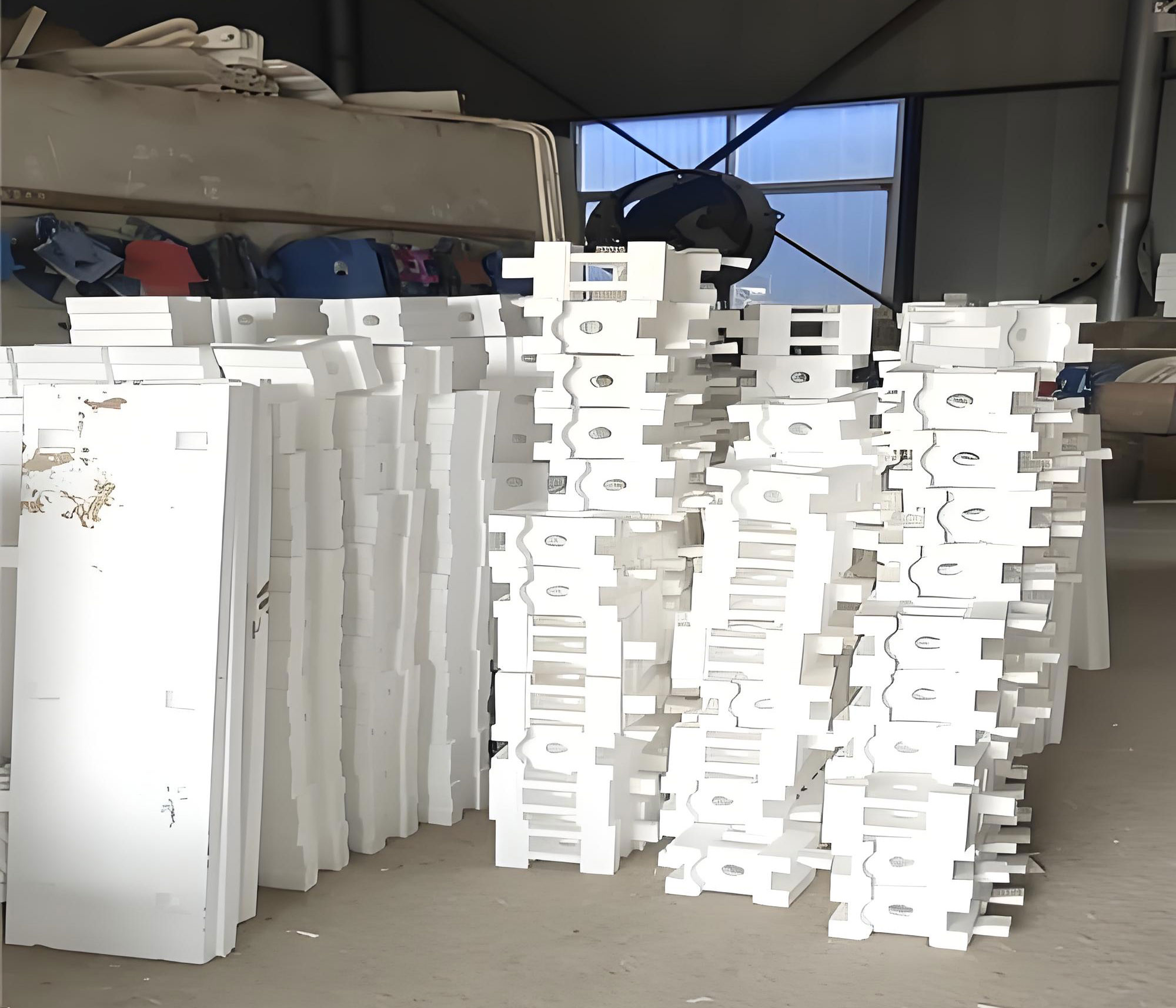
Figure above illustrates a typical lost foam castings setup for an aluminum cylinder head, showing the foam pattern and pouring system. We used this configuration in our simulations to evaluate the influence of three key variables: negative pressure (vacuum level), EPS foam pattern density, and pouring temperature. The ProCAST software allowed us to simulate the coupled thermal and fluid flow phenomena during filling and solidification. After creating a 3D model in UG, we imported it into MeshCAST for finite element meshing. The mesh comprised 345,847 elements and 67,186 nodes, using a non-uniform tetrahedral grid to balance accuracy and computational efficiency. Table 1 lists the chemical composition of ZL104 aluminum alloy used in all simulations.
| Al | Si | Fe | Mg | Ti | Sn | Cu | Pb | Mn | Ni |
|---|---|---|---|---|---|---|---|---|---|
| 89.89 | 9.56 | 0.15 | 0.4 | 0.016 | 0.007 | 0.007 | 0.021 | 0.002 | 0.002 |
The thermophysical properties of the materials used in the simulations are summarized in Table 2. The heat transfer coefficient between the casting and the sand mold was set to 240 W·m⁻²·K⁻¹. The solidus and liquidus temperatures of ZL104 were 546°C and 598°C, respectively.
| Material | Density (kg/m³) | Specific heat (kJ/kg·K) | Latent heat (kJ/kg) | Thermal conductivity (W/m·K) | Solidus temperature (°C) | Liquidus temperature (°C) |
|---|---|---|---|---|---|---|
| ZL104 alloy | 2.65×10³ | 0.25 | 300 | 203 | 546 | 598 |
| EPS foam | 25 (typical) | 3.7 | 100 | 0.035 | 603 | 623 |
The filling process in lost foam castings differs from conventional sand casting because the molten metal must decompose and gasify the foam pattern as it advances. This creates a complex interaction between thermal degradation, gas pressure, and metal flow. Our baseline simulation used a pouring temperature of 750°C, a negative pressure of 25 kPa, and an EPS foam density of 20 kg/m³. The filling sequence was observed: the metal first flowed down the sprue, spread along the runner, entered through the four ingates, and then filled the cylinder head cavity progressively from the front toward the rear corners. The last filled regions were the two end corners of the cylinder head, which are critical for avoiding misruns and cold shuts.
Effect of Negative Pressure on Filling Time
One of the most influential parameters in lost foam castings is the vacuum level applied within the mold. The negative pressure helps remove the gaseous decomposition products of the EPS foam, thereby reducing backpressure and enhancing metal fluidity. However, excessive vacuum can cause unstable flow or even collapse of the foam pattern. We simulated three foam densities (18, 20, and 25 kg/m³) at a fixed pouring temperature of 700°C and varied the negative pressure from 15 kPa to 30 kPa. Table 3 presents the resulting filling times.
| Negative pressure (kPa) | Foam density 18 kg/m³ | Foam density 20 kg/m³ | Foam density 25 kg/m³ |
|---|---|---|---|
| 15 | 22.3 | 24.1 | 28.6 |
| 18 | 20.5 | 22.0 | 26.2 |
| 20 | 19.8 | 21.2 | 25.0 |
| 22 | 20.1 | 21.5 | 25.4 |
| 25 | 19.2 | 20.6 | 24.3 |
| 30 | 18.5 | 19.8 | 23.5 |
The data indicate that filling time decreases with increasing negative pressure, but the reduction rate slows beyond 20 kPa. This nonlinear behavior can be approximated by an inverse exponential relationship. For the density of 20 kg/m³, the filling time $t_f$ (s) as a function of negative pressure $p_v$ (kPa) can be fitted to:
$$
t_f \approx 24.5 – 0.82(p_v – 15) + 0.015(p_v – 15)^2
$$
This equation shows that the benefit of raising negative pressure diminishes at higher levels. In lost foam castings, the optimal negative pressure balances filling speed and risk of pattern deformation. From our analysis, a negative pressure of 20 kPa provides a good compromise, yielding a filling time of 21.2 s for 20 kg/m³ foam, while maintaining stable filling and minimal defect formation.
Effect of Foam Pattern Density on Filling Time
The density of the EPS foam pattern determines the amount of material that must be gasified per unit volume. Higher density requires more heat from the molten metal, which slows down the filling and can lead to incomplete decomposition. We examined foam densities ranging from 16 to 30 kg/m³ at a fixed pouring temperature of 750°C and two different negative pressure levels (18 kPa and 20 kPa). Table 4 summarizes the filling times.
| Foam density (kg/m³) | Negative pressure 18 kPa | Negative pressure 20 kPa |
|---|---|---|
| 16 | 18.2 | 17.8 |
| 18 | 19.5 | 18.9 |
| 20 | 20.8 | 20.0 |
| 22 | 22.3 | 21.1 |
| 25 | 24.6 | 22.7 |
| 30 | 28.1 | 25.3 |
At 20 kPa, the relationship is nearly linear, with a slope of approximately 0.42 s per kg/m³. For lower negative pressure (18 kPa), the dependence becomes slightly stronger, indicating that the combination of low vacuum and high density further impedes filling. From the perspective of lost foam castings, using a pattern density that is too high (>25 kg/m³) may result in prolonged filling times and increased risk of cold shunts. Conversely, very low density foams (<16 kg/m³) may lack sufficient mechanical strength to maintain shape during handling and coating. Our simulations suggest that a density of 20 kg/m³ is optimal for this cylinder head, as it offers a reasonable filling time and stable filling behavior.
Effect of Pouring Temperature on Filling Time
Pouring temperature directly affects the amount of heat available to decompose the foam pattern. Higher temperatures increase the decomposition rate, reduce the viscosity of the molten metal, and lower flow resistance. We simulated a range of pouring temperatures from 700°C to 780°C at a fixed negative pressure of 20 kPa and foam density of 20 kg/m³. The results are shown in Table 5.
| Pouring temperature (°C) | Filling time (s) |
|---|---|
| 700 | 23.5 |
| 720 | 22.1 |
| 740 | 20.8 |
| 750 | 20.0 |
| 760 | 19.3 |
| 780 | 18.2 |
The decreasing trend can be empirically expressed as:
$$
t_f = 71.2 – 0.068 \cdot T
$$
where $T$ is in °C. However, the linear fit only holds within the tested range. In practice, extremely high pouring temperatures can cause excessive gas generation, oxidation, and shrinkage defects in lost foam castings. For aluminum alloys, temperatures above 780°C may lead to increased hydrogen pickup and porosity. Therefore, the optimal pouring temperature range is 750–780°C, with 750°C providing a good balance between adequate filling and controlled solidification.
Solidification Time and Shrinkage Defects
We also analyzed the solidification behavior of the cylinder head under various conditions. The solidification time was primarily influenced by the pouring temperature and the thermal mass of the casting; negative pressure and foam density had only minor effects. Figure 9 (not shown) illustrates a typical solidification time field, where the last solidifying regions were located near the water jacket bends and the end corners. The overall solidification pattern followed a directional sequence from the front of the cylinder head toward the rear, consistent with the gating design.
The Niyama criterion was used to predict shrinkage porosity defects. We evaluated the average shrinkage defect volume fraction for different foam densities and pouring temperatures. Table 6 presents the average shrinkage defect percentage as a function of foam density at a fixed pouring temperature of 750°C and negative pressure of 20 kPa.
| Foam density (kg/m³) | Shrinkage defect fraction (%) |
|---|---|
| 16 | 7.82 |
| 18 | 7.55 |
| 20 | 7.10 |
| 22 | 7.48 |
| 25 | 7.15 |
| 30 | 6.85 |
The defect fraction first decreases, then increases, and finally drops again. The minimum value occurs at 20 kg/m³ (7.10%). This non-monotonic behavior suggests that an intermediate density provides the best combination of decomposition kinetics and feeding efficiency. For pouring temperature variation (Table 7), we observed a clear decreasing trend as temperature increased.
| Pouring temperature (°C) | Shrinkage defect fraction (%) |
|---|---|
| 720 | 7.28 |
| 740 | 6.95 |
| 750 | 7.10 |
| 760 | 6.80 |
| 780 | 6.58 |
Higher pouring temperatures reduce shrinkage defects because they improve feeding and delay solidification, allowing more time for intergranular flow. However, excessively high temperatures can increase gas porosity and metal oxidation. The optimal temperature of 750°C thus provides a trade-off: it yields a low shrinkage defect fraction (7.10%) while maintaining acceptable melt quality.
Optimal Process Parameters for Lost Foam Castings
Based on the comprehensive simulation results, we determined the following optimal parameters for the aluminum cylinder head in lost foam castings:
- Negative pressure: 20 kPa
- Foam pattern density: 20 kg/m³
- Pouring temperature: 750 °C
These parameters produce a filling time of 20.0 s, a solidification time that ensures directional solidification, and a shrinkage defect fraction of 7.10%. The filling process is stable, with no evidence of cold shuts or misruns. The use of a top gating system with four ingates acting as risers also promotes effective feeding of the hot spots. This optimized combination can be directly applied to industrial production of cylinder heads via lost foam castings, enhancing yield and reducing scrap rates.
Conclusion
We utilized the ProCAST simulation environment to systematically optimize the lost foam castings process for an aluminum alloy cylinder head. By varying negative pressure, foam pattern density, and pouring temperature, we analyzed their effects on filling time, solidification behavior, and shrinkage porosity. The simulations revealed that:
- The filling time decreases with increasing negative pressure, but the benefit saturates beyond 20 kPa.
- Foam pattern density has a nearly linear effect on filling time; densities around 20 kg/m³ give the best compromise between filling speed and defect minimization.
- Higher pouring temperatures reduce both filling time and shrinkage defects, but the optimal range is 750–780°C, with 750°C being the most balanced choice.
- The top gating design with four ingates ensures stable filling and directional solidification for this thin-walled geometry.
The recommended process conditions—negative pressure 20 kPa, foam density 20 kg/m³, pouring temperature 750°C—produce sound lost foam castings with minimal defects. This work demonstrates the power of numerical simulation in optimizing complex casting processes and provides a reliable basis for industrial implementation of lost foam castings for aluminum cylinder heads.