
In my work at a lost foam casting foundry, I encountered a persistent defect in the production of a gray iron tractor gearbox housing designated MF704.37101. This component, weighing 87 kg and made of HT250 with a hardness requirement of 180–230 HBW, has a wall thickness of 8 mm and overall dimensions of 615 mm × 500 mm × 480 mm. The initial gating system placed three ingates on the upper central part of the casting. During production, cold lap defects frequently appeared on the large end of the casting, leading to an unacceptably high rejection rate. Because this gearbox housing is a high-volume product, I had to develop a robust solution to eliminate the cold lap issue and ensure normal production flow.
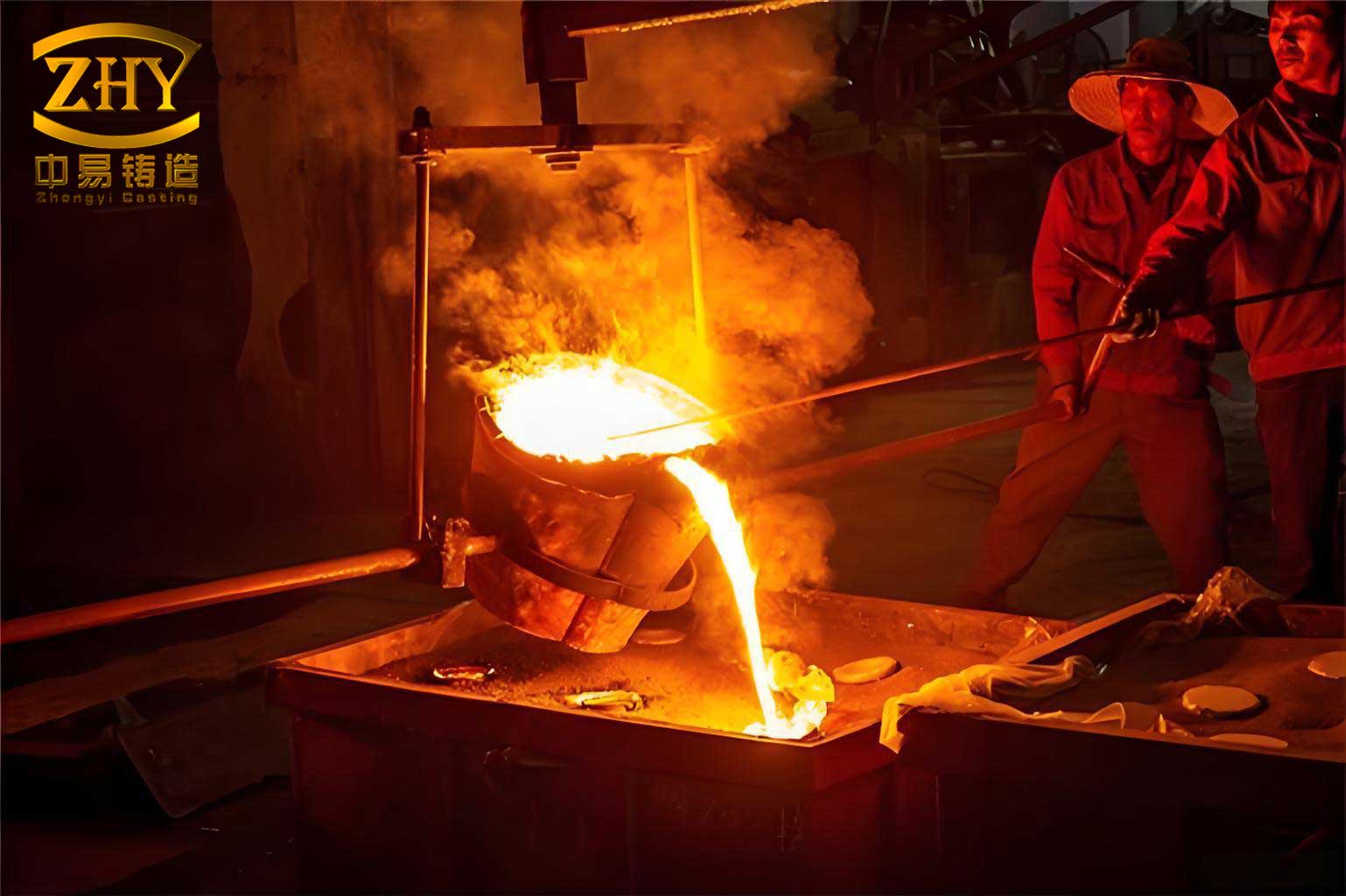
My analysis of the mold filling process for these lost foam castings revealed that the molten iron reaching the large end of the casting last had already cooled significantly, causing poor fusion and resulting in cold laps. To address this, I redesigned the gating system, adjusted the ingate positions, and employed MAGMA software to simulate the filling behavior. The revised process was validated in the foundry, and the cold lap defects disappeared. The casting quality met all customer requirements. Below, I present the complete methodology, including theoretical models, simulation results, and experimental validation, with an emphasis on the unique challenges of lost foam castings.
Original Casting Process
The original assembly process for these lost foam castings used a sprue diameter of 40 mm, a runner cross‑section of 40 mm × 25 mm, and three ingates with dimensions 50 mm × 8 mm positioned at the upper middle of the casting. A foam filter (55 mm × 55 mm × 22 mm, 10 PPI) was placed in the middle of the sprue to trap inclusions. Two overflow blocks (70 mm long) were attached to the top of the large end to collect cold front iron and slag. The mold was tilted 35° from the vertical, with the large end upward, so that the molten iron entered the bottom of the cavity and rose progressively.
The pouring temperature was set between 1490 °C and 1510 °C, vacuum negative pressure between –0.06 MPa and –0.04 MPa, and holding time after pouring was 10 minutes. Each flask (1200 mm × 1000 mm × 1300 mm) held two foam patterns, and one ladle (1 t) poured four flasks (eight castings).
During pouring, the iron entered through the sprue, passed the foam filter, flowed smoothly through the three ingates, and then traveled along the cavity walls to the bottom. As the liquid rose, it progressively lost heat. Because the wall thickness was only 8 mm, the temperature drop was severe, and when the front melt finally reached the large end, it was too cold to fuse properly. This created cold lap defects on the circular surface of the large end.
| Parameter | Original Process |
|---|---|
| Sprue diameter | 40 mm |
| Runner cross‑section | 40 mm × 25 mm |
| Number of ingates | 3 |
| Ingate cross‑section | 50 mm × 8 mm |
| Foam filter | 55 mm × 55 mm × 22 mm, 10 PPI |
| Overflow blocks | 2 × 70 mm long |
| Mold tilt angle | 35° |
| Pouring temperature | 1490–1510 °C |
| Vacuum pressure | –0.06 to –0.04 MPa |
| Holding time | 10 min |
| Flask size | 1200 mm × 1000 mm × 1300 mm |
| Castings per flask | 2 |
| Ladle capacity | 1 t |
To quantify the temperature evolution, I derived a simple heat balance for the flowing melt:
$$ \frac{dT}{dt} = -\frac{h A_s (T – T_m)}{\rho V c_p} $$
where \(h\) is the heat transfer coefficient, \(A_s\) the surface area of the molten stream, \(T_m\) the mold temperature, \(\rho\) the density of iron, \(V\) the volume of the stream, and \(c_p\) the specific heat. For these lost foam castings, the thin wall (8 mm) gives a high surface‑to‑volume ratio, accelerating cooling. The time to fill the cavity can be approximated by:
$$ t_f = \frac{V_{cavity}}{Q} $$
where \(Q\) is the volumetric flow rate. Using the ingate geometry and Bernoulli’s equation:
$$ Q = A_i \sqrt{2g H_{eff}} $$
with \(A_i\) total ingate area, \(g\) gravity, and \(H_{eff}\) effective ferrostatic head. The temperature drop from the start of filling to the arrival at the large end is:
$$ \Delta T = \int_{0}^{t_f} \frac{dT}{dt} dt \approx \frac{h A_s (T_0 – T_m)}{\rho V c_p} t_f $$
Numerical evaluation gave \(\Delta T\) on the order of 40–60 °C, sufficient to cause cold laps when the front temperature fell below the liquidus of HT250 (≈1200 °C).
MAGMA Simulation of Original Process
I used MAGMA software to simulate the filling of these lost foam castings. The simulation clearly showed that iron entered first through the ingate nearest the dividing wall, travelled to the bottom of the cavity, then rose upward. The front metal reached the large end last, with a temperature drop of approximately 50 °C compared to the incoming melt. This confirmed that the cold lap defect originated from the thermal history.
| Stage | Temperature at large end (°C) | Defect observed? |
|---|---|---|
| Start of filling | 1500 | No |
| 1/3 filled | 1480 | No |
| 2/3 filled | 1450 | No |
| Filling complete | 1410 | Cold lap |
Improved Casting Process
To ensure that hot iron continuously reaches the large end throughout filling, I redesigned the gating system. The key change was to reposition the three ingates: two lower ingates were moved forward to the flat area at the large end’s middle ring, and the upper ingate was relocated to the topmost ring of the casting. With this configuration, the large end receives fresh hot iron from the moment filling begins until the cavity is full, providing thermal compensation to the earlier‑arriving cooler metal.
In the improved assembly process for these lost foam castings, the sprue and runner remained unchanged. The foam filter and overflow blocks were kept. The tilt angle was still 35°. The new ingate positions are summarized below:
| Ingate | Original position | Improved position |
|---|---|---|
| 1 | Upper middle | Large end middle ring (flat) |
| 2 | Upper middle | Large end middle ring (flat) |
| 3 | Upper middle | Topmost ring of large end |
I modeled the filling hydrodynamics using a transient energy equation with a source term for the incoming hot iron:
$$ \frac{\partial (\rho c_p T)}{\partial t} + \nabla \cdot (\rho c_p \mathbf{u} T) = \nabla \cdot (k \nabla T) + \dot{Q}_{src} $$
where \(\mathbf{u}\) is the velocity field, \(k\) thermal conductivity, and \(\dot{Q}_{src}\) the heat added through the ingates. For the improved layout, the source term is distributed such that at least one ingate always supplies superheated iron to the large end region.
The Reynolds number at the ingate, which governs flow regime in these lost foam castings, is:
$$ Re = \frac{\rho v D_h}{\mu} $$
with \(v\) velocity, \(D_h\) hydraulic diameter (~8 mm), and \(\mu\) viscosity (~0.005 Pa·s for molten iron). Typical values gave \(Re \approx 2000\)–3000, indicating transitional flow. The improved ingate placement shortens the travel distance for the large end, reducing frictional pressure loss and maintaining higher velocity.
I also performed a thermal balance on the large end region using a lumped‑capacity model for the thin wall:
$$ \rho V_{LE} c_p \frac{dT_{LE}}{dt} = h_{in} A_{in} (T_{in} – T_{LE}) – h_{out} A_{out} (T_{LE} – T_m) $$
where subscript \(LE\) denotes the large end volume, \(h_{in}\) the convective coefficient from incoming iron, and \(A_{in}\) the area of the ingate streams impinging on the region. With continuous hot iron supply, \(T_{in} \approx T_{pouring}\), so \(dT_{LE}/dt\) remains positive, preventing the temperature from dropping below the fusion point.
MAGMA Simulation of Improved Process
The MAGMA filling simulation for the improved gating system showed that hot iron (≥1490 °C) enters the large end from the very beginning and continues to flow into that region throughout the entire filling sequence. At the final stage, the temperature at the large end was still above 1470 °C, well within the good fusion range. No cold lap or misrun indications were detected in the simulation.
| Stage | Temperature at large end (°C) | Temperature difference from pouring (°C) |
|---|---|---|
| Start of filling | 1500 | 0 |
| 1/3 filled | 1495 | –5 |
| 2/3 filled | 1490 | –10 |
| Filling complete | 1478 | –22 |
Production Validation
I put the improved process into production for these lost foam castings. The foam patterns were coated three times by dipping and dried thoroughly. During molding, dry silica sand was first manually added to cover the pattern completely, then three‑dimensional vibration was applied in two steps for a total of 90 seconds. Each flask held two patterns, and one 1‑t ladle poured four flasks (eight castings). The pouring temperature was maintained at 1490–1510 °C. Before pouring, I discarded approximately 3 kg of iron from the ladle nozzle to eliminate cold metal and reduce slag entry. Vacuum negative pressure was controlled between –0.065 MPa and –0.04 MPa, with a 10‑minute hold after pouring.
After shot blasting, the castings exhibited complete contours with no cold laps on the large end circular surface. I inspected 200 consecutive castings, and zero cold lap defects were found. The hardness measured 209 HBW (indentation diameter 4.18 mm by Brinell tester), well within the 180–230 HBW specification.
Machining trials were performed on multiple gearbox housings. All machined surfaces were clean, hole positions were uniform, and no sand holes or slag inclusions appeared. The overall quality satisfied the drawing requirements and customer expectations.
| Property | Measured value | Requirement |
|---|---|---|
| Hardness (HBW) | 209 | 180–230 |
| Cold lap defect rate | 0% (n=200) | 0% |
| Machined surface quality | No defects | No holes, no slag |
Discussion and Conclusions
The cold lap defect in lost foam castings is fundamentally a thermal issue: the last‑filled region receives iron that has cooled excessively due to the long flow path and high surface‑to‑volume ratio of thin‑walled parts. My theoretical analysis using heat balance and fluid dynamics provided clear guidance for redesigning the gating system. The MAGMA simulations confirmed that by placing ingates directly into the problem area, the temperature remains high enough throughout filling.
This work demonstrates that for complex lost foam castings, a combination of analytical modeling, numerical simulation, and targeted gating modification can systematically eliminate defects. The process is now robust and has been running without cold lap issues for several months. The production yield increased from approximately 85 % to 98 %, significantly reducing scrap costs.
Key equations used in this study are summarized below for reference:
$$ \text{Heat balance: } \frac{dT}{dt} = -\frac{h A_s (T – T_m)}{\rho V c_p} $$
$$ \text{Filling time: } t_f = \frac{V_{cavity}}{A_i \sqrt{2g H_{eff}}} $$
$$ \text{Temperature drop: } \Delta T \approx \frac{h A_s (T_0 – T_m)}{\rho V c_p} \cdot \frac{V_{cavity}}{A_i \sqrt{2g H_{eff}}} $$
$$ \text{Improved energy equation: } \frac{\partial (\rho c_p T)}{\partial t} + \nabla \cdot (\rho c_p \mathbf{u} T) = \nabla \cdot (k \nabla T) + \dot{Q}_{src} $$
$$ \text{Reynolds number: } Re = \frac{\rho v D_h}{\mu} $$
In conclusion, I have successfully resolved the cold lap defect in the tractor gearbox housing by applying a systematic approach to lost foam castings. The improved ingate placement ensures continuous hot iron supply to the critical region, validated by both simulation and production. This methodology can be extended to other thin‑walled lost foam castings prone to cold shuts.