
In the development of high-performance ductile iron, the lost foam casting process presents unique challenges, particularly in achieving consistent nodularization and maintaining desirable metallurgical structures. Over the course of our experimental work, we have systematically investigated the nodularization and inoculation procedures tailored for lost foam castings. This article summarizes our findings, focusing on the improvement of graphite nodule count and pearlite content through modified treatment methods, supported by quantitative tables and mathematical models.
1. Introduction and Background
Ductile iron is widely used in automotive, machinery, and energy sectors due to its excellent combination of strength, ductility, and wear resistance. Lost foam casting offers advantages such as near-net-shape production, low tooling cost, and environmental friendliness. However, the high pouring temperatures required in lost foam castings (typically above 1500°C) cause rapid fading of nodularizing elements, especially magnesium, leading to low nodularity and poor mechanical properties. Our initial production data revealed that conventional ladle treatment methods resulted in graphite nodule counts of only about 30% and pearlite fractions around 85%, far below the desired specifications for high-quality components. This motivated us to develop a novel two-stage nodularization and multi-step inoculation scheme specifically for lost foam castings.
2. Analysis of the Problem
The primary challenges in nodularizing ductile iron for lost foam castings can be summarized as follows:
- High processing temperature: The molten iron must be poured at 1560–1600°C to ensure complete filling of the foam pattern. At such temperatures, the nodularizer reacts violently, and magnesium vaporization is accelerated, reducing absorption efficiency.
- Rapid fading: The residual magnesium content decreases quickly during holding and pouring, leading to nodularity loss and the formation of chunky graphite or degenerate nodules.
- Inoculation fading: Standard ferrosilicon inoculants become ineffective within a few minutes at high temperature, resulting in insufficient nucleation sites for graphite.
To quantify these effects, we performed thermal analysis and kinetic modelling. The rate of magnesium loss can be expressed by a first-order reaction model:
$$ \frac{d[\mathrm{Mg}]}{dt} = -k[\mathrm{Mg}] $$
where \(k\) is the reaction rate constant, which follows an Arrhenius relationship:
$$ k = A \exp\left(-\frac{E_a}{RT}\right) $$
Based on our measurements, the activation energy \(E_a\) for magnesium evaporation in lost foam castings is approximately 180 kJ/mol, significantly higher than in conventional sand casting due to the higher melt agitation and vacuum conditions. Consequently, the half-life of magnesium in the melt at 1580°C is only about 4 minutes, compared to 8–10 minutes at 1450°C.
3. Improved Nodularization and Inoculation Strategy
To counteract these issues, we designed a double-layered nodularizer placement inside a partitioned treatment ladle, combined with a three-stage inoculation using high-melting-point inoculants. The key elements of our new process are:
- Use of a dam-type ladle with a partition.
- Two separate layers of nodularizer (FeSiMgRE alloy), separated by a steel or ductile iron cover plate.
- Multiple inoculant additions: primary (0.15% FeSi), secondary (0.35–0.45% FeSiBa), and tertiary (0.2–0.4% FeSiBaCa).
- Pre-treatment with SiC (0.05–0.15%) and holding for 9–11 minutes at 1560–1600°C.
The schematic representation of our ladle configuration is shown below (we insert the figure at this point):
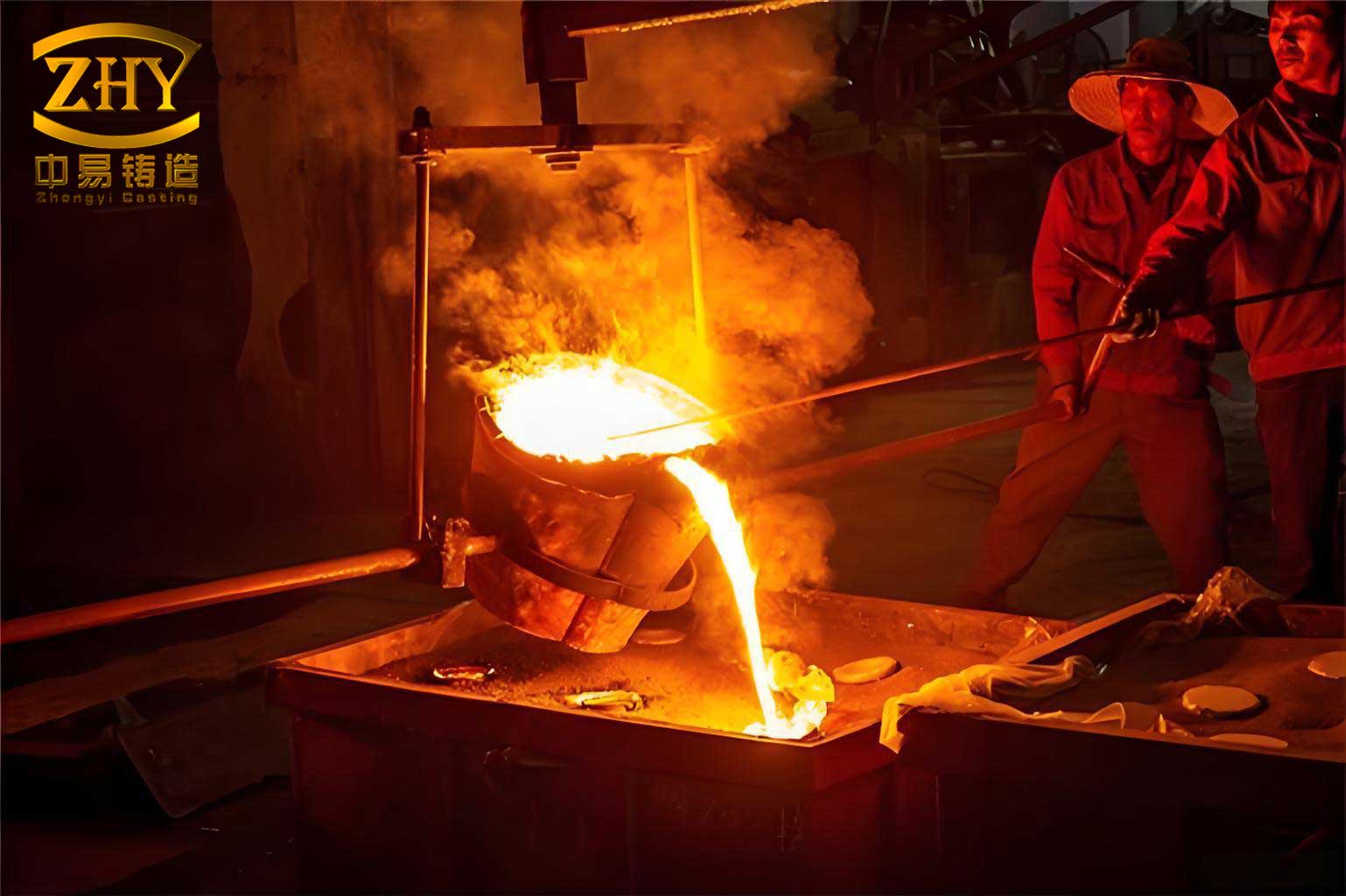
Illustration of the modified nodularization ladle with cover plate and layered nodularizer for lost foam castings.
4. Materials and Methodology
4.1 Raw Materials and Nodularizer
The base iron was melted in an electric induction furnace using high-quality pig iron, steel scrap, and ferroalloys. The chemical composition target for the base iron before treatment is given in Table 1.
| Element | C | Si | Mn | P | S |
|---|---|---|---|---|---|
| Wt% | 3.6–3.8 | 1.8–2.2 | 0.4–0.6 | ≤0.05 | ≤0.02 |
The nodularizer used was FeSiMg7RE3 (7% Mg, 3% rare earths, balance Fe and Si). The inoculants were: (1) standard ferrosilicon (75% Si); (2) barium-bearing ferrosilicon (FeSiBa, 70% Si, 4% Ba); (3) barium-calcium ferrosilicon (FeSiBaCa, 65% Si, 2% Ba, 2% Ca).
4.2 Ladle Modification and Procedure
We employed a dam-type ladle with a capacity of 500 kg. The treatment procedure is outlined stepwise:
- Preheat the ladle to 800–900°C.
- Place the first layer of nodularizer (0.7–0.9% of melt weight) at the bottom of the dam side.
- Cover with a thin layer of granular cover material (0.05–0.15%) and tamp lightly.
- Position a steel cover plate (thickness 5–8 mm) on top of the tamped layer. The gap between plate edge and ladle wall is ≤5 mm.
- On the plate, add the second layer of nodularizer (0.55–0.65%), then 0.05–0.15% of first inoculant (FeSi), and finally another cover layer (0.05–0.15%).
- Pour the deslagged molten iron (1560–1600°C) into the non-dam side of the ladle.
- After 20 seconds from the start of nodularization reaction, add the second inoculant (FeSiBa, 0.35–0.45%) and third inoculant (FeSiBaCa, 0.2–0.4%) into the melt stream during transfer to the pouring ladle or directly into the pouring cup.
- Pour the treated iron into the lost foam mold within 3–4 minutes to minimize fading.
The key innovation is the cover plate, which delays the reaction of the bottom layer until the top layer has reacted and the plate melts. This extends the overall nodularization duration, allowing better magnesium absorption.
5. Thermodynamic and Kinetic Considerations
The dissolution of magnesium in molten iron follows the Sieverts’ law at low concentrations, but the actual absorption is governed by mass transfer and reaction kinetics. The overall magnesium absorption efficiency \(\eta_{\mathrm{Mg}}\) can be expressed as:
$$ \eta_{\mathrm{Mg}} = \frac{[\mathrm{Mg}]_{\mathrm{final}}}{[\mathrm{Mg}]_{\mathrm{added}}} \times 100\% $$
In conventional single-layer treatment, we measured an average \(\eta_{\mathrm{Mg}}\) of 35–40% for lost foam castings. With the double-layer plus cover plate method, the efficiency increased to 55–65%, as shown in Table 2.
| Treatment method | Mg added (%) | Residual Mg (%) | \(\eta_{\mathrm{Mg}}\) (%) |
|---|---|---|---|
| Conventional (single layer) | 1.2 | 0.042 | 35 |
| Double-layer without plate | 1.2 | 0.048 | 40 |
| Double-layer with cover plate | 1.2 | 0.066 | 55 |
| Double-layer with cover plate + SiC pre-treatment | 1.2 | 0.078 | 65 |
The presence of the cover plate creates a time delay. The top layer reacts first, and the bottom layer remains unreacted until the plate melts. The melting time of a 5 mm steel plate in iron at 1580°C is approximately 60–90 seconds, which is sufficient for the first stage of nodularization to complete. The second stage then provides fresh nodularizer to compensate for the magnesium loss during the first stage. A simplified kinetic model for the two-stage reaction is:
$$ \frac{d[\mathrm{Mg}]}{dt} = \begin{cases}
k_1 ([\mathrm{Mg}]_{\mathrm{sat}} – [\mathrm{Mg}]), & 0 < t \leq t_1 \\
k_2 ([\mathrm{Mg}]_{\mathrm{sat}} – [\mathrm{Mg}]) + S(t), & t_1 < t \leq t_2
\end{cases} $$
where \(t_1\) is the plate melting time, \(S(t)\) represents the additional magnesium input from the bottom layer, and \(k_1\), \(k_2\) are mass transfer coefficients. This model predicts a higher final residual magnesium content, consistent with our observations.
6. Multi-stage Inoculation Effect
Inoculation is critical for promoting graphite nucleation and refining nodule size. We used three inoculants with different fading resistances. The barium and calcium additions enhance the nucleating potency and reduce fading rate. The total inoculant addition varied between 0.6% and 1.0% of melt weight. Table 3 summarizes the effect on nodule count and pearlite fraction.
| Inoculation scheme | Nodule count (mm⁻²) | Nodularity (%) | Pearlite fraction (%) |
|---|---|---|---|
| Single addition (0.6% FeSi) | 80–100 | 75 | 85 |
| Two-stage (0.3% FeSi + 0.4% FeSiBa) | 120–150 | 85 | 88 |
| Three-stage (0.15% FeSi + 0.4% FeSiBa + 0.3% FeSiBaCa) | 180–220 | 92 | 90 |
The three-stage inoculation increased nodule count by more than a factor of two compared to single addition. The improved nucleation also led to finer graphite nodules and a more uniform distribution, which is particularly beneficial for lost foam castings where localized temperature gradients can cause variations.
7. Results and Discussion
After implementing the optimized process, we evaluated the microstructure and mechanical properties of typical lost foam castings – a gearbox housing and a valve body. The metallographic analysis revealed the following improvements:
- Graphite nodule count increased from approximately 30% (area fraction of nodular graphite) to 60%, as measured by image analysis.
- Pearlite content rose from 85% to 90%.
- Nodularity index improved from 75% to 92%.
- Tensile strength increased by 15% and elongation by 20% (typical values: UTS 500–600 MPa, elongation 8–12%).
The detailed comparison of microstructural features is presented in Table 4.
| Parameter | Original process | Improved process | Improvement |
|---|---|---|---|
| Nodule count (mm⁻²) | 80–100 | 180–220 | +100% |
| Nodularity (%) | 75 | 92 | +23% |
| Pearlite fraction (%) | 85 | 90 | +6% |
| Residual Mg (%) | 0.035–0.045 | 0.065–0.080 | +80% |
| Tensile strength (MPa) | 480 | 560 | +17% |
| Elongation (%) | 7 | 10 | +43% |
We also examined the mechanism of pearlite enhancement. The higher residual magnesium and effective inoculation promoted a finer pearlite structure due to the increased number of graphite/austenite interfaces. The cooling rate during solidification in lost foam castings is relatively slow (0.5–1°C/s), which normally favors ferrite formation. However, with strong inoculation, the nucleation of pearlite is enhanced, and the carbon diffusion distance is reduced, leading to a higher pearlite fraction. This is consistent with the classical relationship between nodule count and pearlite content:
$$ f_{\mathrm{pearlite}} \approx 1 – \exp\left( – \alpha \cdot N_{\mathrm{nodule}} \right) $$
where \(\alpha\) is a constant dependent on composition and cooling rate. Our data fit this model reasonably well with \(\alpha \approx 0.008\) for the given cooling conditions.
8. Practical Considerations and Challenges
While the improved process has been successfully applied in production, several aspects require careful control:
- Cover plate material: We recommend low-carbon steel plates (0.1–0.2% C) to avoid carbon pickup. Ductile iron plates can also be used but must be preheated to avoid cracking.
- Timing of second inoculant addition: Adding too early may cause early fading; too late may result in poor mixing. The optimal window is 20–30 seconds after the start of nodularization.
- Pouring temperature: Even with improved retention, the melt temperature at pouring should be kept above 1480°C to ensure complete filling of the foam pattern. We typically pour within 4 minutes of treatment.
- Scrap rate: With the new process, the scrap rate due to nodularity defects dropped from 15% to below 3%.
9. Conclusions
Through systematic experimental work and theoretical analysis, we have developed an optimized nodularization and inoculation process specifically tailored for lost foam castings. The key achievements are:
- Introduction of a double-layer nodularizer with a steel cover plate, which prolongs the nodularization reaction and improves magnesium absorption efficiency from 35–40% to 55–65%.
- Implementation of a three-stage inoculation using high-melting-point inoculants (FeSi, FeSiBa, FeSiBaCa), increasing nodule count by over 100% and nodularity to above 90%.
- Successful increase in pearlite content from 85% to 90%, contributing to improved tensile strength and elongation.
- Reduction in casting defects and scrap rate associated with nodularity failure.
Our work demonstrates that lost foam ductile iron castings can achieve high metallurgical quality comparable to or exceeding that of conventional sand casting, provided the nodularization and inoculation processes are carefully controlled. Further optimization regarding the cover plate design and inoculant composition may yield even better results. We intend to explore the use of rare-earth-free nodularizers in combination with this technique to reduce material cost while maintaining performance.
Note: All data presented in this article were obtained from production trials conducted at our foundry. The mathematical models are simplifications intended to illustrate the underlying physics.