
In our work on high precision investment casting of K403 superalloy shell castings, we encountered significant challenges including porosity, dimensional deviations, and cold shuts. The component is a critical part of an aero-engine, featuring complex geometry with varying wall thickness, multiple thermal centers, and stringent requirements for mechanical properties and surface finish. Through systematic experimental studies on wax pattern production, shell mold fabrication, and melting-pouring parameters, we successfully established an optimized process that yields consistent high quality. This article presents our methodology and findings, emphasizing the role of high precision investment casting in achieving defect-free, dimensionally accurate parts.
The alloy K403 is a nickel-based superalloy with a composition carefully selected for high-temperature strength. The nominal chemical composition is given in Table 1. The casting is characterized by a pillar height of 129 mm, length 111 mm, diameters ranging from 14 mm to 32 mm, and a wall thickness of 6.5 mm. The presence of numerous thermal centers and sharp transitions makes this a high-difficulty precision casting. Our initial production attempts suffered from severe porosity, mold cracking, run-out, and dimensional nonconformances, prompting a comprehensive investigation into the causes and remedies.
| Element | C | Cr | Co | W | Mo | Ti | Al | Ce | Fe | Si | Mn | S | P | Ni |
|---|---|---|---|---|---|---|---|---|---|---|---|---|---|---|
| Content | 0.11–0.18 | 10.00–12.00 | 4.50–6.00 | 4.80–5.50 | 3.80–4.50 | 2.30–2.90 | 5.30–5.90 | ≤0.01 | ≤2.00 | ≤0.50 | ≤0.50 | ≤0.01 | ≤0.02 | Bal. |
1. Casting Structure and Technical Challenges
The shell casting geometry presented three major technical hurdles in the context of high precision investment casting:
- Complex structure: The intricate shape with undercuts and deep cavities made wax pattern extraction difficult, leading to distortion and dimensional instability.
- Shell cracking and run-out: During pouring, the shell mold often developed cracks due to uneven thermal expansion and insufficient strength, resulting in flash and metal leakage.
- Solidification defects: Multiple thermal centers and poor feeding caused porosity, hot tearing, and cold shuts. The large difference in section thickness (from 14 mm to 32 mm) exacerbated these issues.
These challenges demanded a systematic approach to each step of the high precision investment casting process, from wax injection to final pouring.
2. Wax Pattern Manufacturing
Wax pattern quality directly influences the dimensional accuracy and surface finish of the final casting. The key process parameters are wax temperature, mold temperature, injection pressure, and holding time. We optimized these parameters through designed experiments. Table 2 summarizes the final selected values.
| Parameter | Value |
|---|---|
| Wax temperature | 55–63 °C |
| Mold temperature | 25–35 °C |
| Injection pressure | 15–25 bar |
| Holding time | 15–20 s |
In our early trials, the wax pattern was produced in three separate pieces using independent dies and then manually assembled using a jig. This approach led to significant alignment errors. Dimensional inspection after machining revealed that the center offset between the φ14 mm cylinder and the 2-φ23 mm cylinders ranged from 1.7 to 2.2 mm, and the 41.5 mm dimension became elongated. Such deviations were unacceptable for high precision investment casting.
To eliminate the assembly-induced errors, we redesigned the casting blank and manufactured a single-piece wax die. This integrated approach not only improved dimensional consistency but also increased production efficiency. The shrinkage of the wax pattern can be described by the linear thermal contraction:
$$ \epsilon_{\text{wax}} = \alpha_{\text{wax}} \cdot \Delta T $$
where \(\alpha_{\text{wax}}\) is the coefficient of thermal expansion of the wax (approximately 0.0002 °C-1) and \(\Delta T\) is the temperature difference between injection and ambient. With proper parameter control, we achieved a uniform shrinkage behavior, minimizing the risk of distortion.
3. Shell Mold Manufacturing
The shell mold must possess sufficient green strength and high-temperature strength to withstand the thermal and mechanical stresses during pouring. For high precision investment casting, the mold also needs to provide directional solidification and efficient heat transfer at thermal centers. Table 3 lists the optimized shell building parameters.
| Layer | Slurry composition | Viscosity | Stucco | Air drying | Ammonia drying | Exhaust |
|---|---|---|---|---|---|---|
| 1 | Silica sol – zircon flour | 40–50 s | White fused alumina WAF70 | ≥12 h | – | – |
| 2 | Ethyl silicate hydrolysate – Shangdian powder | 37–42 s | Shangdian sand 36 mesh | ≥20 min | 10 min | ≥10 min |
| 3–8 | Ethyl silicate hydrolysate – Shangdian powder | 13–15 s | Shangdian sand 24 mesh | ≥20 min | 10 min | ≥10 min |
| Seal coat | Ethyl silicate hydrolysate – Shangdian powder | 13–15 s | – | ≥12 h | – | – |
A critical issue was the porosity observed at thick sections due to slow local cooling. To enhance heat extraction, we applied a selective shell thinning technique. After applying the fourth coating layer, we returned the assembly to the wax room and applied soft wax plugs at the upper and lower holes of the casting, and also wrapped a soft wax ring around each of the eight ingate openings. This effectively reduced the shell thickness in these regions, promoting faster solidification and reducing the local thermal modulus.
The solidification time of a casting can be estimated using Chvorinov’s rule:
$$ t_{\text{solid}} = C \left( \frac{V}{A} \right)^2 $$
where \(V\) is the volume, \(A\) is the cooling surface area, and \(C\) is a constant depending on mold material and metal properties. By reducing the shell thickness locally, we effectively increased the heat transfer coefficient \(h\), leading to a shorter solidification time and finer microstructure. The shell mold preheating temperature was selected between 950 °C and 1000 °C to ensure proper thermal gradient during pouring.
4. Melting and Pouring
The pouring system in high precision investment casting serves both as a gating system and as a riser for feeding shrinkage. We designed the gating to promote directional solidification from the casting toward the risers. The pouring temperature and speed were optimized based on the alloy’s liquidus temperature and the casting complexity.
The liquidus temperature \(T_{\text{liq}}\) of K403 was determined by differential scanning calorimetry as approximately 1340 °C. The pouring temperature was chosen as:
$$ T_{\text{pour}} = T_{\text{liq}} + (50\ \text{to}\ 100)\ ^{\circ}\text{C} $$
Based on our experience, we adopted a pouring temperature of 1430 °C ± 10 °C. Higher pouring temperature improves fluidity but increases shrinkage porosity risk; lower temperature promotes cold shuts. Table 4 summarizes the pouring parameters.
| Parameter | Value |
|---|---|
| Shell preheat temperature | 950–1000 °C |
| Pouring temperature | 1430 ± 10 °C |
| Pouring speed | 2–3 seconds per mold |
The pouring speed was kept as fast as possible (2–3 seconds per complete mold) to maintain a high metal head and ensure complete filling of thin sections. The relationship between fluidity and superheat can be expressed by the fluidity length \(L\):
$$ L = k \cdot (T_{\text{pour}} – T_{\text{liq}}) $$
where \(k\) is a constant dependent on mold and alloy properties. With our parameters, we achieved consistent filling of all cavities without cold shuts.
5. Results and Verification
We produced 40 castings using the optimized process. Metallurgical inspection and full dimensional measurement were performed according to the product acceptance standard. The results are summarized in Table 5.
| Indicator | Value |
|---|---|
| Total castings poured | 40 |
| Accepted castings | 35 |
| Acceptance rate | 87.5% |
| Defects eliminated | Porosity, cold shuts, dimensional deviation, shell cracking |
Compared to the initial trials where the yield was below 50%, the improvements were dramatic. The single-piece wax die eliminated the center offset issue. The selective shell thinning effectively resolved porosity at thermal centers, as confirmed by radiographic inspection. The optimized pouring temperature and speed ensured complete filling without hot tears. This demonstrates the capability of high precision investment casting to produce complex aerospace components when all parameters are finely tuned.
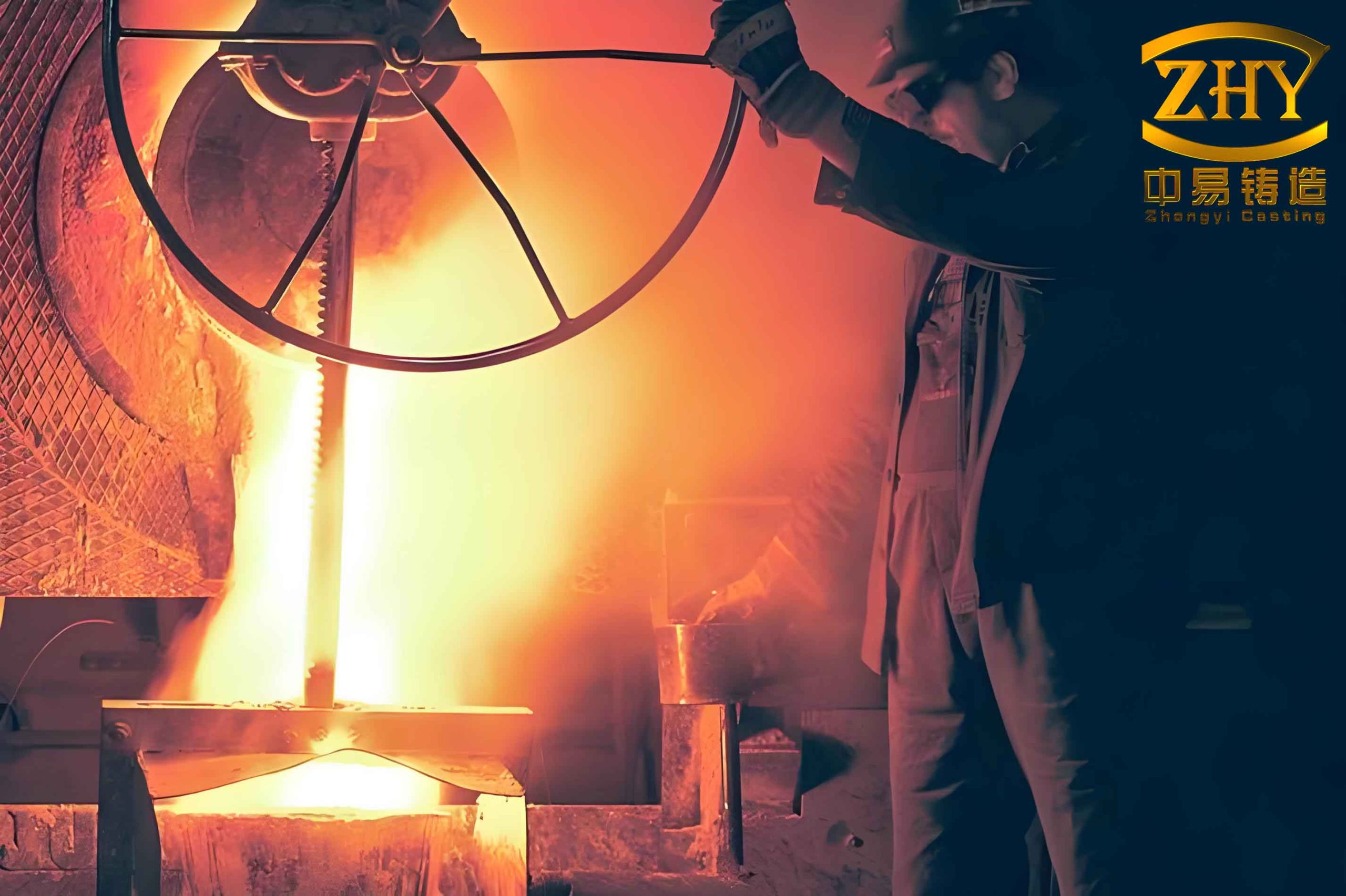
The image above illustrates a typical high precision investment casting setup, showing the integrated wax assembly and shell mold before pouring. Our approach aligns with the principles of high precision investment casting, where each process step is controlled to achieve near-net-shape components with minimal post-processing.
6. Conclusions
Through systematic investigation of high precision investment casting for K403 shell castings, we have achieved the following:
- Wax pattern optimization: Using a single-piece die with controlled injection parameters (wax temperature 55–63 °C, mold temperature 25–35 °C, injection pressure 15–25 bar, holding time 15–20 s) eliminates assembly errors and ensures dimensional stability.
- Shell mold design: Selective shell thinning after the fourth coating layer, combined with proper slurry composition and drying cycles, enhances heat extraction at thermal centers and reduces porosity. The shell preheat temperature of 950–1000 °C balances fluidity and solidification gradient.
- Pouring process: A pouring temperature of 1430 ± 10 °C and a fast fill time of 2–3 seconds per mold eliminate cold shuts and ensure complete filling.
- Results: The optimized high precision investment casting process yields an acceptance rate of 87.5% (35/40), with no porosity, cold shuts, dimensional deviations, or shell cracking. This demonstrates the robustness of the proposed methodology for complex superalloy castings.
Our work provides a reference for the development and optimization of high precision investment casting processes for similar thin-walled, complex-shaped components in the aerospace industry. Continuing advances in high precision investment casting will further enable the production of lightweight, high-performance parts with stringent quality requirements.