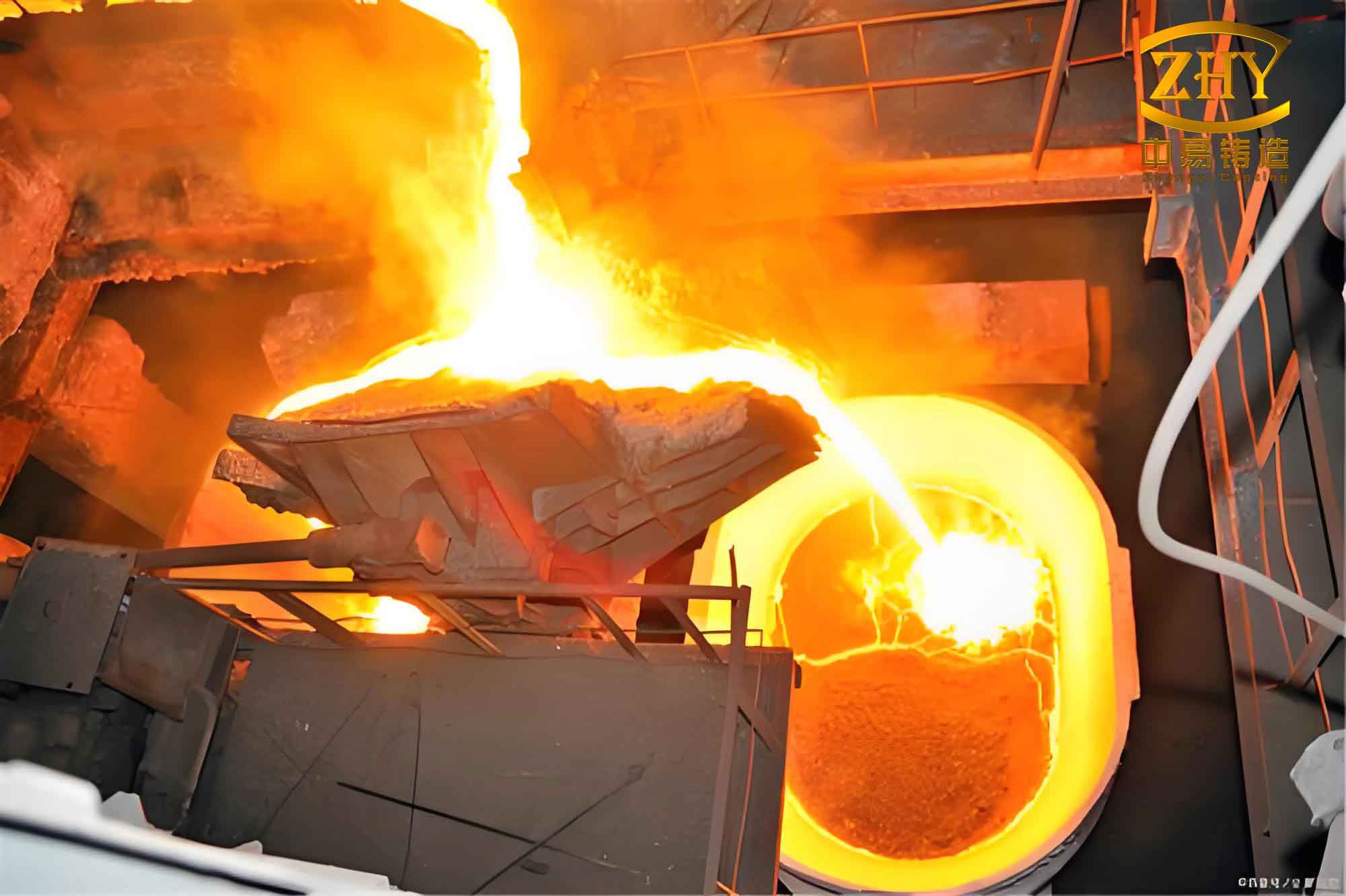
In the realm of advanced manufacturing, high precision investment casting stands as a cornerstone technology for producing complex superalloy components, particularly for aerospace engines and industrial gas turbines. The ceramic shell, as the critical mold material, must meet stringent requirements: sufficient green strength to withstand wax removal and sintering, adequate high-temperature strength and dimensional stability to resist thermal stresses during solidification, low chemical reactivity with the molten alloy, high thermal conductivity to facilitate cooling, and suitable porosity for easy removal after casting. Over the past decades, significant efforts have been devoted to optimizing the composition and structure of ceramic shells to satisfy the ever-increasing demands of high precision investment casting. This review summarizes our recent investigations and the current state of knowledge on ceramic shell materials, their preparation, and the interfacial interactions with superalloys.
Refractory Materials for Ceramic Shells
Refractory materials constitute the matrix of the ceramic shell, accounting for over 90% of its total mass. For directional solidification of superalloys, alumina (Al₂O₃) is widely employed due to its high thermal conductivity, thermal expansion coefficient close to that of superalloys, and excellent chemical stability. However, the performance of alumina can be further enhanced by adding kyanite, which promotes mullitization during sintering. This process improves mechanical strength and creep resistance while reducing sintering shrinkage and increasing apparent porosity. Table 1 summarizes the physical properties of common refractory materials.
| Material | Melting Point (°C) | Density (g/cm³) | Linear Expansion Coefficient (×10⁻⁶/°C) |
|---|---|---|---|
| Alumina (Al₂O₃) | 2045 | 3.95–4.02 | 8.4 (20–1250 °C) |
| Silica (SiO₂) | 1723 | 2.7 | 13.7 (1000 °C) |
| Mullite (3Al₂O₃·2SiO₂) | 1810 | 3.08–3.15 | 5.3 (20–1250 °C) |
| Zircon (ZrSiO₄) | 2400 | 4.3 | 5.1 (20–1540 °C) |
Other refractory materials such as silica, mullite, and zircon are also utilized. Nevertheless, studies have shown that during high precision investment casting, ceramic shells can react with certain alloying elements (e.g., Cr, Hf, Co, Ta), leading to chemical sand adhesion on the casting surface, which degrades surface finish and dimensional accuracy, and increases post-processing costs.
Binders and Their Influence
The binder is a crucial component that directly affects the properties of the ceramic shell. Colloidal silica is the most widely used binder due to its non-toxic nature, ability to form a silica gel network during drying, and enhancement of green strength. The particle size of the colloidal silica significantly influences the shell’s performance: smaller particles reduce the viscosity of the slurry, leading to lower fired bending strength but higher permeability and collapsibility. In contrast, polymer-modified silica binders improve green strength and reduce residual stress but may increase surface roughness of the final casting. To avoid unwanted reactions between SiO₂ and reactive elements in superalloys, non-silica binders (e.g., Al₂O₃, ZrO₂, Y₂O₃ sols) have been explored for high precision investment casting of superalloys with high Al, Hf, or Y contents.
Fiber Reinforcement in Ceramic Shells
Fiber modification is an innovative approach to enhance shell performance while reducing thickness. Traditional shells require increased thickness to ensure strength, which impairs heat dissipation during directional solidification and reduces the temperature gradient, thereby lowering the yield of single-crystal castings. By incorporating fibers, one can achieve high mechanical strength with thinner shells, improving thermal conductivity and solidification conditions. Table 2 summarizes the effects of various fibers.
| Fiber Type | Content | Advantages |
|---|---|---|
| Nylon fiber | 20 g/L | Enhanced permeability and mechanical strength; reduced shell-making time |
| ZrO₂ fiber | 1.0–6.0 wt% | High mechanical strength; good permeability; low cost |
| Aluminosilicate + polypropylene fibers | 0.2–1.0 wt% | Increased bending strength; reduced self-load deformation |
| Carbon + nylon fibers | 1–5 g/L | Improved bending strength and thermal conductivity |
Despite these benefits, challenges remain in controlling fiber orientation, as pores left after fiber burnout can act as crack initiation sites when oriented parallel to the fracture plane.
Preparation Process of Ceramic Shells
The typical high precision investment casting process involves wax pattern assembly, slurry coating, stuccoing, dewaxing, sintering, and finally pouring the superalloy melt. Each step influences the shell’s final quality. The choice of refractory powder, powder-to-liquid ratio, additives, and sintering parameters must be carefully optimized. For instance, increasing the solids loading in the slurry reduces shrinkage but may increase viscosity. Additives like calcium aluminate or magnesium oxide can modify sintering behavior and reactivity. Our work has shown that controlling the shell’s porosity and surface finish is critical to minimize metal penetration and interfacial reactions.
Interfacial Reactions Between Ceramic Shells and Superalloys
During casting, the molten superalloy contacts the ceramic shell for extended periods, especially for large single-crystal blades with high melting points and long solidification times. This leads to chemical interactions that form oxide layers or reaction products on the casting surface, known as chemical sand adhesion. The interfacial reaction mechanism can be classified into several types:
Decomposition of the oxide:
$$ M_xO_y = xM_{(dissolved)} + yO_{(dissolved)} $$
Thermal decomposition generating gas and dissolved oxygen:
$$ M_xO_y = xM_{(g)} + yO_{(dissolved)} $$
Displacement reactions between the oxide and active alloy elements:
$$ M_xO_y + zM_A_{(dissolved)} = M_{Az}O_y + xM_{(dissolved)} $$
Here, \(M_xO_y\) represents the ceramic oxide (e.g., SiO₂, Al₂O₃), and \(M_A\) is an active element in the alloy (e.g., Al, Cr, Hf, Y). For example, SiO₂ from the binder can be reduced by Al or Hf, forming Al₂O₃ or HfO₂ at the interface. Such reactions not only contaminate the casting surface but also locally alter the alloy composition, affecting mechanical properties.
Influence of Ceramic Materials on Interfacial Reactions
Different ceramic oxides exhibit varying reactivity with superalloy melts. For instance, when using zircon-based shells for DD6 single-crystal alloy, a “reaction pit” model was proposed: at high temperatures, zircon decomposes into liquid SiO₂ and ZrO₂, and the liquid SiO₂ reacts readily with Al in the alloy, leading to localized severe attack. In contrast, alumina shells show relatively lower reactivity, but their performance can be improved by adding kyanite. Table 3 compares the interfacial reaction behavior for several ceramics.
| Ceramic | Main Reaction Product | Reaction Layer Thickness (μm) | Notes |
|---|---|---|---|
| Al₂O₃ | HfO₂, Y₃Al₅O₁₂ | 20–50 | Reactivity depends on Hf, Y content |
| SiO₂ (from binder) | Al₂O₃, Cr₂O₃ | 10–30 | Strong interaction with Al, Cr, Hf |
| ZrSiO₄ | SiO₂ (liquid), ZrO₂, HfO₂ | 30–60 | Liquid SiO₂ accelerates attack |
| Y₂O₃ | Y₂O₃ (stable layer) | <5 | Minimal reaction; high chemical stability |
These results highlight that for high precision investment casting of superalloys containing reactive elements, the selection of face coat material is crucial. Y₂O₃ appears to be the most inert, but its high cost and limited availability restrict widespread use.
Effect of Alloying Elements
The composition of the superalloy plays a dominant role in determining the extent of interfacial reactions. Below we discuss the most influential elements.
Chromium (Cr)
Cr is a common alloying element in Ni-based superalloys, known for forming a protective Cr₂O₃ scale. However, at casting temperatures above 1500 °C, Cr can react vigorously with silica-based ceramics, producing Cr₂O₃ and leading to a rough, damaged surface. In alumina-based shells, Cr shows lower reactivity but can still participate in reactions if the ceramic contains SiO₂ impurities.
Hafnium (Hf)
Hf is added to superalloys to improve castability and creep strength. Its high oxygen affinity makes it a major contributor to interfacial reactions. Studies by our group and others have shown that as the Hf content increases, the reaction layer thickens and becomes more complex. For example, in an alloy with 0.08% C and 1.17% Hf, a continuous HfO₂ layer forms at the interface. With higher Hf (1.6%) and C (0.12%), a dual layer appears: an inner HfO₂ layer and an outer layer containing Al₂O₃, Cr₂O₃, and mullite. The presence of C also influences the reaction because carbides can decompose and affect local oxygen activity.
Yttrium (Y)
Y is a potent oxygen getter and is used to enhance oxidation resistance and refine microstructure. However, its extreme reactivity causes it to readily displace Al from Al₂O₃, forming yttrium aluminates. The reaction products vary with Y concentration: at 0.017 wt% Y, Y₃Al₂(AlO₄)₃ forms; at 0.1 wt% Y, Y₃Al₅O₁₂ is the main product; and at 0.5 wt% Y, Y₄Al₂O₉ and residual Y₂O₃ are observed. This progression reflects the changing ratios of Y₂O₃ to Al₂O₃ as reactions proceed.
Rhenium (Re)
Re is a refractory element that strongly segregates to the γ/γ’ interface, strengthening the alloy. Unlike Hf and Y, Re is chemically stable and does not directly react with ceramics. However, it influences wettability: increasing Re content raises the contact angle between the melt and the alumina substrate, thereby reducing the driving force for capillary penetration and the extent of interfacial reaction. In our experiments, with 3 wt% Re, a double reaction layer (Al₂O₃ + HfO₂) formed but decreased in thickness; with 6 wt% Re, only a thin Al₂O₃ layer was detected, indicating minimal reaction.
Table 4 summarizes the influence of different alloying elements on the interfacial reaction.
| Element | Reactivity | Typical Products | Impact on Wettability |
|---|---|---|---|
| Cr | Moderate | Cr₂O₃ | Increases wettability with SiO₂-based ceramics |
| Hf | High | HfO₂ | Improves wetting; reduces contact angle |
| Y | Very high | Y₃Al₅O₁₂, Y₄Al₂O₉ | Strongly improves wetting via reaction |
| Re | Low | No direct product | Increases contact angle; suppresses reaction |
Wetting Phenomena at the Interface
Wetting governs the initial contact between the molten alloy and the ceramic shell, thereby influencing the subsequent interfacial reaction. Non-reactive wetting is driven by van der Waals forces and occurs rapidly (<10⁻³ s), but reactive wetting, driven by chemical interactions, takes longer (10⁻¹ to 10⁴ s) and typically results in better wetting. For high precision investment casting, ideal wetting is a balance: sufficient to ensure complete mold filling, yet not so strong that the melt penetrates into the ceramic pores and reacts excessively.
The contact angle θ is a key parameter. Table 5 shows how alloy composition affects the contact angle on alumina substrates.
| Alloy Composition | Contact Angle θ (degrees) | Reaction Layer Thickness (μm) |
|---|---|---|
| Ni base (no Hf, Y) | 110 | <5 |
| + 1% Hf | 85 | 20 |
| + 0.1% Y | 70 | 40 |
| + 3% Re | 100 | 15 |
| + 6% Re | 115 | <5 |
The correlation between wetting and reaction is evident: improving wettability (lower θ) often promotes interfacial reactions because the intimate contact allows faster elemental diffusion. Conversely, elements like Re that increase θ tend to suppress reaction. Understanding this interplay is essential for designing both the shell material and the alloy composition to minimize defects in high precision investment casting.
Future Directions
Looking ahead, several challenges remain in high precision investment casting technology. First, the development of more advanced refractory composites—such as Al₂O₃-Y₂O₃, Al₂O₃-ZrO₂, or multilayered shells—could offer improved chemical inertness and mechanical properties. Second, additive manufacturing (3D printing) of ceramic shells holds promise for reducing tooling costs and production lead time, while enabling geometrically complex shell designs that improve thermal management. Third, a deeper mechanistic understanding of the interfacial reactions—especially the role of trace elements and the dynamics of multiphase reaction layers—is needed. Quantitative models linking wetting, reaction kinetics, and thermodynamics would be invaluable for predicting shell performance. Finally, in situ observation techniques (e.g., high-temperature X‑ray diffraction, synchrotron imaging) should be employed to directly monitor reactions during casting. Addressing these issues will push the boundaries of high precision investment casting toward higher yields and superior component quality.
Conclusion
We have reviewed the state of the art in ceramic shell materials for high precision investment casting of superalloys, covering refractory selection, binders, fiber reinforcement, and preparation processes. The interfacial reactions between ceramic shells and superalloys are complex, involving decomposition, displacement, and dissolution mechanisms, strongly influenced by the ceramic composition and alloying elements such as Cr, Hf, Y, and Re. Wettability is intimately linked to reaction extent: active elements that reduce contact angle often accelerate attack, while elements that increase contact angle (e.g., Re) mitigate it. Future progress in this field will hinge on developing tailored ceramic composites and adopting advanced manufacturing technologies, coupled with fundamental studies that bridge wetting, reaction, and scale-up. Our ongoing work aims to provide practical solutions for the next generation of high precision investment casting processes.