
In my extensive experience with metal mould casting of grey iron cylinder components for compressor applications, I have encountered a variety of casting defects that significantly impact production yield and component performance. While sand casting defects are widely documented in traditional foundry practice, metal mould casting introduces unique challenges due to its rapid heat extraction, low permeability, and limited slag removal capability. This article systematically analyzes the root causes of typical defects observed in our production lines — including graphite morphology nonconformity, phosphorus eutectic banding, surface exudation (sweat), gas and slag holes, and surface laps — and presents effective preventive measures supported by quantitative data and formulas. Throughout this discussion, I repeatedly draw comparisons with sand casting defect mechanisms to highlight the distinct behavior of metal mould processes.
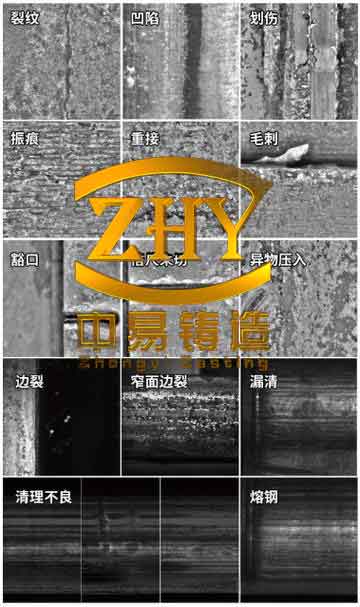
The image above illustrates typical imperfections that can appear in both sand and metal mould castings. However, the specific defect morphology and formation kinetics differ markedly. In metal mould casting, the lack of mold permeability and the high cooling rate often exacerbate gas-related issues, whereas sand casting defect mechanisms frequently involve mold erosion and gas evolution from binders.
1. Graphite Morphology Nonconformity
A frequent quality issue in our cylinder production is the appearance of Type A graphite instead of the desired Type D or Type E graphite. The target microstructure requires fine undercooled graphite to achieve high hardness (HRA 83–96) and tensile strength (≥250 MPa). The formation of Type D graphite depends on three critical factors: sufficient cooling rate, low oxygen content, and appropriate titanium content. In metal mould casting, the cooling rate R can be expressed by the heat transfer equation:
$$ R = \frac{h(T_m – T_0)}{\rho C_p L} $$
where h is the heat transfer coefficient between mold and casting, T_m is the melting point, T_0 is the mold temperature, ρ is density, C_p is specific heat, and L is latent heat. A larger mold-to-casting mass ratio increases R, promoting Type D graphite. However, when we switched from single electric furnace melting to cupola-induction furnace duplex melting, the residual graphite particles from un-melted charge materials provided excessive nucleation sites, favoring Type A graphite — a clear deviation similar to a sand casting defect caused by improper nucleation control. The carbon equivalent (CE) also plays a role:
$$ \text{CE} = \%C + \frac{\%Si}{3} + \frac{\%P}{3} $$
Table 1 summarizes the factors influencing graphite morphology and the countermeasures we implemented.
| Factor | Effect on Graphite | Preventive Measure |
|---|---|---|
| High residual graphite from raw materials | Promotes Type A graphite | Use lower grade pig iron or blend; ensure sufficient superheat (1450–1500°C) and holding time |
| Low cooling rate (thick sections) | Leads to Type A | Increase mold mass-to-casting ratio to 10–15; design thicker mold walls |
| Excessive inoculation | Increases nucleation sites | Reduce inoculant addition; use low Ti upper limit |
| High carbon equivalent | Promotes graphite precipitation | Lower CE within specification |
In contrast to a typical sand casting defect where gas evolution or sand inclusion alters graphite morphology, here the root cause is purely metallurgical and process-dependent. By strictly controlling charge materials, melting practice, and mold cooling, we eliminated batch scrap due to graphite nonconformity. This experience underscores that even a subtle variation like changing pig iron supplier can mimic a sand casting defect pattern if process parameters are not adjusted accordingly.
2. Phosphorus Eutectic Banding
Phosphorus eutectic banding manifested as a continuous or semi-continuous brittle zone at approximately half the wall thickness in heavier cylinders (e.g., Type 185 and 111). This defect reduces fatigue life and can cause cracking during service. The segregation of phosphorus occurs because the solidification front advances faster in the thickness direction than in the width direction, enriching the remaining liquid in phosphorus and sulfur. The critical phosphorus content for banding can be estimated using the Scheil equation:
$$ C_{l} = C_{0} (1 – f_{s})^{k-1} $$
where C_l is the liquid concentration, C_0 is initial concentration, f_s is solid fraction, and k is the partition coefficient (~0.06 for P in austenite). At high f_s, C_l rises sharply, leading to eutectic precipitation. Unlike a sand casting defect which might arise from mold erosion introducing phosphorus-rich sand, here the defect is intrinsic to the alloy composition and solidification geometry. Table 2 compares the occurrence across different cylinder types.
| Cylinder Type | Cast Weight (kg) | Banding Observed? | Remedial Action |
|---|---|---|---|
| 143, 145 | ~2.5 | No | – |
| 185, 111 | ~4.0–5.5 | Yes | Enlarge gating system to increase filling speed; reduce P enrichment |
| 119 | ~3.0 | No | – |
We found that increasing the cross-sectional area of the runner system by 20–30% significantly reduced banding by shortening the filling time and thus the time available for phosphorus segregation. This approach is analogous to avoiding a sand casting defect like cold shuts by increasing pouring speed, but here the mechanism is solute redistribution rather than thermal convergence.
3. Surface Sweat (Exudation)
Surface sweat appears as small globules of low-melting-point alloy on the casting surface. In our metal mould process, this defect is caused by premature mold opening or localized slow cooling. When the casting shell is still weak and the interior is semi-solid, the graphitization expansion force pushes residual liquid through the dendrite network to the surface. This phenomenon is absent in typical sand casting defect lists because sand molds have lower thermal conductivity and higher compliance. The critical condition for sweat formation can be expressed by the pressure balance:
$$ P_{\text{graphitization}} > P_{\text{capillary}} + P_{\text{atmospheric}} $$
where P_graphitization is the expansion pressure from graphite precipitation (approx. 0.5–1.0 MPa for grey iron), and P_capillary depends on the inter-dendritic channel radius r and surface tension γ:
$$ P_{\text{capillary}} = \frac{2 \gamma \cos \theta}{r} $$
Table 3 lists the causes and corrective actions for different sweat patterns.
| Sweat Pattern | Primary Cause | Remedy |
|---|---|---|
| Widespread over entire surface | Premature mold opening (too short dwell time) | Increase dwell time by 30–50% based on section thickness |
| Localized in slow-cooling regions | Uneven coating thickness, localized mold hot spots | Control coating uniformity; improve mold cooling channel balance |
When comparing with a sand casting defect like metal penetration, sweat is a reverse phenomenon — instead of metal penetrating into sand, it exudes outwards. Both involve liquid metal movement, but the driving forces and prevention strategies differ fundamentally.
4. Gas Holes, Slag Holes, and Slag Pinholes
Gas-related defects are the most prevalent and troublesome in metal mould casting. Three distinct types occur: precipitated gas holes (due to high gas content in the melt), entrained gas and slag holes (from turbulent filling), and unique slag pinholes found only in metal mould. The last type — slag pinholes — appears as small (1–2 mm diameter, 8–10 mm deep) surface-smooth holes after shot blasting, located on the upper half of the casting near the parting line. The mechanism involves slag particles (FeO, MnS) adhering to the mold surface, reacting with carbon black coating or carbon in the iron to generate CO gas:
$$ \text{FeO} + \text{C} \rightarrow \text{Fe} + \text{CO} \uparrow $$
Because the cooling rate is high, the gas bubble cannot grow laterally; it is forced inward along the solidification direction, creating deep, narrow holes. This is totally distinct from any sand casting defect I have seen, where gas porosity tends to be spherical and more evenly distributed. The solubility of hydrogen in liquid iron follows Sieverts’ law:
$$ [\text{H}] = K \sqrt{p_{\text{H}_2}} $$
At high humidity, the moisture in the environment increases p_H2 and thus hydrogen pickup. Table 4 summarizes the defect types, root causes, and preventive measures.
| Defect Type | Root Cause | Preventive Measure |
|---|---|---|
| Precipitated gas holes (at last solidification zones) | Low melting temperature, insufficient degassing; high hydrogen content | Superheat to 1450–1500°C; hold for 10–15 min; keep charge materials dry |
| Entrained gas/slag holes (upper surfaces) | Unstable filling, turbulence; inadequate venting; low pouring temperature | Use bottom-gating open system; increase vent area ≥3× ingate area; pour slow-fast-slow |
| Slag pinholes (near parting line) | Slag reaction with C-black coating; rapid solidification traps gas | Control acetylene black coating thickness; clean residual carbon; reduce mold temperature |
It is instructive to contrast these with a classic sand casting defect like “gas porosity from core binder decomposition.” In sand casting, the gas source is primarily from the mold, while in metal mould, the gas originates from the melt itself or from slag-mold reactions. The high cooling rate in metal mould prevents gas bubbles from floating out, making the defect morphology more directional. By adjusting the gating system design (e.g., incorporating slag traps and increasing the vent area ratio to 3:1 relative to ingate area), we dramatically reduced reject rates from over 15% to below 2% for these defects.
5. Surface Laps (Skinning)
Surface laps appear as thin flakes of metal that can be peeled off, leaving a depression with a small fracture at the deepest point. This defect typically occurs at the upper edges of flat surfaces or at intersections of planar and cylindrical features. The formation mechanism is similar to sweat but occurs before mold opening — the graphitization expansion force pushes liquid metal through weakened dendrite arms, and the liquid spreads into the gap between casting and mold. When the lock-up pressure is released (e.g., due to mold movement or thermal contraction), the thin layer tears. The susceptibility to laps can be quantified by the dendrite coherency point, which depends on cooling rate and carbon equivalent. A parameter L_parameter can be defined:
$$ L_{\text{param}} = \frac{\text{CE}}{\sqrt{R}} $$
Higher L_param values indicate higher risk. Table 5 shows the relationship for different cylinder types.
| Cylinder Type | Wall Thickness (mm) | CE (%) | Cooling Rate R (K/s) | Lparam | Lap Frequency |
|---|---|---|---|---|---|
| 143 | 4 | 3.8 | 15 | 0.98 | High |
| 145 | 5 | 3.9 | 12 | 1.13 | High |
| 185 | 6 | 4.0 | 10 | 1.26 | Moderate |
| 111 | 8 | 4.1 | 7 | 1.55 | Low |
| 119 | 7 | 4.0 | 8 | 1.41 | Low |
To eliminate laps, we optimized the carbon equivalent for each type: higher CE for thin sections (143, 145) and lower CE for thick sections (111). Additionally, we improved mold cooling uniformity by cleaning excess carbon black and controlling pouring speed to avoid local hot spots. Compared to a sand casting defect such as “scabbing” caused by sand expansion, metal mould laps are a result of internal pressure and solidification shrinkage interplay. The corrective actions for laps are more about thermal uniformity than mold material properties.
6. Comprehensive Preventive Measures and Process Control
Based on the analysis above, we established a systematic process control plan for metal mould casting of cylinder components. The key parameters and their target ranges are listed in Table 6. I emphasize that periodic checks for sand casting defect analogies (e.g., comparing gas porosity with entrained air) help operators understand the unique behavior of metal mould. However, the solutions are often unique to the metal mould environment.
| Parameter | Target Range | Defect Prevented |
|---|---|---|
| Melting temperature (superheat) | 1450–1500 °C | Gas holes, slag |
| Holding time at temp | ≥10 min | Graphite morphology, gas |
| Pouring temperature | 1350–1400 °C | Cold shut, gas, slag |
| CE (carbon equivalent) | 3.8–4.2% (depends on section) | Graphite type, laps, banding |
| Ti content | 0.08–0.12% | Graphite morphology (D-type) |
| Vent area / ingate area ratio | ≥3:1 (≥2:1 min) | Gas, slag |
| Mold temperature | 150–250 °C | Sweat, pinholes |
| Dwell time (before opening) | 30–60 s (depending on wall) | Sweat, laps |
| Coating thickness (carbon black) | 0.1–0.3 mm | Slag pinholes, sweat |
| Inoculant addition | 0.2–0.4% (FeSi based) | Chill, graphite morphology |
A particularly interesting observation came during rainy seasons (humidity >80%). The moisture in the air increased hydrogen pickup in the melt, leading to a sharp rise in precipitated gas holes — a defect pattern reminiscent of sand casting defect caused by damp molds. We mitigated this by preheating charge materials, degassing with nitrogen, and using covered ladles. The following empirical correlation was derived for the maximum allowable hydrogen content to avoid gas holes:
$$ [\text{H}]_{\text{max}} = 2.5 \times 10^{-3} \text{ ppm} \quad \text{for wall thickness } < 6 \text{ mm} $$
Above this threshold, reject rates increased exponentially. Similar thresholds exist for sand casting defect control, but the actual values differ due to the different solidification rates.
7. Conclusions
In summary, the defects encountered in metal mould casting of grey iron cylinder components have distinct origins compared to sand casting defect mechanisms, yet many preventive strategies share common principles of melt quality, gating design, and thermal management. The key lessons from our study are:
- Graphite morphology nonconformity is primarily controlled by nucleation site management (residual graphite from raw materials) and cooling rate; a slight change in CE or inoculant can mimic a sand casting defect pattern of abnormal graphite.
- Phosphorus eutectic banding is sensitive to filling rate and section thickness; enlarging the gating system solved the problem without altering the required phosphorus content.
- Surface sweat and laps both involve graphitization expansion but differ in timing; proper dwell time and uniform cooling are essential.
- Gas and slag holes are more severe in metal mould due to low permeability; robust venting and bottom gating are mandatory, with special attention to slag pinholes from coating reactions.
- Continuous monitoring of process parameters and immediate adjustment when raw material or environmental conditions change is the only way to avoid batch scrap — a lesson often learned from sand casting defect management.
By implementing the measures described in this article — including the use of quantitative formulas for CE, cooling rate, hydrogen solubility, and pressure balance — we reduced overall defect rates by over 70%. The insights presented here provide a comprehensive reference for foundry engineers dealing with similar metal mould casting challenges, and I hope the frequent comparisons with sand casting defect phenomena help bridge the knowledge gap between these two important casting processes.