
In my work at a medium-sized automotive casting facility, I have been responsible for improving the quality of gray iron cylinder blocks produced by the sand-coated iron mold process. This process involves coating a permanent iron mold with a thin layer (4–10 mm) of resin-coated sand to form the cavity. While the iron mold provides rapid cooling and fine grain structure, its lack of permeability makes gas evacuation challenging. During initial production of a four-cylinder block (HT250, dimensions 420 mm × 268 mm × 255 mm, wall thickness 6–11.5 mm), I encountered a severe sand casting defect—porosity—that caused scrap rates as high as 11.31%. This article details my systematic investigation and the countermeasures I implemented to reduce this sand casting defect to only 0.45%.
Process Overview and Defect Identification
The casting process employed a vertical parting line, two cavities per mold. Venting was provided by ejector pins at the cope and by drilling φ6 mm holes at core prints for the water jacket and tappet chamber cores. Despite these provisions, the dominant sand casting defect was porosity, accounting for over 75% of total scrap. Table 1 summarizes the distribution of all defects during the early production phase.
| Defect type | Percentage of total production (%) |
|---|---|
| Porosity | 11.31 |
| Sand inclusion | 2.20 |
| Incomplete fill | 0.72 |
| Core shift | 0.69 |
| Others | 0.10 |
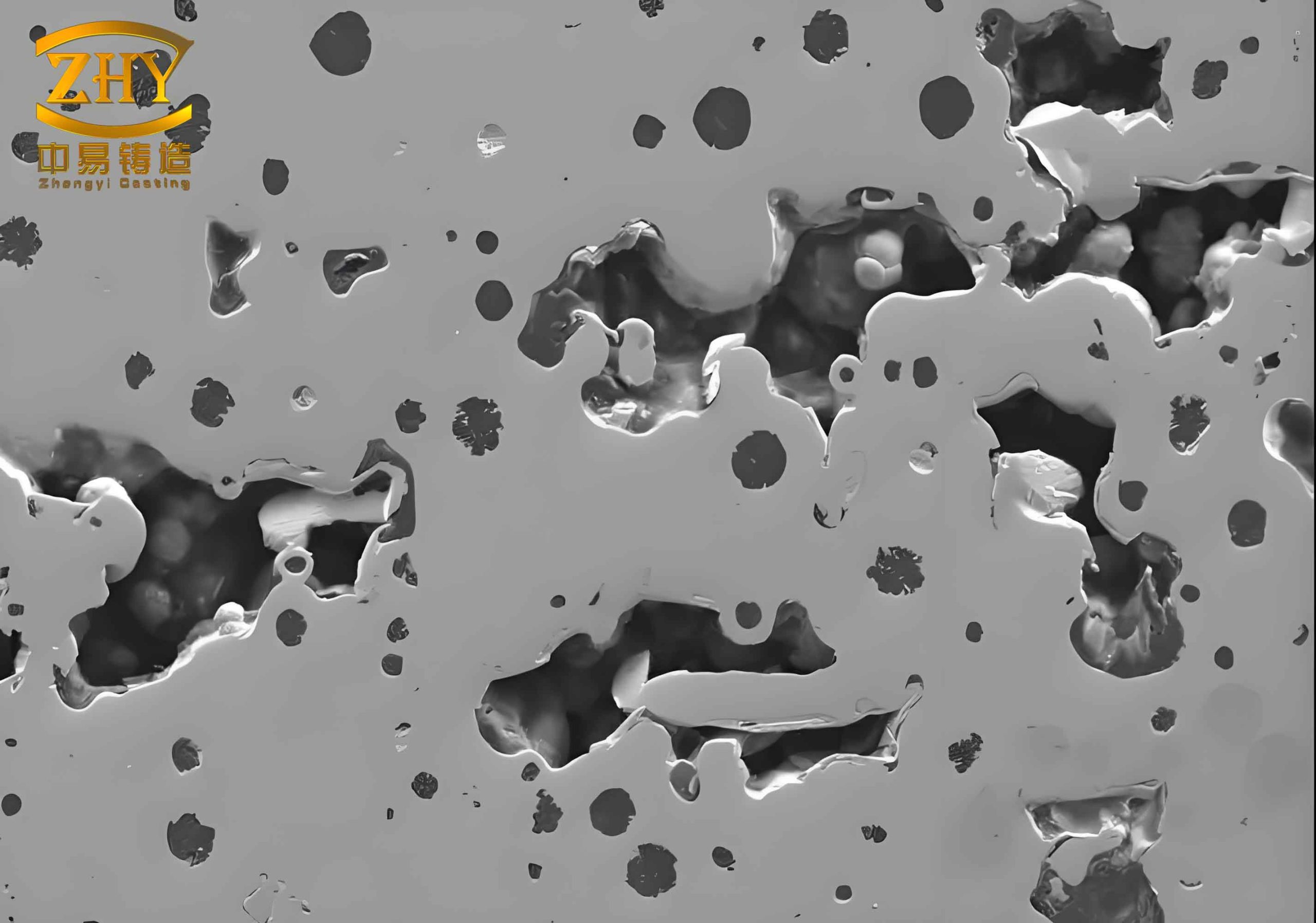
The porosity appeared as round or slightly elongated holes (φ2–6 mm) located on the tappet chamber surface, near the highest points of the mounting feet, and on the cope-side bosses. Based on the morphology and location, I classified this sand casting defect as an invasive gas pore. The mechanism is well known: during filling, resin in the sand layer and cores decomposes under high temperature, generating gas. When the gas pressure exceeds the opposing pressure from the liquid metal (ferrostatic head + atmospheric pressure + capillary resistance), bubbles form and become trapped, leading to porosity.
The governing condition for invasive gas porosity can be expressed by:
$$P_g > P_{\text{atm}} + \rho g h_{\text{metal}} + \frac{2\sigma}{r}$$
where \(P_g\) is the local gas pressure, \(\rho\) is the liquid iron density, \(h_{\text{metal}}\) is the height of the metal column above the bubble, \(\sigma\) is the surface tension, and \(r\) is the bubble radius. To eliminate this sand casting defect, I targeted three root causes: insufficient iron mold temperature, high resin content in cores, and slow pouring speed.
Root Cause Analysis and Improvements
1. Iron Mold Temperature Control
The resin-coated sand requires the iron mold to be at 210 ± 15 °C to achieve complete curing (from greenish-yellow to dark brown). In the initial layout, the iron mold traversed a closed loop: after casting, it passed through a cooling station, a cleaning station, then returned to the shooting station. I measured the temperature at various points along the cycle and found that before shooting it had dropped to about 180 °C, well below the requirement. Table 2 shows the temperature measurements from one full cycle.
| Station | Temperature (°C) |
|---|---|
| After pouring (immediately) | 240 |
| After 20 min cooling | 200 |
| Before opening | 195 |
| At ejection | 190 |
| At cleaning | 185 |
| At waiting/transfer | 180 |
| At shooting station (before modification) | 180 |
To remedy this, I installed an induction heating station between the cleaning and shooting positions. The heater uses eddy currents induced by a varying magnetic field to raise the iron mold temperature. After this modification, the pre-shoot temperature consistently stayed within 210–225 °C, and the curing quality improved from 68% to over 90% acceptable. The reduction in uncured sand directly lowered the gas generation during pouring, contributing to a decrease in this sand casting defect.
The heat transfer during mold heating can be approximated by the transient conduction equation:
$$\frac{\partial T}{\partial t} = \alpha \nabla^2 T + \frac{\dot{q}}{\rho C_p}$$
where \(\dot{q}\) is the volumetric heat generation from eddy currents, \(\alpha\) is thermal diffusivity, \(C_p\) is specific heat, and \(\rho\) is density. The required heating time was calculated using the lumped capacitance method for the iron mold’s thin section, ensuring uniform temperature before shooting.
2. Reducing Resin Content in Cores
The cores (water jacket, tappet chamber, etc.) were produced using the hot-box process with furan resin. Higher resin content increases both total gas evolution and the rate of gas generation. I monitored the relationship between resin percentage and the porosity scrap rate over several months, as shown in Table 3.
| Month | Resin addition (%) | Porosity scrap rate (%) |
|---|---|---|
| April | 1.69 | 10.73 |
| June | 1.57 | 8.33 |
| July | 1.69 | 12.73 |
Clearly, a reduction in resin addition correlated with fewer sand casting defects. However, lowering resin too much would weaken the core. To maintain sufficient strength, I replaced the original washed sand (high angularity coefficient, slightly alkaline) with reclaimed sand (lower angularity coefficient, near-neutral pH). The reclaimed sand required less resin to achieve the same bond strength. I also improved core storage and handling to minimize breakage. Ultimately, I reduced resin addition to 1.38–1.47%, while still meeting the core strength specification. The gas evolution from a core can be modeled by first-order kinetics:
$$\frac{dV_g}{dt} = k (V_{\text{max}} – V_g)$$
where \(V_g\) is the volume of gas released, \(V_{\text{max}}\) is the total potential gas, and \(k = A \exp(-E_a/(RT))\) follows an Arrhenius law. Lower resin content directly reduces \(V_{\text{max}}\), thereby lowering the peak gas pressure.
3. Increasing Pouring Speed
Rapid filling shortens the contact time between liquid iron and the sand/core surfaces, allowing the metal to solidify a thin shell before gas peaks occur. I observed that the original average pouring time was 22 seconds, which was too slow. To accelerate filling, I trained operators to maintain a metal level above two-thirds of the pouring cup height, ensuring a high ferrostatic head. I also modified the gating system by manually enlarging the bottom ingates of the stepped runner by 2 mm in thickness (verified by sequential trials). Figure 1 shows the gating configuration after modification.
The flow rate through an ingate can be expressed by the Bernoulli equation:
$$Q = C_d A_i \sqrt{2g H}$$
where \(C_d\) is the discharge coefficient (≈0.7 for sand molds), \(A_i\) is the total ingate area, \(g\) is gravity, and \(H\) is the effective metal head. Increasing \(A_i\) by enlarging the ingate thickness from, say, 8 mm to 10 mm (while keeping width constant) increased the area by 25%, leading to a proportional increase in flow rate. The improved practice reduced the average pouring time from 22 s to 18 s, a reduction of 18%. The faster filling ensured that the metal front advanced quickly, reducing the residence time of the liquid against the sand layers. The gas generation rate from the resin peaks twice during solidification; by completing the fill before the first peak, the risk of pore entrapment diminished dramatically.
Results and Discussion
After implementing these three modifications simultaneously, I tracked the porosity scrap rate over the subsequent three months. The average sand casting defect rate fell from 11.31% to 0.45%, a reduction of over 96%. Table 4 summarizes the before-and-after comparison. Other defects (sand inclusion, incomplete fill, core shift) did not increase, indicating that the changes were robust.
| Defect type | Before (%) | After (%) |
|---|---|---|
| Porosity | 11.31 | 0.45 |
| Sand inclusion | 2.20 | 2.15 |
| Incomplete fill | 0.72 | 0.68 |
| Core shift | 0.69 | 0.70 |
The success can be attributed to the synergistic effect of all measures. The higher iron mold temperature ensured complete curing of the sand layer, minimizing gas evolution from that source. The lower resin content reduced the core’s gas output, while the faster pouring speed shortened the exposure time, shifting the balance of gas pressure below the critical threshold. The combined improvement can be quantified by a simple model of gas accumulation during filling. If the total gas evolved per unit time is \(G(t) = G_{\text{sand}}(t) + G_{\text{core}}(t)\), and the gas escape rate through vents is \(E(t)\), then the net pressure build-up is proportional to \(\int (G – E) dt\). By reducing both \(G_{\text{sand}}\) and \(G_{\text{core}}\) and by completing filling earlier (smaller integration interval), the maximum pressure fell below the value needed to form invasive bubbles.
I also performed a finite element thermal simulation to verify that the modified process kept the metal surface temperature above the liquidus until filling was complete. The simulation showed that with a 4-second reduction in pouring time, the skin solidification thickness at the end of filling increased only from 0.3 mm to 0.5 mm, which was still negligible for cast iron with a high carbon equivalent. No cold shut defects appeared.
This case demonstrates that persistent sand casting defects like porosity can be systematically eliminated by focusing on gas generation sources and fluid dynamics. The improvements were cost-effective: installing a small induction heater and switching to reclaimed sand involved minimal capital expenditure, while operator training and a 2 mm ingate modification were virtually free. The reduction in scrap saved the foundry approximately $120,000 annually based on a production volume of 10,000 cylinder blocks per month.
Conclusions
Through a structured root cause analysis and targeted corrective actions, I successfully reduced the invasive porosity sand casting defect rate in sand-coated iron mold gray iron cylinder blocks from 11.31% to 0.45%. The key steps were:
- Adding an induction heating station to raise the iron mold temperature to 210–225 °C before sand shooting, ensuring complete resin curing.
- Replacing angular, alkaline washed sand with low-angularity, neutral reclaimed sand, which allowed the resin addition to be lowered from 1.69% to 1.38–1.47% without sacrificing core strength.
- Increasing the pouring speed (from 22 s to 18 s) by maintaining a high metal head in the pouring cup and enlarging the bottom ingate thickness by 2 mm.
These measures not only eliminated the dominant sand casting defect but also improved overall casting soundness without adverse effects on other quality attributes. The methodology can be applied to other sand-coated iron mold castings facing similar gas porosity issues.