
In my many years of experience working with track shoe manufacturing for heavy equipment, I have encountered numerous challenges related to sand casting defect issues and heat treatment inconsistencies. Track shoes are critical components for crawler-type vehicles such as bulldozers, excavators, and other heavy machinery operating in swampy, muddy, or load-intensive environments. Unlike rubber tracks or rolled steel profiles, cast track shoes offer a lower ground pressure and better adaptability to complex working conditions, making them indispensable for specialized applications. The manufacturing process involves multiple steps including melting, sand mixing, molding, pouring, shakeout, cleaning, normalizing, rough machining, quenching, tempering, shot blasting, and painting. Among these, the casting and heat treatment stages are the most critical for quality control. Over the years, I have systematically analyzed the common sand casting defect problems and their root causes, and developed effective solutions that have significantly improved yield rates. In this article, I will share my insights and practical countermeasures based on first-hand production experience.
Chemical Composition Variability
The raw materials used in melting are often various types of scrap steel with different chemical compositions, sourced from different suppliers. This leads to significant fluctuations in the chemical composition of the molten steel. In a single heat, multiple track shoes are poured sequentially, and elements such as carbon, silicon, manganese, and chromium undergo different degrees of oxidation loss over time. Consequently, the chemical composition of the first poured shoe may differ from that of the last poured shoe. To ensure that all castings meet the required specifications, I have implemented rigorous control measures: using scrap steel from the same source within a single heat, and conducting chemical analysis at three stages—before melting, during melting, and after pouring. The required chemical composition for a typical cast track shoe (alloy cast steel) is shown in Table 1.
| C | Si | Mn | S | P | Cr |
|---|---|---|---|---|---|
| 0.40–0.47 | 0.3–0.8 | 0.7–1.4 | ≤0.035 | ≤0.035 | ≤0.3 |
Furthermore, since subsequent heat treatment is required, I introduced the concept of DI value (hardenability index) as a reference to ensure consistent through-hardening behavior. Through extensive process trials, I determined that for wetland-type track shoes, the DI value should be controlled within the range of 50–70. The DI value can be calculated using the following empirical formula based on the chemical composition:
$$
DI = 70.8 + 3.0 \cdot [\text{C}] + 1.7 \cdot [\text{Si}] + 2.5 \cdot [\text{Mn}] + 5.6 \cdot [\text{Cr}] + 1.4 \cdot [\text{Ni}] + 2.2 \cdot [\text{Mo}]
$$
where the concentrations are in weight percent. By monitoring DI values, I have been able to predict the hardenability and adjust the alloying additions accordingly, reducing the batch-to-batch variation.
Sand Casting Defect Analysis
Among all the quality issues encountered in track shoe production, sand casting defect problems are the most frequent. Based on my statistical analysis over a one-year production period, I constructed a Pareto chart (conceptually described here) to prioritize the most common defect types. The three dominant defects were: sand inclusion and scabbing, sand holes, and metal penetration. Together, they accounted for over 80% of all casting rejections. For example, in one typical month, out of 1200 rejected castings, 480 had sand inclusion/scabbing, 320 had sand holes, and 210 had metal penetration. These defects often necessitate expensive repair welding or complete scrapping, especially when located at critical functional areas such as bolt holes, which bear high shear and impact loads during operation.
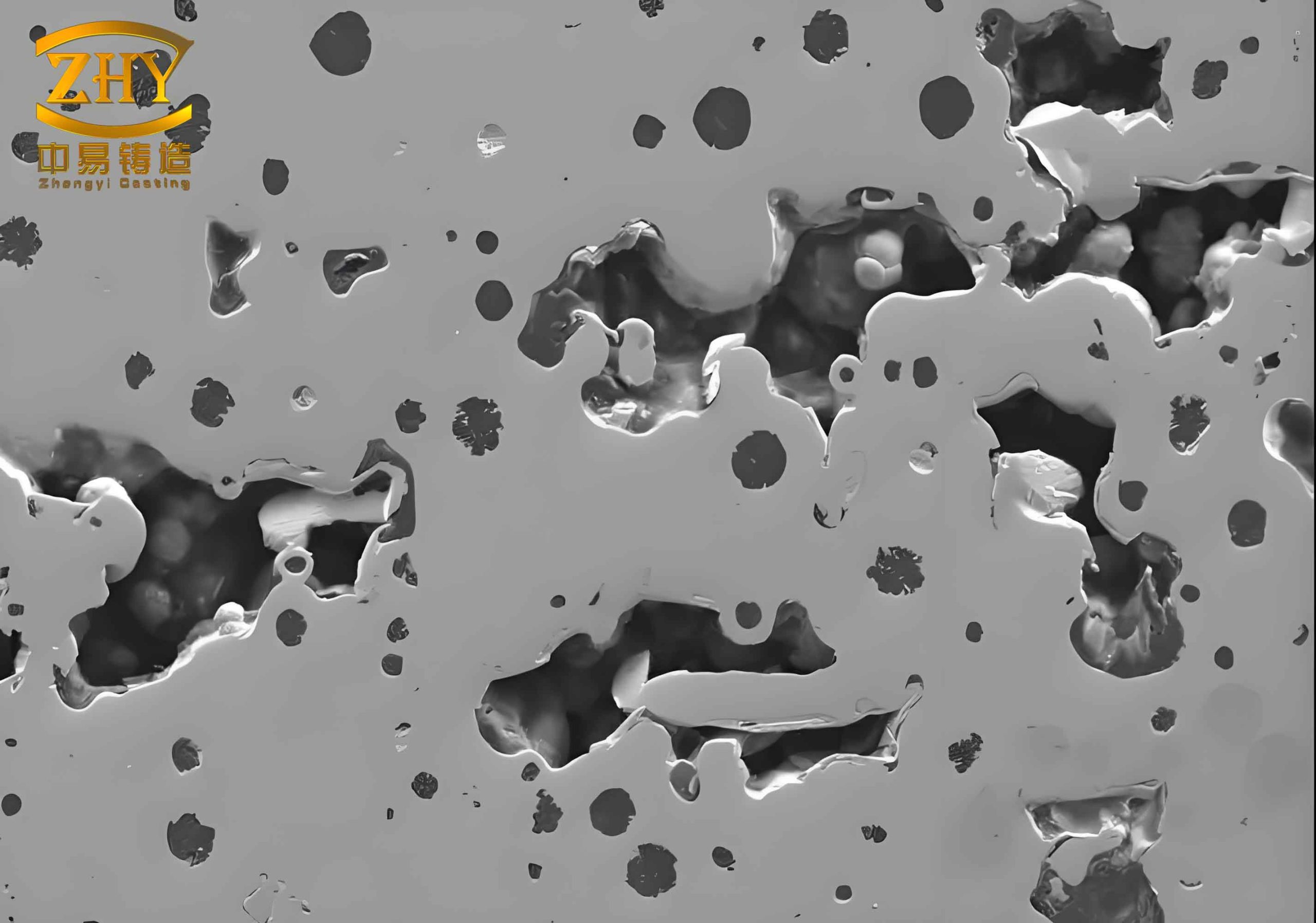
To systematically address these sand casting defect issues, I traced the sources of sand contamination. Table 2 summarizes the main sources of sand in the molten metal and the corrective actions I implemented.
| Source | Defect Type | Root Cause | Countermeasure |
|---|---|---|---|
| Ladle lining | Sand inclusion, sand holes | Traditional ramming mix using silica sand had low strength and spalled under thermal shock | Replaced with high-purity mullite-based neutral refractory with low thermal expansion and conductivity |
| Furnace lining | Sand inclusion, sand holes | Silica ramming mix for induction furnace lining suffered from high-temperature erosion and spalling | Switched to corundum-based neutral lining with spinel bonding phase; optimized sintering cycle |
| Sand mold | Severe sand inclusion, scabbing | High moisture content, too fine sand grain size causing poor permeability; insufficient CO₂ gassing for hardening | Controlled silica sand moisture below 0.5%; ensured grain size 40–70 mesh; standardized CO₂ gassing time |
| Loose sand in mold cavity | Sand holes, surface defects | Incomplete cleaning after molding; loose sand trapped during mold assembly | Compulsory high-pressure air cleaning after molding and before closing |
In addition to these measures, I also optimized the sand reclamation system. The residual Na₂O content in reclaimed sand was found to be a key parameter affecting the bench life and strength of ester-cured sodium silicate sand. High Na₂O content accelerated the reaction rate, reducing the available working time, especially during hot summer months. By adjusting the thermocouple positions in the sand reclamation calciner to increase temperature uniformity and enhancing the dust collection at the scrubber, I reduced the residual Na₂O content from above 0.8% to below 0.5%. Furthermore, I reduced the sodium silicate addition from 3.0% to 2.6% by weight of sand, which not only lowered the cost but also decreased the load on the reclamation line. As a result, the reject rate due to sand casting defect dropped from 5.12% in 2014 to 1.94% in 2015.
Mechanical Property Nonconformities
Another major category of issues was the failure to meet mechanical property requirements, particularly elongation and impact toughness. Track shoes must withstand the weight of the entire machine and endure severe impact loads during operation. The required mechanical properties after heat treatment are listed in Table 3.
| State | Hardness | Yield Strength (MPa) | Tensile Strength (MPa) | Elongation (%) | Impact Toughness (J/cm²) |
|---|---|---|---|---|---|
| Normalized | ≥183 HBW | 343 | 588 | ≥15 | ≥29.4 |
| Quenched | ≥50 HRC | — | — | — | — |
| Tempered | 269–321 HBW | 539 | 784 | ≥10 | ≥39.2 |
Through systematic investigation, I identified three main reasons for substandard impact toughness, especially after tempering.
1. Casting Defects in Test Specimens
The coupons used for mechanical testing often contained internal defects such as gas pores, shrinkage cavities, shrinkage porosity, and non-metallic inclusions. These defects act as stress raisers and significantly reduce the measured ductility and toughness. Moreover, the sampling location was not standardized. Since defects follow a Poisson distribution, the number of defects varies with position. By analyzing the stress distribution of the actual track shoe under load, I established a fixed sampling location: the center of the thickest section of the track shoe (the area connecting the bolt hole base). This location is most representative of the worst-case material property. Furthermore, I added ultrasonic inspection for all test coupons to ensure they were free of significant internal defects before testing.
2. Improper Normalizing Conditions
After casting, track shoes must be normalized to refine the as-cast structure and improve machinability. Typical normalizing is performed in a car-bottom furnace at 850°C ± 10°C with a holding time of 2.5 hours after reaching temperature. However, I often observed non-uniform hardness across the furnace load: the surface of the parts had a normalized structure while the core still exhibited as-cast coarse grains and even retained some dendritic segregation. This occurred because the furnace temperature uniformity was poor, and the holding time was insufficient for the thickest sections to reach the transformation temperature and complete the austenitization. To resolve this, I conducted a temperature uniformity survey of the furnace according to the AMS 2750 standard. The furnace was graded as Class A for normalizing (Table 4).
| Class | Quenching, Carburizing, Nitriding | Normalizing, Annealing (≥400°C) | High-Temperature Tempering (>400°C) | Low-Temperature Tempering (<400°C) | Tolerance (°C) |
|---|---|---|---|---|---|
| A | ±7.5 | ±10 | ±7.5 | ±5 | ±10 (for normalizing) |
| A1 | ±10 | ±15 | ±10 | ±7.5 | — |
| B | ±15 | ±25 | ±15 | ±10 | — |
In addition, I drilled holes at the thickest location of a track shoe (the central rib area, approximately 40 mm thick) and inserted thermocouples to the half-thickness depth. I measured the core heating curves at three positions: near the furnace door, at the center of the hearth, and near the inner back wall. The results showed that the core temperature lagged behind the furnace temperature by about 35 minutes. Therefore, I extended the holding time from 2.5 hours to 3.0 hours to ensure full austenitization of the core. The temperature profile can be approximated by a lumped capacitance model for the heating process:
$$
T_{\text{core}}(t) = T_{\text{furnace}} – (T_{\text{furnace}} – T_{\text{initial}}) \cdot e^{-\frac{h A}{\rho c_p V} t}
$$
where \(h\) is the effective heat transfer coefficient, \(A\) is the surface area, \(V\) is the volume, \(\rho\) is the density, and \(c_p\) is the specific heat. Using the measured data, I calibrated the time constant and determined that 180 minutes was sufficient to bring the core within 10°C of the furnace set point.
3. Improper Tempering Conditions
Tempering is performed in a pit furnace to achieve a balanced combination of strength and toughness. The target hardness after tempering is 269–321 HBW. However, early production runs often resulted in hardness above 350 HBW, leading to low elongation and impact toughness. The tempering temperature needs to be optimized to achieve the desired hardness while minimizing the loss of toughness. I designed a three-factor three-level orthogonal experiment using the L₉ orthogonal array. The factors were tempering temperature (450°C, 500°C, 550°C), holding time (1.5 h, 2.0 h, 2.5 h), and cooling method (air cooling, furnace cooling to 300°C then air cooling, and oil quenching from tempering temperature to simulate industrial practice). The response variables were hardness, tensile strength, yield strength, elongation, and impact toughness. The results were analyzed using the signal-to-noise ratio. The optimal parameters were determined to be: tempering temperature 510°C, holding time 2.0 hours, and air cooling. The regression equations derived from the experimental data are:
$$
\text{Hardness (HBW)} = 450 – 0.45 \times T_{\text{temp}} + 20 \times t_{\text{hold}} – 0.02 \times T_{\text{temp}} \times t_{\text{hold}}
$$
$$
\text{Impact Toughness (J/cm}^2\text{)} = 15 + 0.08 \times T_{\text{temp}} – 5 \times t_{\text{hold}} + 0.01 \times T_{\text{temp}}^2
$$
where \(T_{\text{temp}}\) is in degrees Celsius and \(t_{\text{hold}}\) in hours. The optimal point was verified by confirmatory runs, which yielded an average hardness of 295 HBW, impact toughness of 41.2 J/cm², and elongation of 11.5%, all within specification.
Conclusion
Through years of hands-on work in the foundry and heat treatment shop, I have developed a systematic approach to tackle the most challenging issues in cast track shoe production. The key is to recognize that sand casting defect control and heat treatment optimization are inseparable. By addressing the chemical composition variability through DI value monitoring, eliminating sand contamination sources through improved refractory materials and sand reclamation processes, and fine-tuning normalizing and tempering parameters based on furnace characterization and statistical experiments, I have successfully reduced the overall reject rate from over 6% to under 2%. These improvements not only save cost but also enhance the reliability of the final product in harsh field conditions. The experience I have gained offers valuable reference for similar heavy-equipment components manufactured by sand casting.