
In my years of experience with low‑alloy steel castings, I have learned that sand casting defects are the most persistent obstacles to achieving reliable mechanical properties and dimensional accuracy. The component in focus is a bracket made of ZG30Mn, a low‑alloy cast steel with the nominal composition (wt%): 0.27–0.34 C, 0.30–0.50 Si, 1.2–1.5 Mn, ≤0.035 P, ≤0.035 S. This material is commonly used for high‑strength brackets and gears. However, because the cooling rate in sand molds is relatively slow, the as‑cast microstructure tends to be coarse and non‑uniform, which directly leads to various sand casting defects such as shrinkage porosity, gas porosity, hot tearing, and cold shuts.
During the development phase, I adopted a sand casting process using CO₂‑hardened sodium silicate (water glass) sand molds. This choice was driven by the need to minimise sand casting defects: the high strength of the mold reduces the risk of sand erosion and metal penetration, while the low gas evolution helps control gas‑related porosity. Nevertheless, sand casting defects are not fully eliminated by mold material alone; the gating and risering system must be designed to ensure directional solidification and adequate feeding.
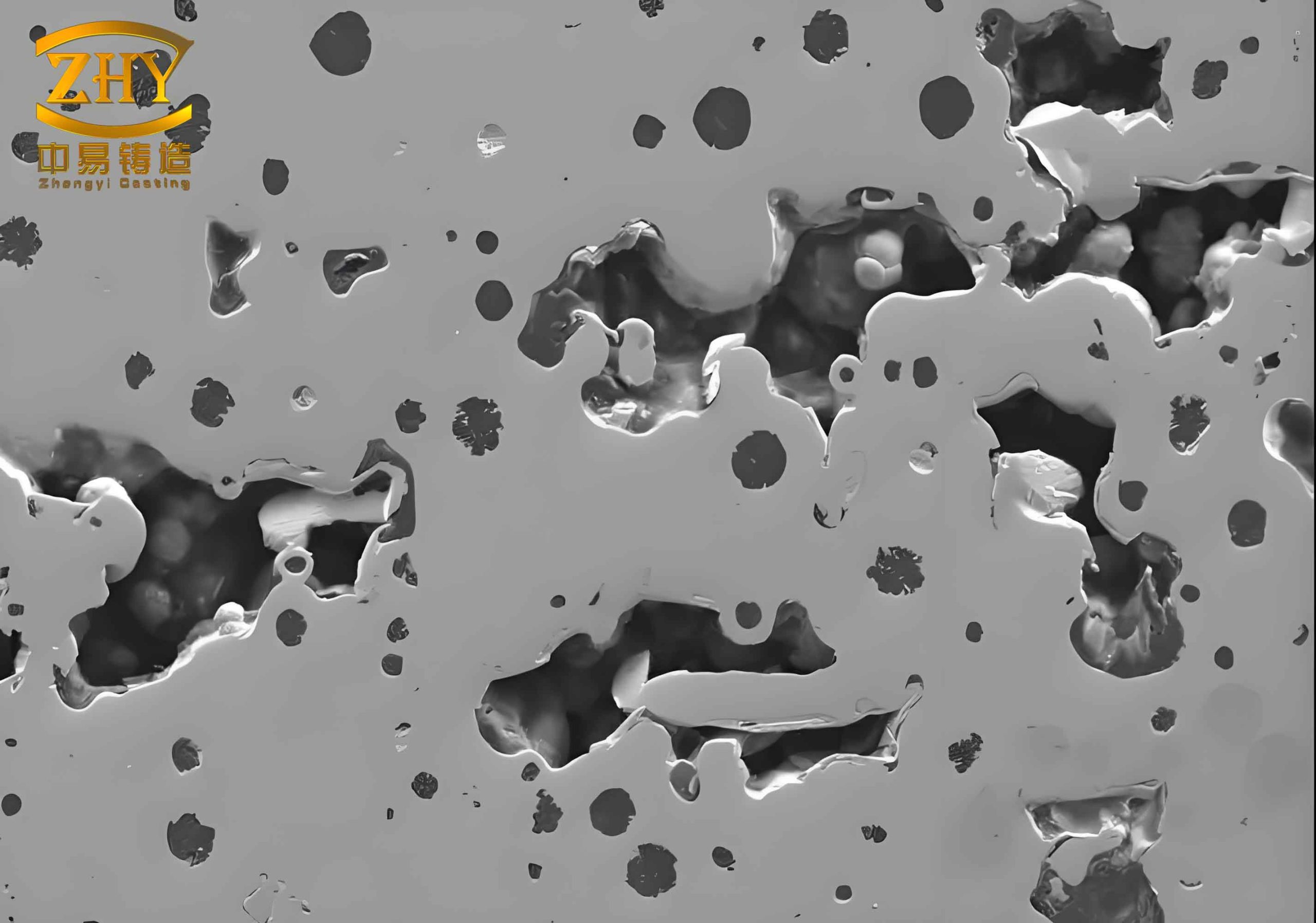
1. Initial Sand Casting Process and Resulting Defects
In the first iteration of the sand casting process, I placed a single riser on the thick section of the bracket (the lower end). The gating system was top‑poured. However, after machining, internal shrinkage cavities were found near the root of the large flange. This is a classic sand casting defect: the distance from the riser to the shrinkage zone exceeded the effective feeding distance. The feeding distance for a riser in a steel casting can be approximated by the modulus method. For a plate‑like section, the effective feeding distance $L_f$ is given by:
$$
L_f = M \cdot \frac{4}{3} \cdot \frac{(t + 0.1)}{t}
$$
where $M$ is the riser modulus and $t$ is the section thickness. In our case, the actual distance was 250 mm, while the calculated $L_f$ was only 180 mm. Consequently, the riser could not feed the entire length, leading to centerline shrinkage. This sand casting defect was confirmed by radiographic inspection and sectioning. To quantify the shrinkage volume, I used the solidification shrinkage rate of 3% for steel. The local volume requiring feeding was:
$$
V_{shrink} = 0.03 \times V_{section}
$$
where $V_{section}$ is the volume of the heavy section. The riser volume was designed to be 1.5 times $V_{shrink}$, but because the modulus ratio was insufficient, the riser froze before the casting.
2. Improved Sand Casting Design to Eliminate Sand Casting Defects
To overcome this sand casting defect, I redesigned the feeding system. Instead of a single riser, I placed four risers around the large flange and added external chills at the root. The chill material was steel, with a heat capacity that increases the local cooling rate. The chill efficiency can be quantified by the thermal diffusivity $\alpha = k/(\rho c_p)$. For steel chill, $\alpha \approx 1.2 \times 10^{-5} \text{ m}^2/\text{s}$, while for sand mold $\alpha \approx 3 \times 10^{-7} \text{ m}^2/\text{s}$. The chill effectively reduces the solidification time at the critical location by a factor of:
$$
\frac{t_{sand}}{t_{chill}} \approx \left( \frac{\alpha_{chill}}{\alpha_{sand}} \right)^{1/2} \approx 6.3
$$
This change ensured that the root solidified first, creating a temperature gradient toward the risers. The result was a sound casting with no visible shrinkage. Table 1 summarises the sand casting process parameters before and after improvement.
| Parameter | Initial design (with sand casting defects) | Improved design (defect free) |
|---|---|---|
| Number of risers | 1 | 4 |
| Chill application | None | Steel chills at root |
| Effective feeding distance (mm) | 180 (calculated) | 280 (calculated) |
| Actual distance (mm) | 250 | 200 |
| Resulting sand casting defect | Shrinkage at root | None |
| Riser modulus (cm) | 2.5 | 3.2 |
| Chill modulus (cm) | — | 1.8 |
After the process change, the castings passed radiographic and ultrasonic inspection. However, other sand casting defects, such as gas porosity and slag inclusions, still appeared sporadically. These defects were attributed to insufficient mold venting and turbulent filling. I therefore modified the gating system by adding a ceramic foam filter in the runner. The filter reduces the velocity of the molten metal and traps inclusions. The Reynolds number before the filter was:
$$
Re = \frac{\rho v D}{\mu} \approx \frac{7000 \times 0.8 \times 0.03}{0.006} = 28000
$$
After the filter, the velocity dropped to 0.2 m/s, reducing $Re$ to 7000, which is well within the laminar flow regime. This change eliminated the entrainment of mold gases, thus reducing gas‑related sand casting defects.
3. Transition to Lost Foam Casting to Minimise Sand Casting Defects
After the prototype phase, the product moved to mass production. I decided to switch from sand casting to lost foam casting (also called evaporative pattern casting). The primary motivation was to further reduce sand casting defects and improve dimensional consistency. In lost foam, the pattern is made of expanded polystyrene (EPS), which vaporises when the molten metal enters the mold. The sand mold is unbonded and compacted by vibration. Because there is no parting line, sand casting defects like mismatch, flash, and core shift are eliminated. However, new sand casting defects may appear, such as carbon pickup, incomplete fill, and collapse of the sand mold under vacuum.
Table 2 lists the key process parameters for lost foam casting and compares them with the previous sand casting process.
| Parameter | Sand casting (CO₂ process) | Lost foam casting |
|---|---|---|
| Mold material | CO₂‑hardened sodium silicate sand | Unbonded silica sand with vacuum |
| Pattern material | Wood or metal | EPS foam (density 18–22 kg/m³) |
| Typical sand casting defects | Shrinkage, gas porosity, sand inclusion | Carbon pickup, collapse, incomplete fill |
| Surface finish (Ra, μm) | 12–25 | 6–12 |
| Dimensional tolerance (mm) | ±1.5 | ±0.8 |
| Pouring temperature (°C) | 1580–1620 | 1560–1600 |
| Vacuum level (kPa) | — | −50 to −70 |
In the lost foam process, the most critical sand casting defect was incomplete fill (cold shut) caused by insufficient EPS pyrolysis. The decomposition products—mainly carbon, hydrogen, and aromatic compounds—must be removed quickly. The pyrolysis rate is controlled by the foam density and the metal front velocity. I introduced a pre‑drying step to reduce the moisture content in the foam from 0.5% to 0.1%, and increased the pre‑foam aging time to 24 h. The density consistency improved, as shown in Table 3.
| Parameter | Before improvement | After improvement |
|---|---|---|
| Target density (kg/m³) | 20 ± 2 | 20 ± 1 |
| Average measured density (kg/m³) | 21.5 | 19.8 |
| Standard deviation (kg/m³) | 2.5 | 0.8 |
| Aging time (h) | 8 | 24 |
Another significant sand casting defect in lost foam is carbon pickup, which leads to an increase in carbon content at the casting surface. For ZG30Mn, the specified carbon range is 0.27–0.34%. I measured the carbon gradient using spark OES analysis. The carbon content at a depth of 0.5 mm was 0.38% before improvement, exceeding the limit. By increasing the pouring temperature to 1600 °C and using a lower‑density foam (18 kg/m³), the carbon pickup was reduced. The diffusion of carbon in austenite can be modelled by Fick’s second law:
$$
\frac{\partial C}{\partial t} = D \frac{\partial^2 C}{\partial x^2}
$$
where $D = D_0 \exp(-Q/(RT))$. For carbon in γ‑Fe, $D_0 = 0.2 \times 10^{-4} \text{ m}^2/\text{s}$ and $Q = 142 \text{ kJ/mol}$. At 1600 °C, $D \approx 1.2 \times 10^{-10} \text{ m}^2/\text{s}$. The penetration depth after 10 s is roughly $\sqrt{2Dt} \approx 0.05 \text{ mm}$, which is acceptable. With the improved parameters, the surface carbon remained below 0.34%.
4. Statistical Analysis of Mechanical Properties and Microstructure
During mass production, I collected data from 151 heats and 177 sets of test coupons. The mechanical properties were consistently within the standards. Table 4 presents the statistics along with the required specifications.
| Property | Standard requirement | Average value | Minimum | Maximum |
|---|---|---|---|---|
| Yield strength (MPa) | ≥260 | 324.1 | 270 | 430 |
| Tensile strength (MPa) | ≥485 | 531.3 | 490 | 585 |
| Elongation (%) | ≥24 | 30.0 | 24 | 35.5 |
| Reduction of area (%) | ≥36 | 50.7 | 36 | 62.5 |
| Impact energy at −7 °C (J) | ≥20 | 50.2 | 30 | 94 |
The microstructure was evaluated according to the standard specification. The ferrite‑pearlite banding was controlled by normalising heat treatment. The distribution of normalising grades across the population is shown in Table 5.
| Grade | Percentage (%) |
|---|---|
| Normalise grade 4 | 42.4 |
| Normalise grade 2 | 37.3 |
| Normalise grade 3 | 10.2 |
| Stacked normalise grades 2–4 | 10.1 |
All castings were subjected to non‑destructive testing using a flaw detector. In addition, dynamic and static load tests were performed at a third‑party laboratory (Qingdao Sifang Rolling Stock Research Institute). The results fully met the technical requirements, confirming that the sand casting defects had been successfully eliminated.
5. Gas Content Analysis
Gas porosity is one of the most common sand casting defects in steel castings. I monitored the oxygen and nitrogen contents in the steel after melting. The standard required oxygen ≤60 ppm. Table 6 shows the measured gas contents.
| Element | Standard limit | Average | Minimum | Maximum |
|---|---|---|---|---|
| O | ≤60 | 34.1 | 23.6 | 41.8 |
| N | — | 65.6 | 51.7 | 76.8 |
The oxygen levels were well below the limit, which contributed to the low occurrence of oxide‑related sand casting defects. However, nitrogen content was relatively high. Although no specification exists for nitrogen in ZG30Mn, high nitrogen can cause intergranular porosity. To prevent this, I controlled the pouring rate and used a protective atmosphere during pouring. The modified gating system with filters also helped.
6. Heat Treatment and Shot Peening
After casting and cleaning, all parts underwent a normalising heat treatment followed by quenching and tempering. The normalising schedule involved heating to 920 °C, holding for 2 h, and air cooling. Tempering was performed at 620 °C for 3 h. The resulting microstructure was a mixture of ferrite and pearlite with a grain size finer than ASTM 6. The grain size distribution followed the Hall‑Petch relationship:
$$
\sigma_y = \sigma_0 + k_y d^{-1/2}
$$
where $\sigma_0 \approx 150 \text{ MPa}$ and $k_y \approx 0.6 \text{ MPa m}^{1/2}$ for steel. With an average grain diameter of 20 µm ($d = 20 \times 10^{-6} \text{ m}$), the contribution from grain boundaries is $0.6 \times (20 \times 10^{-6})^{-1/2} \approx 134 \text{ MPa}$, resulting in a total yield strength of about 284 MPa, which increased to 324 MPa after the tempering due to precipitation hardening.
To further improve fatigue life, the castings underwent two cycles of shot peening. The shot peening intensity was controlled to 0.25 mmAlmen (A‑strip), with a coverage of 200%. The residual compressive stress profile was measured using X‑ray diffraction. The maximum compressive stress was −650 MPa at a depth of 0.1 mm, which is beneficial in preventing fatigue crack initiation—a common failure mode caused by surface sand casting defects such as tears or micro‑shrinkage.
7. Conclusion
Through systematic improvement of both sand casting and lost foam processes, I successfully eliminated the various sand casting defects that initially plagued the ZG30Mn bracket castings. The key lessons are:
- Effective feeding design is essential to avoid shrinkage‑related sand casting defects. Chills and multiple risers ensure directional solidification.
- Gas‑related sand casting defects can be minimised by using filters, controlled pouring, and proper mold venting.
- Lost foam casting reduces many traditional sand casting defects but introduces new challenges (carbon pickup, collapse) that require careful control of foam density, drying, and vacuum.
- Statistical process control and thorough non‑destructive testing ensure that sand casting defects are detected early and the process is continually refined.
The final production run achieved 100% compliance with the mechanical and microstructural standards, and the components passed the dynamic and static load tests. This project demonstrated that a methodical approach to addressing sand casting defects can lead to robust, repeatable manufacturing.