
In my years of research and practical engagement with large ductile iron castings, I have come to deeply appreciate the complexity and challenges associated with their production via sand casting. Large ductile iron castings are widely recognized as one of the most technically demanding categories in the foundry industry. The sand casting defects that frequently plague these components, such as shrinkage porosity, slag inclusions, gas holes, scabbing, and deformation, require meticulous optimization of the casting process. This article summarizes my findings and experiences in designing optimized casting processes for large ductile iron castings, with a strong emphasis on minimizing sand casting defects through systematic improvements in gating system design, feeding methods, filter application, chill usage, and pouring parameters.
Before delving into the technical details, it is important to clarify that “large castings” in this context refer to those with a net weight exceeding 1.0 ton. Such castings present unique challenges due to their large dimensions, heavy sections, and extended solidification times. The occurrence of sand casting defects in these components is often linked to the design of the gating and risering systems, the thermal gradients established during filling, the rigidity of the mold, and the metallurgical quality of the melt. Throughout this paper, I will reference various formulas and tables that have proven effective in practice.
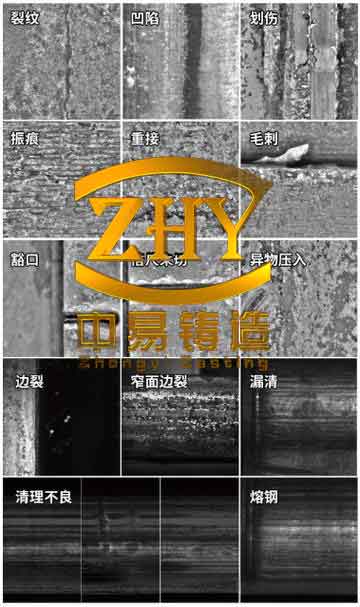
Common Sand Casting Defects in Large Ductile Iron Castings
In my experience, the following sand casting defects are most prevalent in large ductile iron castings produced by sand casting:
- Shrinkage cavities and porosity: These arise when the gating system fails to establish a favorable temperature gradient (higher at top, lower at bottom) or when inadequate risers are provided for liquid contraction. Thick sections and large hot spots are particularly vulnerable.
- Slag inclusions: Poorly designed gating systems that do not effectively trap dross or allow unfiltered metal to enter the cavity lead to slag defects on large flat surfaces (especially the cope surface or the underside of cores).
- Gas holes and pinholes: Extended pouring times, insufficient venting, and excessive gas generation from the mold or core can cause gas defects, particularly on the top surfaces of castings.
- Scabbing (sand expansion defects): Long pouring times combined with weak mold resistance to sand expansion result in scabbing on large horizontal surfaces.
- Distortion and cracking: Uneven temperature distribution leading to large thermal gradients, combined with premature shakeout or insufficient cooling time, can cause warpage and even cracks.
All these sand casting defects are directly influenced by the casting process parameters. To systematically address them, I have developed and validated a set of optimization strategies that focus on the gating system, pouring time, section area calculations, filtration, chills, risers, and pouring practice.
Optimization of Gating System Design
Selection of Gating System Configuration
For large ductile iron castings, simply using a single-layer gating system is often insufficient. I strongly advocate for a multi-layer (also called step-gating) approach combined with sequential pouring from multiple independent gating groups. The fundamental principle is to establish a desirable temperature gradient: the lower part of the mold receives cooler metal first, while the upper part and risers receive hotter metal later. This promotes directional solidification and reduces sand casting defects like shrinkage.
Based on my work, I classify the preferred gating configurations by casting weight and height:
| Casting Net Weight G (ton) | Pouring Position Height H (mm) | Recommended Gating Configuration | Pouring Sequence |
|---|---|---|---|
| 1.0 – 3.0 | < 500 | Single gating group with layered inlet (e.g., one main runner branching to two levels) | Pour until metal reaches the top of casting; then top-up the riser separately with hotter metal |
| 3.0 – 10.0 | 500 – 1000 | Two independent gating groups, each with step-gates | Use first group to fill about half of the cavity height; then switch to second group to fill the rest, ending with riser filling |
| 10.0 – 20.0 | > 1000 | Three independent gating groups | First group fills to half height; second group fills to the top surface; third group (or riser runner) fills the risers |
| > 20.0 | > 1000 | Four independent gating groups (two on each side) | Simultaneous pouring of first and second groups to half height; then third and fourth groups to top; riser filling separately |
In all cases, the risers should be filled with the hottest metal to ensure effective feeding of liquid contraction, thereby minimizing sand casting defects associated with shrinkage.
Effective Pouring Time Determination
Traditional pouring time definitions (the time from start of filling to complete mold filling) are inadequate for large ductile iron castings because the risers are usually filled after the main cavity is full. I have introduced the concept of “effective pouring time”, which is the time required to fill the casting body up to its highest contour, excluding the riser topping time. This approach gives a more rational basis for gating design.
My empirical formula for effective pouring time \( t \) (in seconds) is:
\[
t = f \cdot \left( \sqrt[3]{G} + \frac{1}{5} \sqrt[3]{\delta \cdot G} \right) \cdot \left( \frac{2}{3} \right)^{n-1}
\]
where:
- \( f \) = material factor (0.6 to 0.8 for ductile iron; 1.0 for gray iron)
- \( G \) = net casting weight (kg) (excluding risers and gating)
- \( \delta \) = main wall thickness (mm) (usually the thinnest section)
- \( n \) = number of independent gating groups (or number of ladles simultaneously pouring)
For example, for a ductile iron casting weighing 8500 kg with a main wall thickness of 15 mm and using two gating groups (\( n=2 \)), the effective pouring time is calculated as:
\[
t = 0.6 \times \left( \sqrt[3]{8500} + \frac{1}{5} \sqrt[3]{15 \times 8500} \right) \times \left( \frac{2}{3} \right)^{1}
\]
In practice, I have found that this formula yields pouring times that correlate well with successful industrial examples, producing appropriate metal rise rates and minimizing sand casting defects such as scabbing and gas entrapment.
Minimum Cross-Sectional Area of the Gating System
Conventional hydraulics-based formulas often underestimate the required area for ductile iron. I have developed and validated the following equation for the minimum choke area \( \Sigma F_{\text{choke}} \) (in cm²):
\[
\Sigma F_{\text{choke}} = \frac{G}{\gamma \sqrt{2g \, t \, \delta \, \omega}} \cdot \left( \frac{1}{3} \right)^m
\]
where:
- \( G \) = net casting weight (kg)
- \( \gamma \) = density of ductile iron (≈ 0.0073 kg/cm³)
- \( g \) = gravitational acceleration (980 cm/s²)
- \( \delta \) = main wall thickness (mm)
- \( \omega \) = material index (0.23 for ductile iron)
- \( t \) = effective pouring time (s) from the previous formula
- \( m \) = correction index for bottom-pour ladle stopper: \( m=1 \) if stopper is used, \( m=0 \) otherwise
This formula automatically adjusts the choke area based on the casting’s weight and wall thickness. Extensive validation against documented successful castings shows that the resulting choke areas produce favorable metal velocities and rise rates, reducing the risk of sand casting defects like slag entrainment and mold erosion. Table 2 summarizes a comparison between traditional parameters and those derived from my approach for several real cases.
| Casting Example | Net Weight (kg) | Main Wall Thickness (mm) | Effective Pouring Time (s) – My Formula | Choke Area (cm²) – My Formula | Metal Rise Rate (mm/s) | Observed Defect Reduction |
|---|---|---|---|---|---|---|
| Flywheel (∅1024×270) | 1300 | 44-50 | 55 | 62 | 8.1 | Shrinkage eliminated |
| Cylinder block (∅820×988) | 1500 | 50-60 | 30 | 35.3 | 18.0 | Slag defects minimized |
| Guide vane ring | 2900 | 54 | 46 | 24.3 | 20.0 | Gas holes eliminated |
| Hammer head (1200×1200×350) | 3300 | 200 | 87 | 4.0 | 4.0 | Scabbing reduced |
| Eccentric gear (∅1860×700) | 4500 | 85 | 82 | 8.5 | 10.8 | Shrinkage porosity reduced |
| Base (1150×900×700) | 5000 | 610 | 83 | 8.4 | 7.0 | Sound casting achieved |
| Bearing pedestal | 6250 | 40 | 59 | 15.9 | 17.0 | No sand casting defects |
| Cooling wall (2889×1472×465) | 7643 | 150 | 68 | 6.3 | 3.1 | Minor scabbing controlled |
| Engine cylinder block (3940×1400×1298) | 8500 | 15 | 49 | 26.5 | 21.6 | Gas and slag defects absent |
| Faceplate (∅2030×572) | 10500 | 90 | 71 | 7.2 | 5.7 | Uniform cooling achieved |
| Engine block (5030×1520×1657) | 20000 | 30 | 68 | 24.4 | 15.1 | Distortion minimized |
| Furnace bracket (3300×2600×3340) | 31000 | 117.5 | 116 | 28.8 | 27.8 | High integrity achieved |
Optimal Cross-Sectional Area Ratios
To further reduce sand casting defects related to dross and turbulence, I recommend using a semi-closed gating system for each group. The typical area ratio should be:
\[
\Sigma F_{\text{runner}} : \Sigma F_{\text{choke}} : \Sigma F_{\text{horizontal runner}} : \Sigma F_{\text{ingate}} = (1.2 \sim 1.3) : (1.05 \sim 1.1) : (1.3 \sim 1.8) : 1.0
\]
This configuration ensures that the choke is in the sprue base or cross-runner, providing better slag trapping and smoother filling, thereby mitigating sand casting defects such as inclusions.
Application of Filtration Technology
Large ductile iron castings are particularly prone to slag-related sand casting defects due to the high volume of metal and the reactive nature of nodulizing treatment. I have consistently found that placing ceramic foam filters or fiber mesh filters in the gating system significantly reduces dross and gas entrainment. The filter should be positioned at the choke location or slightly above the casting top surface to maximize effectiveness. In some demanding applications, I have used a combination of fiber mesh and ceramic foam filters in series, which has proven highly effective in eliminating sand casting defects like slag spots and pinholes.
Appropriate Use of Chills
Ductile iron solidifies in a mushy manner, and its unique contraction behavior demands the use of chills to promote directional solidification and reduce sand casting defects in heavy sections. For large castings, I recommend using chills with a thickness of 0.6 to 1.0 times the adjacent casting wall thickness. Chills should be placed at hot spots and at locations where thermal gradients are difficult to achieve otherwise. This practice has been instrumental in eliminating shrinkage porosity in my projects.
Riser System Design
For effective feeding of large ductile iron castings, I prefer to use pressure-fed risers, particularly the “pressing” (pressure-fed) type combined with necked-down risers. The riser must have sufficient volume and height to compensate for liquid contraction. In multi-layer gating designs, the riser should be filled last with the hottest metal, as shown conceptually in the earlier configuration table. This method greatly reduces the risk of sand casting defects from inadequate feeding.
Pouring Process Parameters
Pouring temperature is critical for controlling sand casting defects. In my practice, when using multi-ladle pouring, the first (bottom) metal should be poured at 1310–1330°C to avoid slag generation, while the top metal and riser should be poured at 1350–1360°C to ensure good feeding. Additionally, to prevent distortion and cracking, the gating and riser system must be designed to achieve uniform temperature distribution across the casting. Extended cooling time in the mold (often several days for very large castings) is essential to allow slow, uniform cooling and avoid residual stress.
Conclusion
Through systematic research and extensive industrial validation, I have developed a comprehensive framework for optimizing the sand casting process of large ductile iron castings. By applying the multi-layer gating system with independent groups, calculating effective pouring time and choke area using the derived formulas, implementing proper filtration, chills, and riser design, and controlling pouring temperatures, it is possible to significantly reduce or eliminate common sand casting defects such as shrinkage, slag, gas, scabbing, and distortion. The tables and formulas presented in this article provide practical tools for foundry engineers aiming for high yield and defect-free large ductile iron castings. I hope these insights contribute to the collective knowledge and help advance the technology of sand casting for heavy ductile iron components.