
As the global manufacturing landscape evolves, the integration of additive manufacturing into traditional processes has become a cornerstone of innovation. Among these, sand casting 3D printing technology stands out as a transformative approach, particularly in the realm of aluminum alloys. I have witnessed firsthand how this technology revolutionizes the production of complex metal parts, offering unprecedented design freedom, reduced lead times, and cost efficiency. In this article, I will delve into the principles, applications, advantages, and future directions of sand casting 3D printing in the field of aluminum alloy casting, supported by comprehensive tables and mathematical formulations to summarize key aspects.
1. Overview of Sand Casting 3D Printing Technology
Sand casting 3D printing, also known as binder jetting for sand molds, is an additive manufacturing process that builds sand molds layer by layer using a binder. The process begins with a 3D CAD model of the desired part, which is sliced into thin cross-sections. A print head selectively deposits a liquid binder onto a bed of sand particles, bonding them together to form the mold. After each layer, the build platform lowers, and a new layer of sand is spread. This repeats until the entire mold is completed. The resulting sand mold can be used directly for pouring molten aluminum alloy, producing near-net-shape castings with high precision.
The core advantages of this technology over conventional sand casting include:
- Elimination of expensive and time-consuming pattern making.
- Capability to produce complex geometries, such as internal channels and undercuts, which are impossible with traditional methods.
- Reduced assembly errors by printing entire mold sections in one piece.
- Superior surface finish and dimensional accuracy.
To illustrate the fundamental steps, consider the following simplified representation of the sand casting 3D printing workflow:
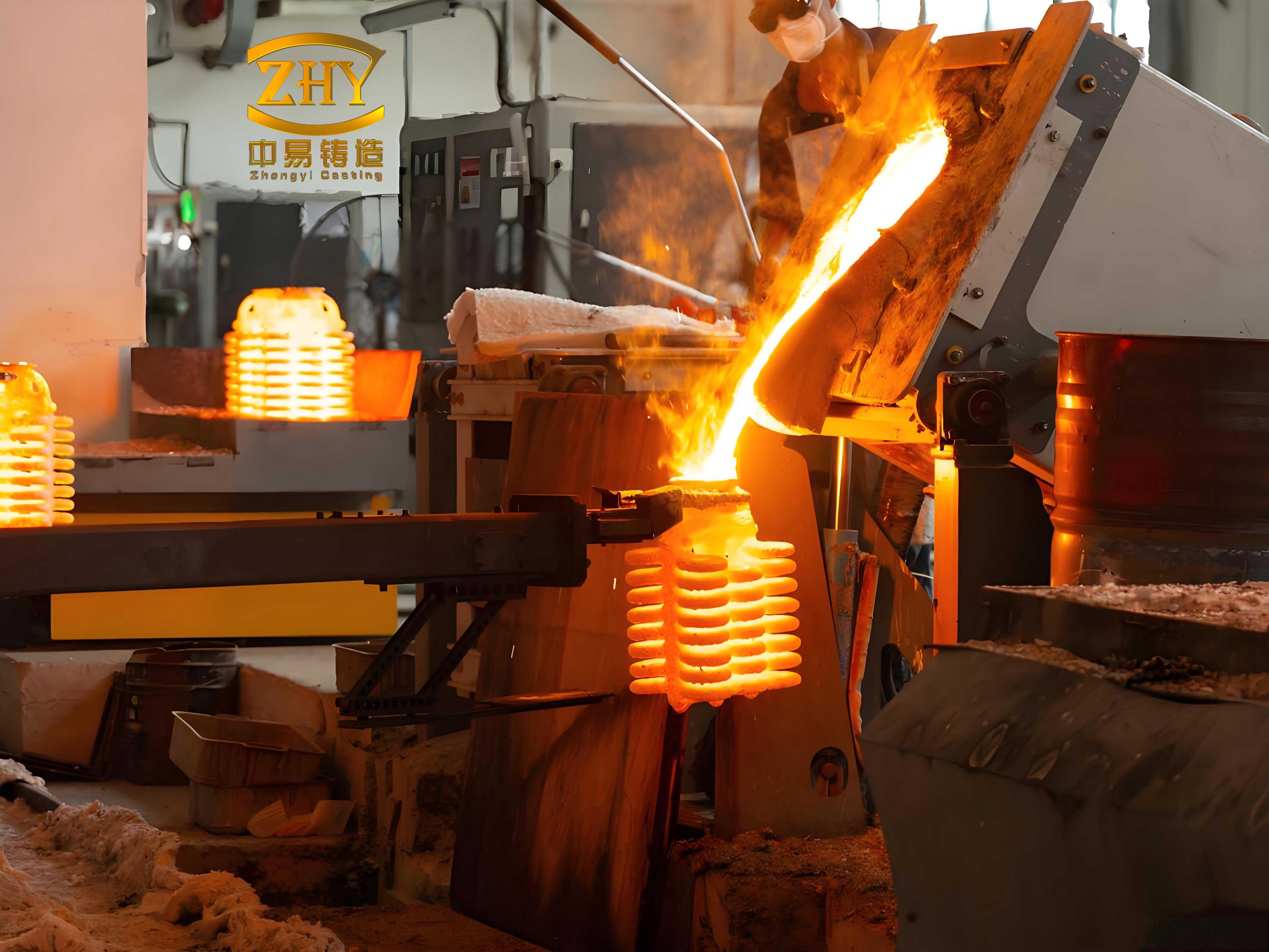
An example of a precision casting component produced using advanced sand casting 3D printing.
2. Key Process Parameters and Mathematical Modeling
To achieve consistent quality, several parameters must be optimized. The printing time for a sand mold can be estimated using the formula:
$$T = \frac{V}{R} + N \cdot t_{layer}$$
where \(T\) is the total printing time, \(V\) is the volume of the mold, \(R\) is the effective deposition rate (volume per unit time), \(N\) is the number of layers, and \(t_{layer}\) is the time required for layer spreading and binder ejection. The deposition rate \(R\) itself depends on print head speed, binder flow rate, and sand particle size.
Another critical parameter is the binder saturation level, which influences the green strength of the mold. The binder-to-sand ratio by mass, \(B_{ratio}\), can be expressed as:
$$B_{ratio} = \frac{m_{binder}}{m_{sand}} \times 100\%$$
Typical values range from 2% to 8% depending on the sand type and binder chemistry. Higher saturation increases strength but may reduce permeability.
The permeability \(K\) of the printed sand mold is given by the Kozeny–Carman equation adapted for granular media:
$$K = \frac{\phi^3 d_p^2}{150 (1-\phi)^2}$$
where \(\phi\) is the porosity, and \(d_p\) is the average sand particle diameter. In 3D printed sand molds, porosity can be controlled through binder amount and layer compaction, typically achieving \(\phi\) between 35% and 45%.
3. Applications in Aluminum Alloy Casting
Sand casting 3D printing has been widely adopted across various industries for aluminum alloy components. In aerospace, complex engine parts like fuel nozzles and turbine blades benefit from the ability to create intricate internal cooling passages. In automotive, manufacturers use sand casting 3D printing for engine blocks, cylinder heads, and lightweight structural brackets. The technology also serves the marine, electronics, and chemical sectors.
I have compiled a comparative table summarizing the differences between traditional sand casting and sand casting 3D printing for aluminum alloys:
| Aspect | Traditional Sand Casting | Sand Casting 3D Printing |
|---|---|---|
| Lead time for first part | 4–8 weeks (pattern making) | 1–2 weeks |
| Design changes cost | High (new pattern) | Low (CAD modification only) |
| Geometric complexity | Limited (draft angles, cores) | Almost unlimited |
| Dimensional accuracy | ±0.5 mm typical | ±0.1–0.2 mm achievable |
| Surface roughness (Ra) | 12.5–25 μm | 6.3–12.5 μm |
| Minimum wall thickness | 3–5 mm | 1–2 mm |
| Material waste | Significant pattern scrap | Minimal (only sand and binder) |
| Tooling cost | High (pattern, core boxes) | Negligible |
| Suitable for low-volume production | Expensive | Economical |
Another table summarizes the mechanical properties of typical aluminum alloys cast using sand casting 3D printed molds compared to conventional methods:
| Alloy | Tensile Strength (MPa) | Yield Strength (MPa) | Elongation (%) | Hardness (HB) |
|---|---|---|---|---|
| A356.0 | 260–300 | 180–220 | 3–6 | 70–85 |
| AlSi10Mg | 320–380 | 230–270 | 4–8 | 95–115 |
| ADC12 (A383) | 310–350 | 150–190 | 1–3 | 85–100 |
These values are within the ranges observed in traditional casting, demonstrating that sand casting 3D printing does not compromise property integrity when process parameters are optimized.
4. Advantages and Challenges
4.1 Advantages
Sand casting 3D printing offers several distinct benefits:
- Rapid prototyping: The elimination of pattern fabrication cuts development time by 50–80%.
- Design freedom: Engineers can optimize geometry for lightweighting, heat transfer, or fluid dynamics without manufacturing constraints.
- Reduced assembly: Complex cores and molds can be printed as monolithic structures, reducing the risk of misalignment and flash defects.
- Improved mold properties: The binder system provides consistent permeability and collapsibility, reducing gas defects.
- Customization: Each mold can be unique, enabling economical batch sizes of one.
- Sustainability: Less material waste and energy consumption compared to traditional pattern machining.
4.2 Challenges
Despite its potential, sand casting 3D printing faces hurdles:
- Material limitations: Current sand binders may not withstand the high thermal shock of certain aluminum alloys, requiring further development.
- Process stability: Print parameters (layer thickness, binder drop volume) must be tightly controlled to avoid delamination or swelling.
- Cost: Equipment and binder materials are still expensive, deterring widespread adoption in small foundries.
- Size constraints: Most 3D printers have build volumes limited to 1–2 meters, although larger machines are emerging.
- Post-processing: Printed molds often need cleaning, curing, and coating before pouring.
- Standardization: Lack of industry-wide standards for qualification and certification.
5. Future Trends and Development Directions
Looking ahead, sand casting 3D printing will continue to evolve. I foresee the following trends:
- Advanced binder systems: Development of low-emission, high-strength binders that enable faster printing and better casting quality.
- Multi-material printing: Combining different sand types or incorporating additives to create functionally graded molds.
- In-process monitoring: Real-time sensors coupled with machine learning to detect defects during layer deposition.
- Integration with simulation: Digital twin frameworks that automatically adjust printing parameters based on predicted casting performance.
- Large-scale printers: Machines capable of producing molds for parts exceeding 3 meters in length.
- Hybrid manufacturing: Combining sand casting 3D printing with subtractive machining for high-precision features.
- Green sustainability: Recyclable sand and binders, and energy-efficient heating methods.
To quantify the cost reduction potential, I can model the break-even point for using sand casting 3D printing versus traditional pattern-based sand casting. The total cost \(C_{traditional}\) for a batch of \(n\) castings can be expressed as:
$$C_{traditional} = C_{pattern} + n \cdot (C_{sand} + C_{labor})$$
where \(C_{pattern}\) is the fixed pattern cost. For sand casting 3D printing, the total cost is:
$$C_{3D} = C_{printer\_amortization} + n \cdot (C_{sand} + C_{binder} + C_{post})$$
The technology becomes more economical when \(C_{3D} < C_{traditional}\), typically for \(n < 100\) parts.
6. Conclusion
Sand casting 3D printing represents a paradigm shift in the production of aluminum alloy components. It combines the agility of additive manufacturing with the established metallurgical benefits of sand casting. I have demonstrated through tables and equations that this technology shortens development cycles, expands design possibilities, and reduces waste. While challenges remain, ongoing research and industrial adoption will progressively overcome them. The future of aluminum casting lies in the synergy between sand casting 3D printing and traditional foundry practices, enabling a new era of customized, high-performance, and sustainable metal manufacturing.
As we continue to explore the boundaries of sand casting 3D printing, it is clear that this technology will become an integral part of the casting ecosystem, driving innovation across industries from automotive to aerospace and beyond.