
The manufacturing of high-integrity components, particularly for demanding applications like internal combustion engines and air compressors, often relies on sand casting due to its versatility and cost-effectiveness for complex geometries. Producing sound sand casting parts free from shrinkage porosity, gas entrapment, and cold shuts requires precise control over the filling and solidification sequence. Traditional trial-and-error methods for process development are time-consuming and resource-intensive. In this analysis, I employ the ProCAST simulation software to model, analyze, and optimize the gravity sand casting process for a ZL104 aluminum alloy piston. The goal is to demonstrate a systematic, simulation-driven approach to enhancing the quality and yield of such critical sand casting parts.
1. Introduction to the Challenge: Producing Reliable Pistons via Sand Casting
Pistons are foundational components in compressors and engines, subjected to severe cyclical mechanical and thermal stresses. Their operational reliability is paramount, demanding high microstructural integrity, especially in load-bearing sections like the crown and pin boss areas. Any internal defect such as shrinkage porosity or a crack can act as a stress concentrator, leading to premature failure. The geometry of a typical piston—characterized by a thick crown, thinner skirt, and reinforced pin bosses—presents a classic solidification challenge: the thicker sections solidify last and are prone to shrinkage defects if not properly fed. The sand casting process, while suitable for its shape, introduces variables like mold material, gating design, and pouring parameters that directly influence the final soundness of the sand casting parts.
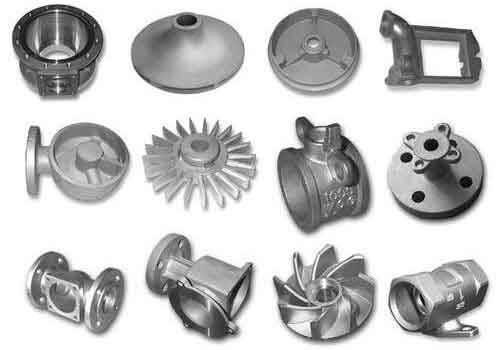
My objective is to virtually prototype the casting process for a V0.17/7 air compressor piston. The base material is ZL104 aluminum alloy, a common casting alloy known for good castability and mechanical properties. The initial gating design employs a bottom-filling system aimed at promoting tranquil filling. However, without numerical insight, the efficacy of this design and the potential for defects remain uncertain. By utilizing ProCAST, I will dissect the physics of the process, predict defect locations, and implement targeted optimizations to ensure the production of flawless sand casting parts.
2. Numerical Modeling Methodology with ProCAST
The fidelity of a casting simulation hinges on accurate geometric representation, material property definition, and boundary condition setup. My methodology follows a structured pre-processing, solving, and post-processing workflow within the ProCAST environment.
2.1. Geometric Discretization and Material Properties
The 3D CAD model of the piston, including the part, initial gating system (sprue, runner, ingate), and a side riser, was imported. The model was then meshed into a finite element volume grid. A fine mesh is critical in areas of geometric complexity and expected thermal gradients to capture accurate results. The final computational model consisted of over 500,000 tetrahedral elements.
Material properties are temperature-dependent and crucial for predicting solidification behavior. For the ZL104 alloy, key properties were assigned from the ProCAST database. The solidus and liquidus temperatures define the freezing range. The evolution of enthalpy, $H(T)$, and thermal conductivity, $k(T)$, are particularly important for the energy balance during solidification. The density variation, often simplified for shrinkage prediction, was also considered.
| Temperature (°C) | Thermal Conductivity, $k$ (W/m·K) | Enthalpy, $H$ (kJ/kg) |
|---|---|---|
| 285 | 180.6 | 255 |
| 365 | 180.7 | 337 |
| 465 | 180.9 | 443 |
| 578 | 114.8 | 916 |
| 660 | 85.1 | 1124 |
| 760 | 89.5 | 1239 |
The mold materials were defined as silica sand for the main mold and resin sand for the core. The interfacial heat transfer coefficients (IHTC) between the casting and the mold, and between different mold parts, significantly affect cooling rates. For this sand casting process, typical values were applied: 500 W/m²·K for metal-sand interfaces and 200 W/m²·K for sand-sand interfaces.
2.2. Initial Process Parameters and Governing Equations
The initial process conditions were set based on standard foundry practice for aluminum sand casting parts:
- Pouring Temperature: $T_{pour} = 760°C$
- Pouring Velocity (at ingate): $v_{pour} = 0.8 , m/s$
- Mold Initial Temperature: $T_{mold} = 25°C$
The simulation solves the fundamental governing equations of fluid flow and heat transfer. The Navier-Stokes equations for incompressible flow, coupled with the energy equation, model the filling phase:
$$
\rho \left( \frac{\partial \mathbf{v}}{\partial t} + \mathbf{v} \cdot \nabla \mathbf{v} \right) = -\nabla p + \mu \nabla^2 \mathbf{v} + \rho \mathbf{g}
$$
$$
\rho C_p \left( \frac{\partial T}{\partial t} + \mathbf{v} \cdot \nabla T \right) = \nabla \cdot (k \nabla T) + \dot{Q}
$$
During solidification, the fluid flow diminishes, and the energy equation incorporates the latent heat release, $L$, through an enthalpy formulation:
$$
\frac{\partial (\rho H)}{\partial t} = \nabla \cdot (k \nabla T)
$$
where $H = \int C_p , dT + (1 – f_s) L$, and $f_s$ is the solid fraction. The critical output for defect prediction is the spatial and temporal evolution of $f_s$.
3. Analysis of the Initial Casting Process
3.1. Filling Phase: Velocity and Temperature Fields
The filling sequence revealed a generally tranquil process. The velocity field showed a peak at the ingate due to the constricted cross-sectional area, as expected from the continuity equation $A_1 v_1 = A_2 v_2$. Upon entering the mold cavity, the metal velocity dropped significantly, promoting a non-turbulent, upward advancement of the melt front. This is desirable for sand casting parts as it minimizes mold erosion and air entrainment. The temperature field at the end of filling (t=0.794s) indicated a relatively uniform thermal distribution with the riser region being the hottest, which is a positive sign for its function as a thermal reservoir.
3.2. Solidification Phase and Defect Prediction
The solidification sequence is the most critical phase for determining the internal quality of sand casting parts. The simulation output for the initial design showed a mostly directional progression from the thin skirt towards the thick crown and finally the side riser. However, a detailed analysis using the solid fraction ($f_s$) isolines revealed a problem.
Defect prediction in ProCAST often relies on tracking isolated liquid pockets. A critical threshold is when the local solid fraction reaches about 0.7 ($f_s^{crit}$), inter-dendritic fluid flow becomes severely restricted. If such a region is isolated from a feeding source (riser), it will develop shrinkage porosity. The governing relationship for the pressure drop in a mushy zone, simplified by the Niyama criterion, is indicative of this condition:
$$
G / \sqrt{\dot{T}} \leq \text{Constant}
$$
where $G$ is the thermal gradient and $\dot{T}$ is the cooling rate. A low value of this criterion correlates with porosity.
In the initial design, the solid fraction analysis clearly identified the central and upper portion of the thick piston crown as the last region to pass the $f_s^{crit}$ threshold. Although the side riser was the last to solidify overall, the thermal connection between the riser and the hottest spot in the crown was insufficient. A “hot spot” existed in the crown, creating an isolated liquid pocket that could not be effectively fed by the side riser alone. This zone was predicted to have a high probability of macro- and micro-shrinkage defects, which is unacceptable for a high-integrity component like a piston.
| Process Stage | Observation from Simulation | Implication for Sand Casting Parts |
|---|---|---|
| Filling | Smooth, bottom-up filling. Low velocity in cavity. | Low risk of sand inclusion or excessive turbulence. |
| Solidification Start | Skirt and thin sections solidify first. | Establishes directional solidification towards riser in principle. |
| Solidification Midpoint | Crown center remains liquid after surrounding areas reach high $f_s$. | Formation of an isolated hot spot; feeding path is interrupted. |
| Defect Prediction | High porosity risk zone in the piston crown. | The initial design fails to produce a sound casting. |
4. Process Optimization Strategy and Validation
The simulation diagnosis provided a clear direction for optimization. The goal was to eliminate the isolated hot spot in the crown by ensuring a continuous thermal gradient and liquid feed path towards a riser until the entire casting solidified.
4.1. Implemented Modifications
1. Addition of a Top Insulating Riser: The most direct solution was to place a feeding source directly on the hot spot. A cylindrical insulating riser was added to the top center of the piston crown. Its function is twofold: a) it acts as a thermal cap, slowing down the cooling of the crown center, and b) it provides a liquid metal reservoir to compensate for the solidification shrinkage in the crown. The efficiency of a riser can be approximated by the modulus method, ensuring its modulus (Volume/Surface Area) is greater than that of the casting region it feeds.
2. Reduction of Pouring Velocity: While the initial filling was stable, reducing the pouring velocity from 0.8 m/s to 0.3 m/s was implemented to further guarantee a quiescent mold filling. This minimizes any dynamic pressure that might disrupt the delicate air/ gas evacuation path in the green sand mold and reinforces the defect-free filling of these sand casting parts. The modified gating system was adjusted to accommodate the slower pour while maintaining complete filling.
4.2. Simulation Results of the Optimized Process
Re-running the ProCAST simulation with the new geometry and parameters yielded a markedly different solidification pattern.
- Filling: The mold filled completely and even more smoothly with the lower velocity.
- Solidification: The solidification sequence now showed a clear and continuous directional path. The piston skirt solidified first, followed by the crown, then the top riser, and finally the side riser. The top riser successfully maintained the crown center as part of a larger liquid region connected to the riser.
- Defect Prediction: The critical solid fraction ($f_s^{crit}$) analysis showed the isolated liquid zone in the piston crown was completely eliminated. The last point to solidify was now safely within the volume of the top insulating riser.
The success of the modification is quantitatively highlighted by the shift of the predicted defect zone from the critical casting body to the sacrificial riser material, which is machined off post-casting.
| Parameter | Initial Design | Optimized Design | Impact on Sand Casting Parts Quality |
|---|---|---|---|
| Riser Configuration | One side riser | Side riser + Top insulating riser | Enables direct feeding of the crown hot spot. |
| Pouring Velocity | 0.8 m/s | 0.3 m/s | Promotes ultra-quiet filling, reducing oxide entrapment. |
| Last-to-Solidify Zone | Center of Piston Crown | Top Insulating Riser | Defects are relegated to riser, not the functional part. |
| Predicted Soundness | High shrinkage risk in crown | Fully sound casting body | Directly leads to higher mechanical integrity and yield. |
4.3. Foundry Validation and Practical Outcome
The optimized process parameters and riser design derived from the simulation were implemented in the foundry. The production trials confirmed the virtual results. Previously observed shrinkage cavities in the piston crown were absent. Any residual porosity was confined to the riser necks and the riser bodies themselves, which are removed during machining. This change increased the dimensional and quality consistency of the final sand casting parts, translating directly to a significant improvement in the casting yield—by approximately 15% for this specific component. The ability to achieve this without multiple physical trial pours saved substantial material, energy, and time costs.
5. Discussion: The Role of Simulation in Advancing Sand Casting
This case study underscores the transformative power of numerical simulation in the domain of sand casting. The process of creating reliable sand casting parts is governed by complex, interdependent physical phenomena—fluid dynamics, heat transfer, phase change, and solid mechanics. ProCAST and similar tools provide a virtual window into this process, enabling a deep scientific analysis that replaces educated guesswork.
The key insights gained were not just about the presence of a defect, but the physical reason for it—an interrupted feeding path due to an unfavorable thermal geometry. The optimization was then physically principled: re-establish the feeding path by adding a thermal reservoir (riser) at the right location. Furthermore, the simulation allowed for testing the secondary modification (reduced pouring speed) without risk, confirming it did not create new issues like mistruns.
The general methodology demonstrated here is applicable to a vast array of sand casting parts. The core principles remain:
- Define the Thermal Gradients: The solidification sequence must be visualized and understood. Directional solidification towards risers is the fundamental rule for soundness.
- Identify Isolated Liquid Regions: Use solid fraction ($f_s$) or criteria like Niyama to pinpoint areas where feeding is cut off. These are defect nucleation sites.
- Modify Thermal Geometry: Use risers (insulating, exothermic), chills, or mold material changes to alter the $G/\dot{T}$ landscape and eliminate isolated liquid zones.
- Validate Filling Integrity: Ensure that process changes do not adversely affect the filling pattern, leading to surface defects.
The economic and qualitative benefits are clear: reduced scrap rates, shorter development cycles, optimized material use (smaller, more efficient risering), and ultimately, the ability to consistently produce high-performance sand casting parts for critical applications.
6. Conclusion
Through the detailed numerical simulation of the ZL104 aluminum piston casting process using ProCAST, I successfully diagnosed a significant shrinkage porosity risk in the initial gating and risering design. The analysis of velocity, temperature, and solid fraction fields provided a clear physical understanding of the problem: the side riser was insufficient to feed the thermally isolated hot spot in the thick piston crown. The implemented optimization—adding a top insulating riser and reducing the pouring velocity—directly addressed this root cause by establishing a controlled directional solidification pattern ending in a sacrificial riser.
The simulation predicted, and production confirmed, that the defect zone was transferred from the critical casting body to the riser, resulting in a sound piston and a measurable increase in product yield. This work exemplifies the modern, simulation-driven approach to sand casting process design. It moves the industry away from empirical methods towards a science-based framework, ensuring the reliable and economical production of high-integrity sand casting parts.