
In my extensive experience within the manufacturing sector, the assessment of cast iron parts quality stands as a paramount yet persistently challenging endeavor. Cast iron parts form the foundational bulk of machinery, particularly in machine tools where they constitute a significant majority of the total weight. The overarching quality of these cast iron parts directly dictates the performance, durability, and economic viability of the final mechanical products. However, the prevailing state of casting production, often characterized by high labor intensity, subpar working environments, low productivity, and most critically, inconsistent quality, acts as a severe bottleneck for industrial advancement. The core issue, from my perspective, extends beyond mere technical capability; it is deeply intertwined with systemic management practices, pricing policies, and the absence of a nuanced, quantitative evaluation system. This article presents a comprehensive methodology I have developed to standardize and digitize the quality assessment of cast iron parts. The goal is to move beyond simplistic pass/fail criteria and towards a multifaceted scoring system that intuitively reflects the true manufacturing quality state of any given cast iron component.
The fundamental problem in evaluating cast iron parts lies in their inherent complexity. Quality is a broad concept encompassing both design and manufacturing attributes. Judging manufacturing quality in isolation from design considerations can be misleading. For instance, a cast iron part designed with excessively thick walls may easily achieve “high-quality” status in terms of defect avoidance, whereas a more optimized, thin-walled design of the same function might exhibit more defects during initial production runs. This does not necessarily indicate inferior manufacturing quality. Therefore, for the purpose of internal quality control, benchmarking, and fair pricing, we must focus on evaluating how well the cast iron part conforms to its specified design drawings and technical requirements. The prevalent use of a single metric—the scrap rate—as the primary quality indicator for foundries is a profound flaw in current management systems. A low scrap rate can sometimes mask poor quality in accepted cast iron parts if standards are lax, while a high scrap rate during a quality improvement drive might actually signify better final product quality. This paradox underscores the need for a system that evaluates the quality of the accepted cast iron parts themselves.
My proposed solution is a weighted, percentage-based scoring system. It involves a comprehensive inspection of cast iron parts across several key dimensions: dimensional and weight accuracy, geometric form and aesthetic appearance (商品性外观), the severity of surface and internal defects, mechanical properties and durability, and finally, economic feasibility for machining. Each dimension is assigned a weighting coefficient based on the intended use of the cast iron part. The final composite score, expressed as a percentage, provides an immediate, intuitive gauge of the cast iron part’s manufacturing quality level, classifying it as Conforming, First-Grade, or Premium. This method transforms subjective judgments into objective, data-driven evaluations.
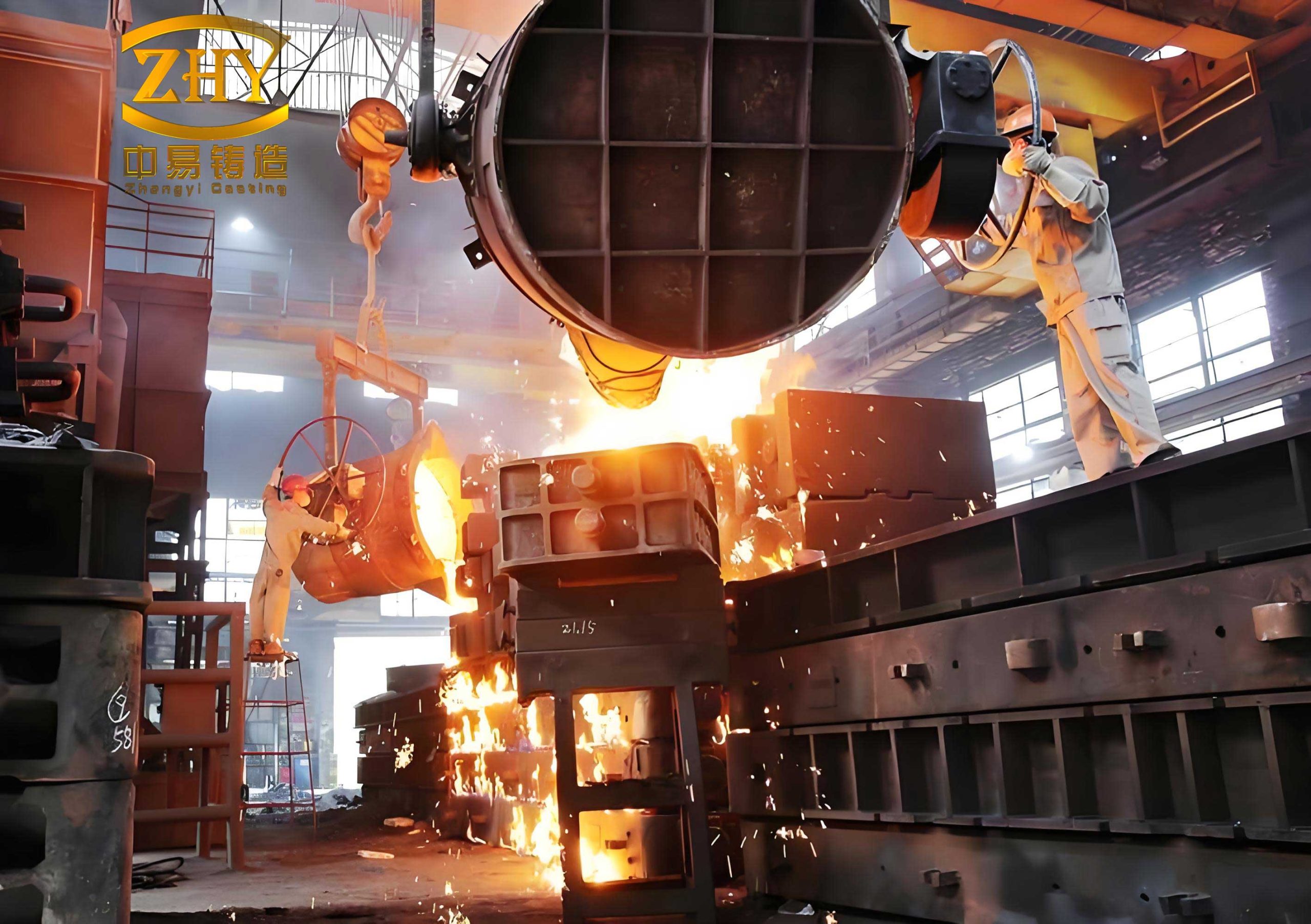
The first critical dimension is the Dimensional and Weight Accuracy of cast iron parts. It is impractical to measure every single dimension. Therefore, I classify dimensions into three categories: Critical Dimensions (those significantly affecting machining and assembly), General Dimensions, and Non-machined Wall & Rib Thickness. Sampling frequencies and tolerance ranges are defined for each category. The tolerance tables are constructed based on the nominal size and the overall maximum dimension of the cast iron part. For the weight of cast iron parts, an upper deviation limit is set as a percentage of the nominal weight. Excessive weight indicates poor design optimization and wasteful material use, a common issue when cast iron parts are priced purely by weight. The score for this section, $S_d$, is calculated based on the conformity rate of sampled dimensions and adherence to weight and straightness tolerances. For a cast iron part with $n_c$ critical dimensions checked, $n_g$ general dimensions, and $n_w$ wall thicknesses, with $p_c$, $p_g$, $p_w$ being the pass rates respectively, and assessments for straightness ($f_s$) and weight ($f_w$), the score can be modeled as:
$$ S_d = w_1 \left( \frac{p_c + p_g + p_w}{3} \right) + w_2 \cdot f_s + w_3 \cdot f_w $$
where $w_1$, $w_2$, $w_3$ are sub-weights within this dimension. If straightness or weight deviation exceeds twice the allowable limit, the respective sub-score $f_s$ or $f_w$ becomes zero.
The following table exemplifies the tolerance scheme for general dimensions of cast iron parts:
| Maximum Dimension of Cast Iron Part (mm) | Nominal Size Range (mm) | Tolerance ± (mm) |
|---|---|---|
| ≤ 1000 | ≤ 100 | 1.0 |
| 101 – 250 | 1.5 | |
| 251 – 630 | 2.0 | |
| 631 – 1000 | 2.5 | |
| 1001 – 2500 | ≤ 250 | 2.0 |
| 251 – 1000 | 2.5 | |
| 1001 – 2500 | 3.0 | |
| > 2500 | ≤ 1000 | 3.0 |
| > 1000 | 4.0 |
The second dimension is Geometric Form and Aesthetic Appearance. This encompasses the visual and tactile quality of cast iron parts. Key metrics include surface flatness over any 600mm length, correctness of fillets and rounds, mismatch on non-machined fitting surfaces, and the severity of surface defects like sand inclusion, rough surfaces, cold shuts, and shallow porosity. The allowable limits for surface defects are defined based on the weight of the cast iron part and the maximum dimension of individual defects or their total area. For example, oil reservoir surfaces on cast iron parts must be completely free from sand adherence or potential leakage. The score $S_a$ for appearance is reduced proportionally based on the extent of deviations. If flatness or defect size exceeds double the allowable limit, the full points for that sub-category are lost.
| Weight of Cast Iron Part (kg) | Max Defect Dimension (mm) | Max Total Defect Area (cm²) |
|---|---|---|
| ≤ 100 | 3 | 2 |
| 101 – 1000 | 5 | 5 |
| 1001 – 5000 | 8 | 10 |
| > 5000 | 12 | 20 |
The third dimension addresses Internal and Structural Defects in cast iron parts. This includes all subsurface discontinuities such as gas holes, slag inclusions, shrinkage porosity, cracks, and gross defects like broken cores or missing sections. Defects are penalized based on their location and severity. Defects on non-machined surfaces incur a base deduction. If found on general machined surfaces, the penalty is increased; if on critical sliding surfaces like guideways, the penalty is significantly higher. However, the total deduction from this category cannot exceed its assigned weighting coefficient. A specific table governs the scoring reduction for cracks based on their length relative to the part’s dimension in that direction and the part’s classification (e.g., base component, stressed part). This ensures that the evaluation of cast iron parts accounts for the criticality of defect location.
The fourth and often most crucial dimension is the Material Properties of the cast iron parts. This is subdivided into Mechanical Performance and Service Durability. Mechanical performance for cast iron parts is primarily evaluated via tensile strength ($\sigma_b$), bending strength ($\sigma_{bb}$), deflection ($f$), and hardness (HB). Since test bars can differ from the actual cast iron part, a “quality rate” is defined. For strength and deflection, values exceeding the standard by 10% are considered optimal, while falling below 10% of the standard constitutes a failure. The scoring, $S_m$, uses a piecewise function. For a property $P$ with standard value $P_s$, the quality rate $Q(P)$ is:
$$
Q(P) = \begin{cases}
1.0 & \text{if } P \ge 1.1P_s \\
\frac{P – 0.9P_s}{0.2P_s} & \text{if } 0.9P_s \le P < 1.1P_s \\
0 & \text{if } P < 0.9P_s
\end{cases}
$$
Hardness is treated differently. The standard specifies a range. The midpoint of the specified hardness range for the cast iron part’s grade and wall thickness is taken as the optimal value ($H_{opt}$). For major surfaces like guideways, the quality coefficient $Q_h$ is calculated as the ratio of the measured average hardness $H_m$ to $H_{opt}$, capped at 1.0 (i.e., $Q_h = \min(H_m / H_{opt}, 1.0)$). This encourages consistency rather than just maximum hardness.
Service durability for cast iron parts includes machinability and wear resistance. Machinability is assessed via the precision class of machining allowances, which directly affects the economic cost of subsequent processing. A scoring table maps allowance precision classes to points. Durability also involves factors like residual stress and wear resistance. For cast iron parts under alternating loads (e.g., connecting rods), surface treatments like shot peening are mandatory for full points. For guideway cast iron parts, a standardized wear test is proposed: a reciprocating test under specified pressure, speed, and lubrication conditions, measuring weight loss over time. Residual stress is measured, with a target value for premium cast iron parts set at, for example, 50 MPa. Exceeding this reduces the score proportionally.
The overall quality index $Q_{total}$ for the cast iron part is the weighted sum of scores from all dimensions:
$$ Q_{total} = \sum_{i=1}^{n} k_i \cdot S_i $$
where $k_i$ is the weighting coefficient for dimension $i$ (with $\sum k_i = 1$), and $S_i$ is the normalized score (0 to 1) for that dimension. The final percentage is $Q_{total} \times 100\%$. Based on this percentage, the cast iron part is graded:
– Premium: $Q_{total} \ge 0.85$
– First-Grade: $0.70 \le Q_{total} < 0.85$
– Conforming: $0.60 \le Q_{total} < 0.70$ (with any single critical defect category possibly leading to failure regardless of score).
The weighting coefficients $k_i$ are not fixed; they must be assigned based on the functional class of the cast iron part. I propose classifying machine tool cast iron parts into seven usage categories, such as Base/Frame Components, Highly Stressed Parts, Pressure Containment Parts, Precision Parts, Exterior/Aesthetic Parts, and Balancing Parts. For a base component like a machine bed cast iron part, dimensional accuracy and material properties might carry higher weights. For an exterior cover cast iron part, aesthetic appearance would be more significant. This tailored weighting is essential for a fair evaluation that reflects the true fitness-for-purpose of different cast iron parts.
To illustrate the application of this system, consider a vertical column cast iron part made of HT250, with a length of 2500 mm, wall thicknesses around 25 mm, and a rough weight of 1500 kg. Suppose inspection yields: Dimensional accuracy score $S_d = 0.75$, Appearance score $S_a = 0.80$, Defect score $S_f = 0.65$, and Material score $S_m = 0.70$. Assuming weights $k_d=0.25$, $k_a=0.15$, $k_f=0.20$, $k_m=0.40$ for this type of stressed base cast iron part, the total quality index is:
$$ Q_{total} = (0.25 \times 0.75) + (0.15 \times 0.80) + (0.20 \times 0.65) + (0.40 \times 0.70) = 0.1875 + 0.12 + 0.13 + 0.28 = 0.7175 $$
This corresponds to 71.75%, placing this particular cast iron part in the First-Grade category. If this same cast iron part were made from a superior material like vermicular graphite iron with enhanced properties ($S_m$ rising to 0.90), the total index could rise to 0.8325 or 83.25%, potentially elevating it to the Premium grade, demonstrating how the system incentivizes material and process improvement for cast iron parts.
Implementing this comprehensive evaluation framework for cast iron parts requires commitment but offers transformative benefits. It moves the focus from mere defect avoidance to holistic quality excellence. For foundries, it provides clear, multi-faceted targets. For purchasers and designers, it offers a transparent metric for qualifying suppliers and justifying premium prices for high-quality cast iron parts. This, in turn, can drive the reform of outdated pricing policies that sell cast iron parts simply by weight—a practice that stifles innovation in lightweighting and performance enhancement. When the economic reward is tied to a comprehensive quality score, manufacturers of cast iron parts gain a powerful motivation to invest in better processes, materials, and process control.
Furthermore, this system addresses the inadequacy of current standards, which often have vague or impractical limits for defects in cast iron parts. By providing clear, measurable, and weighted criteria, it reduces subjectivity in quality arbitration. The integration of machining economy (through allowance precision) and durability (through wear tests) ensures that the evaluation of cast iron parts captures their life-cycle value, not just their as-cast state.
Of course, the practical application of this system for cast iron parts demands reliable inspection data and calibrated measurement techniques. Non-destructive testing methods become crucial for assessing internal defects in cast iron parts. Standardized sample preparation and testing protocols for mechanical and wear properties are essential. The initial setup may seem demanding, but the long-term gains in consistent quality, reduced waste, and higher-performing end products are substantial. The continuous application of this scoring system would generate a valuable database, allowing for statistical process control and the identification of improvement areas specific to the production of various types of cast iron parts.
In conclusion, the persistent quality challenges surrounding cast iron parts are not insurmountable. They require a shift from simplistic management metrics to sophisticated, data-driven evaluation. The methodology I present here—a standardized, digitized, weighted percentage system—aims to provide such a tool. By comprehensively assessing dimensions, appearance, defects, and material properties, and by tailoring importance weights to the cast iron part’s function, we can achieve an intuitive yet rigorous reflection of manufacturing quality. This approach can form the backbone of a reformed quality culture, one that incentivizes the production of superior, reliable, and economically efficient cast iron parts, thereby strengthening the very foundation of the machinery manufacturing industry. The path forward for excellence in cast iron parts lies in embracing such holistic and quantitative quality assessment paradigms.