
In the rapidly evolving landscape of high-speed rail systems, the demand for superior damping components has become paramount to ensure safety, reliability, and passenger comfort. As a key participant in this field, I have focused on enhancing the manufacturing processes for critical parts like the ZG25MnCrNiMo high-speed rail damping box, which plays a vital role in absorbing vibrations and preventing resonance. The current state of domestic foundry technology often falls short in terms of performance stability and longevity, primarily due to gaps in casting and machining processes. Through this project, we aim to leverage advanced foundry technology to improve the quality and durability of these components, thereby contributing to the overall efficiency of rail networks. Foundry technology, particularly in the context of lost foam casting, offers a pathway to overcome existing limitations, and this article delves into the technical nuances of its application.
The high-speed rail damping box, fabricated from ZG25MnCrNiMo steel, is subjected to complex dynamic loads during operation, including static and dynamic stresses from traction motors and wheel-rail interactions. Historically, materials like ZG230-450 carbon steel were used, but the shift to low-alloy steels such as ZG25MnCrNiMo has been driven by the need for enhanced strength and fatigue resistance. However, domestic production has struggled with low yield rates and inconsistent mechanical properties. By adopting lost foam casting—a form of advanced foundry technology—we have achieved significant improvements. This method involves creating a foam pattern, coating it with refractory materials, and embedding it in sand before pouring molten metal, which vaporizes the foam and forms the casting. The intricacies of this process require meticulous control over parameters like tree assembly, coating application, and pouring techniques to minimize defects such as shrinkage, cracks, and inclusions.
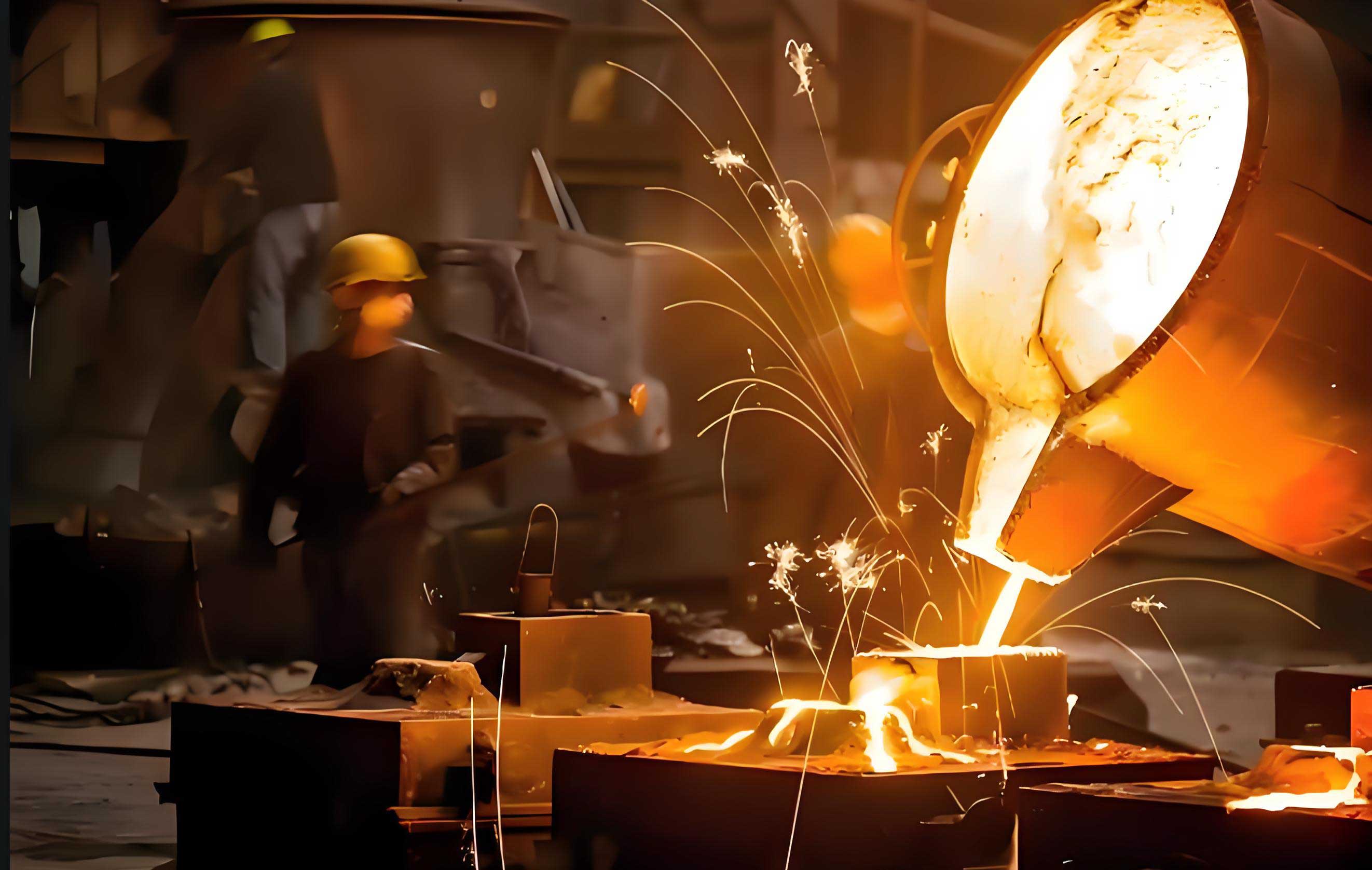
One of the foundational aspects of this foundry technology is the tree assembly process, which involves arranging multiple foam patterns into a cluster to optimize metal flow and solidification. Using finite element analysis (FEA), we simulate the casting process to predict potential defects and refine the gating and riser design. For instance, the riser dimensions are calculated based on the thermal modulus of the casting, ensuring adequate feeding to prevent shrinkage porosity. The gating system is designed to facilitate a bottom-filling approach, which reduces turbulence and slag entrapment. The relationship between the casting volume $V_c$ and the riser volume $V_r$ can be expressed using Chvorinov’s rule for solidification time: $$t = k \left( \frac{V}{A} \right)^2$$ where $t$ is the solidification time, $V$ is the volume, $A$ is the surface area, and $k$ is a constant dependent on the material and mold conditions. By optimizing this, we achieve a yield rate exceeding 75%, a marked improvement over traditional methods.
The coating process is another critical element in this foundry technology, as it directly impacts the surface quality and dimensional accuracy of the castings. We apply multiple layers of refractory coatings—specifically, the first two layers consist of zircon flour and silica sol-based mixtures—to ensure high-temperature resistance and prevent metal penetration. The viscosity of the coating is controlled between 30 to 50 seconds, as measured by a flow cup, to achieve uniform application. During drying, temperature and time are carefully regulated to avoid cracking; typically, we maintain a drying temperature of 40–50°C for 4–6 hours per layer. The coating thickness $\delta$ can be related to the drying rate $R_d$ through an empirical equation: $$\delta = \alpha \cdot R_d^{-0.5}$$ where $\alpha$ is a material-specific constant. This controlled process reduces surface defects and enhances the overall integrity of the damping box.
Melting and pouring operations are pivotal in foundry technology for achieving the desired metallurgical properties. We use medium-frequency induction furnaces to melt the ZG25MnCrNiMo steel, with strict control over charge composition and tapping temperature. The liquid metal is treated with deoxidizers to minimize oxide inclusions, and the pouring temperature is maintained between 1610°C and 1625°C to ensure fluidity while avoiding gas evolution. The pouring sequence follows a “slow-fast-slow” pattern, with the entire process completed within one minute under a vacuum negative pressure of 0.04–0.06 MPa. The heat transfer during solidification can be modeled using Fourier’s law: $$q = -k \nabla T$$ where $q$ is the heat flux, $k$ is the thermal conductivity, and $\nabla T$ is the temperature gradient. Post-pouring, the pressure is held for 1–2 minutes to stabilize the casting, resulting in a defect-free structure that meets standards like TB/T2427 and TB/T1464.
| Parameter | Before Implementation | After Implementation |
|---|---|---|
| Product Quality | Surface roughness 12.5 µm; inconsistent mechanical properties | Surface roughness 6.5 µm; compliant with TB/T2427 and TB/T1464 |
| Foundry Technology | Precision casting or sand casting; high cost and long lead times | Lost foam casting; improved surface finish and reduced costs |
| Process Yield | Approximately 50%合格率; 70% yield rate | Over 90%合格率; 75% yield rate |
| Machining Efficiency | CNC turning without dedicated fixtures; low precision | Machining centers with custom fixtures; doubled efficiency |
| Equipment Utilization | Medium-frequency furnaces and heat treatment ovens | Enhanced with dedicated tooling and controlled processes |
To further elucidate the advancements in foundry technology, we can examine the mechanical properties achieved through this process. The ZG25MnCrNiMo steel exhibits a tensile strength $\sigma_t$ that can be calculated using the Hall-Petch relationship for grain size strengthening: $$\sigma_t = \sigma_0 + k_y \cdot d^{-1/2}$$ where $\sigma_0$ is the friction stress, $k_y$ is the strengthening coefficient, and $d$ is the average grain diameter. By controlling the cooling rate and heat treatment parameters—such as normalizing at 920°C followed by tempering—we achieve a fine-grained microstructure that enhances fatigue resistance. Non-destructive testing, including ultrasonic and magnetic particle inspection, confirms the absence of internal defects like cracks and porosity, which are common pitfalls in inferior foundry technology.
The economic implications of adopting this advanced foundry technology are substantial. As shown in the table above, the shift to lost foam casting has not only improved product quality but also reduced production costs and lead times. For example, the use of dedicated fixtures in machining centers has halved the processing time while improving dimensional accuracy to within ±0.05 mm. This aligns with the broader goals of sustainable manufacturing, as the reduced scrap rates and energy consumption contribute to a lower environmental footprint. The integration of digital simulations and real-time monitoring in foundry technology allows for predictive maintenance and continuous improvement, ensuring that the damping boxes withstand the rigorous demands of high-speed rail operations.
In conclusion, the application of advanced foundry technology, specifically lost foam casting, has revolutionized the production of ZG25MnCrNiMo high-speed rail damping boxes. By addressing key aspects such as tree assembly, coating formulation, and controlled pouring, we have achieved a product that exceeds industry standards in terms of performance and longevity. The repeated emphasis on foundry technology throughout this process underscores its critical role in overcoming the limitations of traditional methods. As high-speed rail networks continue to expand, the ongoing refinement of foundry technology will be essential for meeting future challenges and enhancing global transportation safety.
Looking ahead, we plan to explore further innovations in foundry technology, such as the incorporation of additive manufacturing for pattern creation and the use of artificial intelligence for process optimization. These developments promise to push the boundaries of what is possible in metal casting, ensuring that components like the damping box remain at the forefront of engineering excellence. The journey of improving foundry technology is continuous, and through collaborative efforts, we can achieve even greater milestones in the years to come.