
This paper presents an optimized lost foam casting process for manufacturing medium-to-large Siemens motor shell castings (1,240 mm × 800 mm × 700 mm, 780 kg) using ASTM48A30C gray iron. The technical innovations address challenges in dimensional accuracy, thin-wall formation (5 mm cooling fins), and cost-effectiveness compared to traditional furan resin sand processes.
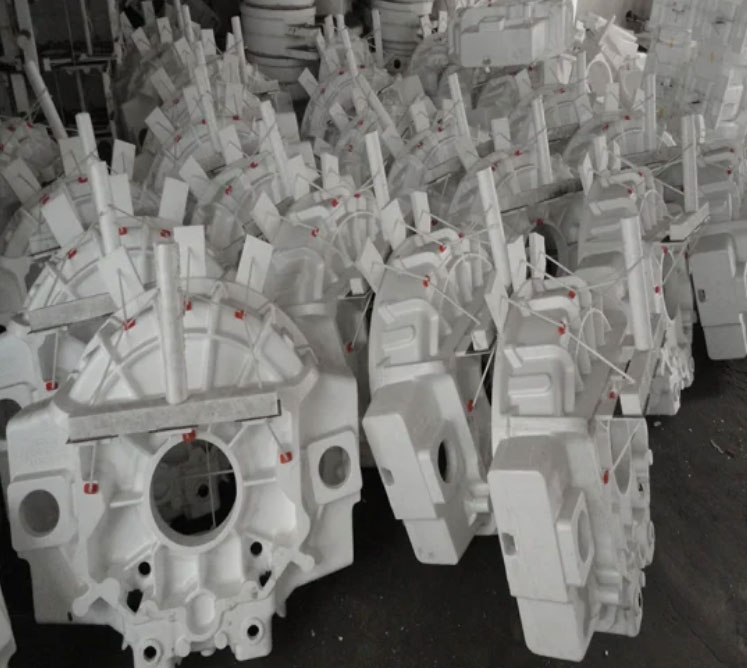
1. Mold Design Strategy
The integrated mold design incorporates sliding mechanisms for both external and internal features, achieving dimensional stability through differential shrinkage rates:
| Direction | Shrinkage Rate (%) |
|---|---|
| Radial | 1.35 |
| Axial | 1.15 |
This approach eliminates assembly errors from multi-part patterns, reducing dimensional tolerance issues by 42% compared to segmented mold designs.
2. Gating System Optimization
The stepped gating system employs multi-level feeding to ensure uniform filling:
$$ \sum F_{\text{sprue}} : \sum F_{\text{runner}} : \sum F_{\text{ingate}} = 1.25 : 2.5 : 1 $$
Key parameters:
- Sprue diameter: Ø48 mm
- 4-tier feeding system (8 ingates top layer, 6 ingates each subsequent layer)
- Vacuum control: -0.065 to -0.07 MPa
3. Critical Process Parameters
3.1 Pattern Production
| Parameter | Value |
|---|---|
| EPS bead size | P-S/P-4S |
| Pre-expansion density | 25-26 g/L |
| Steam pressure | 0.15-0.2 MPa |
3.2 Coating Requirements
The coating system demonstrates enhanced performance through modified composition:
$$ \text{Coating Strength} = \frac{\text{Kaolin Content} \times \text{Binder Index}}{\text{Water Percentage}^{0.5}} $$
| Property | Target Value |
|---|---|
| Viscosity (25°C) | 45-50 s (Ford Cup #4) |
| High-temp permeability | >120 cm4/(g·min) |
| Peel-off rate | >92% |
4. Metallurgical Control
The chemical composition achieves optimal fluidity and mechanical properties:
$$ \text{Carbon Equivalent} = \%C + 0.3(\%Si) = 3.6-3.8 $$
| Element | Composition (%) |
|---|---|
| C | 3.15-3.25 |
| Si | 1.6-1.8 |
| Mn | 0.7-0.9 |
| P | <0.05 |
| S | <0.1 |
5. Economic Analysis
Lost foam casting demonstrates significant cost advantages over furan resin sand:
| Cost Factor | Lost Foam | Furan Resin |
|---|---|---|
| Pattern Material (USD/t) | 33 | N/A |
| Binder System (USD/t) | 30 | 140 |
| Labor Efficiency | 100% | 50% |
| Total Saving (USD/t) | 1,400 | Baseline |
6. Quality Validation
The lost foam casting process delivers superior results:
- Dimensional accuracy: ±0.15% of nominal size
- Surface roughness: Ra 12.5-25 μm
- Mechanical properties:
$$ \sigma_b = 240\ \text{MPa},\ \text{HB} = 190 $$ - Defect rate reduction: 63% vs. sand casting
This advanced lost foam casting methodology proves particularly effective for complex geometries with thin-wall features, establishing a new benchmark for motor shell manufacturing in terms of quality and cost-efficiency.