
In the pursuit of manufacturing high-performance, intricate metal components, the production of complex sand casting parts remains a significant challenge for traditional foundry methods. The limitations of conventional pattern-making and core assembly often constrain design freedom, lead to dimensional inaccuracies due to tooling wear, and result in defects like shrinkage porosity in difficult-to-feed sections. This study delves into an integrated approach combining advanced numerical simulation with additive manufacturing (3D printing) to revolutionize the process for creating demanding sand casting parts. We present a detailed investigation focused on a specific complex geometry—a turbocharger volute—to demonstrate the efficacy of this methodology in overcoming traditional limitations.
The component in question is a representative example of geometrically intricate sand casting parts. Its defining feature is a spiral-shaped flow channel with a varying cross-sectional diameter, which must exhibit a smooth surface to minimize aerodynamic turbulence. Externally, it features several mounting bosses and flanges. A critical challenge is the significant thermal mass and height differential between the thin-walled flow channel (often less than 6 mm) and the thicker top sections, creating a high risk of shrinkage defects during solidification. Traditional sand casting struggles with the precise fabrication of the complex core defining this internal spiral cavity, and conventional gating and risering systems often fail to ensure soundness in the upper regions of such parts.
Our methodology is built upon a closed-loop digital process. It begins with the creation of a precise 3D digital model, which serves as the single source of truth for both process simulation and direct manufacturing. The core of our analytical work relies on ProCAST, a dedicated finite element analysis software for simulating casting processes. We simulate the coupled phenomena of mold filling, heat transfer, solidification, and the subsequent formation of potential defects like shrinkage porosity and cold shuts. The initial casting process design followed a conventional approach: a bottom-gating system with a hexagonal star runner at the base and a central riser. The simulation for this initial design (Scheme 1) revealed a critical flaw. While the filling sequence was smooth, the solidification analysis pinpointed a major issue. The relatively small riser solidified too quickly, losing its metallostatic pressure and thermal influence prematurely. This left the top section of the volute, a thermal center, underfed during the critical late stages of solidification. The simulated defect prediction clearly showed a high concentration of shrinkage porosity in this top region, confirming the inadequacy of the design.
The mathematical basis for predicting such shrinkage defects often relates to the local thermal gradient and solidification time. A simplified criterion for soundness in a sand casting part is that the riser must remain liquid and act as a feed source longer than the section it is intended to feed. This can be expressed by comparing solidification times. The solidification time \( t_s \) for a simple shape can be approximated by Chvorinov’s rule:
$$ t_s = B \left( \frac{V}{A} \right)^n $$
where \( V \) is the volume of the casting (or riser), \( A \) is its surface area, \( n \) is an exponent (typically ~2), and \( B \) is a mold constant. For effective feeding, the condition \( t_{s,riser} > t_{s,casting\_section} \) must hold. In our initial design, the \( V/A \) ratio (modulus) of the riser was insufficient relative to the modulus of the volute’s top section.
The optimization (Scheme 2) involved a fundamental redesign of the gating and feeding system. We shifted from a bottom-gate to a top-gate system. More importantly, we integrated the pouring cup and the main riser into a single, voluminous unit. This integration served two key purposes for producing sound sand casting parts: firstly, it significantly increased the thermal mass and modulus of the riser (\( V/A \) ratio), ensuring it solidified last according to Chvorinov’s rule; secondly, the direct contact with the hot metal from the pouring cup provided sustained superheat, further delaying its solidification. This created a powerful thermal and pressure gradient, promoting directional solidification from the thin walls of the volute body toward this massive integrated feeder. ProCAST simulations of the optimized design confirmed this, showing the final hot spots and predicted shrinkage defects successfully moved into the integrated riser, leaving the main volute body sound.
The transition from digital optimization to physical production is where 3D sand printing becomes transformative. Based on the finalized digital model, the mold assembly was decomposed into four discrete sand cores. This decomposition considered practical foundry requirements: ease of handling, coating application, and precise assembly. Key design features included inter-core locating pins to ensure accurate alignment and fixation tabs to prevent core floatation during metal pouring. The following table summarizes the function of each printed core in creating this complex sand casting part:
| Core Number | Primary Function | Key Feature |
|---|---|---|
| 1 | Forms the lower external contour and cavity | Contains location slots for other cores |
| 2 | Forms the upper external contour and cavity | Contains location pins and the top gating/riser cavity |
| 3 | Defines the intricate internal spiral flow channel | Complex geometry only feasible via 3D printing; includes venting channels |
| 4 | Forms the integrated pouring cup/riser | Large volume to ensure thermal mass for feeding |
The cores were manufactured on a binder-jetting 3D printer using silica sand and a furan resin binder. This process builds the cores layer-by-layer directly from the digital data, eliminating the need for any physical patterns or core boxes. This is particularly advantageous for sand casting parts with complex internal geometries like our spiral core (Core 3), which would be extremely difficult or expensive to produce by traditional means.
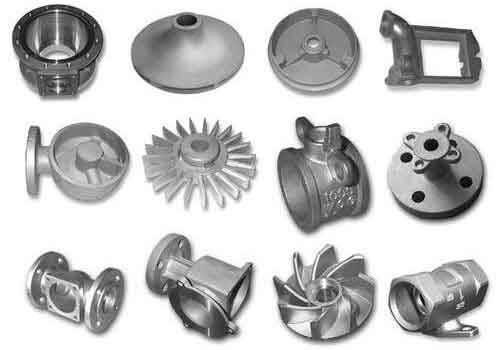
The material selected for this case study was aluminum alloy ZL101A, a common choice for high-integrity sand casting parts in automotive and aerospace applications due to its good castability, strength, and corrosion resistance. Its relevant thermophysical properties for simulation and casting are crucial. The table below outlines key attributes and the boundary conditions used in our simulation and physical trial:
| Parameter Category | Details / Value |
|---|---|
| Alloy | ZL101A (Al-Si-Mg system) |
| Key Properties | Excellent Fluidity, Good Strength-to-Weight Ratio, Good Corrosion Resistance |
| Pouring Temperature | 720 °C |
| Mold Material | 3D-Printed Silica Sand (Furan Binder) |
| Interfacial Heat Transfer Coefficient | 228 W/(m²·°C) |
| Filling Time | ~6 seconds |
The practical validation followed the simulated optimized parameters. The printed cores were assembled, coated with a refractory wash to improve surface finish, and then molded in conventional backing sand. The assembly was secured, and the mold was poured with ZL101A alloy at 720°C. After cooling, the mold was broken, and the casting was cleaned. Visual inspection and, more critically, X-ray non-destructive testing were conducted. The results confirmed the simulation predictions: the final volute casting was free from shrinkage porosity and cold shuts in the main body, with all significant defects successfully relegated to the integrated feeder, which is removed during machining. This validated the entire digital-physical workflow for producing this demanding sand casting part.
The comparative analysis between the initial and optimized schemes highlights the power of simulation-led design. The fundamental improvement can be quantified by comparing the feeding efficiency. We can define a theoretical feeding efficiency \( \eta_f \) for a riser as the fraction of its volume that actually compensates for shrinkage in the casting, excluding the portion that simply solidifies as part of the riser itself. While complex to calculate precisely, the optimization drastically improved this metric for the critical top section of this sand casting part. The key changes are contrasted below:
| Design Aspect | Scheme 1 (Initial) | Scheme 2 (Optimized) | Impact on Sand Casting Part Quality |
|---|---|---|---|
| Gating Method | Bottom Gating (Hexagonal Star Runner) | Top Gating | Simplifies system, reduces erosion potential on delicate core features. |
| Riser Design | Small, Isolated Central Riser | Large, Integrated Pouring Cup/Riser | Maximizes thermal mass and modulus (\(V/A\)), ensuring final solidification and effective feeding pressure. |
| Simulated Defect Location | Shrinkage in Volute Top Section | Shrinkage contained in Integrated Riser | Eliminates defects in the functional body of the casting. |
| Core Count Complexity | Potentially higher (separate riser core) | Reduced & Simplified (4 cores total) | Lowers assembly error, improves dimensional accuracy of the final sand casting part. |
In conclusion, this integrated study demonstrates a robust framework for developing reliable processes for geometrically complex sand casting parts. The synergy between high-fidelity numerical simulation (ProCAST) and flexible digital manufacturing (3D sand printing) creates a potent solution. Simulation allows for rapid, cost-effective iteration and optimization of feeding and gating systems based on scientific principles like Chvorinov’s rule, directly targeting the elimination of defects. 3D printing then faithfully materializes the optimized design, including previously impossible or uneconomical core geometries, while enhancing the dimensional precision and repeatability of the mold assembly. This approach effectively decouples the cost and lead time of new part introduction from part complexity, making it economically viable for both prototyping and low-to-medium volume production of high-value, intricate sand casting parts. The successful production of a sound turbocharger volute serves as a concrete validation, paving the way for broader application of this methodology across industries requiring high-integrity cast components.