
In my extensive experience within the foundry industry, addressing burn-on or bonded sand defects remains one of the most persistent challenges, particularly for complex cast iron parts. These defects not only compromise the surface finish and dimensional accuracy but can lead to complete scrapping of components if the fused sand is irremovable from intricate internal passages. The use of conventional furan resin sand, while efficient, often falls short in specific structural zones where thermal and mechanical stresses are concentrated. This article, drawn from first-hand practical involvement, delves deeply into the root causes and presents a systematic, methodological approach to eliminate bonded sand in these vulnerable areas. The focus is on scalable solutions that do not impede production rhythm or necessitate major alterations to existing pouring practices.
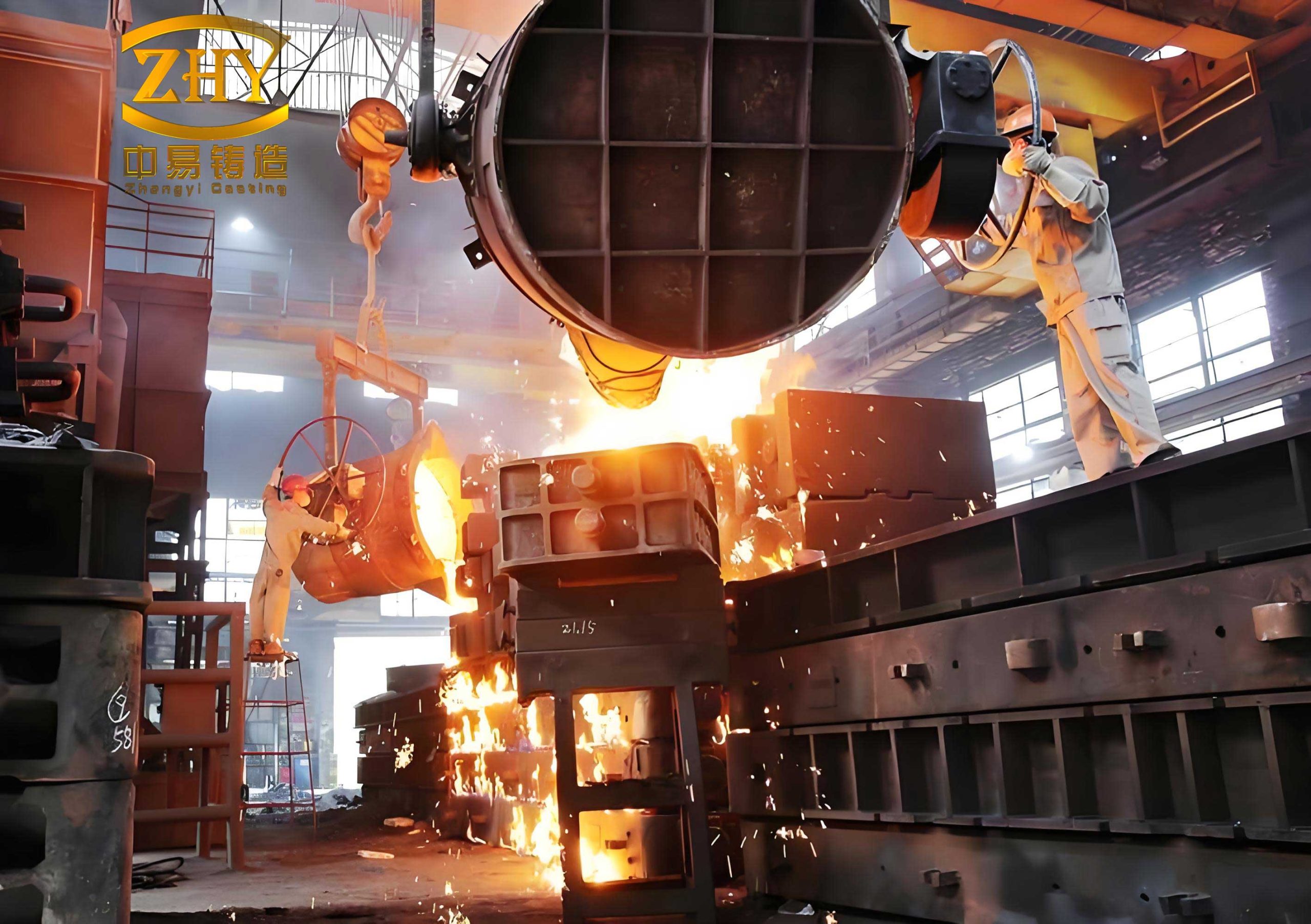
The fundamental issue lies in the infiltration of molten metal or its oxides into the interstices of the sand mold or core. For cast iron parts, this phenomenon is exacerbated in regions with low sand mass-to-metal ratio (low “eat-sand” volume), prolonged metal contact, or intense thermal shock. A comprehensive understanding requires analyzing both mechanical and chemical mechanisms. Mechanically, infiltration is governed by capillary forces. The pressure driving metal penetration can be approximated by the Laplace equation for capillary rise:
$$ P_c = \frac{2 \gamma_{lv} \cos \theta}{r} $$
Here, $P_c$ is the capillary pressure, $\gamma_{lv}$ is the liquid-vapor surface tension of the molten iron, $\theta$ is the contact angle between the iron and the sand substrate, and $r$ is the effective radius of the pores between sand grains. A larger pore radius (coarser sand, poor compaction) and a low or negative $\cos \theta$ (good wettability) significantly increase $P_c$, promoting penetration. Furthermore, the static metallostatic head $P_h = \rho g h$ adds to this driving force. Therefore, the total pressure potential for penetration $P_{total}$ is:
$$ P_{total} = P_h + P_c = \rho g h + \frac{2 \gamma_{lv} \cos \theta}{r} $$
Chemically, the problem intensifies at high temperatures. The silica (SiO₂) in ordinary sand reacts with iron oxide (FeO) from the molten metal to form low-melting-point ferrous silicates like fayalite (Fe₂SiO₄):
$$ 2FeO + SiO_2 \rightarrow Fe_2SiO_4 $$
This reaction has a Gibbs free energy $\Delta G$ that becomes highly negative at casting temperatures, making it spontaneous. The formation of these silicates reduces the viscosity and surface tension of the metal-slag boundary, effectively lubricating the path for deeper metal penetration. The rate of such reaction can be influenced by temperature and the concentration of oxides, following an Arrhenius-type relationship. The chemical attack also dissolves the sand grains, progressively enlarging the pore channels, a process that can be modeled as a surface recession rate. The synergistic effect of mechanical and chemical penetration leads to the tenacious bonded sand layers commonly observed in problematic cast iron parts.
Identifying these critical zones is the first strategic step. Through systematic analysis and pattern recognition in production, I have categorized common failure points across different types of cast iron parts. The following table summarizes these vulnerable locations, which must be targeted during the initial process design phase.
| Part Category | Typical Material | Critical Location | Characteristic Challenge |
|---|---|---|---|
| Machine Tool Components (e.g., beds, columns) | Gray Iron (Flake Graphite Iron) | Jaw chuck surfaces, guideway overhangs (“bending knife” edges), foundation foot pads | Complex geometry leading to inconsistent sand compaction; high pouring temperature (~1380-1400°C). |
| Power Generation Castings (e.g., frames, housings) | Ductile Iron (Spheroidal Graphite Iron) | Lifting lugs, lifting pins, thick-walled bore sections, reinforcing rib junctions | High thermal loading due to section thickness; prolonged exposure to molten metal. |
| Engine Blocks & Cylinder Heads | Gray Iron & Ductile Iron | Internal oil galleries, coolant water jackets, exhaust/intake passages, tappet bores | Very narrow channels surrounded by metal; stringent leak-tightness requirements post-casting. |
| Valve Bodies & Pump Casings | Austenitic Ductile Iron (Ni-Resist) | Flange fillet regions, thin-section protrusions near thick gates | Combination of thermal concentration (hot spots) and structural constraints limiting chill placement. |
Having identified these zones, the core of the solution lies in designing and manufacturing dedicated, high-performance cores or mold sections for these specific areas. A one-size-fits-all approach is ineffective. The selection of the sand mixture, its binder system, and the coating strategy must be tailored to the specific thermal, mechanical, and geometric demands of the location. Based on rigorous experimentation and production validation, I have consolidated four distinct process methodologies, each with its own domain of efficacy for cast iron parts.
| Method Designation | Core Sand Composition & Binder | Coating Strategy | Primary Application Domain (Cast Iron Type & Location) | Key Protective Mechanism |
|---|---|---|---|---|
| Method A: Enhanced Sealing | Standard Silica Sand (AFS 55-65) with Furan Resin (1.1-1.3 wt%) and Acid Catalyst (35-45% of resin weight). | Two-stage brushing: 1st coat: High-penetration refractory coating. 2nd coat: Standard zircon-based/isostatic graphite coating. | Gray iron machine tool parts at jaw chuck, guideway, and foot locations. | Deep penetration of fine refractory particles seals surface pores; secondary coat provides a consolidated barrier. |
| Method B: High Refractoriness & Chill | Chromite Sand (100%), with Furan Resin (0.9-1.2 wt%) and reduced Acid Catalyst (30% of resin weight). | Full immersion coating using a high-alumina or zircon slurry. | Ductile iron power castings at lifting lugs, heavy-section bores, and other high-heat-load isolated features. | High refractoriness (>1900°C), high thermal conductivity (≈3x silica sand), and neutral chemical behavior prevent wetting and penetration. |
| Method C: Combined Chill & Molding | Chromite Sand premixed with Steel Shot (Ratio 3:1 by volume). Binder: Furan Resin (0.9-1.2 wt%), Catalyst (30%). | Two-stage brushing as in Method A, ensuring coating covers the composite surface. | Ductile iron castings at critical flange fillets or junction hot spots where external chills are non-viable. | Steel shot provides intense localized chilling, suppressing shrinkage porosity; chromite sand matrix provides the bond-resistant molding surface. |
| Method D: Slag-Forming Barrier | Chromite Sand with addition of Iron Oxide (Fe₂O₃) Powder (0.5-0.7 wt% of sand mix). Binder: Furan Resin (0.9-1.2 wt%), Catalyst (30%). | Full immersion coating with a specialty refractory slurry. | Engine block and cylinder head water jackets, oil galleries, and other internal passages in both gray and ductile cast iron parts requiring pressure tightness. | At high temperature, Fe₂O₃ participates in forming a viscous, glassy silicate glaze on the metal-sand interface, creating an easily separable layer and preventing metal interlocking. |
Method A: Enhanced Sealing for Gray Iron Parts. For high-pour-temperature gray iron castings, the problem is often inadequate surface sealant integrity. Ordinary coatings may only penetrate 1-2 grain depths. The high-penetration (hypertonic) coating has a particle size distribution designed to infiltrate deeper into the sand matrix, filling voids. The penetration depth $d_p$ can be related to coating viscosity $\eta$, applied pressure $P_a$, pore radius $r$, and time $t$ through a simplified form of the Lucas-Washburn equation:
$$ d_p = \sqrt{\frac{r \gamma_{cv} \cos \theta_c}{2\eta} t} $$
where $\gamma_{cv}$ and $\theta_c$ are the surface tension and contact angle of the coating. The first coat achieves deep sealing. The second, standard coat builds a robust facing. This dual-layer system dramatically increases the effective “seal thickness” and pore-plugging efficiency, solving粘砂 in complex but non-heavy-section gray iron features without affecting cycle time.
Method B: Chromite Sand for High-Heat Load Areas. The superior properties of chromite sand are quantifiable. Its thermal diffusivity $\alpha$, crucial for dissipating heat, is significantly higher than silica sand:
$$ \alpha = \frac{k}{\rho C_p} $$
where $k$ is thermal conductivity, $\rho$ is density, and $C_p$ is specific heat capacity. Chromite’s $k$ is approximately 2.5-3.0 W/m·K versus 0.5-1.0 for silica sand. This higher $\alpha$ leads to rapid cooling of the metal skin, increasing its viscosity and freezing time $t_f$ near the interface, thereby reducing penetration time. Furthermore, its basic nature minimizes the acidic reaction with iron oxides, shifting the thermodynamic equilibrium away from low-melting fayalite formation. The reduced binder level is feasible due to chromite’s angular grain shape and high surface area, which improve green strength, and is necessary to minimize gas generation from the resin.
Method C: Chromite-Steel Shot Composite for Hot Spots. This method ingeniously combines chilling and molding. The steel shot, with its very high thermal capacity and conductivity, acts as an internal chill. The heat extraction rate $Q_{extract}$ from the solidifying metal can be approximated by:
$$ Q_{extract} = h_c A_s (T_m – T_s) $$
where $h_c$ is the effective heat transfer coefficient at the metal-chill interface, $A_s$ is the contact area, $T_m$ is the metal temperature, and $T_s$ is the initial chill temperature. The intimate mix ensures a large $A_s$. This rapid extraction not only prevents penetration by promoting a stable solid skin but also addresses the associated shrinkage porosity in these hot spots, a common co-defect in ductile cast iron parts. The chromite sand surrounding the shot maintains the mold shape and provides the non-wetting surface.
Method D: Slag-Forming System for Internal Passages. This is a chemically active defense. The added iron oxide powder (Fe₂O₃) undergoes reduction and reaction at the interface. The process can be simplified as the formation of a ferrous-alumino-silicate glass. The viscosity $\eta_{slag}$ of this glass is temperature-dependent, following the Vogel-Fulcher-Tammann equation:
$$ \eta_{slag} = A \exp\left(\frac{B}{T – T_0}\right) $$
At the interface temperature, $B$, $T_0$ are constants related to composition. A properly formulated mix ensures $\eta_{slag}$ is high enough to form a solid barrier but low enough initially to coat the sand grains. This glaze layer has a very low adhesion strength to the solidified iron, ensuring perfect peel-off during shakeout. This is critical for long, narrow passages in engine cast iron parts where mechanical cleaning is impossible.
The success of these specialized cores hinges not just on their material composition but also on precision in design and rigorous control during core making and handling. Poorly designed or placed cores can introduce other defects like dimensional inaccuracy or even collapse. Based on lessons learned, I adhere to the following design and operational protocol.
| Aspect | Design Principle / Operational Step | Technical Rationale & Mathematical Consideration |
|---|---|---|
| Core Design | Core weight ≤ 20 kg; core for upper mold sections ≤ 2 kg. Adequate core print dimensions for stability. | Minimizes handling deformation and stress on prints. Stability check: Core weight × gravitational acceleration must be less than the shear strength of the print contact area. |
| Dimensional Control | Core-to-mold clearance ≤ 0.5 mm. Use of alignment gauges or fixtures for critical locations. | Prevents metal run-around (finning). Clearance $c$ affects potential fin thickness. For a given metal head $h$, fin length $L_f$ can be estimated from fluid flow between parallel plates. |
| Venting | Mandatory integrated venting from the core interior to the core print or external atmosphere. | Prevents core gas pressure build-up which can cause blowholes or even reverse metal penetration. Gas pressure $P_{gas}$ must satisfy $P_{gas} < P_{metal static} + P_{capillary}$ at the interface to prevent eruption. |
| Core Making | Precise sand mixing: Homogeneity index > 95% for composite mixes (Method C & D). Controlled compaction. | Ensures uniform properties. For Method C, the volume fraction of steel shot $\phi_{shot}$ must be consistent to guarantee predictable chilling power. |
| Coating Application | For brush coatings (Methods A, C): Ensure full, even coverage without pooling. For dip coatings (B, D): Control dip time and draining to achieve consistent coating weight. | Coating thickness $t_{coat}$ is critical for barrier effectiveness. Target $t_{coat} > 3 \times d_{90}$ sand grain size. Dip time $t_{dip}$ is optimized using the drainage model for a thin film. |
| Core Setting | 1. Clean seat. 2. Dry-fit and verify alignment/gap. 3. Apply adhesive bead (Ø~5mm) only on print perimeter. 4. Set and press firmly. 5. Seal any residual gap with backed-up sand. | The adhesive bead provides sealing against metal penetration along the print joint without creating a thick, gas-generating layer. The perimeter application minimizes trapped gas volume $V_{trap}$. |
The implementation of these methods requires a synergistic view of the entire process. For instance, the gating system design must be reviewed to minimize direct impingement on these special cores. The pouring temperature, while not drastically lowered, should be optimized within the acceptable range for the specific cast iron parts grade to reduce thermal load. A quantitative assessment of the effectiveness can be made by defining a “Bonding Resistance Index” $BRI$ for a core:
$$ BRI = \frac{(k_{sand} \cdot \Delta T_{solidus}) + (S_{coat} \cdot t_{coat}) + (C_{chem} \cdot \Delta G_{reaction})}{r_{pore} \cdot \cos \theta} $$
where $k_{sand}$ is thermal conductivity of the sand, $\Delta T_{solidus}$ is the undercooling achievable, $S_{coat}$ is the sealing factor of the coating, $C_{chem}$ is a chemical inertness coefficient, and $\Delta G_{reaction}$ is the Gibbs free energy change for the detrimental silicate formation (preferably positive or less negative). The denominator represents the driving force for penetration. Methods B, C, and D aim to maximize the numerator while Methods A and D also work to minimize the effective $r_{pore}$ and $\cos \theta$ through sealing and glaze formation.
In conclusion, combating bonded sand in critical areas of cast iron parts is not about a single silver bullet but a targeted, engineered response. The four methodologies—Enhanced Sealing with hypertonic coatings for gray iron, High-Refractoriness Chromite sand for isolated heavy sections, Composite Chromite-Steel Shot for hot spots, and the Slag-Forming Chromite-Iron Oxide system for internal passages—provide a robust toolkit. Their successful deployment hinges on proactive identification of risk zones during the CAD and process simulation stage, the design of dedicated cores, and strict adherence to specialized mixing and handling protocols. By integrating these methods, foundries can achieve a significant reduction in scrap rates and finishing costs for high-integrity cast iron parts, moving towards zero-defect manufacturing in even the most geometrically and thermally challenging castings. The continuous refinement of these methods, perhaps through the integration of advanced simulation tools to predict $P_{total}$ and $BRI$ for specific core designs, remains a fruitful avenue for further research and application in the field.