
In our pursuit of advanced foundry technologies, we have developed and implemented a novel process utilizing basic oxygen furnace (BOF) slag as a hardening agent in flowable and self-hardening sands for the production of large cast iron parts. This approach stems from a commitment to leveraging local resources and improving the quality and efficiency of casting operations. The adoption of BOF slag, a by-product from steelmaking, replaces traditional hardeners like red mud, offering significant advantages in terms of material performance, cost-effectiveness, and environmental sustainability. Over extensive trials and practical applications, we have observed that this method not only enhances the properties of molding sands but also mitigates common defects in cast iron parts, such as shrinkage and deformation, thereby ensuring the reliability of heavy-duty components like machine tool beds and columns.
The core of this innovation lies in the chemical and mineralogical characteristics of BOF slag. Compared to red mud, BOF slag exhibits a higher basicity, which influences the hardening kinetics and thermal stability of the sand mixtures. Basicity is defined as the ratio of basic oxides to acidic oxides, typically expressed as: $$ \text{Basicity} = \frac{\text{CaO}}{\text{SiO}_2} $$ For BOF slag, this ratio averages around 2.5, whereas red mud has a basicity of approximately 1.8. This difference plays a crucial role in the hydration and polymerization reactions with water glass (sodium silicate), leading to a more controlled hardening process suitable for large cast iron parts. The mineral composition of BOF slag is dominated by low-temperature dicalcium silicate (β-C2S), which lacks inherent hydraulic properties but contributes to reduced high-temperature deformation, a critical factor in preventing defects during the solidification of cast iron parts.
| Component | BOF Slag | Red Mud |
|---|---|---|
| SiO2 | 15-20 | 20-25 |
| CaO | 40-50 | 20-30 |
| Al2O3 | 5-10 | 20-25 |
| Fe2O3 | 10-15 | 30-35 |
| MgO | 5-10 | 1-3 |
| Others | 5-10 | 5-10 |
The mineralogical analysis further highlights the distinctions between these hardeners. BOF slag primarily consists of β-dicalcium silicate, magnesioferrite, and traces of periclase, while red mud contains hydraulic high-temperature dicalcium silicate, hematite, and calcium aluminate ferrite phases. This composition affects the sand’s behavior during the casting process, particularly in terms of hardening time and thermal expansion. For instance, the absence of highly hydraulic phases in BOF slag results in a slower, more manageable hardening rate, which is beneficial for large molds used in producing massive cast iron parts. The reduction in high-temperature deformation minimizes the risk of mold wall movement, a common cause of shrinkage defects in thick-section cast iron parts.
| Mineral Phase | BOF Slag | Red Mud |
|---|---|---|
| β-Dicalcium Silicate (β-C2S) | Major | Minor |
| Magnesioferrite (Mg,Fe)O | Significant | Absent |
| Periclase (MgO) | Trace | Absent |
| High-Temp Dicalcium Silicate (α-C2S) | Absent | Major |
| Hematite (Fe2O3) | Minor | Major |
| Calcium Aluminate Ferrite | Trace | Present |
In our experimental setup, we formulated flowable and self-hardening sands using BOF slag as the hardening agent. The basic recipe for flowable sand includes silica sand, BOF slag, water glass, sodium alkyl silicate as a surfactant, and water. The proportions are optimized based on the specific requirements of the cast iron parts. For example, a typical mix for flowable sand involves: 100 parts silica sand, 8-10 parts BOF slag, 6-8 parts water glass (with a modulus of 2.2-2.4), 0.1-0.2 parts sodium alkyl silicate, and 4-5 parts water. This formulation ensures adequate fluidity for molding complex geometries while providing sufficient strength after hardening. The hardening reaction can be described by the interaction between water glass and calcium oxides in the slag: $$ \text{Na}_2\text{O} \cdot n\text{SiO}_2 + \text{CaO} + \text{H}_2\text{O} \rightarrow \text{CaSiO}_3 \cdot m\text{H}_2\text{O} + \text{NaOH} $$ This yields a calcium silicate hydrate gel that binds the sand grains, contributing to the mold’s integrity during the pouring of molten iron for cast iron parts.
We conducted comprehensive tests to evaluate the performance of BOF slag-based sands. Key parameters included hardening time, compressive strength, high-temperature deformation, and residual strength. The hardening time is measured as the duration for a standard test specimen to reach a specific hardness, typically using a penetration method. For flowable sand with 7% water glass, the hardening time is approximately 90-120 minutes, which allows adequate working time for molding large cast iron parts. Compressive strength is assessed using cylindrical samples, and the results show that BOF slag sands achieve strengths of 5-8 kg/cm² after 24 hours, suitable for withstanding the metallostatic pressure of heavy cast iron parts. The strength development follows an exponential trend: $$ \sigma(t) = \sigma_{\infty} (1 – e^{-kt}) $$ where \(\sigma(t)\) is the compressive strength at time \(t\), \(\sigma_{\infty}\) is the ultimate strength, and \(k\) is a rate constant dependent on the slag content and ambient conditions.
| Property | Value | Test Conditions |
|---|---|---|
| Hardening Time | 90-120 min | With 7% water glass, at 25°C |
| Compressive Strength (24h) | 5-8 kg/cm² | Standard cylindrical sample |
| High-Temperature Deformation | < 1% | At 800°C under 2 kg load |
| Residual Strength (after burnout) | 2-4 kg/cm² | Heated to 1000°C for 30 min |
| Flowability | Good | Measured by spread diameter |
High-temperature deformation is a critical factor for cast iron parts, as excessive mold wall movement can lead to shrinkage cavities and dimensional inaccuracies. We measured deformation by heating sand specimens to 800°C under a load of 2 kg, simulating the conditions during casting. BOF slag sands exhibit less than 1% deformation, significantly lower than red mud-based sands, which often show over 2% deformation. This improvement is attributed to the stable mineral phases in BOF slag that resist thermal softening. Additionally, the residual strength after burnout—tested by heating samples to 1000°C for 30 minutes and cooling—remains at 2-4 kg/cm², ensuring that the mold retains enough cohesion to prevent collapse during the cooling of cast iron parts. These properties collectively enhance the quality of large cast iron parts by reducing defects like shrinkage and improving dimensional stability.
In practical applications, we have successfully used BOF slag-based sands to produce a variety of large cast iron parts, including machine tool columns weighing up to 10 tons. Previously, with red mud as the hardener, similar cast iron parts suffered from severe “shrinkage sinking” defects, leading to high rejection rates despite adjustments in pouring techniques and riser design. After switching to BOF slag, these defects were virtually eliminated, demonstrating the effectiveness of this material. For instance, in casting a 5-ton bed plate for a lathe, the flowable sand with BOF slag provided excellent mold filling and minimal distortion, resulting in a sound cast iron part with precise tolerances. This success underscores the potential of BOF slag for heavy-section cast iron parts in industrial foundries.
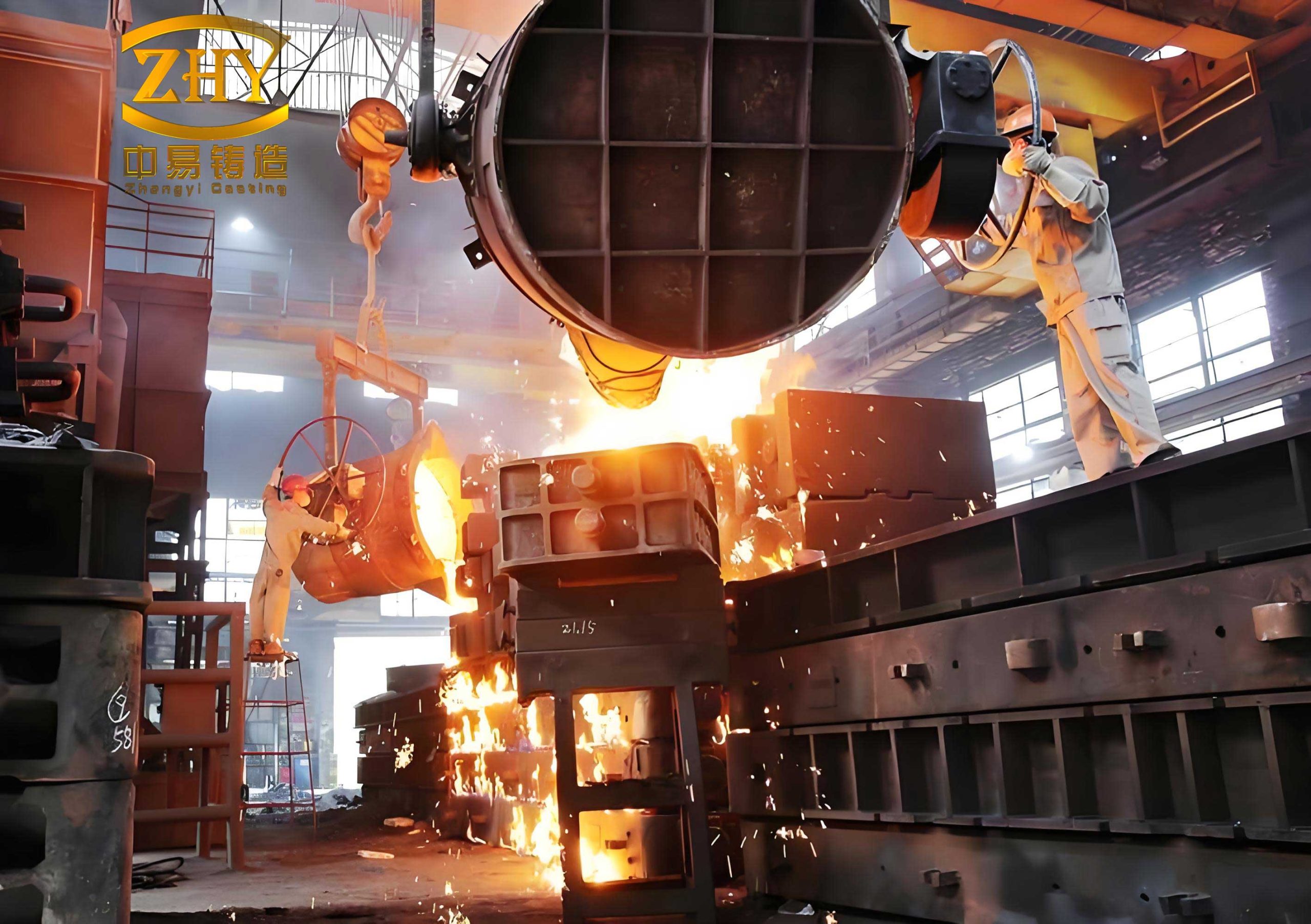
The preparation and handling of BOF slag-based sands are straightforward, requiring no major changes in existing foundry operations. The slag, obtained from basic oxygen steelmaking processes, is self-pulverizing upon cooling, eliminating the need for calcination or fine grinding. We simply screen it to remove coarse particles, resulting in a powder with a bulk density of 1.2-1.5 g/mL. When mixed with silica sand and other additives, the homogeneity of the blend is maintained without premature hardening, which is crucial for consistent performance in producing cast iron parts. The sand mixtures are prepared in batch mixers, ensuring uniform distribution of BOF slag and water glass. For self-hardening sands, used for thicker cast iron parts prone to shrinkage, the配方 is adjusted to include higher slag content (10-12%) and lower water glass (5-6%), promoting faster surface hardening while maintaining core permeability for gas escape during solidification.
We have developed standard formulations for both flowable and self-hardening sands, as summarized in Table 4. These recipes are tailored to different types of cast iron parts, considering factors like wall thickness and complexity. For flowable sands, the emphasis is on fluidity and controlled hardening for intricate shapes, whereas self-hardening sands prioritize early strength and thermal stability for massive cast iron parts. In all cases, the inclusion of BOF slag enhances the sand’s resistance to thermal shock, a common issue in casting large cast iron parts with high pouring temperatures.
| Component | Flowable Sand | Self-Hardening Sand |
|---|---|---|
| Silica Sand | 100 | 100 |
| BOF Slag | 8-10 | 10-12 |
| Water Glass (Modulus 2.3) | 6-8 | 5-6 |
| Sodium Alkyl Silicate | 0.1-0.2 | 0.05-0.1 |
| Water | 4-5 | 3-4 |
The benefits of using BOF slag extend beyond technical performance. Economically, it is a low-cost material sourced locally from steel plants, reducing transportation expenses and reliance on imported hardeners. Environmentally, it repurposes an industrial by-product, aligning with sustainable practices. However, we acknowledge that the properties of BOF slag can vary based on the steelmaking process and slag composition. Therefore, we recommend regular quality control checks, such as chemical analysis and performance testing, to ensure consistency in sand mixtures for cast iron parts. The basicity index can be monitored using the formula: $$ \text{Basicity Index} = \frac{\% \text{CaO} + \% \text{MgO}}{\% \text{SiO}_2 + \% \text{Al}_2\text{O}_3} $$ A target range of 2.0-3.0 is ideal for optimal hardening behavior in cast iron parts production.
In terms of process optimization, we have studied the effects of various parameters on sand performance. For example, the modulus of water glass (ratio of SiO₂ to Na₂O) influences the hardening speed and final strength. A modulus of 2.3-2.5 is preferred for BOF slag sands, as it balances workability and strength development. The water content is critical for flowability; too much water can delay hardening, while too little may reduce fluidity, affecting mold filling for complex cast iron parts. We use the following empirical relation to estimate the optimal water addition: $$ W_{\text{opt}} = k_1 \cdot S + k_2 \cdot G $$ where \(W_{\text{opt}}\) is the optimal water amount, \(S\) is the slag content, \(G\) is the water glass content, and \(k_1\), \(k_2\) are constants derived from experimental data (typically \(k_1 \approx 0.4\) and \(k_2 \approx 0.6\)). This helps in achieving consistent sand properties across different batches for cast iron parts.
Looking ahead, we believe that BOF slag-based sands hold great promise for the foundry industry, especially for large cast iron parts. Future research could explore blending BOF slag with other additives to further enhance properties like collapsibility and moisture resistance. Additionally, life-cycle assessments may quantify the environmental benefits compared to conventional hardeners. We encourage foundries to experiment with this material, adapting the formulations to their specific needs for cast iron parts. By sharing our experiences, we hope to contribute to the advancement of casting technologies, ensuring high-quality production of durable cast iron parts for machinery, automotive, and infrastructure applications.
In conclusion, the integration of basic oxygen furnace slag as a hardening agent in flowable and self-hardening sands represents a significant innovation in foundry practice. Its superior chemical and mineralogical properties lead to improved sand performance, reducing defects and enhancing the dimensional accuracy of large cast iron parts. Through systematic testing and practical application, we have validated its effectiveness, paving the way for broader adoption. As we continue to refine these processes, we remain committed to leveraging local resources and advancing sustainable manufacturing for cast iron parts, ultimately supporting industrial growth and technological progress.