
In the field of aerospace manufacturing, the demand for lightweight and high-strength components has driven significant research into advanced casting techniques. Among these, sand casting remains a versatile and cost-effective method, particularly for large and complex parts. However, producing ultra-thin-walled sand casting parts with stringent dimensional and mechanical requirements presents formidable challenges. This study focuses on the development of a robust sand casting forming process for an aluminum alloy hatch door with an overall wall thickness of only 2 mm. The research encompasses material preparation, mold-filling capabilities, dimensional accuracy control, and internal quality enhancement, all critical for achieving reliable performance in critical structural applications. Through systematic experimentation and process optimization, we have established a comprehensive methodology that ensures the integrity and precision of such delicate sand casting parts.
The primary objective of this work is to address the technical hurdles associated with manufacturing large, thin-walled sand casting parts. These components, such as the hatch door studied here, often feature intricate geometries and must meet rigorous standards for mechanical properties, dimensional tolerances, and internal soundness. By leveraging anti-gravity casting principles and refined sand molding techniques, we aim to demonstrate that sand casting can be successfully applied to produce ultra-thin-walled parts without compromising quality. The insights gained from this research are expected to contribute to the broader advancement of sand casting technology for high-performance applications.
One of the foundational aspects of producing high-quality sand casting parts is the preparation of the alloy material. In this study, we employed D357 aluminum alloy, which is specified in aerospace standards for its excellent strength and castability. However, this alloy requires precise control over composition, particularly regarding impurity levels. To achieve this, we developed a melting and refining process that minimizes gas absorption and oxide inclusion, thereby enhancing the purity of the molten metal.
The key steps in our material preparation process include low-temperature silicon addition and a simultaneous refining, grain refinement, and modification treatment. This integrated approach reduces the thermal exposure of the alloy, limiting hydrogen pickup and slag formation. The refining stage utilizes a combined method of high-purity argon rotary degassing and flux treatment. The rotating injector creates finely dispersed argon bubbles that ascend through the melt, effectively capturing and removing dissolved gases and non-metallic inclusions. The efficiency of this refining process can be described by the following relationship, which models the removal rate of hydrogen:
$$ \frac{dC}{dt} = -k \cdot A \cdot (C – C_s) $$
where \( C \) is the hydrogen concentration in the melt, \( t \) is time, \( k \) is the mass transfer coefficient, \( A \) is the total bubble surface area, and \( C_s \) is the equilibrium concentration at the bubble interface. By optimizing parameters such as gas flow rate and rotation speed, we maximize the refining effect.
To illustrate the compositional requirements, Table 1 compares the standard chemical ranges of D357 alloy with a similar domestic alloy, ZL114A. The stringent limits on impurities in D357 are evident, necessitating high-purity raw materials and meticulous process control.
| Element | ZL114A Alloy (GB/T 1173) | D357 Alloy (AMS 4241) |
|---|---|---|
| Si | 6.5–7.5% | 6.5–7.5% |
| Fe | ≤0.2% | ≤0.12% |
| Mn | ≤0.1% | ≤0.1% |
| Mg | 0.45–0.60% | 0.55–0.60% |
| Ti | 0.1–0.2% | 0.1–0.2% |
| Be | 0.04–0.07% | 0.04–0.07% |
| Individual Impurities | Not specified | ≤0.05% |
| Total Impurities | ≤0.75% | ≤0.15% |
| Al | Balance | Balance |
Through real-time composition analysis and adjustments, we maintained the magnesium content within the narrow range of 0.55–0.60%, ensuring the desired mechanical properties. The resulting alloy exhibited low gas and inclusion levels, providing a clean base material for casting ultra-thin-walled sand casting parts.
The core challenge in manufacturing thin-walled sand casting parts is ensuring complete mold filling while avoiding defects. For the 2 mm wall thickness hatch door, we explored various anti-gravity casting methods, including adjusted-pressure, low-pressure, and counter-pressure casting. These techniques utilize pressure to drive metal flow into the mold, enhancing fillability and controlling solidification under pressure.
Initial trials were conducted using a test mold designed to produce multiple 2 mm thin-walled plates in a single pour. This allowed for a direct comparison of fillability and internal quality under different casting conditions. The浇注 parameters for each method are summarized in Table 2.
| Casting Method | Pouring Temperature (°C) | Synchronization Pressure (kPa) | Fill Speed (mm/s) | Pressure Differential (kPa) | Holding Time (s) |
|---|---|---|---|---|---|
| Adjusted-Pressure | 750 | -90 | 100 | 40 | 400 |
| Low-Pressure | 750 | 0 | 100 | 40 | 400 |
| Counter-Pressure | 750 | 500 | 100 | 40 | 400 |
The fillability results indicated that both adjusted-pressure and low-pressure casting could completely fill the thin sections, while counter-pressure casting showed slightly reduced fillability but was still adequate with proper venting design. However, internal quality assessment via X-ray radiography revealed distinct defect patterns. Adjusted-pressure casting tended to produce pinhole porosity due to hydrogen evolution under vacuum, whereas low-pressure and counter-pressure casting exhibited shrinkage porosity, albeit at lower severity in the counter-pressure case. This can be explained by the influence of pressure on gas solubility and solidification feeding. The equilibrium hydrogen solubility in aluminum follows Sieverts’ law:
$$ C_H = K_H \cdot \sqrt{P_{H_2}} $$
where \( C_H \) is the dissolved hydrogen concentration, \( K_H \) is the equilibrium constant, and \( P_{H_2} \) is the partial pressure of hydrogen. Higher ambient pressure during counter-pressure casting suppresses hydrogen bubble formation, reducing pinhole defects. Nevertheless, shrinkage remains a concern in thin-walled sections due to rapid solidification and limited feeding.
To further evaluate the mechanical performance, we cast test plates with optimized gating and feeding systems using both low-pressure and counter-pressure methods. The tensile properties measured from these sand casting parts are presented in Table 3.
| Casting Method | Tensile Strength, Rm (MPa) | Yield Strength, Rp0.2 (MPa) | Elongation, A (%) |
|---|---|---|---|
| Low-Pressure | 335 | 250 | 8 |
| Counter-Pressure | 365 | 285 | 9 |
| Required Values | ≥345 | ≥276 | ≥5 |
The data clearly shows that counter-pressure casting yields superior mechanical properties, meeting the stringent requirements for critical sand casting parts. The enhanced densification under high pressure improves both strength and ductility. Based on these findings, we selected counter-pressure casting as the primary method for producing the hatch door component.
During initial full-scale trials of the hatch door, incomplete filling occurred in certain areas. Analysis suggested that heat loss in the thin sections was too rapid, hindering metal flow. To mitigate this, we redesigned the gating system to feature closely spaced cylindrical ingates, which distribute heat more evenly and promote平稳 filling. Additionally, we increased the pouring temperature to 755°C ± 5°C and the fill speed to 120 mm/s. Applying a insulating coating to the mold surfaces and improving venting further aided fillability. These modifications successfully eliminated misruns, producing fully formed sand casting parts.
Achieving high dimensional accuracy in large, thin-walled sand casting parts is notoriously difficult due to mold deformation and assembly errors. Traditional wooden patterns and manual core setting are insufficient for tolerances as tight as ±0.6 mm. To overcome this, we adopted a precision sand molding approach using numerically controlled (NC) machined metal patterns for both the cope and drag sections as well as the cores.
The assembly process incorporates定位 pins and sockets embedded in the sand molds to ensure accurate core positioning relative to the mold walls. This method minimizes misalignment and guarantees consistent wall thickness across the entire casting. The following formula can be used to estimate the dimensional error accumulation in sand casting parts:
$$ \Delta D = \sqrt{ \sum_{i=1}^{n} (\delta_i)^2 } $$
where \( \Delta D \) is the total dimensional deviation, \( \delta_i \) represents individual error sources such as pattern tolerance, core shift, and sand expansion. By controlling each \( \delta_i \) through precision tooling and定位 systems, we reduce \( \Delta D \) to within acceptable limits.
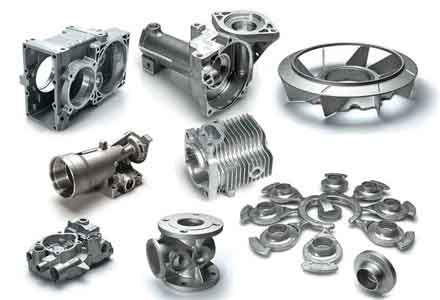
The image above illustrates the type of precision metal molds and sand blocks used in this process, highlighting the complexity involved in creating such thin-walled geometries. Coordinate measuring machine (CMM) inspections confirmed that the produced hatch door castings consistently met the specified dimensional tolerances, validating the effectiveness of this approach for high-precision sand casting parts.
Internal soundness, particularly freedom from shrinkage porosity and voids, is paramount for the structural integrity of sand casting parts. Despite the advantages of counter-pressure casting, our initial hatch door castings revealed localized shrinkage defects at rib intersections and along the centers of panel sections. These areas act as thermal hotspots, solidifying later than the surrounding thin walls and suffering from inadequate feeding.
To address this, we implemented a combined riser and chills system. Riser are placed at strategic locations to provide liquid metal feed during solidification, while chills are interspersed to accelerate cooling in thicker sections, thereby promoting directional solidification towards the riser. The thermal dynamics can be modeled using the Chvorinov’s rule for solidification time:
$$ t_s = B \cdot \left( \frac{V}{A} \right)^n $$
where \( t_s \) is the solidification time, \( V \) is the volume of the section, \( A \) is its surface area, \( B \) is a mold constant, and \( n \) is an exponent typically around 2. For thin walls, \( V/A \) is small, leading to rapid solidification. In contrast, rib intersections have a larger \( V/A \) ratio, resulting in longer \( t_s \) and susceptibility to shrinkage. By applying chills, we effectively reduce \( t_s \) in these areas, synchronizing solidification with the thinner regions.
The optimized riser-chill arrangement is detailed in Table 4, showing the configuration for critical zones of the hatch door casting.
| Location | Section Thickness (mm) | Riser Type | Chill Type | Purpose |
|---|---|---|---|---|
| Rib Intersections | 4–6 | Blind Riser | Iron Chill | Enhance feeding and reduce hotspot |
| Panel Center | 2 (nominal) | Open Riser | Copper Chill | Promote directional solidification |
| Perimeter Edges | 2 | None | Sand Chill | Uniform cooling |
After implementing these modifications, subsequent castings exhibited显著 improved internal quality, with X-ray inspection showing no detectable shrinkage defects above acceptable levels. This demonstrates that proper thermal management through riser and chills is essential for producing sound ultra-thin-walled sand casting parts.
Throughout this research, we have developed and validated a comprehensive sand casting process for manufacturing large, ultra-thin-walled aluminum alloy components. The key achievements include the successful preparation of high-purity D357 alloy, the selection and optimization of counter-pressure casting for superior fillability and mechanical properties, the implementation of precision mold assembly techniques for dimensional control, and the application of targeted riser-chill systems for internal soundness. These elements collectively ensure that challenging sand casting parts, such as the 2 mm wall thickness hatch door, can be produced to meet aerospace-grade standards.
The insights from this work underscore the potential of sand casting as a viable method for high-performance thin-walled applications. Future efforts could focus on further refining process parameters through computational modeling and exploring the integration of additive manufacturing for mold and core production. By continuing to advance these techniques, the manufacturing of complex sand casting parts will become even more efficient and reliable, supporting the evolving needs of modern engineering.