
In the production of complex engine components, the manufacturing of large, intricate housings presents a significant challenge. A particular front-end housing, part of a strategically important diesel engine series, exemplifies the difficulties associated with high-grade gray iron castings. This component is characterized by an extremely complex internal cavity structure, requiring assembly from over forty sand cores of varying shapes to form three distinct layers of water jackets and oil passages. It stands as a quintessential example of a complicated box-type gray iron casting, demanding precision and robustness for high-performance applications.
The rough casting of this front-end housing has an overall envelope dimension of approximately 1800mm x 1100mm x 990mm and weighs roughly 2000kg. Critical wall sections are designed to be 11mm thick, while localized heavy sections can reach up to 60mm. The material specification is high-strength gray iron HT300, a grade known for its demanding compositional control requirements. Instability in melt chemistry further complicates the production of these high-integrity gray iron castings. Furthermore, the component must undergo rigorous hydrostatic pressure testing post-machining, imposing stringent quality standards that preclude any internal defects.
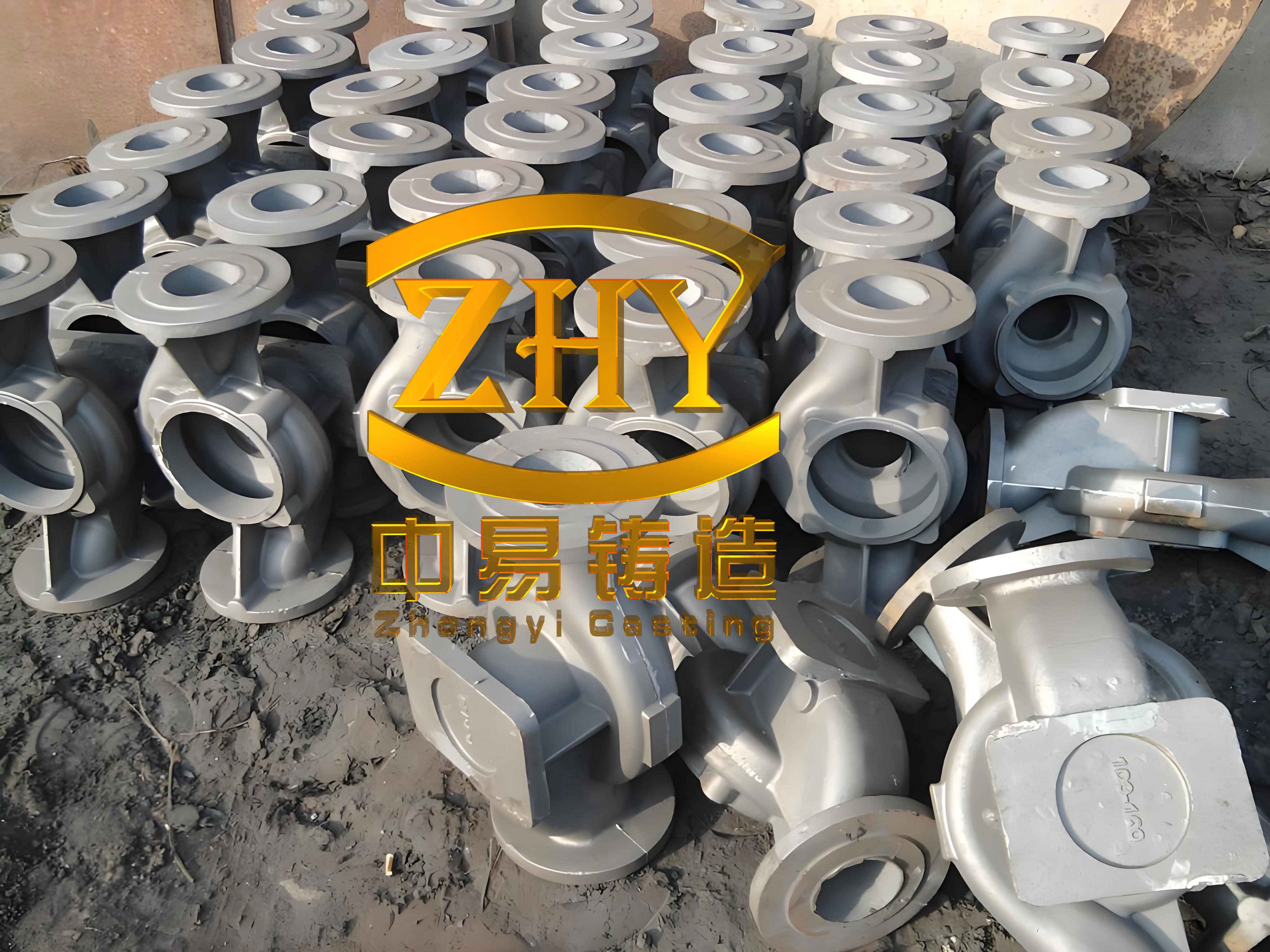
The initial manufacturing process for these gray iron castings utilized alkaline phenolic resin no-bake sand for mold-making, with cores produced manually. A bottom-gating top-riser system was employed. During the trial production phase, several critical defects emerged, severely impacting the yield and quality of these gray iron castings. The primary issues identified were:
- Cracking at internal corners of the intercooler cavity after shakeout.
- Core fracture leading to missing wall sections (misrun due to displaced cores).
- Blowhole defects, particularly severe on the top casting surface and beneath large core assemblies.
The prevalence of gas-related defects was especially pronounced, indicating systemic issues in the process for these large gray iron castings.
Root Cause Analysis and Systematic Improvement Strategy
The approach to rectifying these issues involved a combination of metallurgical principle analysis, process simulation, and practical modification. Each defect family was addressed systematically to enhance the overall quality of the gray iron castings.
1. Analysis and Elimination of Casting Cracks
Cracks in gray iron castings typically result from thermal stresses developed during solidification and cooling exceeding the material’s strength at that temperature. The stress magnitude, $\sigma_{thermal}$, can be conceptually related to the restraint and thermal gradient:
$$
\sigma_{thermal} \propto E \cdot \alpha \cdot \Delta T \cdot R
$$
where $E$ is the elastic modulus, $\alpha$ is the coefficient of thermal expansion, $\Delta T$ is the temperature gradient, and $R$ is the restraint factor. For the problematic housing, analysis revealed two contributing factors: sharp geometrical transitions (small fillet radii) at the crack locations and poor core yield. The massive sand cores provided excessive restraint, hindering the natural contraction of the solidifying gray iron castings.
The implemented countermeasures focused on reducing stress concentration and improving core compliance:
| Problem | Root Cause | Improvement Action | Outcome |
|---|---|---|---|
| Cracking at internal corners | Sharp geometry & high restraint from large core | 1. Added material allowance on core prints to increase fillet radius on final casting. 2. Created hollow structure in large core to improve yield. |
Complete elimination of crack defects in subsequent gray iron castings. |
The core hollowing was ingeniously achieved by placing large-diameter ceramic tubes wrapped with vent ropes during core-making. After curing, the rope was pulled out, allowing the tube to be removed easily, leaving a hollow cavity. This significantly reduced the core’s resistance to contraction, a critical improvement for these restrained gray iron castings.
2. Preventing Core Fracture and Movement
Core fracture (breakage) or floating (displacement) leads to gross dimensional errors and wall thickness violations in gray iron castings. The primary causes are inadequate core strength, insufficient core prints (supports), and unstable core positioning under the dynamic pressure of molten metal. A specific “L-shaped” core was identified as vulnerable due to its unbalanced geometry and lack of support at the corner.
The core’s ability to withstand the metallostatic pressure $P_{metal}$ is crucial:
$$
P_{metal} = \rho \cdot g \cdot h
$$
where $\rho$ is the density of molten iron, $g$ is gravity, and $h$ is the height of the metal column above the core. The original segmented core backbone could not transmit stresses effectively across the corner.
The improvement involved redesigning the core reinforcement system:
- Extended Curing Time: To ensure full resin polymerization and optimal intrinsic sand strength.
- Redesigned Core Barrel (Reinforcement): Shifted from a two-part disconnected backbone to an interlocking system using a connecting block at the critical corner. This created a continuous, rigid structure that could be extracted and reused after casting. The enhanced bending strength of the core backbone directly increased the robustness of the mold assembly for these heavy gray iron castings.
3. Solving the Pervasive Blowhole Defect Problem
Blowholes, particularly the invasive type, were the most dominant defect. Invasive blowholes in gray iron castings form when gases from the mold or core invade the molten metal before the surface solidifies. The pressure balance at the metal-mold interface is key. For a gas bubble to invade, the gas pressure $P_{gas}$ must exceed the sum of the metallostatic pressure $P_{metal}$ and the pressure due to surface tension $P_{\sigma}$ at the pore nucleation site:
$$
P_{gas} > P_{metal} + P_{\sigma} = \rho g h + \frac{2\sigma}{r}
$$
where $\sigma$ is the surface tension and $r$ is the pore radius. The high gas evolution from the resin-bonded sands, coupled with inadequate venting and turbulent filling, created ideal conditions for this defect in our initial gray iron castings.
Our investigation pinpointed two main culprits: ineffective gas evacuation from the complex core assembly and poor gating system design causing turbulence and air entrainment.
A. Revolutionizing Core Venting:
The original method of embedding fibrous vent ropes in the cores was flawed. During sand compaction, the ropes were easily crushed, blocking the intended gas escape paths. Furthermore, there was no system to route these gases outside the mold cavity; they simply accumulated inside, leading to defects in the gray iron castings.
The solution was to replace vent ropes with rigid, perforated metal tubes. These tubes, placed during core-making, cannot be collapsed by sand pressure, maintaining a guaranteed open channel. During mold assembly, these tubes were interconnected and routed to the exterior of the mold using flexible extensions. This created a positive, low-resistance exhaust path for all core gases, fundamentally changing the gas pressure dynamics within the mold and protecting the solidifying gray iron castings.
B. Optimizing the Gating System via Simulation:
We employed MAGMA simulation software to diagnose the original filling pattern. The simulation revealed a critical flaw: the bottom-gating system was unbalanced. Metal flowed preferentially through the first few ingates, while the last ingates saw reverse flow, indicating a non-pressurized, aspirating system highly prone to air entrainment and splashing—a major source of defects in gray iron castings.
| Parameter | Original Gating System | Optimized Gating System |
|---|---|---|
| Type | Unbalanced bottom gating | Bottom gating with “fountain” risers / Extended runner |
| Filling Pattern | Turbulent, reverse flow in some ingates | Laminar, sequential filling from one end |
| Air Entrainment Risk | Very High | Low |
| Slag Trapping | Poor | Good (extended runner acts as slag trap) |
The new system was redesigned as a “fountain” or up-flow style from an extended runner. MAGMA analysis of the new design confirmed a dramatic improvement. The initial metal velocity was reduced, and the runner remained full throughout filling, preventing air aspiration. Tracer particle simulations showed the first metal remained contained within the gating system until the mold cavity began filling quietly from the bottom up. This laminar fill pattern is essential for producing sound, dense gray iron castings free from oxide films and blowholes.
The combined effect of the positive core venting system and the optimized, tranquil filling gating system led to a remarkable reduction in blowhole defects. The quality of the top surface and other previously affected areas of the gray iron castings showed marked improvement.
Consolidated Process Improvements and Results
The series of targeted interventions transformed the manufacturability of this complex front-end housing. The table below summarizes the holistic approach taken to elevate the quality of these challenging gray iron castings.
| Defect Category | Primary Cause | Technical Solution | Mechanism/Principle |
|---|---|---|---|
| Cracking | Stress concentration & core restraint | 1. Increased fillet radii via core print modification. 2. Created hollow core sections. |
Reduced stress concentration factor and improved core yield to accommodate shrinkage of gray iron castings. |
| Core Fracture | Inadequate core strength & stability | 1. Optimized curing cycle. 2. Implemented interlocking core barrel design. |
Increased bending strength and moment resistance of core assembly against $P_{metal}$. |
| Blowholes | 1. Trapped core gases 2. Turbulent filling |
1. Metal tube venting network routed to mold exterior. 2. Redesigned gating for laminar fill (simulation-validated). |
Ensured $P_{gas} < P_{metal} + P_{\sigma}$ via positive venting. Minimized air entrainment by controlling filling velocity profile. |
The final optimized process parameters for producing these high-integrity gray iron castings are captured in the following set of guiding equations and specifications:
Key Process Windows:
- Core Curing: Ensure full cross-linking of resin binder. Time $t_{cure}$ must exceed threshold $t_{critical}$ defined by binder kinetics and core mass.
- Gating Design: The fill time $t_{fill}$ should be controlled to maintain a critical ingate velocity $v_{gate}$ below the turbulence threshold for gray iron, typically below 0.5 m/s. This can be estimated from the Bernoulli principle, considering the effective sprue height $H$:
$$
v_{gate} \approx \eta \cdot \sqrt{2gH}
$$
where $\eta$ is a friction loss coefficient (typically 0.6-0.8 for ceramic systems). The goal is to keep $v_{gate}$ low.
- Venting Design: The total cross-sectional area of vent channels $A_{vents}$ must be sufficient to handle peak gas generation rate $\dot{Q}_{gas}$ from sands without exceeding a critical back-pressure. A rule of thumb is $A_{vents} > k \cdot A_{choke}$, where $A_{choke}$ is the choke area of the gating system and $k$ is an empirical factor (often >1 for large resin-bonded molds).
Conclusion
The successful quality enhancement of this large, high-grade front-end housing underscores several critical principles in the production of complex box-type gray iron castings. First, a systemic approach is necessary, where interactions between geometry, material properties, process physics, and tooling design are thoroughly analyzed. Second, the stability and functionality of the core assembly are paramount; this includes not only strength but also engineered gas evacuation and improved yield to mitigate casting stresses. Third, the critical role of filling dynamics cannot be overlooked. A gating system designed for tranquility, validated through modern simulation tools, is essential to prevent defects like entrapped air and oxides that plague gray iron castings.
The implementation of these synergistic improvements—geometrical modification, core reinforcement and venting, and gating system optimization—resulted in a significant increase in the product yield and quality consistency. The castings now reliably meet the stringent pressure testing requirements post-machining. This case study provides a validated framework for tackling similar challenges in producing other large, intricate, and high-performance gray iron castings, where quality demands are uncompromising.