
In the competitive landscape of mechanical manufacturing, the development of high-integrity shell castings, such as casing couplings, presents significant challenges due to complex geometries involving thick sections, varying wall thicknesses, and multi-cavity structures. These shell castings are critical components in power transmission systems, where defects like shrinkage porosity and macro-shrinkage can compromise mechanical performance and lead to costly failures. Traditional trial-and-error methods in casting process development are time-consuming and resource-intensive, often requiring multiple physical prototypes. To address this, we have adopted an integrated approach leveraging Computer-Aided Design (CAD) and Computer-Aided Engineering (CAE) technologies. This methodology enables virtual prototyping and simulation-driven optimization, substantially reducing development cycles and minimizing试制 costs for new shell castings. In this article, I will detail our comprehensive workflow, from initial process design to final validation, emphasizing the iterative refinement made possible by digital tools.
The foundation of any reliable casting process lies in a well-conceived initial design based on material characteristics and component geometry. For the shell castings under consideration—a large-scale casing coupling with dimensions approaching 500 mm—the material is ductile iron (nodular graphite iron), chosen for its excellent strength-to-weight ratio and castability. However, the presence of heavy sections adjacent to thin walls creates inherent thermal gradients during solidification, predisposing the shell castings to shrinkage defects. Our preliminary process design employed sand casting with a single-cavity mold (“one casting per mold”) configuration. The entire shell casting was positioned in the drag (lower mold half) to facilitate slag removal and enhance feeding for the upper thick sections. The gating system was designed with a top-running approach, aligning the ingate plane with the upper plane of the shell casting to establish a favorable temperature gradient from top to bottom. This promotes the sequential filling and solidification of thin sections under gravitational influence. To counteract shrinkage in the massive upper regions, four insulating feeder heads (risers) were placed on the top surface, supplemented by a feeding riser at the ingate location. The dimensions of the pouring basin, sprue, runners, and ingates were determined through empirical calculations and foundry experience. A summary of key initial design parameters is presented in Table 1.
| Parameter | Value / Description |
|---|---|
| Casting Material | Ductile Iron (Grade EN-GJS-400-18) |
| Process | Green Sand Mold, Single Cavity |
| Casting Orientation | Entirely in Drag |
| Feeding Strategy | 4 Top Insulating Riser Heads + 1 Ingate Riser |
| Gating Type | Top Gating, Ingate Co-planar with Casting Top |
| Key Design Objective | Establish Vertical Temperature Gradient for Thin Sections |
Following the initial design phase, we transitioned to detailed three-dimensional modeling using Pro/ENGINEER (Pro/E), a powerful CAD software. The primary goal was to create accurate digital representations of all tooling components—the shell casting itself, the sand cores (required for internal passages), the gating system, and the insulating riser shells. Creating separate part models for each element enhanced modularity and facilitated subsequent modifications. A critical step in CAD modeling for CAE simulation is geometry simplification. Features non-essential to solidification analysis, such as minor draft angles and fillets added solely for manufacturability or machining purposes, were suppressed. This simplification improves mesh quality during the CAE preprocessing stage, leading to more accurate surface capture and reduced computational time. Since these features relate to post-casting machining allowances, their omission does not materially affect the prediction of solidification-related defects in the shell castings. The individual solid models are shown conceptually below, though actual feature details are omitted per the guidelines.
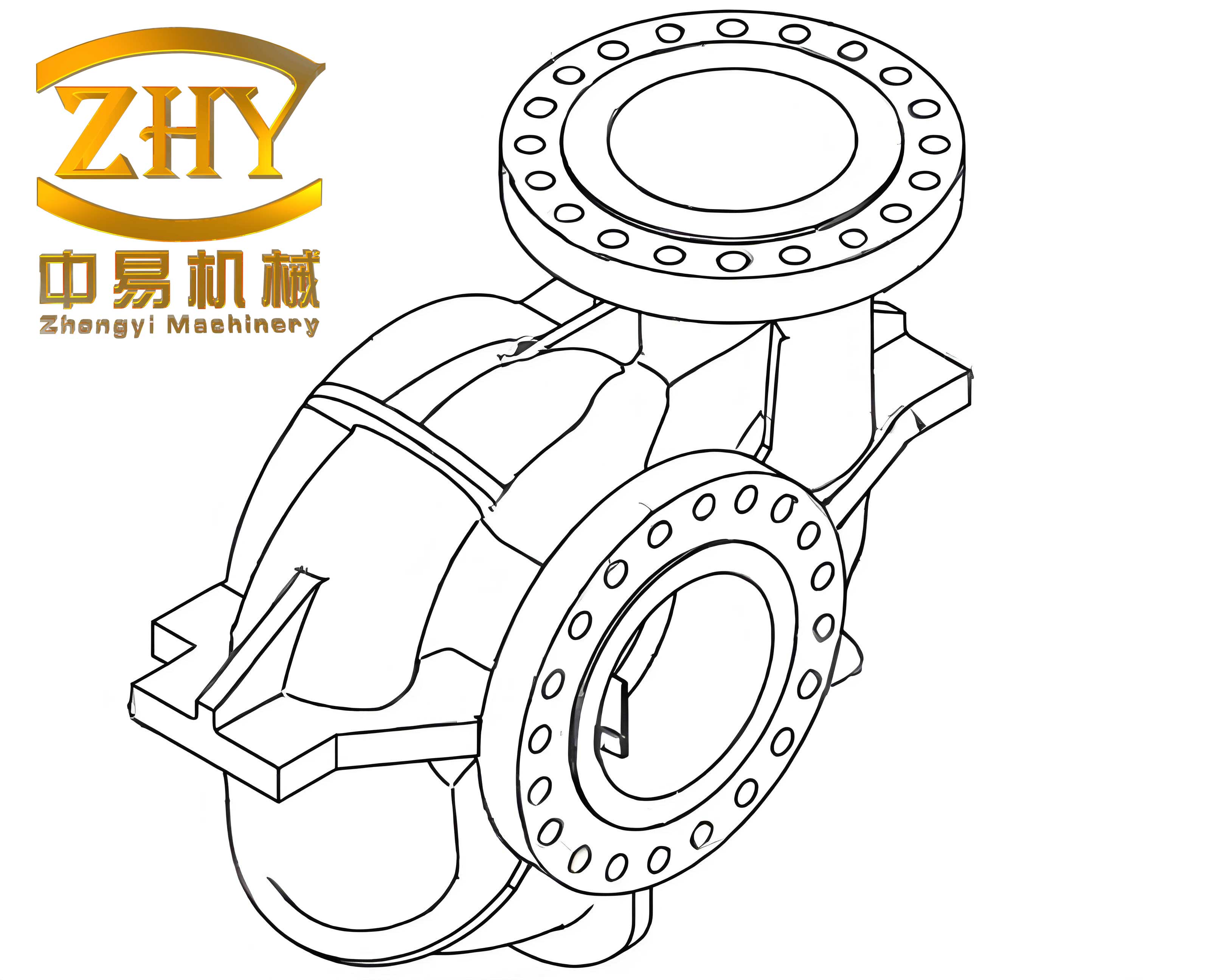
The assembly of all components was performed within the Pro/E assembly module, ensuring correct spatial relationships between the shell casting, cores, and gating channels. To prepare for CAE analysis, the assembly was exported as four distinct STL (Stereolithography) files representing the casting, the gating system, the sand cores, and the riser shells. This format is universally compatible with casting simulation software. Notably, for simulation purposes, the insulating riser volumes were modeled as part of the casting geometry to accurately represent their thermal interaction, even though they are removed during finishing.
The core of our process optimization lies in casting simulation using AnyCasting software. The STL files were imported into the AnyPRE pre-processing module. Here, material properties, boundary conditions, and process parameters were defined. A crucial aspect of efficient simulation is adaptive mesh generation. The computational domain was discretized using a variable-density mesh, with finer cells allocated to the shell casting region and coarser cells to the gating system and mold. This approach balances accuracy and computational cost. The governing equations for fluid flow and heat transfer during mold filling and solidification are solved numerically. The Navier-Stokes equations describe the fluid motion:
$$ \frac{\partial \rho}{\partial t} + \nabla \cdot (\rho \mathbf{u}) = 0 $$
$$ \frac{\partial (\rho \mathbf{u})}{\partial t} + \nabla \cdot (\rho \mathbf{u} \mathbf{u}) = -\nabla p + \nabla \cdot \boldsymbol{\tau} + \rho \mathbf{g} $$
where $\rho$ is density, $\mathbf{u}$ is velocity, $p$ is pressure, $\boldsymbol{\tau}$ is the stress tensor, and $\mathbf{g}$ is gravity. The energy equation, incorporating latent heat release during solidification, is given by:
$$ \frac{\partial (\rho h)}{\partial t} + \nabla \cdot (\rho \mathbf{u} h) = \nabla \cdot (k \nabla T) + S $$
where $h$ is enthalpy, $k$ is thermal conductivity, $T$ is temperature, and $S$ is a source term for latent heat. For the solidifying shell castings, the enthalpy is defined as $h = c_p T + f_L L$, with $c_p$ as specific heat, $L$ as latent heat, and $f_L$ as liquid fraction. The key thermal boundary condition at the metal-mold interface is defined by a heat transfer coefficient (HTC). The parameters configured for the initial simulation are consolidated in Table 2.
| Parameter Category | Parameter | Value |
|---|---|---|
| Process Conditions | Pouring Temperature | 1385 °C |
| Pouring Time | 16.58 s | |
| Sprue Base Diameter | 46 mm | |
| Heat Transfer Coefficients (HTC) | Metal / Sand Mold & Core | 0.1 kW/m²·K |
| Air / Sand Mold | 0.001 kW/m²·K | |
| Sand Mold / Insulating Riser Shell | 0.02 kW/m²·K | |
| Metal / Insulating Riser Shell | 0.000295 kW/m²·K | |
| Computational Setup | Total Mesh Cell Count | 4,387,830 |
The simulation solver (AnySOLVER) calculated the filling and solidification sequences. Post-processing in AnyPOST revealed potential defect regions. The analysis focused on shrinkage porosity, a critical issue for thick-section shell castings. The Niyama criterion, a widely used indicator for predicting shrinkage porosity in castings, was evaluated. This criterion is expressed as:
$$ N_y = \frac{G}{\sqrt{\dot{T}}} $$
where $G$ is the temperature gradient and $\dot{T}$ is the cooling rate. Regions with a Niyama value below a critical threshold are prone to microporosity. The simulation results identified a high-probability zone for macro-shrinkage in the upper thick section of the shell casting, distant from the risers. The solidification sequence visualization confirmed this zone as the last region to solidify, leading to an isolated hot spot inadequately fed by the existing riser system.
This virtual defect prediction prompted the first iteration of process improvement. The root cause was identified as insufficient directional solidification towards the risers in that specific region of the shell casting. To modify the thermal profile, we introduced external chills. Chills are materials with high thermal conductivity (e.g., iron, copper) placed in the mold to extract heat rapidly from specific casting areas, thereby promoting earlier solidification. We designed iron chills to be placed adjacent to the problematic thick section via a core print on Core #1. The enhanced heat extraction alters the solidification sequence, ideally shifting the last-to-freeze point towards the feeder heads. The heat extraction by a chill can be modeled as an increased effective HTC at that interface. For the revised simulation, the HTC between the metal and the iron chill was set to 0.25 kW/m²·K, significantly higher than that for sand. The modified tooling assembly was re-modeled in Pro/E, and a new CAE simulation was run with the updated parameters.
The results of the second simulation cycle demonstrated a marked improvement. The predicted shrinkage defect zone in the shell casting was reduced in volume and shifted closer to the feeding source. The solidification sequence showed a more progressive solidification front from the chilled area towards the risers. This validated the effectiveness of using chills as a corrective measure for these specific shell castings. However, achieving an optimal solution often requires multiple iterations. Further parameters that can be optimized include riser size, placement, and insulation efficiency, as well as pouring temperature and gating design. The impact of riser dimensions can be assessed using modulus-based calculations. The feeding modulus $M$ is defined as the volume-to-cooling surface area ratio of a casting section:
$$ M = \frac{V}{A_c} $$
A riser should have a modulus greater than that of the section it feeds ($M_{riser} > M_{casting}$) to ensure it remains liquid longer. This principle guided subsequent adjustments to the riser design for the shell castings.
The iterative loop of CAD modification, CAE simulation, and result analysis was repeated several times. Each cycle provided deeper insights into the thermal behavior of the shell castings. For instance, we investigated the effect of varying pouring temperature on fluidity and defect formation. The relationship between superheat and fluid flow length can be approximated by:
$$ L_f \propto \frac{\Delta T \cdot d}{\mu} $$
where $L_f$ is flow length, $\Delta T$ is superheat, $d$ is characteristic diameter, and $\mu$ is dynamic viscosity. However, excessive superheat can increase shrinkage volume. Therefore, an optimal balance must be found. The final set of parameters, after three major iterations, is summarized in Table 3.
| Iteration | Modification | Key Parameter Change | Observed Effect on Shell Castings |
|---|---|---|---|
| Baseline | Initial Design | As per Table 1 & 2 | Major shrinkage predicted in upper thick section |
| 1 | Addition of Iron Chills | HTCmetal-chill = 0.25 kW/m²·K | Shrinkage zone reduced and shifted; directional solidification improved |
| 2 | Riser Size Optimization | Increased riser modulus by 15% | Further reduction in predicted porosity; improved feeding efficiency |
| 3 | Gating System Adjustment | Reduced pouring temperature to 1375°C | Minimized total shrinkage volume while maintaining complete filling |
The power of the CAD/CAE integration extends beyond defect correction. It allows for comprehensive design for manufacturability (DFM) analysis for shell castings. We can quantify yield efficiency, which is the ratio of casting weight to total poured metal weight (including gating and risers). The initial design had a yield of approximately 58%. Through simulation-driven optimization of riser sizes and gating dimensions, the final process design achieved a yield of 65%, representing significant material savings for high-volume production of such shell castings. Furthermore, the simulation provides data on solidification time, which is critical for estimating cycle time in production. The total solidification time $t_s$ for a sand casting can be estimated using Chvorinov’s rule:
$$ t_s = B \left( \frac{V}{A} \right)^n $$
where $B$ and $n$ are constants dependent on mold material and metal properties, $V$ is volume, and $A$ is surface area. CAE results provide precise values, enabling better production planning.
In conclusion, the systematic application of CAD and CAE technologies has revolutionized the development process for complex shell castings. By constructing detailed digital twins of the casting system, we can virtually prototype and test numerous design alternatives without the need for physical tooling. The ability to visualize filling patterns, solidification sequences, and predict defect formation with tools like the Niyama criterion allows for targeted, science-based process improvements. For the casing coupling shell castings discussed, this approach enabled us to identify and mitigate shrinkage defects through strategic use of chills and riser optimization, ultimately converging on a robust process design. The iterative methodology—encompassing CAD modeling, CAE simulation, analysis, and refinement—dramatically shortens the research and development timeline. It reduces reliance on costly and time-consuming trial castings, minimizes material waste, and accelerates time-to-market for new shell casting products. As simulation fidelity continues to improve with advancements in multi-physics modeling and high-performance computing, the role of integrated CAD/CAE will become even more pivotal in achieving first-time-right quality for demanding shell castings in the automotive, aerospace, and heavy machinery sectors.