
In my extensive work within the foundry industry, I have dedicated significant effort to optimizing the production of spheroidal graphite cast iron, particularly in the context of lost foam casting. Spheroidal graphite cast iron, often referred to as ductile iron, is a critical material due to its superior mechanical properties, such as high strength, ductility, and wear resistance. Its applications span various sectors, including automotive, machinery, and heavy equipment. However, producing high-quality spheroidal graphite cast iron via lost foam casting presents unique challenges, primarily due to the high pouring temperatures involved, which can adversely affect graphite nodule formation and matrix structure. This article details my exploration and development of improved spheroidization and inoculation processes aimed at enhancing graphite nodule count, pearlite content, and overall casting stability for spheroidal graphite cast iron in lost foam operations.
The conventional method for producing spheroidal graphite cast iron in lost foam casting typically involves a simple ladle transfer process. In this approach, a predetermined amount of spheroidizing agent is placed at the bottom of a treatment ladle, covered with a shielding compound and inoculant, followed by pouring molten iron onto it. While straightforward, this method proves inadequate for lost foam casting because the required high pouring temperatures (often exceeding 1500°C) accelerate the spheroidization reaction. This leads to poor control over reaction time, reduced magnesium absorption efficiency, and rapid magnesium fade. Consequently, the final castings exhibit low nodularity, insufficient graphite nodule counts, and suboptimal pearlite content, directly impacting mechanical performance and increasing scrap rates. For instance, prior to process improvements, microstructural analysis often revealed graphite nodule counts as low as 30% and pearlite content around 85%, which are below the desired benchmarks for high-grade spheroidal graphite cast iron.
To address these issues, I initiated a comprehensive study focusing on two main areas: the selection and application strategy of inoculants, and the redesign of the spheroidization treatment ladle. The goal was to develop a process that maximizes magnesium recovery, delays inoculation fade, and promotes the formation of numerous, well-shaped graphite nodules within a predominantly pearlitic matrix for spheroidal graphite cast iron.
Inoculant Strategy: Multi-Stage Addition for Enhanced Efficacy
Inoculation is paramount in spheroidal graphite cast iron production as it influences graphite nucleation, morphology, and the prevention of chilling. Given the high temperatures in lost foam casting, standard inoculants tend to fade quickly. Therefore, I adopted a multi-stage inoculation approach using a blend of inoculants with varying melting points and fade resistance. This composite inoculation method involves three distinct types of inoculants added at specific times during the treatment process.
The inoculants are categorized as follows:
- Primary Inoculant (First Inoculant): A standard ferrosilicon (FeSi) based inoculant, added at the beginning of the process to initiate graphite nucleation.
- Secondary Inoculant (Second Inoculant): A silicon-barium (Si-Ba) inoculant, known for its moderate fade resistance and ability to refine graphite.
- Tertiary Inoculant (Third Inoculant): A silicon-barium-calcium (Si-Ba-Ca) inoculant, valued for its high melting point and prolonged anti-fade properties, which help sustain inoculation effects during longer holding times.
The addition sequence and quantities are meticulously controlled. The primary inoculant is added in a small amount immediately after the spheroidization reaction begins. Subsequently, the secondary and tertiary inoculants are added in succession. This staggered addition prolongs the active inoculation period, reduces the incidence of degenerate graphite forms, and enhances the final nodule count in spheroidal graphite cast iron. The effectiveness of this method can be modeled using a simple fade kinetics equation, where the inoculant potency \( S \) decays over time \( t \):
$$ S(t) = S_0 e^{-k t} $$
Here, \( S_0 \) is the initial potency, and \( k \) is the fade rate constant specific to the inoculant type and temperature. By using multiple inoculants with different \( k \) values, the overall effective inoculation time \( t_{eff} \) is extended, which can be approximated as:
$$ t_{eff} = \sum_{i=1}^{n} \frac{1}{k_i} \ln\left(\frac{S_{0,i}}{S_{min}}\right) $$
where \( i \) denotes each inoculant type, and \( S_{min} \) is the minimum required potency for effective graphite nucleation. The multi-stage approach ensures that \( t_{eff} \) exceeds the critical time window between treatment and pouring in lost foam casting.
The recommended addition ranges, based on the weight of the molten iron, are summarized in Table 1.
| Inoculant Type | Composition | Addition Timing | Addition Range (% of Iron Weight) | Primary Function |
|---|---|---|---|---|
| Primary (First) | FeSi (75% Si) | 20 seconds after spheroidization start | 0.15% | Initial graphite nucleation |
| Secondary (Second) | Si-Ba | After primary addition | 0.35% – 0.45% | Graphite refinement, moderate fade resistance |
| Tertiary (Third) | Si-Ba-Ca | After secondary addition | 0.20% – 0.40% | Prolonged anti-fade, enhanced nodularity |
Furthermore, to prepare the molten iron for effective treatment, a pretreatment step is employed. The iron is superheated to 1560–1600°C in an electric furnace, after which 0.05–0.15% silicon carbide (SiC) is added as a preconditioner. The iron is held at temperature for 9–11 minutes. This pretreatment helps in carburizing, deoxidizing, and homogenizing the melt, creating a favorable foundation for subsequent spheroidization and inoculation of spheroidal graphite cast iron.
Ladle Design Innovation: Staggered Spheroidization with a Barrier Plate
The core innovation in my process lies in the modification of the spheroidization treatment ladle. I designed and implemented a partitioned, or “dam-type,” ladle equipped with a metallic barrier plate. This setup fundamentally changes the dynamics of the spheroidization reaction, allowing for a controlled, two-stage release of the spheroidizing agent (typically a magnesium-ferrosilicon alloy). The objective is to lengthen the total reaction time, improve magnesium absorption efficiency, and minimize post-treatment magnesium fade in spheroidal graphite cast iron.
The ladle features a central dam dividing it into two sections. The spheroidizing agent is placed in two layers within one section, separated by a barrier plate. The plate is made from low-sulfur carbon steel or a pre-cast spheroidal graphite cast iron plate, shaped to fit the ladle bottom closely, with a clearance of less than 5 mm from the ladle walls to prevent iron leakage. The detailed arrangement is as follows:
- Lower Layer: A base layer of spheroidizing agent, constituting 0.7–0.9% of the anticipated iron weight, is placed at the very bottom of the designated section.
- Covering Layer: This layer is covered with 0.05–0.15% of a shielding compound (cover flux) and firmly rammed.
- Barrier Plate: The metallic plate is placed on top of this compacted layer.
- Upper Layer: On the plate, a second portion of spheroidizing agent (0.55–0.65% of iron weight) is placed, followed by the primary inoculant (0.05–0.15%) and another layer of cover flux (0.05–0.15%).
The treatment proceeds by pouring the pretreated molten iron into the opposite section of the ladle, not directly onto the treatment materials. The iron flows over the dam, initiating contact with the upper layer of the spheroidizing agent. The reaction begins immediately, constituting the first stage. As this reaction proceeds, the heat gradually melts the barrier plate. Once the plate is consumed, the molten iron comes into contact with the lower layer of spheroidizing agent, initiating the second stage of the reaction.
This staggered reaction mechanism offers several advantages for producing spheroidal graphite cast iron. First, it extends the effective reaction time \( t_{total} \), which can be expressed as:
$$ t_{total} = t_1 + t_2 $$
where \( t_1 \) is the duration of the first-stage reaction (upper layer) and \( t_2 \) is the duration of the second-stage reaction (lower layer). The plate melting time \( t_{melt} \) acts as a delay between the two stages:
$$ t_{total} = t_1 + t_{melt} + t_2 $$
A longer, more controlled reaction time promotes more complete magnesium dissolution and reduces violent agitation, leading to higher magnesium recovery. The magnesium absorption efficiency \( \eta_{Mg} \) is defined as:
$$ \eta_{Mg} = \frac{Mg_{residual}}{Mg_{added}} \times 100\% $$
where \( Mg_{residual} \) is the magnesium content in the treated iron and \( Mg_{added} \) is the magnesium introduced via the spheroidizer. The two-stage process helps maintain a higher \( \eta_{Mg} \) by preventing the rapid, exothermic burnout common in single-stage treatments at high temperatures.
Second, the gradual release of magnesium helps sustain a favorable magnesium concentration in the melt for a longer period, delaying fade and providing a wider window for pouring. This is crucial for lost foam casting, where high-temperature holding is often necessary. The fade of magnesium over time can be described by a decay function, but the two-stage input creates a more complex and favorable concentration profile \( C_{Mg}(t) \):
$$ C_{Mg}(t) = C_1 e^{-\lambda_1 t} + C_2 e^{-\lambda_2 (t – \tau)} H(t – \tau) $$
Here, \( C_1 \) and \( C_2 \) are initial concentrations from the first and second stages, \( \lambda_1 \) and \( \lambda_2 \) are fade constants, \( \tau \) is the delay time (plate melting time), and \( H \) is the Heaviside step function. This results in a more sustained magnesium level compared to a single pulse addition.
The specific charge design for a typical treatment is detailed in Table 2.
| Layer Position | Material | Function | Addition Range (% of Iron Weight) | Notes |
|---|---|---|---|---|
| Bottom (Below Plate) | Spheroidizing Agent (Mg-FeSi) | Provides second-stage Mg for sustained treatment | 0.70% – 0.90% | Placed first, covered with flux |
| Interstitial | Cover Flux | Shields agent, delays reaction | 0.05% – 0.15% | Rammed firmly |
| Barrier | Steel or Ductile Iron Plate | Physically separates reaction stages | N/A (Physical barrier) | Melts during process, ~5 mm wall clearance |
| Top (Above Plate) | Spheroidizing Agent (Mg-FeSi) | Initiates first-stage spheroidization | 0.55% – 0.65% | |
| Top (Above Plate) | Primary Inoculant (FeSi) | Initial inoculation | 0.05% – 0.15% | Added with top-layer agent |
| Top (Above Plate) | Cover Flux | Shields top charge from premature reaction | 0.05% – 0.15% |
Process Outcomes and Microstructural Evaluation
The implementation of the multi-stage inoculation and two-stage ladle spheroidization process yielded significant improvements in the quality of spheroidal graphite cast iron produced via lost foam casting. The most notable enhancements were observed in the microstructure, specifically in graphite nodule count and matrix pearlite content.
Prior to these modifications, typical microstructures exhibited graphite nodule counts around 30% (meaning nodules constituted 30% of the graphite area or count per field) and pearlite content approximately 85%. After process optimization, these values improved markedly. Quantitative metallographic analysis consistently showed graphite nodule counts increasing to 60% or higher, and pearlite content rising to about 90%. This represents a substantial gain, directly contributing to improved tensile strength, hardness, and fatigue resistance of the spheroidal graphite cast iron components.
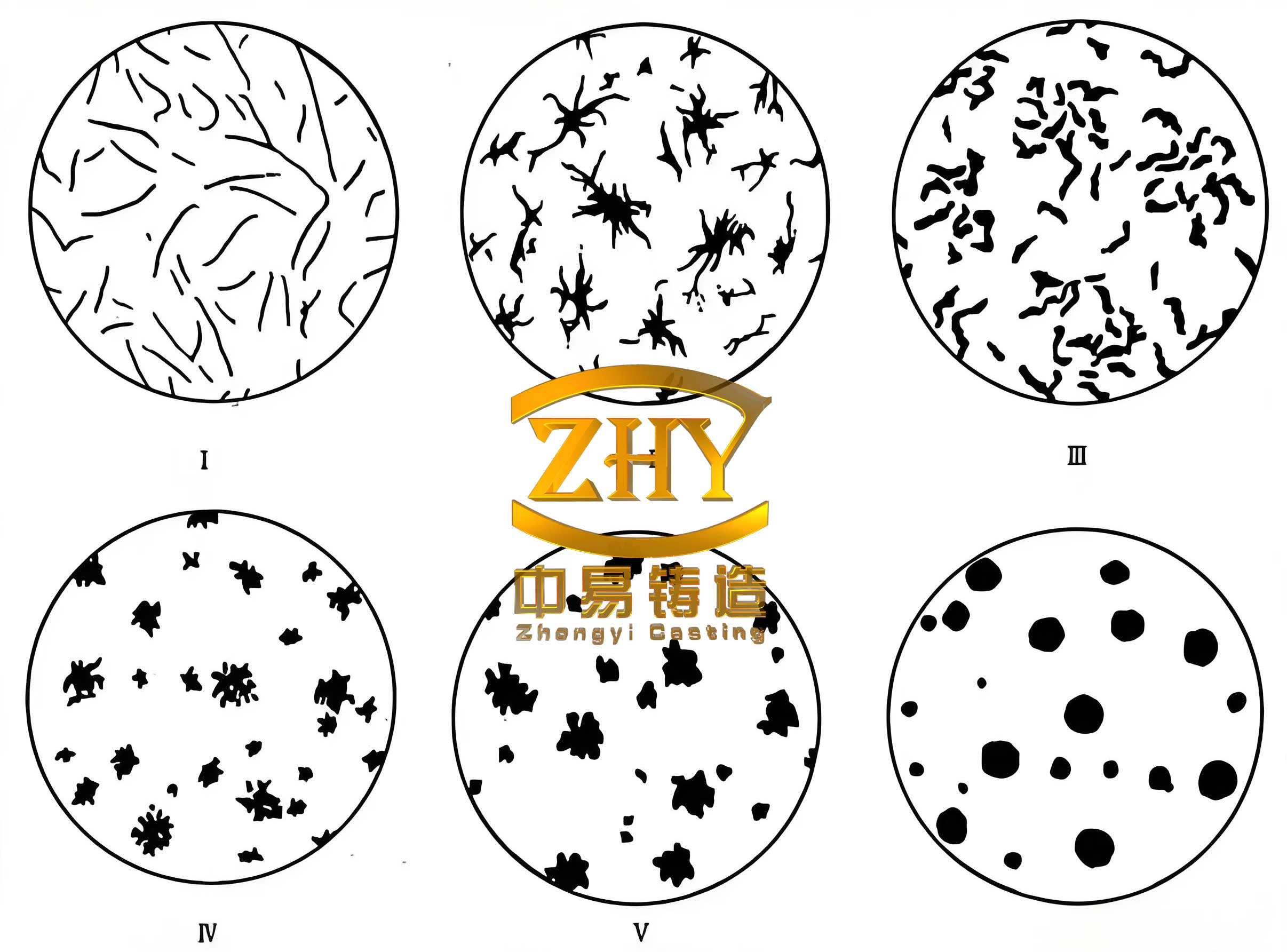
The image above illustrates the refined microstructure achievable with the improved process, showcasing a high density of well-formed graphite nodules embedded in a pearlitic matrix—a hallmark of high-quality spheroidal graphite cast iron.
The relationship between process parameters and final microstructure can be summarized using empirical formulas. For instance, the final graphite nodule count \( N_{nod} \) (nodules per mm²) can be correlated to the effective inoculation potency \( S_{eff} \) and the residual magnesium content \( Mg_{res} \):
$$ N_{nod} = \alpha \cdot S_{eff} \cdot (Mg_{res})^\beta $$
where \( \alpha \) and \( \beta \) are material constants. Similarly, the pearlite content \( P_{ct} \) is influenced by cooling rate and alloying elements, but a stable, high magnesium level promotes pearlite formation by suppressing ferrite. An approximate relation is:
$$ P_{ct} \approx P_0 + \gamma \cdot Mg_{res} – \delta \cdot \Delta T $$
Here, \( P_0 \) is a base pearlite content, \( \gamma \) is a positive coefficient, \( \delta \) is a coefficient for cooling rate effect \( \Delta T \), and \( Mg_{res} \) is the residual magnesium. The improved process increases \( Mg_{res} \) and stabilizes it, thereby boosting \( P_{ct} \).
A comparative summary of key quality metrics before and after process implementation is provided in Table 3.
| Quality Metric | Conventional Process (Before) | Improved Process (After) | Improvement (%) | Significance for Spheroidal Graphite Cast Iron |
|---|---|---|---|---|
| Graphite Nodule Count (Relative Area/Count) | ~30% | ≥60% | >100% increase | Enhances ductility, impact strength, and fatigue life. |
| Pearlite Content in Matrix | ~85% | ~90% | ~6% increase | Improves tensile strength, hardness, and wear resistance. |
| Estimated Magnesium Absorption Efficiency (η_Mg) | 35-45% | 50-60% | ~15-20% increase | Reduces spheroidizer usage, improves consistency, lowers cost. |
| Nodularity Grade (per ISO 945) | III-IV (Low) | I-II (High) | Significant upgrade | Directly correlates to mechanical performance standards. |
| Scrap Rate Due to Poor Nodularity | High | Substantially Reduced | Not quantified but significant | Improves production yield and economic efficiency. |
Discussion and Theoretical Framework
The success of this improved process for spheroidal graphite cast iron can be understood through the principles of nucleation kinetics, mass transfer, and thermal dynamics. The multi-stage inoculation addresses the time-temperature transformation (TTT) constraints of graphite nucleation. Each inoculant type provides nucleation sites with different thermal stability. The silicon-barium-calcium inoculant, in particular, forms stable compounds like BaO·Al₂O₃·2SiO₂ or CaS that persist at high temperatures, acting as long-lasting substrates for graphite precipitation. The overall nucleation rate \( \dot{N} \) can be modeled as a sum of contributions from each inoculant type \( i \):
$$ \dot{N}(t) = \sum_i A_i \exp\left(-\frac{Q_i}{RT}\right) \cdot f_i(t) $$
where \( A_i \) is a pre-exponential factor, \( Q_i \) is the activation energy for nucleation, \( R \) is the gas constant, \( T \) is temperature, and \( f_i(t) \) is a function describing the available potency of inoculant \( i \) over time, which decays per the fade equation mentioned earlier. The staggered addition ensures that \( \dot{N}(t) \) remains above a critical threshold throughout the treatment and pouring cycle.
Regarding spheroidization, the two-stage ladle system optimizes the mass transfer of magnesium into the iron melt. The process can be analyzed using film theory and reaction engineering principles. The rate of magnesium transfer from the agent to the melt \( \dot{m}_{Mg} \) is proportional to the interfacial area \( A \), the concentration driving force \( \Delta C \), and a mass transfer coefficient \( k_m \):
$$ \dot{m}_{Mg} = k_m A \Delta C $$
In the conventional single-layer method, \( A \) is large initially but diminishes rapidly as the agent is consumed, and \( \Delta C \) fluctuates wildly. In the two-stage system, the first stage establishes an initial magnesium concentration, and the second stage acts as a controlled supplement. This maintains a more stable \( \Delta C \) and extends the period of significant \( A \), leading to more efficient mass transfer overall. The total magnesium absorbed \( M_{Mg, absorbed} \) over the treatment time \( t_{total} \) is the integral of the transfer rate:
$$ M_{Mg, absorbed} = \int_0^{t_{total}} \dot{m}_{Mg} \, dt $$
The designed process maximizes this integral for given initial conditions.
Furthermore, the thermal aspect is critical. The melting of the barrier plate \( t_{melt} \) is governed by the heat flux from the molten iron. A simple energy balance gives:
$$ \rho_p V_p [C_p (T_{melt} – T_0) + L_f] = \int_0^{t_{melt}} h A_p (T_{iron} – T_{surface}) \, dt $$
where \( \rho_p, V_p, C_p, T_{melt}, T_0, L_f \) are the density, volume, specific heat, melting point, initial temperature, and latent heat of fusion of the plate material, respectively; \( h \) is the heat transfer coefficient, \( A_p \) is the plate surface area, and \( T_{iron} \) is the iron temperature. By selecting an appropriate plate material and thickness, \( t_{melt} \) can be tuned to provide the desired delay between spheroidization stages, which is typically in the range of 20-40 seconds for the given conditions.
Practical Implementation and Process Control
To consistently produce high-quality spheroidal graphite cast iron using this method, strict process control protocols are essential. The following steps outline the operational sequence:
- Charge Calculation and Ladle Preparation: Based on the tapped iron weight, calculate the exact amounts of spheroidizer, inoculants, and cover flux as per Tables 1 and 2. Prepare the partitioned ladle by placing the lower spheroidizer layer, compacting the cover flux, positioning the barrier plate, and adding the upper spheroidizer, primary inoculant, and final cover flux in that order.
- Iron Melting and Pretreatment: Melt the charge in an electric induction furnace. Superheat to 1560-1600°C. Skim off slag. Add 0.05-0.15% silicon carbide preconditioner. Hold for 9-11 minutes to allow for dissolution and homogenization.
- Transfer and Treatment: Tap the pretreated iron into the empty section of the prepared ladle, allowing it to flow over the dam onto the treatment charge. The spheroidization reaction will commence (first stage). Approximately 20 seconds after the reaction starts, begin the multi-stage inoculation by adding the secondary and tertiary inoculants sequentially into the ladle stream or onto the molten metal surface.
- Post-Treatment Handling and Pouring: Once the reaction subsides (indicating completion of both stages), skim the ladle to remove dross. Perform rapid quality checks, such as thermal analysis or chill wedge tests, to assess nodularity. Pour the treated spheroidal graphite cast iron into the lost foam molds as promptly as possible to minimize fade. The entire treatment-to-pour time should ideally be kept under 8-10 minutes.
Key process variables to monitor and control include:
- Iron Temperature: Maintaining the pretreatment and tapping temperatures within the specified range is crucial for consistent SiC preconditioning and reaction kinetics.
- Weights and Proportions: Accuracy in weighing all additives ensures reproducibility.
- Plate Integrity and Fit: The barrier plate must be free of rust and fit snugly to prevent iron from bypassing it.
- Reaction Observation: Monitoring the vigor and duration of the reaction provides qualitative feedback on process consistency.
Conclusion and Future Directions
My exploration into the spheroidization and inoculation treatment for spheroidal graphite cast iron in lost foam casting has led to the development of a robust, multi-faceted process. By integrating a composite, multi-stage inoculation strategy with an innovative two-stage ladle design featuring a metallic barrier plate, significant improvements in graphite nodule count, pearlite content, and magnesium recovery have been achieved. These enhancements directly translate to higher mechanical properties, better consistency, and reduced scrap rates for spheroidal graphite cast iron castings produced via the lost foam method.
The process leverages fundamental principles of nucleation kinetics and mass transfer to overcome the inherent challenges posed by high pouring temperatures. The use of tables and mathematical models, as presented, aids in understanding, optimizing, and controlling the process parameters.
However, the journey for perfecting spheroidal graphite cast iron production is ongoing. While pearlite content has been increased to around 90%, further improvements may be sought for applications requiring even higher strength and hardness. Future work could focus on:
- Alloying Optimization: Investigating the synergistic effects of copper, tin, or manganese additions in conjunction with the improved treatment process to reliably achieve pearlite contents above 95% without promoting carbide formation.
- Advanced Inoculant Design: Exploring nano-engineered inoculants or inoculants containing rare earth elements like cerium or lanthanum to further increase nucleation potency and fade resistance for spheroidal graphite cast iron.
- Process Modeling and Automation: Developing comprehensive computational fluid dynamics (CFD) and finite element (FE) models to simulate the heat and mass transfer during the two-stage spheroidization process. This could lead to digital twins for predictive control and further optimization of parameters like plate thickness or ladle geometry.
- Sustainability Aspects: Evaluating the environmental footprint of the process, including recycling of slag/by-products and minimizing the use of strategic materials in inoculants, while maintaining the high quality of spheroidal graphite cast iron.
In conclusion, the outlined innovations provide a solid foundation for reliably producing high-integrity spheroidal graphite cast iron components using the lost foam casting process. Through continuous refinement and adherence to scientific principles, the potential of this versatile material can be fully realized in demanding industrial applications.