
In the aerospace industry, the demand for lightweight structural components has driven the extensive application of magnesium alloys. As component designs become larger, more complex, and integrate structure and function, resin‑bonded sand casting foundry processes, particularly counter‑gravity casting, are widely adopted to meet performance and dimensional requirements. However, the high gas evolution and complex composition of resin sand molds lead to severe oxidation and even combustion when in contact with molten magnesium alloys. Despite decades of research, the combustion problem during sand casting foundry operations remains a critical technical bottleneck and safety hazard that restricts the production of high‑performance magnesium alloy castings. This article presents our research progress on flame retardant technologies for magnesium alloy sand casting foundry, covering both melt protection and casting‑solidification protection. The focus is on the underlying ignition mechanisms and the development of effective inhibition strategies tailored to the unique environment of resin‑bonded sand molds.
1. Introduction
Magnesium alloys are increasingly used in aerospace structures due to their high specific strength and stiffness. In a typical sand casting foundry, molten magnesium is poured into resin‑bonded sand molds, which decompose under high temperature and release a mixture of gases. This atmosphere can react vigorously with the melt, causing ignition and burning. Our work aims to systematically understand the oxidation and combustion behavior of magnesium alloys in the sand casting foundry environment, and to develop practical flame retardant methods. The research encompasses both the melting stage (where the melt is exposed to air or protective atmospheres) and the casting stage (where the melt is in contact with the mold cavity). While many melt‑protection techniques exist, they often fail when applied to the casting process because they do not consider the interaction between the molten metal and the sand mold. Therefore, we have conducted dedicated studies on the gas evolution from resin‑bonded sand under thermal shock and the subsequent oxidation of magnesium alloys in that atmosphere. This article summarizes our findings and proposes future directions for flame retardant technology in magnesium alloy sand casting foundry.
| Method | Mechanism | Advantages | Disadvantages / Limitations |
|---|---|---|---|
| Flux protection (e.g., RJ‑2) | Molten salt layer (MgCl₂, NaCl, KCl, BaCl₂, CaF₂) isolates melt from air | Effective at high temperatures | Slag inclusion, corrosion, environmental pollution, reduced melt quality |
| Inert gas (Ar) | Physical barrier; no chemical reaction with Mg | Clean, no residue | Cannot form protective film; Mg vapor escapes; requires addition of reactive gas |
| Reactive gas (CO₂, SO₂, SF₆, HFC‑134a) | Forms compact oxide/fluoride film on melt surface | Effective, low contamination | SF₆ has high global warming potential; HFC‑134a cost; gas handling complexity |
| Alloying (Ca, Be, RE, Ce, Y) | Dense oxide layer containing alloying elements | Intrinsic protection; can improve mechanical properties | May alter alloy composition and properties; not always sufficient for sand casting cavity |
| Controlled atmosphere in mold cavity | Actively regulate gas composition (e.g., CO₂/Ar mixture, removal of reactive gases) | Targeted for sand casting foundry specific conditions | Requires real‑time monitoring and complex equipment |
2. Melt Protection During Melting
2.1 Flux Protection
Flux protection is a traditional method used in sand casting foundry for melting magnesium alloys. Low‑melting‑point inorganic compounds, such as the RJ series (e.g., RJ‑2 containing MgCl₂, NaCl, KCl, BaCl₂, and CaF₂), form a liquid layer that covers the melt and prevents contact with air. While effective, this method introduces several problems: slag entrapment leads to inclusions and reduced mechanical properties, the flux can corrode crucible and equipment, and the disposal of spent flux poses environmental hazards. As a result, the sand casting foundry industry has been seeking alternative protection methods that eliminate the need for flux.
2.2 Gas Protection
2.2.1 Inert Gas Protection
Not all inert gases are suitable for magnesium melt protection. For example, nitrogen reacts with magnesium at elevated temperatures:
$$3\mathrm{Mg} + \mathrm{N_2} \rightarrow \mathrm{Mg_3N_2}$$
The Mg₃N₂ film formed is non‑protective and does not prevent further oxidation. Argon is chemically inert and does not react with magnesium. However, pure argon cannot form a dense protective film on the melt surface; magnesium vapor continues to evaporate, leading to metal loss and potential ignition. Therefore, argon is usually combined with a small amount of reactive gas such as SO₂ or BF₂, which reacts with magnesium to generate a compact oxide layer that suppresses evaporation.
2.2.2 Reactive Gas Protection
Reactive gas protection relies on specific atmospheres that chemically react with the magnesium alloy to form a dense, protective surface film. Common reactive gases include CO₂, SO₂, and fluorine‑containing gases. In particular, HFC‑134a (1,1,1,2‑tetrafluoroethane) has been studied extensively. Our experiments and literature show that at typical melting and casting temperatures, HFC‑134a exhibits even better flame retardant performance than SF₆, and the surface film formed demonstrates a significant “residual effect”: after the protective gas mixture is removed, the film continues to protect the melt for an extended period. This is highly beneficial for sand casting foundry operations where gas flow in the mold cavity may be uneven. The reaction mechanism involves the decomposition of HFC‑134a and subsequent formation of MgF₂ and MgO composite films.
2.3 Alloying Flame Retardant
Adding certain alloying elements to magnesium can intrinsically improve its oxidation resistance by promoting the formation of a dense, protective oxide scale. The most studied elements include Ca, Be, Zn, and rare earth metals (RE) such as Ce, Y, and La. For instance, we have observed that Mg‑Y‑Ce alloys can withstand exposure to air at 900 °C for 0.5 h without ignition. The addition of Ca and Be together is also effective. However, alloying alone is often insufficient for the severe conditions inside a sand casting foundry mold, where the atmosphere is not only air but also contains reactive decomposition products. Thus, alloying is typically combined with other protection strategies.
| Alloy System | Added Elements | Ignition Temperature in Air (°C) | Ignition Temperature in Mold Atmosphere (°C) |
|---|---|---|---|
| AZ91 | – | ~620 | ~560 |
| AZ91 + 1%Ca | Ca | ~720 | ~650 |
| Mg‑3Y‑4Ce | Y, Ce | >900 | ~780 |
| ZK60 + 0.5%Be | Be | ~850 | ~700 |
3. Flame Retardant During Casting and Solidification
The most challenging aspect of magnesium alloy sand casting foundry is the prevention of combustion during mold filling and solidification. Unlike the melting stage, where the melt surface can be protected by a gas blanket or flux, the mold cavity introduces a complex atmosphere containing various hydrocarbons, CO, CO₂, NO, CH₄, and other gases released by the thermal decomposition of the resin binder. Our collaboration with Shanghai Spaceflight Precision Machinery Institute and Harbin Institute of Technology has pioneered a systematic investigation into the ignition mechanism of magnesium alloys within resin‑bonded sand molds. We used Fourier‑transform infrared spectroscopy to analyze the gas evolution from PEP‑SET resin sand under thermal shock. Figure 1 (see below) shows the concentration profiles of different gas species as a function of temperature. The results indicate that the decomposition follows a sequence: first NO, CO, and CO₂ are released, reaching peak concentrations; subsequently, CH₄ and C₂H₆ increase while NO etc. decrease. This knowledge is critical for designing effective flame retardant strategies in the sand casting foundry.
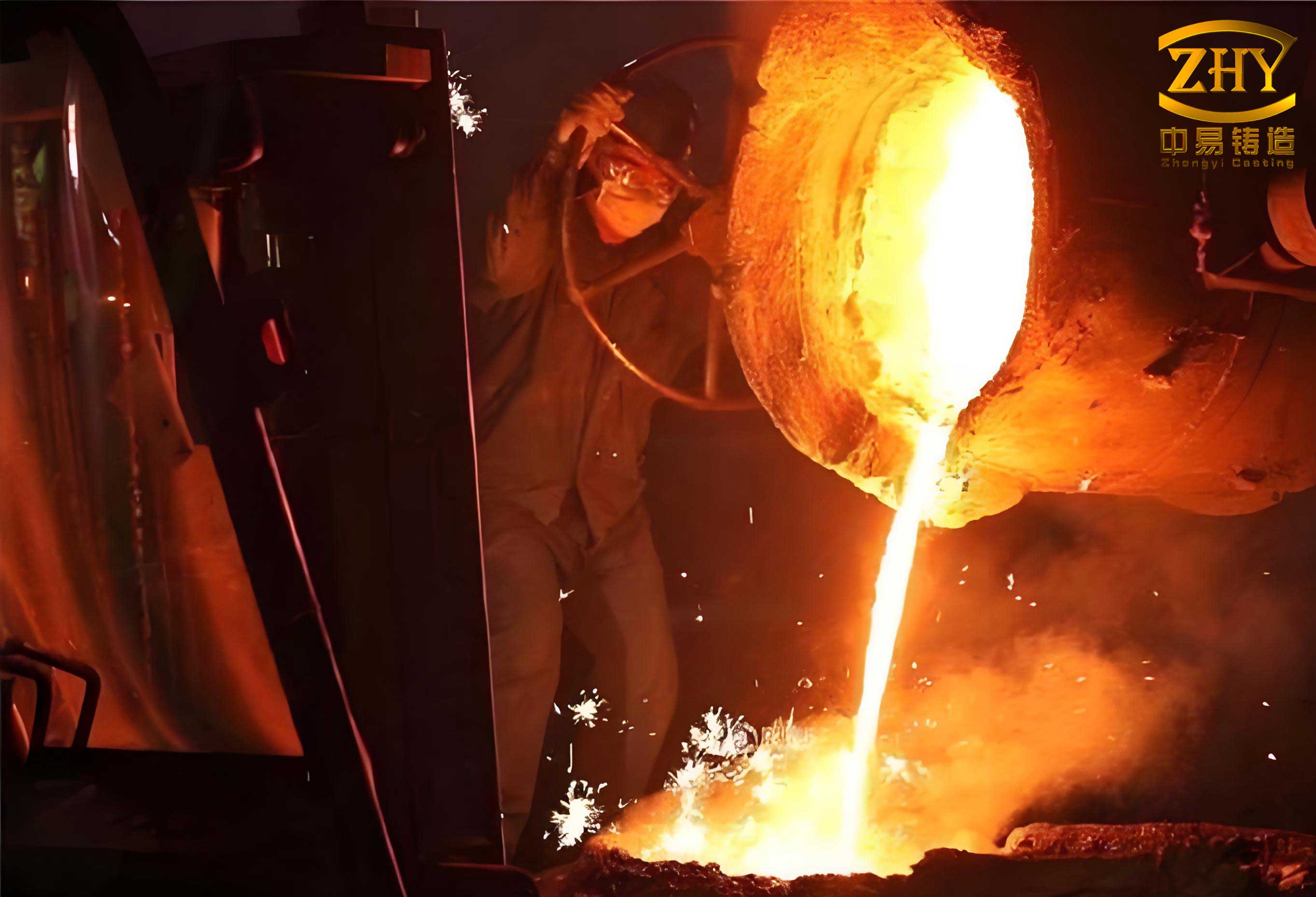
We developed an experimental setup (schematically represented in the image above) that allows us to simulate the environment inside a sand casting foundry mold cavity. By controlling the gas composition and temperature inside a reaction chamber, we can directly observe the oxidation and ignition behavior of molten magnesium alloys. For example, we studied pure magnesium under PEP‑SET resin sand decomposition atmosphere at various temperatures and holding times. The results revealed that the oxide film morphology and thickness evolve in a characteristic manner, and that the onset of ignition correlates strongly with the presence of NO and CO. Based on these observations, we proposed two innovative approaches for flame retardant in sand casting foundry:
- Heat‑affected zone control: By optimizing the casting design and cooling strategy, we can reduce the residence time of the melt in critical hot spots, thereby minimizing the chance of ignition.
- Active atmosphere control: We inject controlled amounts of inert or reactive gases directly into the mold cavity to modify the local atmosphere, for instance by diluting the NO concentration or introducing a protective layer on the melt surface.
These methods go beyond traditional melt protection and are tailored specifically to the resin‑bonded sand casting foundry process. We have validated them on laboratory scale and are now scaling up for industrial trials.
4. Future Directions
The research on flame retardant technology for magnesium alloy sand casting foundry has so far focused mainly on the melting stage, while the casting and solidification stage remains inadequately addressed. Especially for large aerospace components produced with resin‑bonded sand molds, the combustion problem is a major obstacle. We believe that the key to solving this problem lies in understanding the fundamental ignition kinetics: the critical temperature and gas composition thresholds, the role of surface films, and the influence of melt flow. Only by mastering these mechanisms can we develop scientifically sound and practically feasible flame retardant techniques. Future work should explore the following:
- Development of real‑time monitoring systems for cavity gas composition and temperature.
- Advanced resin binder systems that minimize the release of reactive species (e.g., NO, CO).
- Novel alloy compositions that form self‑healing protective films even in aggressive atmospheres.
- Integration of computational fluid dynamics (CFD) with oxidation models to predict ignition risk during mold filling.
In conclusion, the advancement of flame retardant technology in magnesium alloy sand casting foundry requires a shift from empirical practices to a mechanism‑based approach. Our ongoing research aims to provide the scientific foundation and practical solutions for safe and reliable production of high‑performance magnesium alloy castings in the aerospace industry.
5. Conclusion
We have reviewed the state‑of‑the‑art flame retardant technologies for magnesium alloy sand casting foundry, covering flux protection, gas protection, and alloying methods for the melting stage, as well as the specific challenges of the casting stage. Through our own experimental work, we have identified the decomposition products of PEP‑SET resin sand and their role in the ignition of magnesium alloys. The active atmosphere control and heat‑affected zone control methods we propose offer promising pathways to mitigate combustion in resin‑bonded sand molds. Continued research on ignition mechanisms and innovative process designs will be essential to overcome the current limitations and fully realize the potential of magnesium alloys in aerospace sand casting foundry applications.