
In my extensive observation of the foundry industry, I have noted a significant paradigm shift occurring with the increasing adoption of the dry sand vacuum-assisted lost foam casting process. This method, often abbreviated as V-EPC or simply the lost foam casting process, is celebrated for its revolutionary impact, hailed by many as a transformative advancement in 20th-century casting technology. Its unique blend of technical and economic merits—such as the elimination of parting lines and cores, simplified equipment, high dimensional accuracy of castings, and reduced costs—has propelled its implementation across numerous foundries. While applications in aluminum and iron castings are currently more prevalent than in steel, substantial research corroborates the viability and suitability of the lost foam casting process for steel components as well. Consequently, for the specific and challenging category of board-shaped castings, this process demonstrates remarkable adaptability across various metal alloys.
This analysis aims to synthesize the inherent challenges found in different sand casting工艺 schemes for board castings. By leveraging the distinct characteristics of the V-EPC method, I will argue that the lost foam casting process is exceptionally well-suited for producing such geometries. Furthermore, I will delineate key considerations for applying V-EPC to board castings, analyze typical defects encountered in a practical case study, and formulate effective countermeasures and specific casting工艺 plans to yield sound castings.
Challenges in Conventional Sand Casting of Board Castings
My review of traditional methods reveals several persistent issues tied to the geometry and orientation of board castings in sand molds.
Double-Sided Smooth Board Castings
For thick-walled, smooth boards, sand casting typically considers three primary orientations, each with drawbacks.
- Horizontal Placement with Large Plane Up: This orientation exposes the upper mold surface to intense radiant heat from the molten metal, causing rapid sand expansion, scabbing, or cracking. This leads to defects like sand inclusion and scabs on the casting surface. Improper gating can further result in slag inclusions. I consider this scheme fundamentally flawed.
- Vertical Placement with Large Plane Facing Sidewalls: While this mitigates sand and slag issues on the large face, it necessitates taller flask equipment, reduces sand utilization efficiency, requires larger draft angles, and introduces operational complexities. It remains a conditional, albeit less efficient, option.
- Inclined Placement (“Flat Molding, Tilted Pouring”): This is a common compromise in sand casting. It addresses the major flaws of the first two schemes, but垫砂 becomes inconvenient for the flask, limiting the practical倾斜角.
For thin-walled, smooth boards, the problem shifts to distortion. In schemes (a) and (c), the differing cooling rates between the upper and lower surfaces—where the upper surface cools faster—induce significant warping or翘曲变形. Scheme (b) largely avoids this thermal gradient issue.
| 工艺 Scheme | Primary Defects (Thick Wall) | Primary Defects (Thin Wall) | Operational Notes |
|---|---|---|---|
| Horizontal, Plane Up | Sand Inclusion, Scabs, Slag | Warping | Not recommended |
| Vertical, Plane at Sides | Minimal sand/slag defects | Minimal warping | High flask, low efficiency |
| Inclined Pouring | Minimal sand/slag defects | Warping | Flask垫砂困难 |
Board Castings with Reinforcement Ribs
Casting boards with ribs on one or both sides inherently avoids the “large plane up” issue in horizontal placement, effectively preventing sand inclusion, slag, and scabbing. However, if the ribs are thin relative to a large board area, improper工艺 can still lead to warping. In severe cases, cracking may occur at the junction between the rib and the board主体.
The Lost Foam Casting Process: A Primer and Advantage Analysis
The dry sand vacuum-assisted lost foam casting process involves coating an expendable polystyrene (EPS) foam pattern with a refractory coating designed for the process. After drying, the pattern is placed in a flask, surrounded by unbonded dry sand, which is then vibrated to achieve compaction. During metal pouring, a vacuum is applied to the flask, typically between 0.05 and 0.07 MPa, which stabilizes the mold and assists in removing gaseous decomposition products.
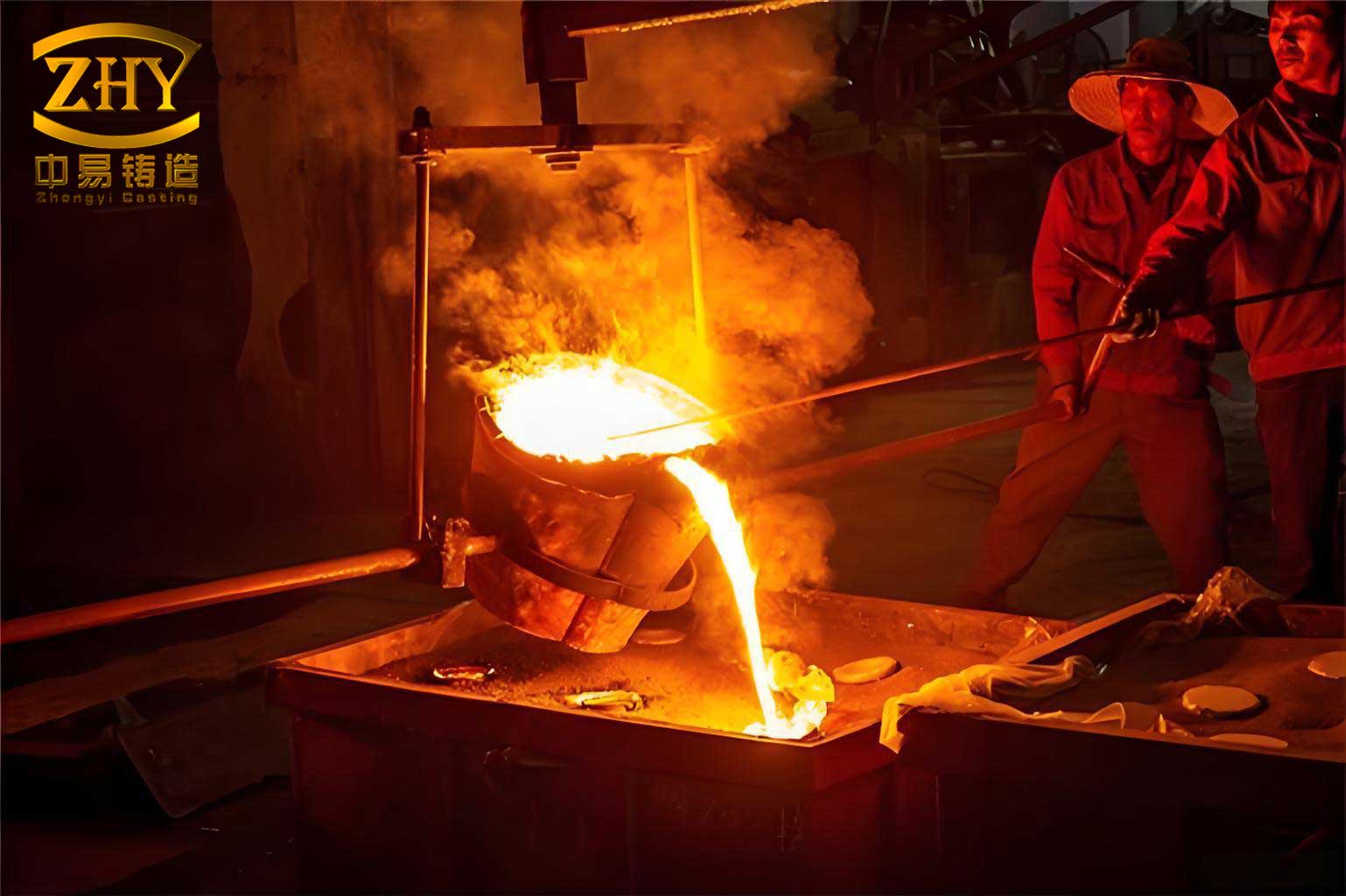
When I evaluate this lost foam casting process for board castings, its advantages become overwhelmingly clear:
- Pattern Simplicity & Cost: EPS patterns can be fabricated as a single board, modified locally, or assembled from multiple glued sections, dramatically lowering pattern costs compared to permanent tooling.
- Unrestricted Orientation: The lack of a parting line or need for draft allows the pattern to be positioned optimally within the flask. The problematic “large plane up” scenario is effortlessly avoided by placing the board vertically or at an angle, significantly simplifying flask preparation and handling.
- Enhanced Productivity: Multiple EPS patterns can be arranged in a stack within a single flask using separators, enabling the simultaneous production of several castings in one molding and pouring cycle. This massively improves production efficiency for board castings.
- Defect Mitigation: The process inherently eliminates mold-related defects like sand inclusion and scabs from the casting surfaces. The controlled, directional solidification possible with strategic placement further addresses distortion issues.
| Aspect | Conventional Sand Casting | Lost Foam Casting Process |
|---|---|---|
| Pattern/Mold Cost | High (permanent patterns, cores) | Low (expendable EPS patterns) |
| Parting Line & Draft | Required, limits design | Not required, design freedom |
| Casting Orientation | Limited by moldability | Unrestricted, optimal for cooling |
| Flask Utilization | Low for vertical boards | High (stacking possible) |
| Common Defects (Sand/Slag) | Likely on large planes | Virtually eliminated |
| Process Flexibility | Low to Medium | Very High |
Case Study & Process Optimization: Wear-Resistant Liner Board
My investigation focused on a real-world application: producing high-manganese steel (ZGMn13) wear-resistant liner boards for crushers. Traditional sand casting resulted in chronic defects—sand inclusion, slag, scabs, and warping on the upper surfaces—leading to high scrap rates. Initial adoption of the lost foam casting process resolved most surface defects but left residual issues: minor slag at the top and significant warping, requiring costly post-casting straightening.
The initial V-EPC scheme vertically stacked four patterns with the toothed surface (B) facing sideways. A bottom-gating system ensured smooth filling. While this was a good starting point, warping persisted with surface A (with ribs) bowing outward and surface B (with thicker teeth) bending inward.
Defect Analysis and Theoretical Foundation
1. Warping Analysis & The Principle of Simultaneous Solidification:
The warping stemmed from differential cooling. Although both surfaces were vertical, their geometries differed. Surface B, with its thicker teeth section, had a higher modulus, causing it to solidify and cool slower than the ribbed Surface A. This created uneven thermal stresses, leading to distortion. The solution lies in promoting simultaneous solidification across the cross-section. This principle aims to minimize thermal gradients by ensuring all parts of the casting cool at nearly the same rate. The cooling rate can be influenced by the local thermal modulus and the heat extraction rate. The solidification time for a section can be approximated by Chvorinov’s rule:
$$ t = B \cdot \left( \frac{V}{A} \right)^n $$
where $t$ is solidification time, $V$ is volume, $A$ is cooling surface area, $B$ is a mold constant, and $n$ is an exponent (often ~2). To achieve simultaneous solidification for two sections (1 and 2), we ideally want $t_1 \approx t_2$, implying:
$$ \left( \frac{V}{A} \right)_1 \approx \left( \frac{V}{A} \right)_2 $$
Given that $(V/A)_B > (V/A)_A$, we must increase the effective cooling rate for section B. This can be done by orienting the casting so that surface B faces upward or toward a better heat sink, enhancing its heat transfer coefficient. The heat flux $q$ is governed by:
$$ q = -k \nabla T $$
where $k$ is thermal conductivity and $\nabla T$ is the temperature gradient. By tilting the pattern, we leverage natural convection and radiation to increase heat loss from the thicker section, helping to equalize solidification times.
2. Top Slag Analysis & The Theory of Proportional Solidification:
The minor slag at the casting top is a known challenge in the lost foam casting process, where loose sand grains, coating fragments, or other inclusions can be trapped by the advancing metal front. While process controls (coating quality, sand compaction, vacuum level) are crucial, a more robust solution is provided by the theory of proportional solidification. This theory emphasizes the role of feeding and impurity transport during the final stages of solidification. A strategically placed “slag collector” or “washburn” at the top of the casting acts as a reservoir for the last metal to solidify, intentionally concentrating any remaining inclusions there. Its design must ensure it is fed last and is easily removable. The efficacy of such a collector can be related to the flow dynamics and the tendency for inclusions to move toward the thermal center of the last-solidifying region.
Optimized Process Scheme
Based on the simultaneous solidification principle and proportional凝固理论, I propose the following optimized lost foam casting process scheme:
- Tilted Orientation: The EPS pattern stack is tilted at a calculated angle within the flask. This positions the thicker toothed surface (B) more favorably for heat dissipation (effectively increasing its $A$ in Chvorinov’s rule) while slightly shielding the ribbed surface (A), thereby balancing their cooling rates.
- Integrated Slag Collector: A small, easily removable appendage—the slag collector—is attached to the top of each EPS pattern. This collector is designed to be the last part to fill and solidify, based on gating and thermal gradient calculations, ensuring it captures floating inclusions.
- Maintained Robust Process Parameters: The bottom gating, vacuum level (0.05-0.07 MPa), and pouring temperature (1410-1430°C for high-manganese steel) are retained to ensure smooth filling and mold stability.
This integrated approach directly tackles both defects: the tilt manages thermal stresses to prevent warping, and the collector eliminates surface slag, eliminating the need for post-cast straightening and improving overall yield and quality.
| Observed Defect | Root Cause in V-EPC | Governing Principle | Corrective Action |
|---|---|---|---|
| Warping/Distortion | Uneven cooling due to section thickness variation in vertical orientation. | Simultaneous Solidification (Minimize $\nabla T$) | Tilt pattern to equalize effective cooling rates; orient thicker section for enhanced heat loss. |
| Slag/Inclusions at Top | Entrapment of decomposition products or loose sand at the metal front terminus. | Proportional Solidification & Impurity Segregation | Design and place a sacrificial slag collector/washburn at the casting top. |
| (Historical) Sand Inclusion/Scabs | N/A – This defect is inherent to green sand molds, not the lost foam process. | N/A | Adopting the lost foam casting process itself is the corrective action. |
Conclusion
My comprehensive analysis firmly establishes the lost foam casting process as a superior and highly effective method for manufacturing board castings. Traditional sand casting is invariably hampered by orientation-related defects such as sand inclusion, slag, and warping, problems that are intrinsically linked to the constraints of the mold and parting line. The lost foam casting process elegantly bypasses these limitations. It provides unparalleled freedom in pattern placement, allowing for optimal thermal management to achieve directional or simultaneous solidification as required. The ability to stack patterns multiplies productivity dramatically. Furthermore, the integration of features like slag collectors, guided by proportional solidification theory, can彻底消除 even the subtle defects sometimes associated with the process. Therefore, by leveraging its unique advantages and applying fundamental solidification principles—simultaneous solidification for stress minimization and proportional solidification for impurity control—the lost foam casting process stands out as the definitive solution for the efficient, high-quality, and cost-effective production of board-shaped castings across a wide spectrum of alloys.