
As an engineer deeply immersed in the field of advanced manufacturing, I have dedicated my career to understanding and advancing aerospace casting techniques. Aerospace casting is a critical discipline that enables the production of complex, high-performance components for aircraft and spacecraft. In this article, I will delve into the intricacies of aerospace casting, covering materials, processes, mathematical models, quality control, and applications. The importance of aerospace casting cannot be overstated; it is the backbone of modern aviation and space exploration, allowing for the creation of parts that are both lightweight and durable. Throughout this discussion, I will emphasize the role of aerospace casting in pushing the boundaries of technology.
The evolution of aerospace casting has been driven by the need for materials that can withstand extreme conditions, such as high temperatures and pressures. In my experience, the selection of materials is paramount in aerospace casting. Common materials include titanium alloys, aluminum alloys, nickel-based superalloys, and magnesium alloys. Each material offers unique properties that make it suitable for specific applications in aerospace casting. Below is a table summarizing key materials used in aerospace casting:
| Material Type | Key Properties | Typical Applications in Aerospace Casting | Challenges in Casting |
|---|---|---|---|
| Titanium Alloys | High strength-to-weight ratio, corrosion resistance | Engine components, airframe structures | High melting point, reactivity with mold materials |
| Aluminum Alloys | Lightweight, good thermal conductivity | Wing sections, landing gear parts | Shrinkage porosity, hot tearing |
| Nickel-Based Superalloys | Exceptional high-temperature strength | Turbine blades, exhaust systems | Complex solidification behavior, cost |
| Magnesium Alloys | Ultra-lightweight, good damping capacity | Gearboxes, interior components | Flammability during melting, oxidation |
In aerospace casting, the choice of material often dictates the casting process. I have worked extensively with various casting methods, each with its advantages and limitations. Investment casting, also known as lost-wax casting, is widely used in aerospace casting for producing intricate parts with tight tolerances. Sand casting is employed for larger components, while die casting is suitable for high-volume production. The table below compares these processes in the context of aerospace casting:
| Casting Process | Description | Advantages for Aerospace Casting | Disadvantages for Aerospace Casting |
|---|---|---|---|
| Investment Casting | Uses a wax pattern coated with ceramic slurry to form a mold | High precision, excellent surface finish, suitable for complex geometries | Time-consuming, high cost for small batches |
| Sand Casting | Utilizes sand molds for shaping metal | Cost-effective for large parts, flexible design changes | Lower dimensional accuracy, rougher surface finish |
| Die Casting | Injects molten metal into a steel die under high pressure | High production rates, good mechanical properties | Limited to non-ferrous metals, high tooling cost |
| Centrifugal Casting | Rotates mold to distribute metal by centrifugal force | Dense structure, minimal porosity for cylindrical parts | Restricted to symmetric shapes, equipment complexity |
The physics underlying aerospace casting involves complex phenomena such as heat transfer, fluid flow, and solidification. I often rely on mathematical models to optimize these processes. For instance, the heat conduction during solidification can be described by Fourier’s law, leading to the partial differential equation:
$$ \frac{\partial T}{\partial t} = \alpha \nabla^2 T $$
where \( T \) is temperature, \( t \) is time, and \( \alpha \) is thermal diffusivity. In aerospace casting, controlling solidification is crucial to avoid defects like shrinkage cavities. The cooling rate \( \dot{T} \) influences microstructure formation, which impacts mechanical properties. Another key equation is the Navier-Stokes equation for fluid flow in mold filling:
$$ \rho \left( \frac{\partial \mathbf{v}}{\partial t} + \mathbf{v} \cdot \nabla \mathbf{v} \right) = -\nabla p + \mu \nabla^2 \mathbf{v} + \mathbf{f} $$
where \( \rho \) is density, \( \mathbf{v} \) is velocity vector, \( p \) is pressure, \( \mu \) is dynamic viscosity, and \( \mathbf{f} \) represents body forces. In aerospace casting, ensuring turbulent-free flow is essential to prevent air entrapment. Additionally, the solidification time \( t_s \) for a casting can be estimated using Chvorinov’s rule:
$$ t_s = C \left( \frac{V}{A} \right)^n $$
where \( V \) is volume, \( A \) is surface area, and \( C \) and \( n \) are constants dependent on material and mold properties. This rule highlights the importance of geometry in aerospace casting design.
Quality assurance in aerospace casting is a multi-faceted endeavor. I have implemented various non-destructive testing (NDT) methods to inspect cast components. These methods ensure that parts meet stringent aerospace standards. The table below outlines common NDT techniques used in aerospace casting:
| NDT Method | Principle | Applications in Aerospace Casting | Detection Capabilities |
|---|---|---|---|
| X-ray Radiography | Uses X-rays to image internal structures | Detecting porosity, inclusions in turbine blades | Volumetric defects down to 0.5% of thickness |
| Ultrasonic Testing | Employs high-frequency sound waves | Measuring wall thickness, finding cracks in structural parts | Sub-surface flaws as small as 0.1 mm |
| Dye Penetrant Inspection | Relies on capillary action of dye | Surface defect detection in alloy castings | Surface cracks and porosity open to surface |
| Eddy Current Testing | Measures changes in electromagnetic fields | Conductivity checks for material integrity | Near-surface defects in conductive materials |
Beyond testing, process control in aerospace casting involves monitoring parameters like pouring temperature \( T_p \) and mold preheat temperature \( T_m \). I often use statistical models to optimize these parameters. For example, a regression equation for tensile strength \( \sigma \) might be:
$$ \sigma = \beta_0 + \beta_1 T_p + \beta_2 T_m + \beta_3 T_p T_m + \epsilon $$
where \( \beta_i \) are coefficients and \( \epsilon \) is error. Such models help in achieving consistent quality in aerospace casting.
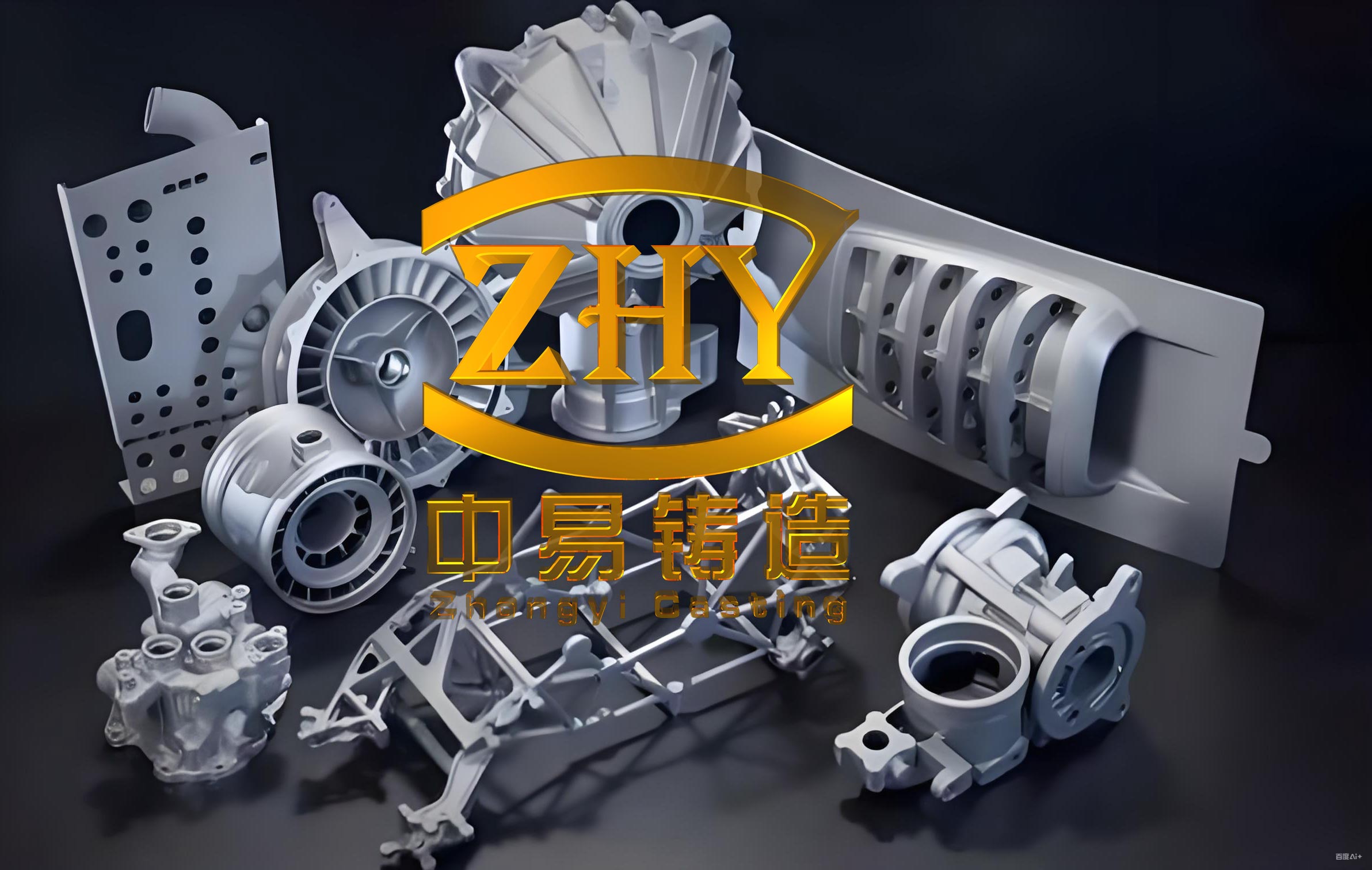
The image above illustrates typical components produced through aerospace casting, showcasing the complexity and precision achievable. In my work, I have seen how aerospace casting enables the fabrication of parts like turbine blades, engine casings, and structural brackets. These components are integral to aircraft performance, and advancements in aerospace casting directly contribute to fuel efficiency and safety. For instance, single-crystal turbine blades cast from nickel superalloys allow engines to operate at higher temperatures, improving thrust. The design of such parts often involves topology optimization, where material is distributed based on stress analysis. The objective function in optimization can be expressed as:
$$ \min_{x} f(x) = \int_{\Omega} \sigma : \epsilon \, d\Omega $$
subject to constraints like volume fraction \( V_f \leq V_0 \), where \( \sigma \) is stress tensor, \( \epsilon \) is strain tensor, and \( \Omega \) is the design domain. This mathematical approach is increasingly used in aerospace casting to reduce weight while maintaining strength.
Recent trends in aerospace casting include the integration of additive manufacturing, or 3D printing, for creating molds and cores. I have explored how this reduces lead times and allows for more complex internal geometries. For example, binder jetting can produce sand molds directly from digital models, revolutionizing traditional sand casting in aerospace casting. The economics of such hybrid processes can be analyzed using cost models. Let \( C_{total} \) be the total cost of a casting process, given by:
$$ C_{total} = C_{material} + C_{labor} + C_{energy} + C_{tooling} $$
where each component depends on process parameters. In aerospace casting, reducing \( C_{tooling} \) through additive methods can make small-batch production more viable. Additionally, simulation software plays a key role in virtual prototyping. Finite element analysis (FEA) solves equations like the heat equation discretized over a mesh:
$$ [K]\{T\} = \{F\} $$
with \( [K] \) as conductivity matrix and \( \{F\} \) as heat load vector. These simulations predict defects before physical casting, saving resources in aerospace casting projects.
Another critical aspect is the environmental impact of aerospace casting. I advocate for sustainable practices, such as recycling metal scraps and using eco-friendly binders in sand casting. The life cycle assessment (LCA) of a cast component involves calculating its carbon footprint \( CF \):
$$ CF = \sum_{i} E_i \times EF_i $$
where \( E_i \) is energy consumption at stage \( i \) and \( EF_i \) is emission factor. In aerospace casting, efforts to minimize \( CF \) align with global sustainability goals. Moreover, material innovation continues to drive progress. For example, the development of aluminum-lithium alloys has reduced weight in aerospace casting parts by up to 10%, enhancing aircraft range. The properties of such alloys can be summarized in a table:
| Alloy System | Density (g/cm³) | Yield Strength (MPa) | Applications in Aerospace Casting |
|---|---|---|---|
| Al-Li (2099) | 2.63 | 530 | Fuselage frames, wing skins |
| Ti-6Al-4V | 4.43 | 830 | Landing gear, engine mounts |
| Inconel 718 | 8.19 | 1030 | Rocket engine components |
Looking ahead, I believe that aerospace casting will continue to evolve with advances in digital twins and artificial intelligence. AI algorithms can analyze casting data to predict defects, optimizing parameters in real-time. For instance, a neural network model might map input variables \( \mathbf{x} \) (e.g., pouring temperature, cooling rate) to output quality \( y \) (e.g., porosity level):
$$ y = f_{NN}(\mathbf{x}; \mathbf{w}) $$
where \( \mathbf{w} \) are weights learned from historical aerospace casting data. This predictive capability enhances reliability in critical applications. Furthermore, the demand for reusable spacecraft underscores the need for durable cast components that withstand multiple launch cycles. Aerospace casting must adapt to these challenges by developing new alloys and processes.
In conclusion, aerospace casting is a dynamic field that combines material science, engineering, and mathematics to produce essential components for the aerospace industry. From material selection to quality control, every step requires precision and innovation. I have shared insights based on my involvement in aerospace casting projects, highlighting how tables and formulas aid in understanding and improving processes. As technology advances, aerospace casting will remain at the forefront of manufacturing, enabling lighter, stronger, and more efficient aircraft and spacecraft. The integration of digital tools and sustainable practices will shape the future of aerospace casting, ensuring its continued relevance in pushing the boundaries of human exploration.
To further elaborate on the mathematical foundations, consider the solidification kinetics in aerospace casting. The growth velocity \( v \) of a dendritic front is often described by the Ivantsov function:
$$ \Delta T = \frac{v \rho L}{2k} \cdot \text{Iv}(Pe) $$
where \( \Delta T \) is undercooling, \( \rho \) is density, \( L \) is latent heat, \( k \) is thermal conductivity, and \( Pe \) is Peclet number. This equation is crucial for controlling microstructure in aerospace casting. Additionally, stress analysis during cooling involves solving the equilibrium equation:
$$ \nabla \cdot \boldsymbol{\sigma} + \mathbf{b} = 0 $$
with \( \boldsymbol{\sigma} \) as stress tensor and \( \mathbf{b} \) as body force. Residual stresses from uneven cooling can compromise part integrity, making this analysis vital in aerospace casting. I often use finite element software to simulate these phenomena, iterating designs to minimize defects.
The economic viability of aerospace casting also depends on yield improvement. The yield \( Y \) is defined as the ratio of good castings to total castings produced:
$$ Y = \frac{N_{good}}{N_{total}} \times 100\% $$
By optimizing gating and riser designs using fluid flow simulations, yield in aerospace casting can be increased, reducing waste. For example, the Bernoulli equation for incompressible flow in gating systems:
$$ \frac{v^2}{2g} + \frac{p}{\rho g} + z = \text{constant} $$
helps ensure smooth metal flow. In aerospace casting, even minor improvements in yield translate to significant cost savings over large production runs.
Finally, I emphasize that collaboration across disciplines is key to advancing aerospace casting. Metallurgists, mechanical engineers, and data scientists must work together to tackle challenges like hot tearing in aluminum alloys or sigma phase formation in superalloys. The future of aerospace casting lies in this interdisciplinary approach, fueled by continuous research and development. As I reflect on my journey in this field, I am excited by the prospects of next-generation aerospace casting technologies that will enable humanity to reach new heights in aviation and space exploration.