
In the realm of lost foam casting, a widely adopted manufacturing process for producing complex iron castings such as automotive body panels and machine tool components, one of the most persistent and challenging issues I have encountered is the occurrence of “coating sheet” slag inclusion defects. These defects manifest as large-area depressions or pits on the surfaces of castings, often filled with coating residues, sand, and other non-metallic inclusions, which severely compromise the mechanical properties and overall quality of the final product. Lost foam casting involves using expandable polystyrene (EPS) or similar foam patterns coated with a refractory layer, which are then embedded in unbonded sand and replaced by molten metal during pouring. Despite its advantages in near-net-shape forming and dimensional accuracy, the process is susceptible to defects like slag inclusions due to the dynamic interactions between the metal, foam decomposition, and coating integrity. In this article, I will delve into the root causes of coating sheet slag inclusion defects, explore fluid dynamics principles relevant to lost foam casting, and propose comprehensive improvement strategies, including optimized gating system design, enhanced coating formulations, and process control measures. By incorporating tables and mathematical equations, I aim to provide a detailed guide for practitioners to minimize these defects and enhance casting reliability in lost foam casting operations.
The formation of coating sheet slag inclusion defects in lost foam casting is multifaceted, stemming from improper gating design, inadequate coating properties, and suboptimal process parameters. Fundamentally, these defects arise when the refractory coating on the foam pattern fractures during metal filling, allowing coating fragments to be entrained into the molten metal. This is often accompanied by sand penetration and gas entrapment, leading to composite defects that are difficult to eradicate. In lost foam casting, the coating serves critical functions: it must provide sufficient permeability to allow the escape of foam decomposition gases, exhibit high strength to withstand thermal shocks, and maintain integrity under metal冲刷. However, if the coating develops micro-cracks during drying, handling, or pouring, it becomes vulnerable to erosion by the molten metal, resulting in slag inclusions. My analysis focuses on the interplay between fluid flow behavior, coating characteristics, and operational factors in lost foam casting, as these elements collectively influence defect formation.
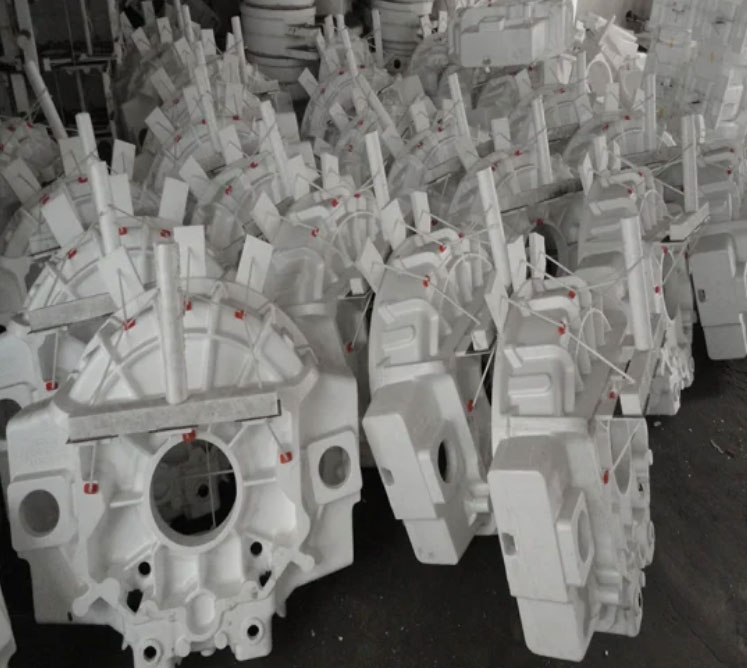
To understand the mechanisms behind coating sheet slag inclusion defects in lost foam casting, it is essential to examine the fluid dynamics of metal filling. Unlike conventional cavity casting, where metal flows in a predictable, gravity-driven manner, lost foam casting involves a complex, multi-dimensional filling process due to the gradual disappearance of the foam pattern. The metal advances while simultaneously gasifying the foam, creating a dynamic balance between liquid metal, gaseous products, and the coating layer. This can be described using principles of fluid mechanics, such as the continuity equation for incompressible flow, which governs the mass conservation in the system. For a one-dimensional, steady flow, the equation is expressed as:
$$ \nu_1 A_1 = \nu_2 A_2 = Q $$
where \( \nu_1 \) and \( \nu_2 \) are the average velocities at cross-sectional areas \( A_1 \) and \( A_2 \), respectively, and \( Q \) is the volumetric flow rate. In lost foam casting, the metal flow is not purely one-dimensional; it is influenced by the pattern geometry and gas evolution, leading to phenomena like “pressure loss” or “instantaneous depressurization.” When the flow cross-section abruptly changes, such as at junctions or thin-to-thick transitions, the velocity fluctuates significantly. A sudden increase in velocity causes turbulence, entrapping slag and gases, while a decrease results in a pressure drop that can destabilize the coating layer. This destabilization is a key contributor to coating fractures in lost foam casting, as the coating may not withstand the combined thermal and mechanical stresses.
Moreover, the coating itself plays a pivotal role in defect prevention. In lost foam casting, the coating is applied directly to the foam pattern and must exhibit specific properties: high permeability to facilitate gas escape, low gas evolution to avoid additional pressures, good adhesion to the pattern, and sufficient strength at both room and elevated temperatures. The coating’s low-temperature strength is particularly critical, as micro-cracks can form during drying or sand compaction, compromising its integrity. Common causes of coating failure in lost foam casting include excessive binder content, improper drying cycles, and inadequate sand support during molding. For instance, if the sand is not compacted firmly around the pattern, the coating lacks the necessary backing to resist metal冲刷, increasing the risk of rupture. To quantify these aspects, I have summarized key coating properties and their impact on defect formation in Table 1.
| Property | Desired Range | Effect on Defects | Improvement Measures |
|---|---|---|---|
| Permeability | High (e.g., >50 cm³/min) | Reduces gas pressure, prevents coating blow-off | Use of porous additives like perlite |
| Low-Temperature Strength | >2 MPa (at 25°C) | Minimizes micro-crack formation during handling | Optimize binder ratio (e.g., sodium silicate + organic binders) |
| Gas Evolution | < 20 mL/g | Lowers risk of gas-induced coating failure | Select low-gas materials and control drying temperature |
| Adhesion | Strong, uniform coverage | Ensures coating remains intact during metal flow | Add surfactants for better wetting on foam |
In practical terms, the gating system design is a major factor in mitigating coating sheet slag inclusion defects in lost foam casting. Traditional gating approaches, such as open or closed systems, may not suffice due to the unique filling characteristics of lost foam casting. For example, a bottom-gating system with multiple ingates can lead to metal flow convergence, creating zones of high turbulence and slag accumulation. To address this, I recommend a semi-closed gating system that balances flow rates and minimizes sudden velocity changes. This can be analyzed using fluid dynamics simulations, which show that metal flow in lost foam casting often exhibits a “pulsating” pattern, with localized velocity peaks near ingates. The relationship between flow velocity and cross-sectional area can be extended to include the effects of foam decomposition, leading to a modified continuity equation that accounts for gas generation:
$$ \rho_m A v = \rho_g Q_g + \frac{dm_f}{dt} $$
where \( \rho_m \) is the metal density, \( A \) is the cross-sectional area, \( v \) is the velocity, \( \rho_g \) is the gas density, \( Q_g \) is the gas flow rate, and \( \frac{dm_f}{dt} \) represents the rate of foam mass loss due to decomposition. This equation highlights how foam gasification introduces additional variables that affect metal flow stability in lost foam casting. By optimizing the gating design to maintain a steady flow velocity and avoid abrupt area changes, the risk of coating erosion and slag entrainment can be significantly reduced.
Another critical aspect is the coating formulation. Based on my experience, a balanced mix of binders, refractories, and additives is essential for enhancing coating performance in lost foam casting. For instance, combining inorganic binders like sodium silicate with organic binders such as latex can improve both green strength and high-temperature resistance. Additionally, the use of surfactants ensures better wetting on the non-polar foam surface, promoting a uniform coating layer. To illustrate, Table 2 provides a typical coating composition and its role in preventing defects.
| Component | Percentage (%) | Function | Impact on Coating Sheet Defects |
|---|---|---|---|
| Refractory Filler (e.g., Zircon) | 50-60 | Provides thermal resistance and permeability | Reduces metal penetration and coating spalling |
| Binder (Sodium Silicate) | 10-15 | Enhances cohesion and strength | Prevents cracking during drying and pouring |
| Organic Additive (Latex) | 5-10 | Improves flexibility and adhesion | Minimizes micro-cracks under thermal shock |
| Surfactant | 0.5-1 | Promotes even coating application | Ensures continuous layer, reducing weak spots |
| Water | 20-30 | Vehicle for slurry | Controls viscosity and drying behavior |
Process controls in lost foam casting also play a vital role in defect prevention. For example, during sand compaction, inadequate ramming can leave voids that fail to support the coating, leading to localized failures under metal pressure. I advocate for rigorous training in molding techniques, emphasizing the importance of filling reverse-side features and ensuring uniform sand density. Furthermore, drying parameters must be carefully monitored; excessive temperatures can cause rapid moisture evaporation, inducing stresses and cracks in the coating. A gradual drying cycle, with temperatures not exceeding 50°C, helps maintain coating integrity in lost foam casting.
To contextualize these principles, consider a hypothetical case study involving a large iron casting for a machine base produced via lost foam casting. Initially, the casting exhibited severe coating sheet slag inclusion defects on horizontal surfaces and at flow convergence points. Analysis revealed that the gating system had multiple ingates causing turbulent metal convergence, and the coating had low strength due to an imbalanced binder ratio. By redesigning the gating to a tapered system that gradually reduced cross-sectional area, metal flow stability improved, as described by the continuity equation. Additionally, the coating formulation was adjusted to include a higher proportion of organic binders, increasing its low-temperature strength from 1.5 MPa to 3.0 MPa. After implementation, defect rates dropped by over 60%, demonstrating the effectiveness of these measures in lost foam casting.
In conclusion, addressing coating sheet slag inclusion defects in lost foam casting requires a holistic approach that integrates fluid dynamics, material science, and process optimization. Key strategies include designing gating systems to minimize flow instability, enhancing coating properties through tailored formulations, and enforcing strict process controls during molding and drying. The mathematical models and tables presented here provide a framework for diagnosing and mitigating these defects. As lost foam casting continues to evolve, further research into advanced coatings and real-time flow monitoring could offer additional insights. By applying these improvements, foundries can achieve higher quality castings and capitalize on the benefits of lost foam casting for complex component manufacturing.