
The pursuit of high-integrity, defect-free casting parts remains a central challenge in foundry engineering. Among the various defects encountered, porosity stands out as a particularly prevalent and detrimental issue, often leading to significant scrap rates, compromised mechanical properties, and failed pressure tests. This article delves into a comprehensive analysis of porosity formation mechanisms, with a specific focus on the invasive type commonly stemming from core gases. Through the detailed examination of a real-world case involving a complex thin-walled casting part, we will explore systematic diagnostic approaches and validated improvement strategies. The integration of process simulation, gating system redesign, enhanced core venting, and precise thermal management forms the cornerstone of an effective mitigation framework, demonstrably reducing defect rates from over 10% to below 1%.
The genesis of porosity in a casting part is a complex interplay of metallurgical, thermal, and hydrodynamic factors. Fundamentally, porosity refers to voids or cavities within the solidified metal caused by trapped gas. These defects can be classified based on their origin, as summarized in the table below:
| Porosity Type | Primary Cause & Source | Typical Characteristics | Common Location in Casting Part |
|---|---|---|---|
| Entrapped Air/Gas | Turbulent mold filling entrapping air from the gating system or mold cavity. | Irregular shape, often clustered near gates or in areas of turbulent flow. | Near ingates, upper surfaces of cores. |
| Precipitated (Microporosity) | Decreased gas solubility in the metal during solidification (e.g., hydrogen in aluminum). | Very small, often spherical pores, distributed uniformly or in interdendritic regions. | Throughout the casting part, especially in heavy sections. |
| Reaction-Induced | Chemical reactions between the melt and mold/core materials (e.g., C-O reaction in steel). | Pores with shiny or oxidized walls, often subsurface. | Near mold-metal or core-metal interfaces. |
| Invasive (Core Gas) | Gas evolution from sand cores/binders invading the liquid metal before a solid skin forms. | Large, smooth-walled, often oxidized cavities located at the top of cores or isolated hot spots. | Upper surfaces of internal cavities, especially above large core volumes. |
Our focus here is on invasive porosity, a critical defect in casting parts with complex internal geometries defined by sand cores. The mechanism can be described by a pressure imbalance. As hot metal surrounds a core, the organic binders (e.g., in cold-box or shell cores) thermally decompose, generating a large volume of gas. This creates a localized gas pressure, $P_{gas}$, at the core-metal interface. For the gas to invade the melt, $P_{gas}$ must exceed the sum of the local metallostatic pressure $P_{metal}$ and the pressure required to form a gas bubble against the surface tension of the liquid metal, often simplified as:
$$P_{gas} > P_{metal} + \frac{2\gamma}{r}$$
where $\gamma$ is the surface tension and $r$ is the radius of the nascent bubble. $P_{metal}$ is given by $ \rho g h $, where $\rho$ is the metal density, $g$ is gravity, and $h$ is the height of the metal column above the point in question. Therefore, areas with low metallostatic head (top of cores) are most vulnerable. Once a bubble forms, it will float upwards and may be trapped if the solidification front advances too rapidly, particularly in thin sections or areas with low metal temperature, leading to a defective casting part.
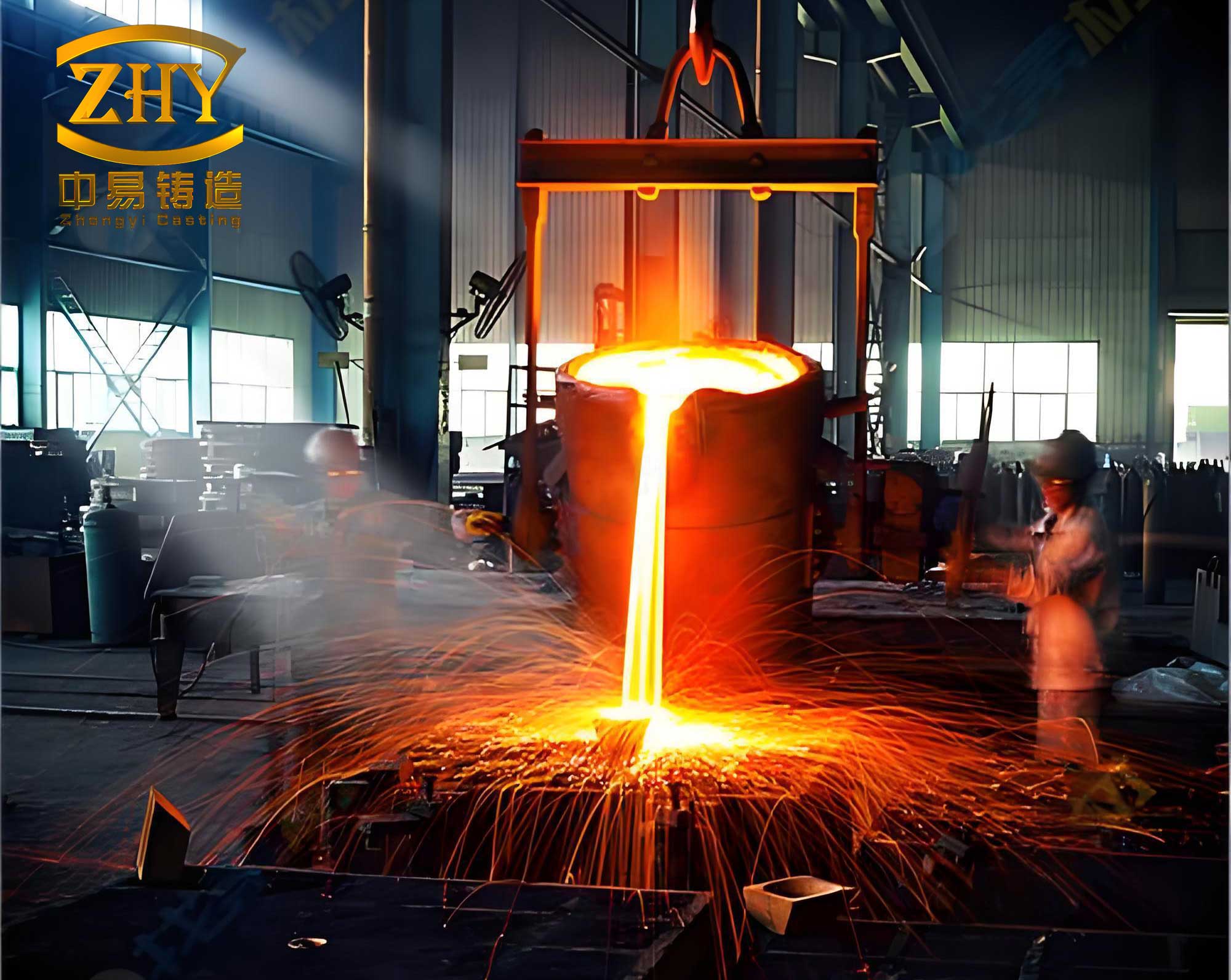
The manufacturing of intricate casting parts, such as engine blocks or cylinder heads, epitomizes this challenge. These components typically feature thin walls and complex, enclosed water jacket passages formed by large sand core assemblies. A pertinent case involves a inline-four cylinder block casting part made of gray iron (HT250), with a minimum wall thickness of 4.5 mm. During initial production, invasive porosity was the dominant defect, accounting for over two-thirds of total scrap and a scrap rate exceeding 10%. The defects were consistently located on the upper deck face at isolated high points corresponding to the water pump bore area of the water jacket core.
A multi-faceted root cause analysis was conducted. First, defect morphology inspection revealed large, smooth-walled cavities on the cope-side surface of the casting part, classic indicators of invasive gas. Second, thermal and gas pressure simulation using casting simulation software was employed. The simulation model incorporated the initial gating system—a bottom-heavy, two-level horizontal gating arrangement. The results were illuminating:
- Thermal Analysis: The simulated temperature field clearly showed that the defective pump bore region was a thermal “cold spot.” It was the last area to fill and, due to the gating design, received metal that had lost significant superheat. The local solidification time was therefore short.
- Gas Pressure Analysis: The simulation of gas pressure buildup within the water jacket core indicated high pressure levels precisely at the pump bore location. This core region had a relatively large volume but was connected to the outside only through small core-print vents, creating a bottleneck for gas evacuation.
The diagnosis was clear: 1) A low-temperature metal region at an isolated high point of the casting part reduced the time window for gas bubbles to escape, and 2) Inadequate venting of the core assembly allowed gas pressure to build up and invade the cooler, more viscous metal. The synergy of these factors guaranteed the formation of porosity in the casting part.
The improvement strategy targeted both thermal and gas pressure conditions simultaneously. The table below outlines the primary measures implemented:
| Improvement Area | Specific Action | Intended Effect on the Casting Part | Key Parameter/Design Change |
|---|---|---|---|
| Gating System Optimization | Addition of a third, upper-level ingate. | Direct delivery of hotter metal to the vulnerable upper region; increase local temperature by 30-40°C; delay solidification. | Changed from 2 to 3 tier ingates; adjusted cross-sectional area ratios. |
| Thermal Management | Controlled increase in pouring temperature. | Lower metal viscosity; extend the “risetime” for gas bubble escape; improve fluidity to fill thin sections. | Pouring temperature raised by 20°C (from 1410-1430°C to 1430-1450°C). |
| Core Venting Enhancement | Creation of an integrated venting network within the core assembly. | Provide low-resistance escape paths for core gases to the atmosphere, preventing pressure buildup. | Added auxiliary core prints, internal vent channels, and ensured all mold vents were open. |
1. Gating System Redesign: The original two-level gating was modified to a three-level system. The new upper ingate was positioned to directly feed the problematic pump bore area. Simulation of the new design confirmed a significant improvement in the thermal profile of the upper casting part. The temperature at the defect location increased substantially, which can be conceptually linked to a longer available time for gas escape, $t_{escape}$. This time is inversely related to the solidification rate, which is governed by the heat transfer equation. The local solidification time can be approximated using Chvorinov’s rule:
$$t_s = B \left( \frac{V_{casting}}{A_{casting}} \right)^n$$
where $t_s$ is solidification time, $V$ is volume, $A$ is surface area, $B$ is a mold constant, and $n$ is an exponent (≈2 for sand molds). By raising the local metal temperature, the effective mold constant $B$ is altered, and the thermal gradient is reduced, increasing $t_s$ and thereby $t_{escape}$ for gases in the casting part.
2. Enhanced Core Venting: This was a critical mechanical solution. The water jacket core was redesigned to incorporate a dedicated venting “highway.” This involved:
* Adding auxiliary core prints on non-critical faces of the casting part.
* Machining or forming internal vent channels within the core connecting the high-gas-volume areas to these new prints.
* Sealing these channels at strategic points with small core plugs to prevent metal intrusion.
* Ensuring the corresponding vents in the mold (e.g., vent pins in overflow risers) were fully open. This network ensured that the gas pressure $P_{gas}$ at any point inside the core was minimized by maintaining a near-atmospheric pressure $P_{atm}$ throughout the vent system, effectively invalidating the invasion inequality ($P_{gas} > P_{metal} + 2\gamma/r$).
The combined effect of these measures was a dramatic reduction in porosity-related scrap for the casting part. Post-implementation production data over several batches showed the scrap rate due to pump bore porosity plummeting from approximately 11% to around 0.6%. The success of this integrated approach provides a generalizable framework for solving invasive porosity in complex casting parts.
In conclusion, the effective elimination of invasive porosity in casting parts requires a holistic understanding of the defect’s physics and a systematic approach to process design. The case study underscores several universally applicable principles:
- Thermal Gradient Management: The gating system must be designed to create a favorable temperature gradient, ensuring that isolated high points or hot spots in the casting part are fed with sufficiently hot metal to allow adequate time for gas evacuation. Computational simulation is an indispensable tool for optimizing this.
- Active Pressure Management: Core and mold design must prioritize gas evacuation. This goes beyond simple core prints; it requires designing an active, low-resistance venting network that connects all potential gas-generating volumes within the core assembly directly to the atmosphere. The goal is to make $P_{gas} \approx P_{atm}$ everywhere inside the core before the metal solidifies around it.
- Process Parameter Synergy: Foundry parameters like pouring temperature must be optimized in concert with the geometric design. A slight, controlled increase in superheat can significantly aid in reducing metal viscosity and extending the gas escape window without introducing other defects like penetration or excessive shrinkage in the casting part.
The journey from an 11% to a 0.6% scrap rate for this particular casting part validates this multi-pronged strategy. By treating the mold cavity and core assembly as an integrated system where gas generation, flow, heat transfer, and solidification interact, foundry engineers can robustly design processes that yield high-quality, reliable casting parts free from invasive porosity. The methodologies outlined—root cause analysis via simulation, targeted gating redesign, proactive core venting, and precise thermal control—constitute a powerful toolkit for advancing the quality and consistency of complex castings across the industry.