
Our sand casting foundry has been engaged in the industrial production of high-aluminum zinc-based alloys since 1994, aiming to replace copper alloys in bearing applications. This paper summarizes our successful development of melting and sand casting foundry techniques for producing high-quality castings such as bushings, worm wheels, nuts, rings, sliders, and valve bodies. By controlling the melting process and optimizing the sand casting foundry design, we achieved mechanical properties comparable to international standards while reducing production costs by 30% to 50% compared to copper alloy castings.
Materials and Equipment
The primary raw materials used in our sand casting foundry include aluminum ingots (99.6%–99.7% Al), zinc ingots (Zn-0 or Zn-1), magnesium ingots (99.95% Mg), copper ingots (Cu-1), and a homemade Al-50%Cu master alloy. We employed two fuel-oil-fired crucible furnaces along with custom-designed tools. For refining, we used ZnCl₂, and for temperature measurement, an XCT-12-EU thermocouple was utilized. The molding material was conventional clay-bonded sand, typical for sand casting foundry operations.
Alloy Composition Design
Considering industrial production factors, raw material variability, and existing equipment conditions, we established the target chemical composition as shown in Table 1.
| Element | Composition (wt%) |
|---|---|
| Aluminum (Al) | 21.0 – 28.0 |
| Copper (Cu) | 2.0 – 3.0 |
| Magnesium (Mg) | 0.010 – 0.035 |
| Impurities (total) | ≤ 0.19 |
| Zinc (Zn) | Balance |
This composition was chosen to ensure good mechanical properties while maintaining castability in our sand casting foundry. The high aluminum content provides strength and hardness, while copper enhances strength and corrosion resistance. Magnesium acts as a grain refiner and deoxidizer.
Melting Process
Melting Method Selection
We compared two melting methods: the direct method (adding all alloying elements directly into the furnace) and the indirect method (melting zinc first, then adding other elements). The direct method in our fuel-oil-fired crucible furnace resulted in severe oxidation losses, especially aluminum losses up to 30%–35%, and poor temperature control. The indirect method, on the other hand, maintained lower melting temperatures, facilitated operation, and reduced element losses. Aluminum loss decreased to 5%–20%. Therefore, we adopted the indirect melting process for all subsequent sand casting foundry production.
Alloying Element Loss and Charge Calculation
Table 2 summarizes the typical losses of alloying elements observed during melting. Based on these values, we calculated the charge composition to achieve the desired final chemistry.
| Element | Loss (wt%) |
|---|---|
| Zinc (Zn) | 1 – 3 |
| Aluminum (Al) | 5 – 20 |
| Magnesium (Mg) | 10 – 30 |
| Copper (Cu) | 0.5 – 1.0 |
The average charge composition used in our sand casting foundry is given in Table 3.
| Material | Average (wt%) |
|---|---|
| Zinc (Zn) | 72 – 75 |
| Aluminum (Al) | 25 – 28 |
| Copper (Cu) | 2.5 – 3.5 |
| Magnesium (Mg) | 0.02 – 0.035 |
| Refining agent (ZnCl₂) | 0.10 – 0.15 |
| Modifier (Ce-based mischmetal) | 0.05 – 0.07 |
Melting Key Points
The melting process in our sand casting foundry follows these steps: preparation of raw materials, furnace and tools → charging → melting → refining and modification → preliminary inspection → pouring. The following points are critical for quality:
- Melting temperature control: We maintained the melting temperature at 580–600°C, with a superheat of 60–80°C. The crucible furnace has good thermal insulation, allowing a cooling rate of 1.2–1.8°C/min. The 60–80°C superheat provides 40–50 minutes for refining, settling, slag removal, and inspection before pouring at 510–520°C. Temperatures above 600°C cause excessive oxidation of Al and Mg, increase gas absorption, and degrade mechanical properties. Below 580°C, insufficient superheat leads to incomplete refining and floating of inclusions.
- Dehydration of refining agent: Incomplete dehydration of ZnCl₂ introduces hydrogen into the melt, causing severe porosity and a 30%–50% drop in mechanical properties. We pre-dehydrate the ZnCl₂ by wrapping it in aluminum foil and storing it near the furnace to keep it dry, synchronizing with the melting process.
- Use of foundry returns: The addition of returned scrap (re-melted gates, risers, defective castings) should not exceed 20% of the total charge. Table 4 shows the effect of scrap addition on mechanical properties.
| Return Addition (%) | σb (MPa) | σs (MPa) | δ5 (%) | HB |
|---|---|---|---|---|
| 0 | 406 | 363 | 9.8 | 103 |
| ≤20 | 369 | 338 | 6.2 | 103 |
| 100 | 395 | — | 1.8 | 114 |
When 100% returns were used, the microstructure showed increased network-like impurities, leading to higher strength and hardness but drastically reduced elongation (brittle behavior). Therefore, in our sand casting foundry we limit returns to ≤20% to maintain ductility.
- Modification treatment: We perform modification simultaneously with the second refining step. The modifier is Ce-based mischmetal (RECe-45), which forms compounds such as AlCe₄, Al₄CuCe, Mg₉Ce, and MgxNay that act as heterogeneous nucleation sites. This refines the grain structure, improves mechanical properties, and suppresses segregation and “bottom shrinkage” defects. Our experiments showed that adding 0–0.1% modifier increased strength and elongation by about 10% and reduced bottom shrinkage. Beyond 0.1%, strength continued to rise but elongation dropped sharply, and no further benefit was observed for defect reduction.
Sand Casting Foundry Process Design
Solidification Characteristics and Defects
High-aluminum zinc-based alloys solidify over a wide temperature range in a mushy mode. They have a large volumetric shrinkage (3%–4%) and density differences between the Al-rich phase (low density) and Zn-rich phase, causing upward floating of Al-rich dendrites. This results in unique defects: “bottom shrinkage” (shrinkage cavities at the bottom of castings) and “secondary bottom shrinkage” (shrinkage below the riser). Our sand casting foundry experiments established that the casting geometry modulus M = V/F (volume/surface area) is a critical parameter. For M ≥ 1 cm (i.e., wall thickness ≥30 mm and weight >20 kg), bottom shrinkage occurs; for M < 1 cm, the defect is absent. Therefore, we apply different solidification principles:
- For M ≥ 1 cm: Use directional solidification (intensified feeding) with side risers and chills to draw the hot spot and shrinkage into the riser.
- For M < 1 cm: Use simultaneous solidification; top risers are sufficient.
Pouring System Design
Considering the alloy’s high thermal conductivity, wide solidification range, low pouring temperature, susceptibility to oxidation, and high shrinkage, the gating system must ensure smooth filling without turbulence, splashing, or impact, with fast filling speed and good slag trapping ability. We adopted bottom-gated (unpressurized) or stepped gating systems. The gating ratios are:
$$\Sigma F_{\text{直}} : \Sigma F_{\text{横}} : \Sigma F_{\text{内}} = 1 : 5 : 3$$
where \(F_{\text{直}}\) is the cross-sectional area of the sprue, \(F_{\text{横}}\) of the runner, and \(F_{\text{内}}\) of the ingate. Ingates are designed with square or circular cross-sections for better heat retention.
The sprue area is calculated using:
$$\Sigma F_{\text{直}} = K \frac{G}{t \sqrt{H_P}}$$
Where:
- \(\Sigma F_{\text{直}}\) = total sprue area (cm²)
- \(K\) = coefficient (18–32; upper limit for high mold resistance)
- \(G\) = total metal weight through sprue (kg)
- \(t\) = pouring time (s), determined by \(t = k \sqrt{G}\)
- \(k\) = wall thickness coefficient (see Table 5)
- \(H_P\) = static pressure head (cm)
| Wall Thickness (mm) | ≤6 | 6–10 | 10–15 | >15 |
|---|---|---|---|---|
| k | 3.0 | 3.2 | 3.6 | 4.0 |
Risers and Chills
For large castings (M ≥ 1 cm), side risers are preferred over top risers to avoid secondary bottom shrinkage. The riser dimensions are determined by the modulus method:
$$M_{\text{casting}} : M_{\text{riser neck}} : M_{\text{riser}} = 1 : 1.1\text{–}1.5 : 1.2\text{–}1.8$$
Chills are typically made of cast iron with a thickness of 0.5–1.5 times the casting wall thickness. They accelerate solidification and promote directional feeding.
Pouring Temperature
For small castings using simultaneous solidification, we control the pouring temperature between 510°C and 525°C. This range ensures proper fluidity without excessive oxidation.
Results and Discussion
Chemical Composition and Mechanical Properties
Using the controlled melting process, we produced high-aluminum zinc-based alloy castings in our sand casting foundry that met the target composition. Table 6 shows the actual chemical compositions and mechanical properties from five representative heats.
| Heat | Al (wt%) | Cu (wt%) | Mg (wt%) | Zn | σb (MPa) | σs (MPa) | δ5 (%) | HB |
|---|---|---|---|---|---|---|---|---|
| 1 | 24.64 | 2.28 | 0.034 | Balance | 362 | 325 | 7.3 | 103 |
| 2 | 23.80 | 2.10 | 0.030 | Balance | 381 | 340 | 9.6 | 99.2 |
| 3 | 25.20 | 2.39 | 0.036 | Balance | 404 | 363 | 11.3 | 113 |
| 4 | 21.71 | 2.35 | 0.030 | Balance | 398 | — | 2.5 | 113 |
| 5 | 21.66 | 2.24 | 0.030 | Balance | 364 | 316 | 2.9 | 126 |
The mechanical properties (σb up to 410 MPa, σs up to 369 MPa, elongation up to 11.3%, and hardness up to 126 HB) are comparable to or exceed the American standard for similar alloys. The variation in elongation is attributed to aluminum content and modifier addition.
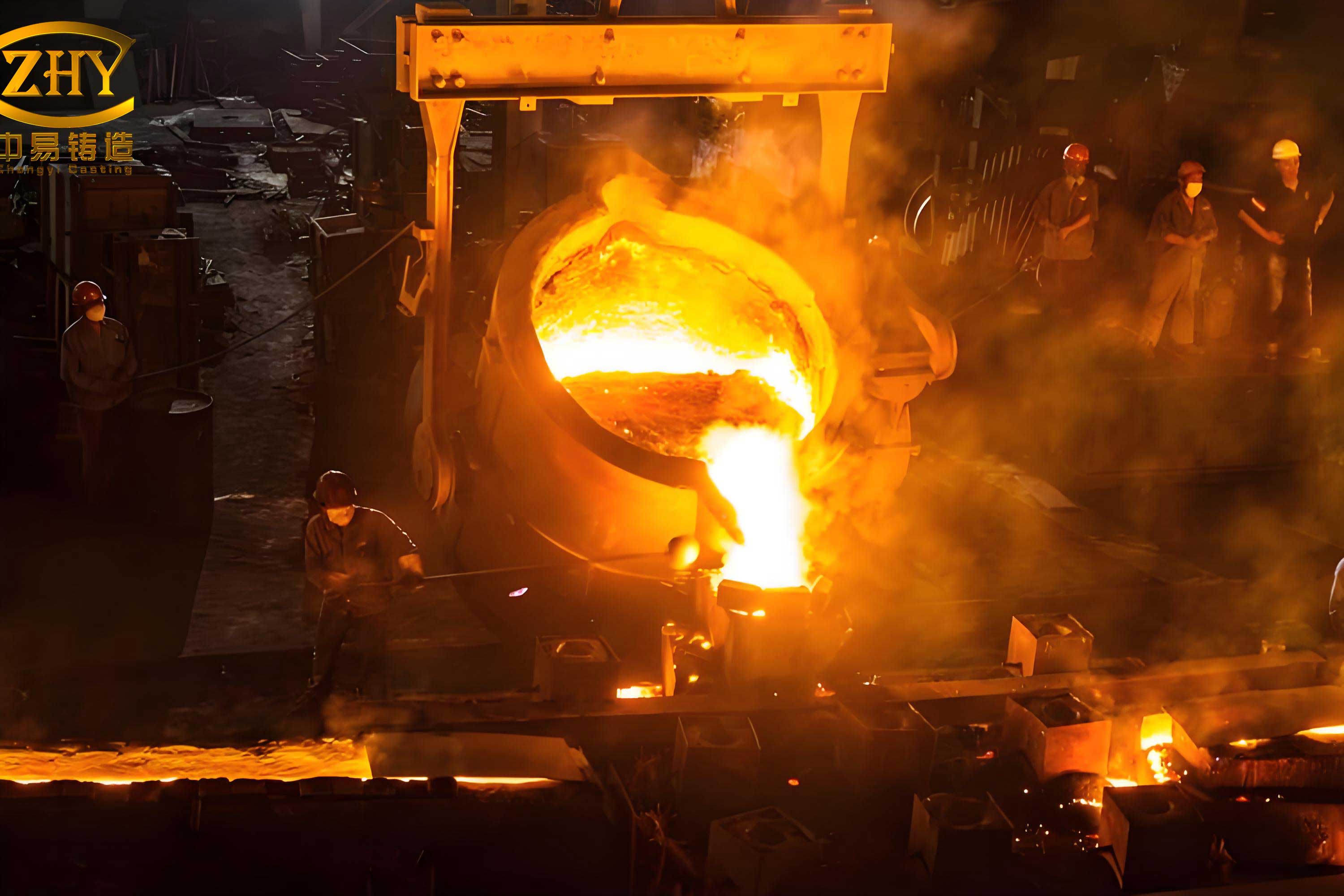
Figure above shows typical castings produced in our sand casting foundry. The castings exhibited sound internal quality with no bottom shrinkage or segregation defects.
Casting Quality
By applying the modulus criterion (M ≥ 1 cm for directional solidification, M < 1 cm for simultaneous solidification) and optimizing the gating, risering, and chilling systems, we eliminated bottom shrinkage and secondary bottom shrinkage defects in all castings. The linear shrinkage rate for sand casting foundry was determined to be 0.8%–1.3% (lower limit when hindered), and volumetric shrinkage 3.0%–4.0%. We used the same machining allowances as for aluminum alloy castings.
Our experiments confirmed that adding more than 0.1% modifier increased strength but reduced ductility; therefore, we limit modifier addition to 0.05%–0.07%. The combination of proper melting, refining, modification, and sand casting foundry design consistently produced castings that passed rigorous quality checks.
Conclusion
- By controlling melting parameters (temperature at 580–600°C, indirect method, thorough refining, and modification with 0.05%–0.07% Ce-based mischmetal), our sand casting foundry can produce high-aluminum zinc-based alloys with mechanical properties: σb = 410–362 MPa, σs = 369–316 MPa, δ5 = 11.3%–2.5%, and HB = 126–99.
- Applying a linear shrinkage of 0.8%–1.3%, volumetric shrinkage of 3%–4%, machining allowances similar to aluminum alloys, and the modulus criterion M = V/F with appropriate solidification principles (directional or simultaneous) enables the sand casting foundry to produce defect-free castings.
- The sand casting foundry process developed here has been validated by producing over 900 kg of qualified castings for multiple customers.
- The production cost of high-aluminum zinc-based alloy castings in our sand casting foundry is 30%–50% lower than that of equivalent copper alloy castings, making it an economically attractive alternative.
Our continued experience in sand casting foundry operations demonstrates that high-aluminum zinc-based alloys are a viable and cost-effective substitute for copper in bearing and sliding applications, provided that proper melting and molding practices are followed.