
In my extensive experience within the sand casting services industry, I have dealt with numerous critical components, among which the column socket for hydraulic supports stands out due to its paramount importance in mining operations. These sockets, typically crafted from cast steel, bear immense pressure from the mine roof, and any defect can compromise the entire hydraulic support system, posing severe safety risks. Therefore, ensuring high-quality output in sand casting services is not just a matter of efficiency but of operational safety. This article delves into the common defects encountered in such castings, specifically focusing on shrinkage porosity, gas holes, and sand sticking, which frequently plague sand casting services. I will analyze their root causes, propose preventive measures, and highlight how modern advancements can enhance the reliability of sand casting services. Throughout this discussion, I will emphasize the integral role of robust sand casting services in manufacturing durable components, and I will incorporate tables and formulas to summarize key points for clarity and practical application.
Sand casting services predominantly utilize sand molds, with sodium silicate-bonded sand being a common choice in many foundries, including those I have worked with. This method offers good fluidity and rapid hardening, but it also presents challenges like poor collapsibility and restricted shrinkage during metal solidification. For materials like ZG30Cr06, a low-carbon alloy steel used in column sockets, the high shrinkage tendency exacerbates defect formation. By understanding and addressing these issues, sand casting services can significantly improve product quality. The following sections break down each defect type, supported by technical insights drawn from hands-on practice in sand casting services.
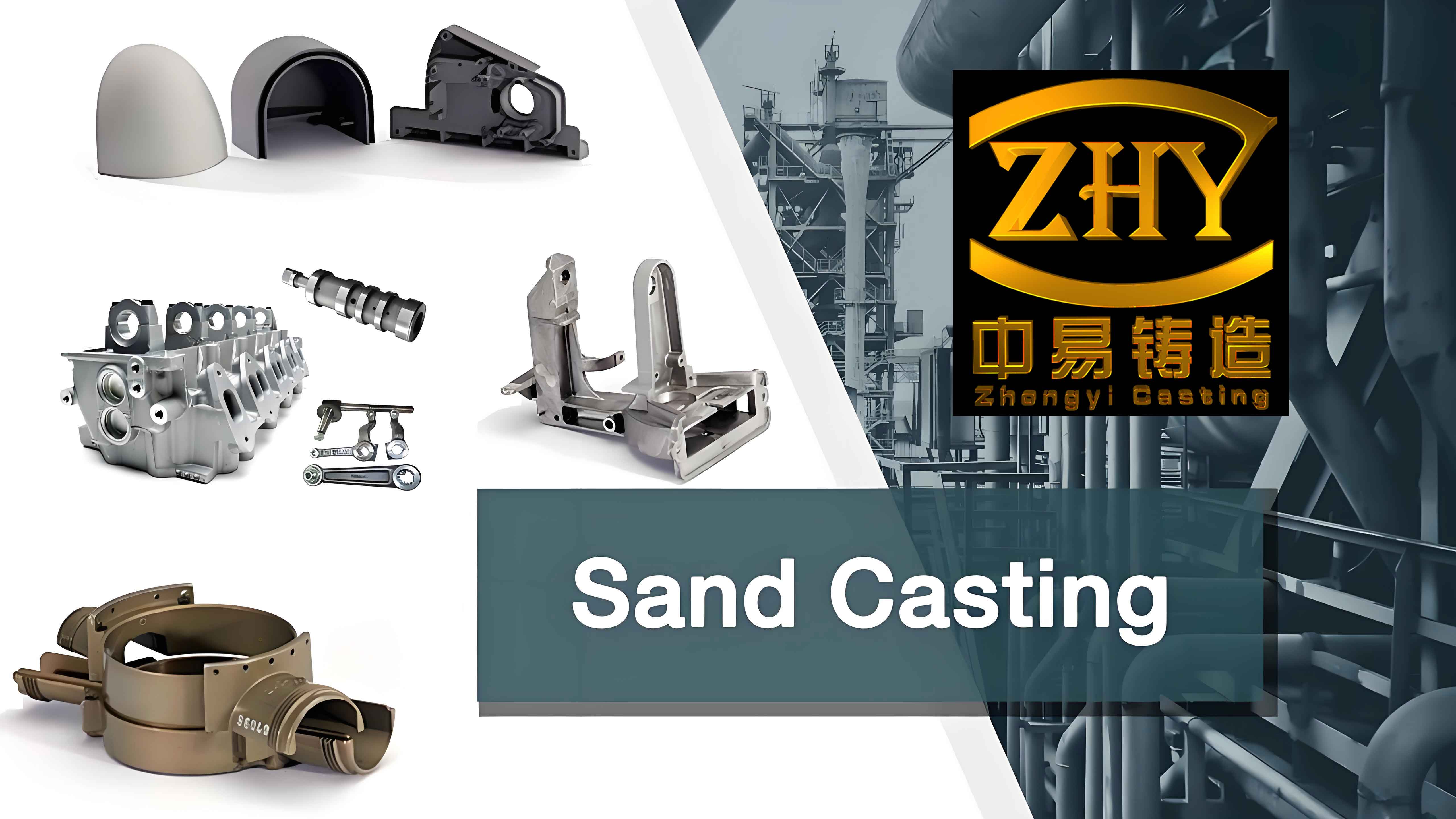
Shrinkage porosity is a prevalent issue in sand casting services, manifesting as irregular cavities with rough walls in the last-solidifying sections of a casting, such as the cross-rib areas of column sockets. These defects reduce effective cross-sections and mechanical strength, jeopardizing the component’s performance. In sand casting services, shrinkage porosity often stems from inadequate feeding during solidification. The primary reasons include obstructed feeding channels, improper riser design, high pouring temperatures, and insufficient riser insulation. To quantify this, the solidification shrinkage can be expressed using the volume shrinkage ratio, which is critical in sand casting services for designing effective feeding systems. For steel castings, the total volume shrinkage typically ranges from 3% to 6%, depending on composition and cooling conditions. A simplified formula for the required riser volume to compensate for shrinkage is:
$$ V_r = \frac{V_c \cdot \beta}{\eta} $$
where \( V_r \) is the riser volume, \( V_c \) is the casting volume, \( \beta \) is the shrinkage rate (e.g., 0.04 for 4% shrinkage), and \( \eta \) is the feeding efficiency factor (often between 0.1 and 0.3 in sand casting services). This highlights the need for precise calculations in sand casting services to prevent shrinkage defects. Below is a table summarizing the causes and characteristics of shrinkage porosity in sand casting services:
| Cause | Description | Typical Location in Casting |
|---|---|---|
| Obstructed feeding channels | Cross-rib areas block metal flow during solidification, hindering补缩. | Last-solidifying sections like ribs or thick junctions |
| Inadequate riser design | Risers with insufficient diameter or height fail to provide enough molten metal for补缩. | Riser roots or hot spots |
| High pouring temperature | Excessive temperature increases contraction and gas absorption, leading to shrinkage cavities. | Throughout the casting, especially in thick sections |
| Poor riser insulation | Risers solidify before the casting, causing reverse feeding or “anti-feeding.” | Riser-casting interface |
To mitigate shrinkage porosity in sand casting services, several strategies can be employed. Optimizing the casting process design is crucial; this involves ensuring sequential solidification by placing risers strategically and using special risers like insulating or exothermic types. In sand casting services, controlling pouring parameters is also vital. Adhering to the principle of “high-temperature melting, low-temperature pouring” helps minimize shrinkage. The pouring temperature \( T_p \) can be related to the liquidus temperature \( T_l \) and a safety margin \( \Delta T \), often set based on casting thickness \( d \):
$$ T_p = T_l + \Delta T \quad \text{where} \quad \Delta T = k \cdot d $$
Here, \( k \) is an empirical constant (e.g., 10–20°C/cm for steel in sand casting services). Additionally, enhancing alloy refinement through proper deoxidation, such as aluminum终脱氧, reduces dissolved gases and impurities, improving feeding capability. During pouring, slowing the rate as the metal reaches the riser neck and adding hot metal to the riser with charcoal coverage can promote effective feeding. These practices are standard in high-quality sand casting services to ensure sound castings.
Gas holes, another common defect in sand casting services, appear as smooth-walled pores on the surface or inside castings, often with oxidized or bright interiors. They degrade internal density and mechanical properties, posing risks in critical applications. Based on their origin, gas holes in sand casting services are classified into precipitated gas holes and invasive gas holes. Precipitated gas holes result from gases like hydrogen, nitrogen, or oxygen dissolved in the molten metal, which precipitate during solidification due to decreased solubility. According to Sievert’s law, the solubility \( S \) of diatomic gases in liquid metal is proportional to the square root of the partial pressure \( P \):
$$ S = k \sqrt{P} $$
where \( k \) is a temperature-dependent constant. During cooling, the solubility drops sharply, leading to the formation of numerous small, dispersed pores. Invasive gas holes, on the other hand, occur when gases from the mold cavity or sand decomposition invade the metal during pouring or solidification. In sand casting services, this often happens due to poor venting or high gas generation from binders like sodium silicate. The table below outlines these gas hole types in sand casting services:
| Type of Gas Hole | Formation Mechanism | Appearance and Distribution |
|---|---|---|
| Precipitated gas holes | Gases dissolved in molten metal析出 during solidification as solubility decreases. | Small, round or needle-shaped pores scattered throughout the casting, often visible after machining. |
| Invasive gas holes | Gases from mold air or sand thermal decomposition invade the metal液. | Larger, irregular pores typically located near the surface or in areas with poor venting, like ear sections of column sockets. |
Preventing gas holes in sand casting services requires a multifaceted approach. During melting, ensuring dry charge materials and preheated tools minimizes gas introduction. Vigorous stirring after melting helps gases float out. In sand casting services, proper deoxidation is critical; adding aluminum屑 to the ladle before tapping and allowing a镇静 time for gas escape are effective. For invasive gas holes, optimizing the gating system design is key. Using open gating systems with appropriate parameters ensures smooth, continuous filling without turbulence, which can entrap air. The Reynolds number \( Re \) for fluid flow in gating systems can indicate turbulence risk:
$$ Re = \frac{\rho v D}{\mu} $$
where \( \rho \) is density, \( v \) is velocity, \( D \) is hydraulic diameter, and \( \mu \) is viscosity. In sand casting services, keeping \( Re \) below 2000 promotes laminar flow, reducing gas entrapment. Additionally, enhancing mold permeability by controlling sand properties—such as using low-clay, coarse-grained sand—and poking adequate vent holes in molds are essential steps. These measures underscore the importance of meticulous process control in sand casting services to eliminate gas-related defects.
Sand sticking, or metal penetration, is a surface defect where molten metal or oxides infiltrate sand grains, forming a hard, adherent layer that complicates cleaning and affects appearance. In sand casting services, this defect arises from low mold surface compactness, loose sand in the cavity, or excessive pouring temperatures. The penetration depth \( \delta \) can be estimated using a simplified model based on capillary pressure and metal viscosity:
$$ \delta = \sqrt{\frac{\gamma \cos \theta \cdot t}{\mu}} $$
where \( \gamma \) is surface tension, \( \theta \) is contact angle, \( t \) is time, and \( \mu \) is dynamic viscosity. High temperatures reduce sand refractoriness and increase metal fluidity, exacerbating penetration. Below is a table summarizing causes and preventive actions for sand sticking in sand casting services:
| Cause | Impact on Casting | Preventive Measure |
|---|---|---|
| Low mold compactness | Large inter-sand空隙 allow metal infiltration, leading to rough surfaces. | Increase sand ramming density uniformly to reduce porosity. |
| Uncleaned cavity浮砂 | Loose sand floats up during pouring, causing surface adherence. | Thoroughly clean molds before closing and pouring. |
| High pouring temperature | Prolonged thermal exposure lowers sand耐火度, enhancing metal penetration. | Control pouring temperature based on casting thickness and geometry. |
| Inadequate sand properties | Poor refractoriness or high binder content promotes metal-sand fusion. | Use high-refractoriness sand with controlled sodium silicate addition (below 8%). |
To combat sand sticking in sand casting services, selecting appropriate molding materials is fundamental. Opt for sands with high耐火度 and optimal grain size, while minimizing binder and moisture content. Improving mold compactness without sacrificing透气性 is a balance; statistical process control in sand casting services can help achieve this. Additionally, adjusting pouring parameters—such as lowering temperature and speed—reduces thermal冲击 and冲刷力. For instance, the pouring speed \( v_p \) can be derived from the Bernoulli equation for gating design:
$$ v_p = \sqrt{2gH} $$
where \( g \) is gravity and \( H \) is the metallostatic head. In sand casting services, reducing \( H \) or using choke sections can moderate speed, lessening metal渗透. These practices are integral to delivering flawless surfaces in sand casting services, enhancing both aesthetics and functionality.
Beyond individual defect prevention, comprehensive quality assurance in sand casting services involves holistic process optimization. This includes rigorous alloy refining, precise control of molding and pouring operations, and continuous monitoring. For example, implementing statistical quality control charts for key variables like pouring temperature or sand compactness can detect deviations early. Moreover, integrating advanced technologies into sand casting services has revolutionized defect reduction. Computer-aided design (CAD) enables optimal riser and gating layouts, while simulation software predicts solidification patterns and defect formation. These tools allow sand casting services to visualize and rectify issues virtually before production, saving time and resources. The adoption of such innovations is becoming standard in modern sand casting services, driving precision and efficiency.
In conclusion, the analysis and prevention of casting defects are central to the success of sand casting services, especially for critical components like hydraulic support column sockets. Through detailed examination of shrinkage porosity, gas holes, and sand sticking, I have outlined practical strategies rooted in both theory and practice. Employing formulas for shrinkage compensation, gas solubility, and penetration depth, along with tabulated summaries, provides a systematic framework for improvement. As sand casting services evolve with computer simulations and advanced materials, the potential for defect-free castings grows. By embracing these advancements and adhering to stringent process controls, sand casting services can ensure high-quality, reliable products that meet the demanding needs of industries such as mining. Ultimately, the commitment to excellence in sand casting services not only enhances product performance but also safeguards operational safety, underscoring the vital role of this manufacturing method in global supply chains.