
In our foundry, we recently encountered a significant quality issue affecting the production of medium-speed engine flywheels made from grey iron casting. A large number of castings exhibited severe surface depressions, often referred to as shrinkage depression, with depths exceeding 3 mm and in some cases surpassing 5 mm, leading to high scrap rates. This problem severely impacted our production costs and order fulfillment, necessitating immediate investigation and resolution. As engineers specializing in grey iron casting process development, we undertook a comprehensive analysis to identify the root causes and implement effective countermeasures.
Grey iron casting is widely utilized for components requiring good machinability, vibration damping, and cost-effectiveness, such as engine flywheels. However, the inherent solidification characteristics of grey iron, involving graphite precipitation and associated expansion, can lead to defects like shrinkage cavities or depressions if the process is not meticulously controlled. The flywheel in question is a disc-shaped component with a substantial cross-section and relatively thick walls, making it prone to solidification-related issues. The casting’s nominal composition is akin to HT250 grade grey iron, with primary microstructural requirements being Type A graphite and a predominantly pearlitic matrix.
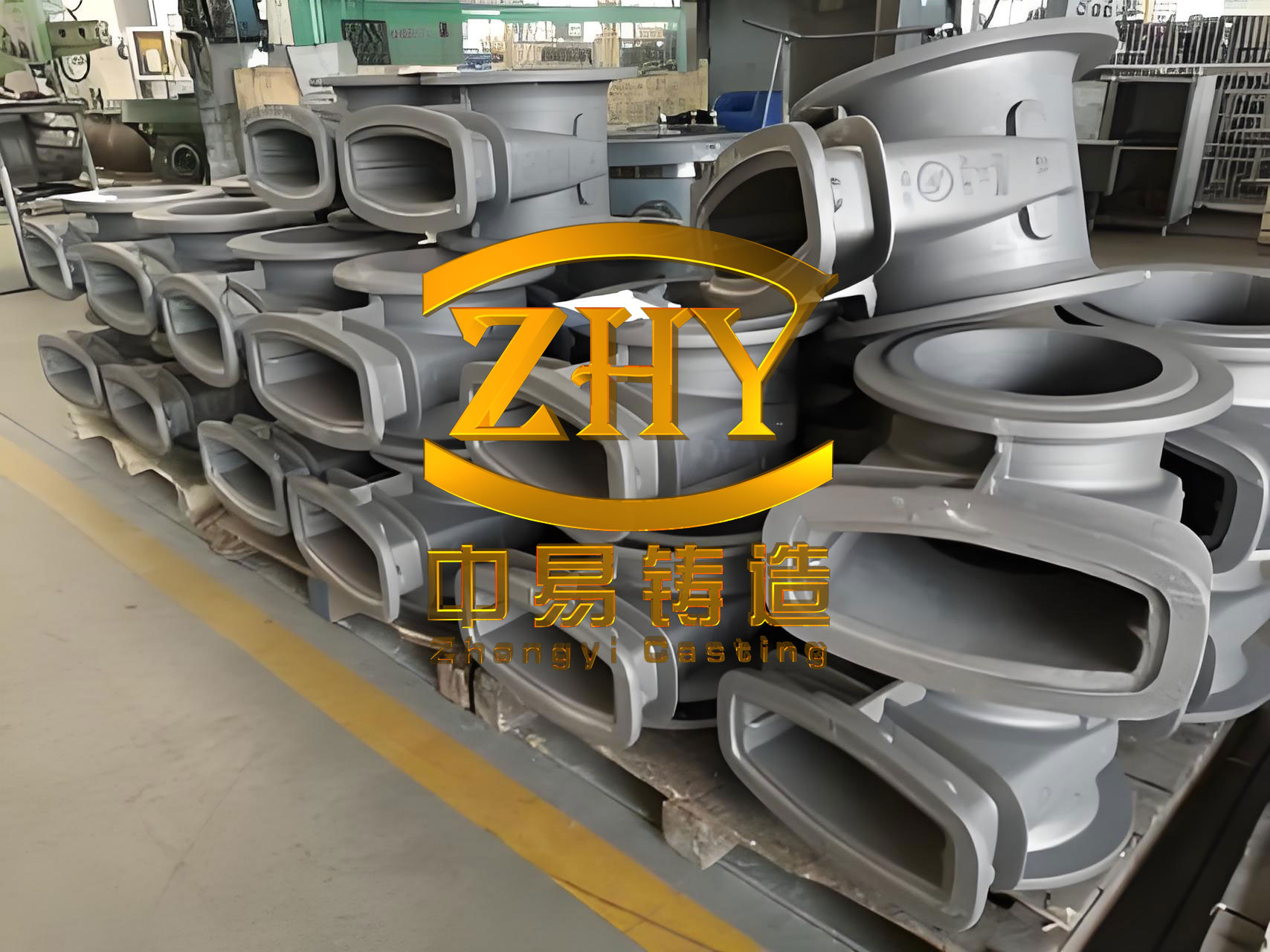
The initial manufacturing process for this grey iron casting involved producing two pieces per mold box on an automated molding line using alkaline phenolic resin-bonded sand. The gating system was a traditional pressurized type. The molten metal composition and key process parameters are summarized in the table below.
| Parameter | Value or Specification |
|---|---|
| Casting Material | Grey Iron (HT250 grade) |
| Key Chemical Composition (wt%) | C: ~3.25, Si: ~1.9, Mn: ~0.95, P: ≤0.04, S: ~0.09, Cu: ~0.4, Cr: ~0.28 |
| Calculated Carbon Equivalent (CE) | Approximately 3.87% (using CE = C + Si/3) |
| Pouring Temperature | 1350 – 1360 °C (initial pour) |
| Molding Sand | Alkaline Phenolic Resin Sand |
| Mold Hardness / Compaction | Standard jolting time of 15 seconds |
| Gating System Type | Pressurized (choke at ingate) |
| Gating Ratio (ΣAsprue:ΣArunner:ΣAgate) | 1.64 : 2.05 : 1 |
| Ingate Dimensions (per gate) | Height: 5 mm (variable width) |
The defect manifested as a depression or sink on the upper cope surface of the grey iron casting. Sometimes, small metallic droplets or “iron beans” were found within the depression. Crucially, the depression area retained the coating layer after shakeout, while the droplets did not, indicating they formed later during solidification. This evidence confirmed the defect as a shrinkage depression, resulting from inadequate compensation for volumetric contraction during the solidification of the grey iron casting.
To understand this phenomenon in grey iron casting, we must consider the total volumetric change from pouring temperature to complete solidification. The total contraction (εtotal) can be expressed as the sum of liquid contraction (εl), liquid-to-solid contraction (εls, often called solidification shrinkage), and solid-state contraction (εs). For grey iron, the unique expansion due to graphite precipitation (εgraphite) partially offsets these contractions. The net volumetric change (ΔV) determining whether a shrinkage defect forms is given by:
$$ \Delta V = V_0 \cdot [\varepsilon_l + \varepsilon_{ls} + \varepsilon_s – \eta \cdot \varepsilon_{graphite}] $$
where \( V_0 \) is the initial volume, and \( \eta \) is an efficiency factor for graphite expansion transmission, heavily dependent on mold rigidity and cooling rate. A negative ΔV implies net shrinkage requiring feeding. In our case, the depression indicated that the combined liquid and solidification shrinkage was not fully compensated by the graphite expansion and liquid metal feeding from the gating system.
Our root cause analysis for the shrinkage depression in this grey iron casting focused on four main aspects: metallurgical composition, pouring parameters, mold characteristics, and gating system design.
1. Metallurgical Composition and Carbon Equivalent: The carbon equivalent (CE) is a critical parameter for grey iron casting, predicting the solidification behavior and tendency for graphite expansion. It is typically calculated as:
$$ CE = C\% + \frac{Si\% + P\%}{3} $$
For our initial composition, CE was approximately 3.87%. This placed the alloy in the slightly hypoeutectic range. Hypoeutectic grey iron castings have a wider solidification range (the temperature interval between liquidus and solidus), leading to a more extended mushy zone and potentially greater solidification shrinkage before the onset of significant graphite expansion. The relationship between solidification shrinkage volume (Vsh) and carbon equivalent can be approximated for near-eutectic compositions, but generally, a lower CE increases the risk of shrinkage defects. We hypothesized that increasing the CE closer to the eutectic point (around 4.3%) would reduce the solidification range and enhance graphite expansion.
2. Pouring Temperature: The initial pouring temperature of 1350-1360°C was relatively high for this section size grey iron casting. The liquid contraction (εl) is proportional to the temperature drop from pouring (Tpour) to the liquidus temperature (Tliq). A higher Tpour increases this temperature interval, thereby increasing the total liquid contraction volume that must be fed. The liquid contraction coefficient (αl) for iron is roughly 1.0 × 10⁻⁴ /°C. Thus, the liquid contraction strain can be estimated as:
$$ \varepsilon_l \approx \alpha_l \cdot (T_{pour} – T_{liq}) $$
Reducing the pouring temperature would directly decrease εl, reducing the demand on the feeding system during the initial stages of cooling.
3. Mold Strength and Rigidity: The resin sand mold must possess sufficient strength and hot rigidity to withstand the metallostatic pressure and, more importantly, resist deformation from the internal graphite expansion pressure during the latter stages of grey iron casting solidification. If the mold wall yields or expands (mold wall movement), it creates extra volume that the solidifying metal must fill, effectively amplifying the shrinkage cavity. The mold’s resistance to deformation is non-linear and depends on compaction density. Our standard jolting time of 15 seconds might have been insufficient to achieve optimal mold hardness, reducing the efficiency (η) of graphite expansion in counteracting shrinkage.
4. Gating System Design: The original pressurized system with the choke at the ingates had several drawbacks for feeding this grey iron casting. Firstly, it caused high metal velocity at the ingates, leading to turbulent filling. This turbulence can lead to air entrapment and inconsistent temperature distribution. Secondly, and most critically for feeding, in a pressurized system, the ingates freeze off quickly once pouring stops. Since our ingate height was only 5 mm, its solidification time was very short. After the sprue and runner solidified, the casting could no longer draw liquid metal from the gating system to compensate for liquid and solidification shrinkage. The system lacked “feeding reserve.” The rapid filling also meant the pourer had to stop abruptly when the overflow well filled, causing a sudden drop in the feeding head pressure.
We quantified the ingate velocity (vgate) using the basic hydraulic equation for a choked system, where Q is the flow rate and Agate is the total ingate area:
$$ v_{gate} = \frac{Q}{A_{gate}} $$
With the original design, vgate was estimated to be excessively high, promoting turbulence. To address these issues systematically, we implemented a multi-pronged improvement plan focusing on the grey iron casting process.
| Aspect | Original Condition | Improved Condition | Objective |
|---|---|---|---|
| Carbon Equivalent (CE) | ~3.87% (C: ~3.25%) | Increased to ~4.0% (C: ~3.3%) | Reduce solidification range, enhance graphite expansion. |
| Pouring Temperature | 1350-1360 °C | Strictly controlled at ≤ 1350 °C | Reduce liquid contraction volume. |
| Process Control | General queue | Dedicated pouring sequence for flywheels; use of thermal imaging. | Avoid superheating from prior pours; ensure temp control. |
| Mold Compaction | Jolt time: 15 s | Jolt time increased to 25 s | Increase mold hardness and rigidity to better utilize graphite expansion. |
| Gating System Design | Pressurized; choke at ingate; full circular runner; 5mm ingate height. | Pressurized-Open hybrid; choke before runner; 3/4 circular runner with slag trap; 8mm ingate height. | Promote tranquil filling; delay ingate solidification; improve feeding. |
| Pouring Practice | Stop at overflow fill | Increased overflow volume to account for wave depression | Maintain effective feeding head until ingates seal. |
The most significant redesign was in the gating system. We employed casting simulation software to model fluid flow, temperature gradients, and solidification sequences. The new design introduced a choke section between the sprue and the main runner, converting the system to a “pressurized-open” type. This meant the system was pressurized up to the choke, but the runner and ingates were effectively open, drastically reducing metal velocity. The simulation results before and after the change were starkly different.
The initial velocity at the ingates, as predicted by simulation, dropped from approximately 2.0 m/s to about 0.8 m/s. This reduction significantly minimized turbulence. Furthermore, we modified the runner from a full circle to a three-quarter circle with a slag collection chamber at the end, further promoting calm flow and slag removal. The most crucial change was increasing the ingate height from 5 mm to 8 mm while adjusting the width to maintain a similar total cross-sectional area. The solidification time of a channel is proportional to the square of its modulus (Volume/Surface Area). Increasing the ingate height increased its modulus, thereby extending its solidification time according to Chvorinov’s rule:
$$ t_s = B \cdot \left( \frac{V}{A} \right)^n $$
where \( t_s \) is solidification time, \( V \) is volume, \( A \) is surface area, \( B \) is a mold constant, and \( n \) is an exponent (typically ~2). This longer life of the ingates meant they could act as liquid feeders for the grey iron casting for a more extended period during the critical liquid and solidification contraction phases.
The chemical adjustment, specifically increasing the carbon content, directly raised the carbon equivalent. The eutectic graphite expansion pressure (Pgraphite) is a function of the amount and morphology of graphite formed. A higher CE promotes more graphite formation, increasing this internal pressure which counteracts shrinkage. The improved mold rigidity from longer jolting ensured this pressure was effectively transmitted to compensate for shrinkage rather than deforming the mold.
Controlling the pouring temperature required operational discipline. We instituted a dedicated pouring schedule for these grey iron castings to prevent the iron from being excessively superheated while waiting for other molds. Thermal monitoring cameras were installed at the pouring station to provide real-time feedback to the pourer, ensuring the 1350°C limit was strictly adhered to.
After implementing all these changes, we produced a batch of over 100 flywheel castings. The results were immediately positive. The severe shrinkage depressions were completely eliminated. The upper surfaces of the grey iron castings were sound and flat, meeting all dimensional and quality specifications. The scrap rate due to this defect fell to zero, resolving the production and delivery crisis.
This case study offers valuable insights for solving similar defects in grey iron casting production. The successful resolution hinged on a holistic approach that addressed multiple interacting factors. Key takeaways include:
1. Optimize Carbon Equivalent: For thick-section grey iron castings, aiming for a CE closer to the eutectic point can significantly reduce shrinkage tendency by maximizing beneficial graphite expansion.
2. Control Pouring Temperature Precisely: Minimizing superheat reduces the liquid contraction demand, a simple but often overlooked factor in grey iron casting quality.
3. Ensure Mold Rigidity: Adequate sand compaction is non-negotiable for grey iron casting to harness graphite expansion. It acts as a contained pressure vessel.
4. Design Gating for Feeding, Not Just Filling: The gating system in grey iron casting must serve a dual purpose. A tranquil fill is essential, but the system must also remain liquid long enough to act as a feeder. Using simulation software to visualize flow and solidification is invaluable for achieving this balance. The shift from a purely pressurized system to a hybrid design with larger ingates was pivotal.
5. Implement Robust Process Controls: Consistent quality in grey iron casting requires controlling variables like temperature and pouring practice through technological aids and standardized work instructions.
The fundamental principles involved can be generalized. The net shrinkage tendency (Snet) in a grey iron casting can be modeled as a function of key variables:
$$ S_{net} = f(CE, T_{pour}, G, R_{mold}, t_{gate}) $$
where \( CE \) is carbon equivalent, \( T_{pour} \) is pouring temperature, \( G \) is the thermal gradient (affected by geometry), \( R_{mold} \) is mold rigidity, and \( t_{gate} \) is the feeding time provided by the gating system. Our intervention successfully optimized each of these variables for the specific flywheel geometry.
In conclusion, the problem of shrinkage depression in this particular grey iron casting was systemic, arising from sub-optimal settings across metallurgy, process, and tooling. By methodically analyzing the defect mechanism—understanding the interplay between liquid contraction, solidification shrinkage, graphite expansion, and mold mechanics—we identified the correct levers to pull. The synergistic effect of increasing carbon equivalent, lowering pouring temperature, enhancing mold strength, and fundamentally redesigning the gating system to promote calm filling and prolong feeding capability proved to be a complete and effective solution. This experience underscores the importance of a integrated process engineering approach in achieving high-quality, defect-free grey iron castings for demanding applications. The lessons learned continue to inform our practices for other grey iron casting components, ensuring robust and economical production.