
In the production of heavy section castings, spheroidal graphite cast iron often faces significant challenges related to graphite degeneration, particularly the formation of chunky graphite in the central regions due to slow cooling rates and prolonged solidification times. This defect severely compromises mechanical properties, such as tensile strength and elongation, leading to quality issues in critical applications like wind power components or large industrial machinery. As a foundry engineer engaged in process design and melting for gray and spheroidal graphite cast iron, I have conducted extensive on-site experimental investigations to address these problems. This article presents a detailed account of three trial schemes aimed at mitigating chunky graphite formation and graphite recession in heavy section spheroidal graphite cast iron, with a focus on compositional control, treatment parameters, and inoculation methods. The goal is to provide practical insights for stabilizing the microstructure and enhancing the performance of thick-walled spheroidal graphite cast iron components.
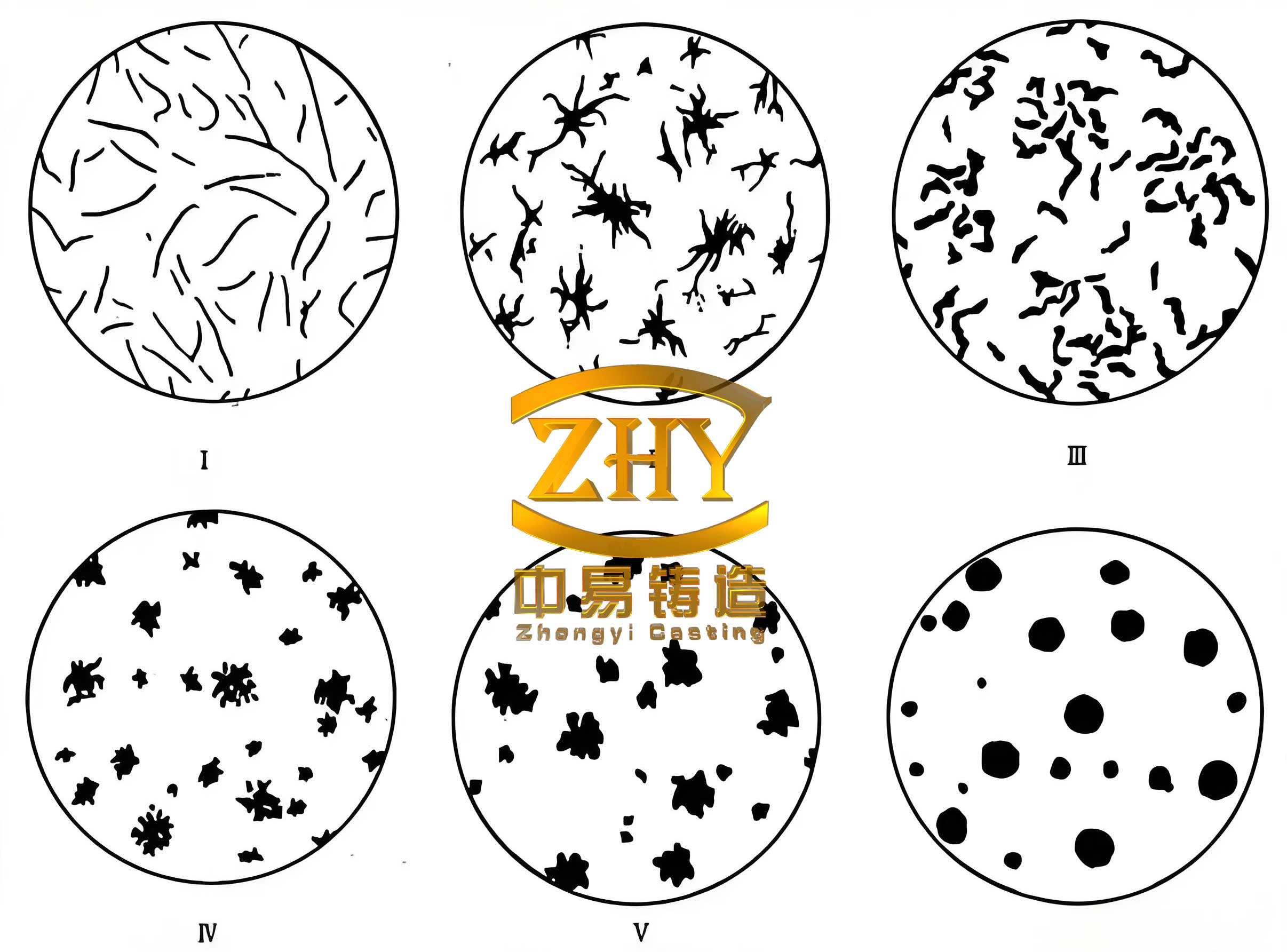
Spheroidal graphite cast iron, also known as ductile iron, relies on the spheroidization of graphite nodules through magnesium or cerium treatment, followed by inoculation to promote graphite nucleation. In heavy sections, typically defined as thicknesses exceeding 200 mm, the slow cooling rate in the thermal centers leads to extended solidification times. This can cause graphite nodules to degenerate into irregular forms, such as chunky graphite, which appears as fragmented or blocky graphite aggregates under microscopy. Chunky graphite is often associated with reduced ductility and toughness, posing a risk of premature failure in castings. The mechanisms behind its formation involve factors like carbon equivalent, trace elements, cooling conditions, and post-inoculation effects. Thus, optimizing these parameters is crucial for producing high-integrity spheroidal graphite cast iron castings.
To systematically study this issue, I designed experiments using test blocks with dimensions of 250 mm × 250 mm × 260 mm, simulating heavy section conditions. The material grade targeted was QT400-15, requiring a minimum elongation of 15% in standard sections but adjusted for thick sections. The investigation involved three sequential schemes, each refining the approach based on previous results. Key variables included the type of nodularizing alloy (with light rare earth, heavy rare earth, or specific additives), inoculation methods, chemical composition ranges, and process controls like treatment temperature and cooling rate. Throughout this work, the term spheroidal graphite cast iron is emphasized to underscore the material’s relevance in industrial applications.
Background and Theoretical Framework
The formation of chunky graphite in spheroidal graphite cast iron can be described using solidification models. During the eutectic reaction, graphite nodules grow in an austenite shell, but under slow cooling, diffusion-controlled growth may lead to instability. The carbon concentration gradient, $C$, around a nodule can be expressed as:
$$ \frac{\partial C}{\partial t} = D \nabla^2 C $$
where $D$ is the diffusion coefficient. In thick sections, low undercooling promotes degenerate graphite morphologies. Additionally, the role of trace elements like bismuth (Bi) or antimony (Sb) can influence graphite shape, often modeled by interfacial energy equations. For spheroidal graphite cast iron, the nodule count, $N$, is critical and relates to inoculation efficiency:
$$ N = f(I_0, T_c, \Delta t) $$
where $I_0$ is the inoculant potency, $T_c$ is the cooling rate, and $\Delta t$ is the treatment-to-pouring time. By controlling these factors, chunky graphite can be suppressed, ensuring that the spheroidal graphite cast iron retains its desirable properties.
Experimental Setup and Methodology
All trials were conducted in a production foundry environment. The base iron was melted in a medium-frequency induction furnace, with raw materials including pig iron, steel scrap, and ferroalloys. The chemical composition was adjusted to target ranges, as detailed in the schemes below. Nodularization was performed using a sandwich method in preheated ladles, with nodularizing alloys added at the bottom covered by steel punchings. Inoculation involved both ladle inoculation (primary) and stream inoculation (secondary). The test blocks were poured in sand molds, and after cooling, samples were taken from edge and center locations, as illustrated in a schematic (though not referenced explicitly). Mechanical testing included tensile tests on machined specimens and hardness measurements, while microstructure analysis used optical microscopy to assess graphite morphology and nodularity.
Scheme One: Initial Trials with Light and Heavy Rare Earth Nodularizers
The first scheme aimed to establish a baseline using existing production practices. Two types of nodularizing alloys were tested: a light rare earth-magnesium alloy (Alloy A) and a heavy rare earth-magnesium alloy (Alloy B), both added at 1.2 wt%. The inoculation employed a calcium-barium composite inoculant, with 0.6% for ladle inoculation and 0.15% for stream inoculation. The chemical composition was controlled within typical ranges for spheroidal graphite cast iron, but with higher silicon content, as shown in Table 1. The pouring temperature was monitored, and the time from nodularization to pouring completion was approximately 7–8 minutes.
| Sample ID | Nodularizer | Pouring Temp. (°C) | C (wt%) | Si (wt%) | Mn (wt%) | P (wt%) | S (wt%) | Mgres (wt%) |
|---|---|---|---|---|---|---|---|---|
| Edge-1 | Alloy A | 1334 | 3.69 | 2.80 | 0.24 | 0.040 | 0.015 | 0.044 |
| Edge-2 | Alloy A | 1334 | 3.69 | 2.80 | 0.24 | 0.040 | 0.015 | 0.044 |
| Center-1 | Alloy A | 1335 | 3.70 | 2.70 | 0.24 | 0.053 | 0.017 | 0.057 |
| Center-2 | Alloy B | 1335 | 3.70 | 2.70 | 0.24 | 0.053 | 0.017 | 0.057 |
After solidification and cooling, the test blocks were sectioned for macro- and micro-examination. The central regions exhibited dark, friable fractures indicative of chunky graphite. Under microscopy, the graphite appeared as fragmented blocks rather than well-formed spheroids, particularly in samples treated with Alloy A. This degradation was more pronounced in the center due to slower cooling. The mechanical properties, summarized in Table 2, showed that elongation values were below target, especially in center samples, correlating with the presence of chunky graphite. The hardness was relatively uniform, but tensile strength varied, highlighting the detrimental impact of graphite degeneration on ductility in spheroidal graphite cast iron.
| Sample ID | Nodularizer | Tensile Strength (MPa) | Elongation (%) | Hardness (HB) |
|---|---|---|---|---|
| Edge-1 | Alloy A | 440 | 4 | 158 |
| Edge-2 | Alloy A | 443 | 4 | 156 |
| Center-1 | Alloy A | 429 | 4 | 148 |
| Center-2 | Alloy A | 424 | 2 | 154 |
| Edge-1 | Alloy B | 414 | 2 | 152 |
| Edge-2 | Alloy B | 405 | 2 | 158 |
| Center-1 | Alloy B | 429 | 2 | 153 |
| Center-2 | Alloy B | 431 | 3 | 158 |
These results underscored the need for improved control. The high silicon content (around 2.7–2.8 wt%) likely contributed to graphite instability, as silicon promotes ferrite formation but can exacerbate degeneration in slow-cooling conditions. Additionally, the nodularizing alloy type showed limited effect without compositional adjustments. Thus, Scheme Two was devised to refine the chemistry and process parameters.
Scheme Two: Enhanced Compositional Control and Cooling Rate
Building on Scheme One, Scheme Two focused on lowering silicon content and introducing bismuth as a trace element to modify graphite growth. The target composition was set to: C: 3.5–3.8 wt%, Si: 2.2–2.5 wt%, Mn: <0.35 wt%, S: <0.02 wt%, P: <0.06 wt%, and residual magnesium: 0.03–0.06 wt%, with Bi added at 20–100 ppm. Heavy rare earth nodularizer Alloy B was used at 1.2%, and the same inoculation practice was applied. Process controls were tightened: the treatment temperature was maintained at 1450–1470°C, the time from treatment to pouring completion was reduced to 7–8 minutes, and pouring temperature was kept at 1300–1320°C. After pouring, fans were used to blow air on the test blocks, increasing the cooling rate to mitigate slow solidification effects.
The chemical analysis and key process parameters for a representative trial are listed in Table 3. The microstructural evaluation revealed a noticeable reduction in chunky graphite compared to Scheme One. The central sections showed smaller regions of fragmented graphite, and the overall nodule count improved. However, some chunky graphite persisted, particularly where silicon content was still relatively high at 2.53 wt%. This suggests that while cooling rate enhancement helped, silicon reduction was critical for spheroidal graphite cast iron quality.
| Parameter | Value |
|---|---|
| Melting Temperature (°C) | 1462 |
| Nodularization Temperature (°C) | 1412 |
| Pouring Temperature (°C) | 1310 |
| Treatment-to-Pouring Time (min) | 9 |
| C (wt%) | 3.53 |
| Si (wt%) | 2.53 |
| Mn (wt%) | 0.28 |
| P (wt%) | 0.044 |
| S (wt%) | 0.018 |
| Mgres (wt%) | 0.034 |
The mechanical properties, given in Table 4, demonstrated improvement: elongation in center samples reached 5–7%, though still below the desired 7% minimum for heavy sections. Tensile strength was adequate, and hardness remained consistent. This indicated that controlling cooling rate and composition partially suppressed chunky graphite, but further optimization was needed for spheroidal graphite cast iron to meet stringent ductility requirements.
| Sample ID | Tensile Strength (MPa) | Elongation (%) | Hardness (HB) |
|---|---|---|---|
| Edge-1 | 468 | 11 | 152 |
| Edge-2 | 452 | 8 | 146 |
| Center-1 | 429 | 5 | 147 |
| Center-2 | 442 | 7 | 147 |
To better understand the role of silicon, consider the carbon equivalent (CE) formula for spheroidal graphite cast iron:
$$ \text{CE} = \%C + \frac{\%Si}{3} + \frac{\%P}{3} $$
In Scheme Two, CE was approximately 4.3–4.4, which is moderate for heavy sections. Lowering silicon reduces CE, decreasing the risk of graphite flotation and degeneration. However, excessive reduction can impair fluidity and ferrite formation. Thus, an optimal balance is essential for high-quality spheroidal graphite cast iron.
Scheme Three: Refined Composition and Nodularizer Selection
Scheme Three implemented stricter compositional limits, particularly targeting lower silicon content: C: 3.4–3.7 wt%, Si: 2.0–2.3 wt%, Mn: <0.35 wt%, S: <0.02 wt%, P: <0.05 wt%, and Mgres: 0.03–0.06 wt%. Trace elements were minimized. Two nodularizers were tested: light rare earth Alloy A and a different heavy rare earth Alloy C, both at 1.2% addition. Inoculation remained unchanged. The process controls from Scheme Two were retained, including fan cooling. This approach aimed to evaluate the combined effect of low silicon and advanced nodularizers on chunky graphite prevention in spheroidal graphite cast iron.
The chemical compositions and pouring temperatures for the test blocks are summarized in Table 5. The results were promising: microstructural analysis showed that chunky graphite was nearly eliminated in both edge and center regions. Graphite nodules appeared more spherical and numerous, indicating effective nodularization and inoculation. The macro-structure exhibited uniform fracture surfaces without dark spots, confirming the suppression of degenerative graphite. This highlights the importance of precise compositional control in spheroidal graphite cast iron production.
| Sample ID | Nodularizer | Pouring Temp. (°C) | C (wt%) | Si (wt%) | Mn (wt%) | P (wt%) | S (wt%) | Mgres (wt%) |
|---|---|---|---|---|---|---|---|---|
| Edge-1 | Alloy A | 1300 | 3.71 | 2.19 | 0.24 | 0.043 | 0.018 | 0.048 |
| Edge-2 | Alloy A | 1300 | 3.71 | 2.19 | 0.24 | 0.043 | 0.018 | 0.048 |
| Center-1 | Alloy A | 1315 | 3.67 | 2.24 | 0.22 | 0.048 | 0.019 | 0.047 |
| Center-2 | Alloy C | 1315 | 3.67 | 2.24 | 0.22 | 0.048 | 0.019 | 0.047 |
The mechanical properties, presented in Table 6, met the target requirements for heavy section spheroidal graphite cast iron. Elongation values in center samples reached 7–9%, exceeding the 7% threshold, while tensile strength and hardness remained consistent. This demonstrates that the optimized composition and process effectively mitigated chunky graphite, ensuring reliable performance in thick-walled spheroidal graphite cast iron castings.
| Sample ID | Nodularizer | Tensile Strength (MPa) | Elongation (%) | Hardness (HB) |
|---|---|---|---|---|
| Edge-1 | Alloy A | 433 | 9 | 144 |
| Edge-2 | Alloy A | 427 | 7 | 143 |
| Center-1 | Alloy A | 431 | 7 | 146 |
| Center-2 | Alloy A | 383 | 7 | 144 |
| Edge-1 | Alloy C | 432 | 11 | 143 |
| Edge-2 | Alloy C | 431 | 10 | 143 |
| Center-1 | Alloy C | 434 | 9 | 141 |
| Center-2 | Alloy C | 429 | 9 | 143 |
The improvement can be attributed to multiple factors. Lower silicon content reduced carbon equivalent, minimizing graphite growth instability. Heavy rare earth nodularizers like Alloy C provided longer-lasting nodularization effects, resisting recession during slow cooling. Additionally, the controlled process parameters ensured consistent treatment and solidification conditions. For spheroidal graphite cast iron, the nodule count $N$ can be estimated using an empirical relation:
$$ N = k \cdot e^{-E_a/(RT)} \cdot [\text{Mg}]^m \cdot [\text{Ce}]^n $$
where $k$ is a constant, $E_a$ is activation energy, $R$ is the gas constant, $T$ is temperature, and $[\text{Mg}]$ and $[\text{Ce}]$ are concentrations. In Scheme Three, the combination of low silicon and heavy rare earths likely increased $N$, promoting finer and more uniform graphite nodules in the spheroidal graphite cast iron matrix.
Discussion and Analysis
The experimental findings underscore the complex interplay of factors influencing chunky graphite formation in heavy section spheroidal graphite cast iron. From a metallurgical perspective, chunky graphite arises from the breakdown of spheroidal graphite due to prolonged exposure to high temperatures during solidification, often exacerbated by certain trace elements or high silicon levels. The trials demonstrate that a systematic approach is necessary for quality assurance in spheroidal graphite cast iron production.
First, chemical composition is paramount. The optimal ranges identified—C: 3.4–3.7 wt%, Si: 2.0–2.3 wt%, Mn: <0.35 wt%, S: <0.02 wt%, P: <0.05 wt%, and Mgres: 0.03–0.06 wt%—strike a balance between graphitization potential and matrix stability. Lower silicon reduces the risk of degenerative graphite, while controlled carbon ensures adequate fluidity without promoting flotation. The role of trace elements like bismuth, though tested in Scheme Two, warrants further study; in these trials, its effect was secondary to silicon control for spheroidal graphite cast iron.
Second, process parameters significantly impact graphite morphology. Key controls include:
– Nodularization temperature: Maintaining it at 1450–1470°C ensures effective magnesium absorption and minimizes fading.
– Treatment-to-pouring time: Keeping it under 8–9 minutes prevents nodularizer recession, crucial for spheroidal graphite cast iron.
– Pouring temperature: A range of 1300–1320°C avoids both cold shuts and excessive slow cooling.
– Cooling rate: Active cooling via fans accelerates solidification, reducing the time window for graphite degeneration.
These parameters can be modeled using heat transfer equations, such as:
$$ \frac{\partial T}{\partial t} = \alpha \nabla^2 T + \frac{Q}{\rho c_p} $$
where $\alpha$ is thermal diffusivity, $Q$ is latent heat, $\rho$ is density, and $c_p$ is specific heat. Faster cooling shifts the solidification curve, favoring spheroidal graphite formation in spheroidal graphite cast iron.
Third, material selection matters. Heavy rare earth nodularizers showed advantages over light rare earth types in sustaining nodularization under slow cooling. This is due to the higher stability of heavy rare earth elements like yttrium or lanthanum, which form more refractory compounds with sulfur and oxygen, protecting magnesium from early consumption. Inoculant type also plays a role; long-acting inoculants with calcium-barium enhance nucleation throughout solidification, vital for heavy section spheroidal graphite cast iron.
From an industrial standpoint, these findings translate into practical guidelines for foundries producing thick-walled spheroidal graphite cast iron components. Regular monitoring of composition via spectroscopy, coupled with strict process discipline, can minimize defects. Additionally, computational simulations of solidification can aid in designing gating and cooling systems to optimize temperature gradients. For spheroidal graphite cast iron, achieving consistent nodularity above 80% in heavy sections is a key quality metric, often correlated with elongation values.
Conclusions
This experimental study successfully addressed the issue of chunky graphite in heavy section spheroidal graphite cast iron through systematic on-site trials. The conclusions are threefold:
- Compositional Control: Preventing graphite degeneration and chunky graphite formation in spheroidal graphite cast iron requires tight control of chemical composition. The recommended ranges are: carbon content between 3.4% and 3.7%, silicon content between 2.0% and 2.3%, manganese below 0.35%, sulfur below 0.02%, phosphorus below 0.05%, and residual magnesium between 0.03% and 0.06%. Trace elements should be minimized to avoid adverse effects on graphite morphology in spheroidal graphite cast iron.
- Process Optimization: Critical process parameters, including nodularization temperature, time from treatment to pouring completion, pouring temperature, and inoculation methods, play a decisive role in suppressing chunky graphite. Implementing active cooling strategies further enhances microstructure uniformity in spheroidal graphite cast iron.
- Material Selection: Using long-acting inoculants and heavy rare earth-based nodularizing alloys contributes to sustained nodularization and improved graphite stability, ensuring the quality of heavy section spheroidal graphite cast iron castings.
These insights provide a robust framework for foundries aiming to produce high-performance spheroidal graphite cast iron components for demanding applications. Future work could explore the effects of alternative trace elements or advanced inoculation techniques on chunky graphite suppression in even thicker sections. Ultimately, mastering these factors will drive innovation in spheroidal graphite cast iron technology, supporting industries like renewable energy and heavy machinery.