
In my years of experience working with ductile iron castings, I have encountered various quality issues, but one of the most critical problems is tooth breakage in gear components. This article delves into a detailed case study of such failures, focusing on root cause analysis and effective preventive measures. The production of ductile iron castings involves complex metallurgical processes, and any deviation can lead to significant defects. Here, I share insights from a specific incident where gear teeth breaking occurred, emphasizing the importance of controlling nodularization and inoculation to ensure the integrity of ductile iron castings.
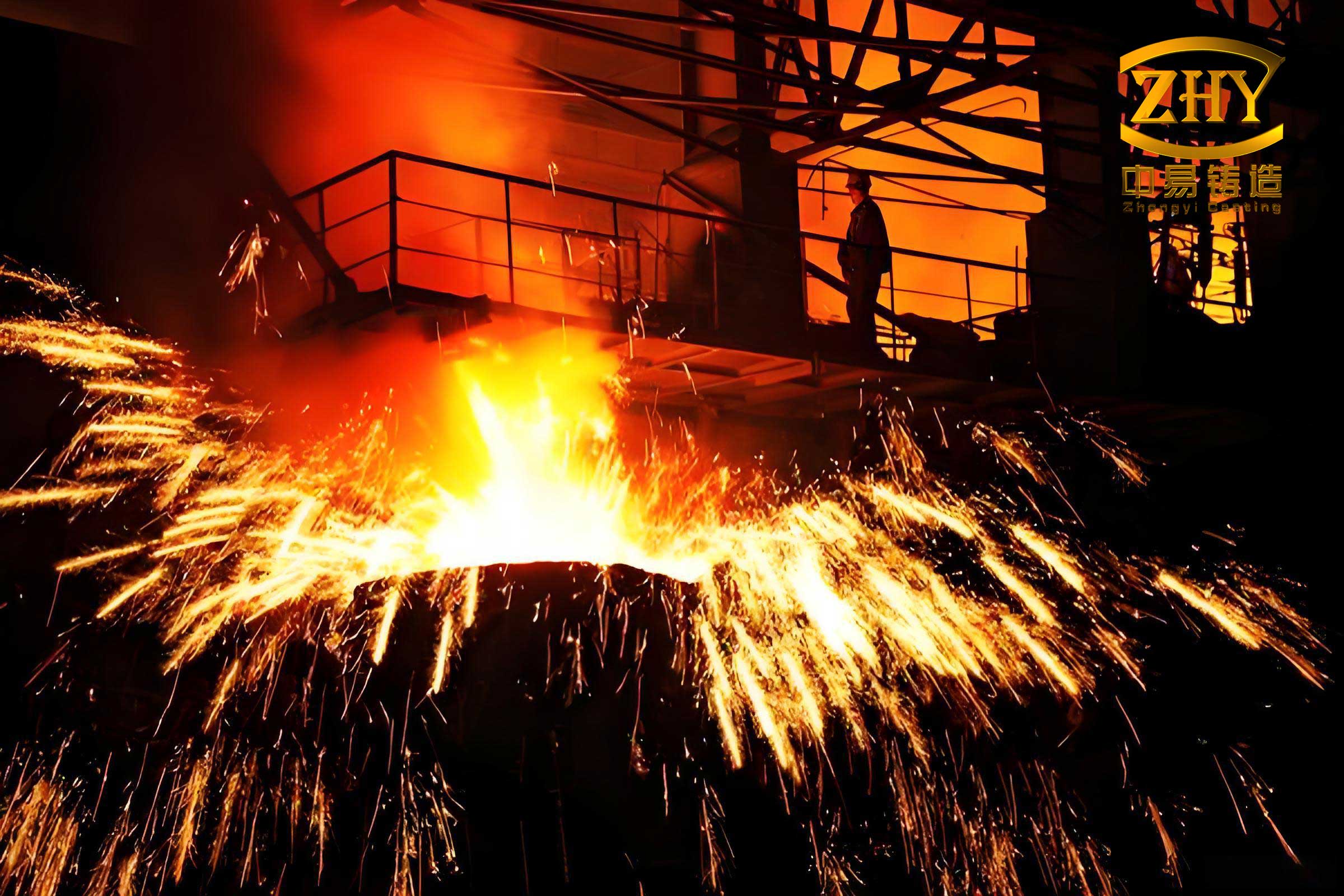
The gear in question was a ductile iron casting with a grade of QT600-3, used in power transmission systems. Its structure featured a diameter of approximately 302 mm and a weight of 16 kg, with a main wall thickness of 56 mm. The original production process involved furan resin sand molding and melting in a 1.5-ton induction furnace. The charge composition included 30% pig iron, 30% returns (such as scrap ductile iron castings), and 40% steel scrap. The target chemical composition was as follows: carbon (C) at 3.6–3.8%, silicon (Si) at 2.3–2.5%, manganese (Mn) at 0.3–0.5%, copper (Cu) at 0.5–0.6%, sulfur (S) ≤ 0.02%, and phosphorus (P) ≤ 0.07%. Nodularization was carried out using a冲入法 (pour-over method) with QRMg8RE3 nodulizer (1.7% addition), and inoculation with 75SiFe inoculant (about 0.7% addition). The pouring temperature was maintained at 1,400–1,420°C, with a pouring speed of 3.5–4 kg/s.
During service, two out of thirty ductile iron castings exhibited tooth breakage, as observed in field reports. Initial suspicions pointed towards shrinkage porosity or slag inclusions, but upon closer examination, the real culprit was identified as nodularization degeneration. This phenomenon, where the graphite morphology deteriorates from spheroidal to flake-like, severely compromises the mechanical properties of ductile iron castings. In this case, hardness tests revealed values as low as 78–80 HB, and metallographic analysis confirmed the presence of flake graphite with only 50% pearlite in the matrix. Chemical analysis showed residual magnesium (Mg) at 0.056% and rare earth (RE) at 0.020%, which were insufficient to maintain proper nodularization. Further inspection of returned castings indicated that several ductile iron castings had not achieved full nodularization, with hardness below 100 HB, highlighting widespread quality issues.
The production setup involved molding two castings per box and using a 550 kg ladle for nodularization treatment. Each ladle was used to pour ten boxes plus three U-shaped test blocks, typically within 8–10 minutes. However, deviations in this process led to nodularization degeneration. Below, I analyze the key factors contributing to this problem in ductile iron castings.
Root Cause Analysis of Nodularization Degeneration
Nodularization degeneration in ductile iron castings is often a result of multiple interrelated factors. Based on my investigation, the primary causes in this case were inadequate inoculation control, suboptimal nodularization temperature, and prolonged pouring time. Let’s break these down in detail.
1. Inoculation Treatment: Inoculation is crucial for promoting graphite nucleation and preventing carbide formation in ductile iron castings. The original process used 75SiFe inoculant with a total addition of 0.7%, split into two-thirds covering the nodulizer and one-third added during tapping. This approach led to inoculation fade, where the effectiveness diminishes over time due to premature reaction or dissolution. The relationship between inoculation efficiency and time can be expressed using a decay model:
$$ I(t) = I_0 \cdot e^{-kt} $$
where \( I(t) \) is the inoculation effect at time \( t \), \( I_0 \) is the initial effect, and \( k \) is the decay constant dependent on temperature and composition. For ductile iron castings, a rapid decline in inoculation can trigger nodularization degeneration, as seen in the flake graphite formation.
2. Nodularization Temperature: The temperature during nodularization treatment significantly impacts the reaction kinetics. The original process aimed for an出炉温度 (tapping temperature) above 1,450°C, but excessive temperatures can cause excessive burning of nodulizer and inoculant. The optimal range for ductile iron castings is typically between 1,470°C and 1,500°C. Above this, the magnesium recovery rate decreases, leading to insufficient residual magnesium for stable nodularization. The magnesium recovery \( R_{Mg} \) can be modeled as:
$$ R_{Mg} = \alpha – \beta \cdot (T – T_{opt})^2 $$
where \( \alpha \) and \( \beta \) are constants, \( T \) is the treatment temperature, and \( T_{opt} \) is the optimal temperature (around 1,485°C for ductile iron castings). High temperatures accelerate fade, contributing to the degradation observed in the gear teeth.
3. Pouring Time: Prolonged pouring time allows for further fade of both nodularization and inoculation. The ladle was designed for a 10-minute pour, but delays due to mold leaks or operational issues extended this period. As time increases, the residual magnesium and inoculant effectiveness drop, leading to nodularization degeneration in later-poured ductile iron castings. The correlation between pouring time and nodularization quality can be summarized in the table below:
| Pouring Time (min) | Residual Mg (%) | Graphite Morphology | Hardness (HB) |
|---|---|---|---|
| ≤ 8 | ≥ 0.04 | Spheroidal | 200-250 |
| 8-10 | 0.03-0.04 | Mostly Spheroidal | 180-220 |
| > 10 | < 0.03 | Flake-like | < 100 |
This table illustrates how extended pouring times directly impact the quality of ductile iron castings, with severe degeneration occurring beyond 10 minutes.
To further quantify the effects, consider the overall quality index \( Q \) for ductile iron castings, which depends on inoculation efficiency \( I \), magnesium recovery \( R_{Mg} \), and pouring time \( t \):
$$ Q = \gamma \cdot I(t) \cdot R_{Mg} \cdot e^{-\delta t} $$
where \( \gamma \) and \( \delta \) are process-specific constants. Minimizing time and optimizing temperature are critical for maintaining high \( Q \) values in ductile iron castings.
Preventive Measures to Avoid Tooth Breakage
Based on the analysis, I implemented several corrective actions to prevent nodularization degeneration and ensure the reliability of ductile iron castings. These measures focus on enhancing inoculation control, optimizing temperatures, and strict time management.
1. Enhanced Inoculation Control: Inoculation is revitalized by increasing the amount and frequency of addition. For ductile iron castings, the 75SiFe inoculant addition was raised to 0.9–1.1%, distributed across three stages to combat fade:
- 40% used to cover the nodulizer in the ladle.
- 40% added during tapping via the runner channel.
- 20% applied as floating silicon inoculant after slag removal.
Additionally, a随流孕育 (stream inoculation) with BaSiFe inoculant (0.1% addition, grain size 0.2–0.7 mm) was introduced using a custom feeder. This multi-stage approach ensures sustained nucleation throughout the process for ductile iron castings. The effectiveness can be expressed as:
$$ I_{total} = \sum_{i=1}^{3} I_i \cdot e^{-k_i t_i} $$
where \( I_i \) and \( t_i \) represent the inoculant amount and time delay for each stage, respectively. By minimizing \( t_i \), the overall inoculation effect is maximized in ductile iron castings.
2. Optimal Nodularization Temperature: The treatment temperature was strictly controlled to 1,470–1,500°C. This range balances magnesium recovery and minimizes fade. Using a calibrated thermocouple system, real-time monitoring ensures consistency. The temperature effect on nodularization quality for ductile iron castings is summarized below:
| Temperature Range (°C) | Mg Recovery (%) | Nodularization Rating | Typical Defects |
|---|---|---|---|
| < 1,470 | Low (< 40%) | Poor | Incomplete Nodularization |
| 1,470-1,500 | Optimal (50-60%) | Excellent | None |
| > 1,500 | Declining (< 50%) | Degeneration | Flake Graphite |
This table highlights the importance of maintaining the sweet spot for producing high-quality ductile iron castings.
3. Controlled Pouring Time: To prevent fade, the pouring time per ladle was capped at 10 minutes, with a target of under 8 minutes. Operational improvements included better mold sealing to avoid leaks and streamlined handling. The relationship between pouring time and quality for ductile iron castings can be modeled with a time-decay function:
$$ Q(t) = Q_0 \cdot e^{-\lambda t} $$
where \( Q_0 \) is the initial quality and \( \lambda \) is the decay rate specific to ductile iron castings. By keeping \( t \) short, \( Q(t) \) remains high.
Furthermore, process parameters were documented in a comprehensive control plan for ductile iron castings, as shown in the following summary table:
| Parameter | Original Value | Improved Value | Impact on Ductile Iron Castings |
|---|---|---|---|
| 75SiFe Inoculant | 0.7% | 0.9-1.1% | Enhanced graphite nucleation |
| Inoculation Stages | 2 | 3 + Stream | Reduced fade |
| Nodularization Temp | >1,450°C | 1,470-1,500°C | Optimal Mg recovery |
| Pouring Time | Up to 10 min | < 10 min (target 8 min) | Minimized degeneration |
| Quality Checks | Limited | 100% hammer test + U-blocks | Early defect detection |
This table underscores the holistic approach needed to safeguard ductile iron castings from failures like tooth breakage.
Production Verification and Results
After implementing these measures, I monitored the production of ductile iron castings over six months. The improvements were evident in both metallurgical and mechanical properties. Regular testing of U-blocks and metallographic samples showed consistent nodularization ratings of 2–3 (according to ASTM A247), with pearlite content ranging from 55% to 65% in the matrix. The graphite morphology reverted to spheroidal form, as desired for ductile iron castings.
Hardness values increased to 200–250 HB, meeting the QT600-3 grade requirements. More importantly, out of 332 ductile iron castings produced and delivered, no further incidents of tooth breakage were reported by customers. The quality control measures, including 100% hammer testing (where a clear, ringing sound indicates soundness), proved effective in screening out defective ductile iron castings.
To quantify the improvement, consider the defect rate \( D \) before and after changes:
$$ D_{before} = \frac{2}{30} \approx 6.67\% $$
$$ D_{after} = \frac{0}{332} = 0\% $$
This dramatic reduction highlights the efficacy of the preventive strategies for ductile iron castings.
Conclusion
In conclusion, tooth breakage in ductile iron castings, such as gears, is often a symptom of underlying nodularization degeneration. Through detailed analysis, I identified key contributors: inoculation fade, improper treatment temperature, and prolonged pouring time. By strengthening inoculation control, optimizing temperature ranges, and strictly managing pouring times, the problem was effectively resolved. These measures not only eliminated breakage but also enhanced the overall consistency of ductile iron castings. The experience underscores the importance of process precision in metallurgy, where small adjustments can yield significant improvements in the performance and reliability of ductile iron castings. Moving forward, continuous monitoring and adaptation are essential to maintain high standards in producing ductile iron castings for demanding applications.
This case study serves as a valuable reference for foundries dealing with similar issues in ductile iron castings. By applying these principles, manufacturers can mitigate risks and ensure the durability of their ductile iron castings, ultimately leading to greater customer satisfaction and reduced waste. The journey from failure to success with ductile iron castings reinforces the idea that thorough investigation and proactive measures are key to excellence in metal casting.