
In the manufacturing of engine components, the cleanliness of casting parts is a critical quality indicator that directly impacts the longevity, reliability, and durability of the final product. Particulate matter adhering to the surfaces of casting parts can lead to severe failures such as cylinder scuffing, bearing wear, and abnormal wear in moving pairs if introduced into assembled engines. As an engineer specializing in casting processes, I have conducted an in-depth investigation into the sources of surface particulate matter on casting parts, focusing on sand casting production. This article presents a comprehensive analysis, defines particulate matter based on morphology and size, and proposes effective improvements from the casting perspective to enhance cleanliness and overall product quality. The insights shared here aim to contribute to the advancement of manufacturing practices for casting parts across industries.
The presence of particulate matter on casting parts surfaces is a multifaceted issue that originates from various stages of production, including casting, machining, and handling. To address this, I developed a systematic detection workflow, which involves sampling, sample preparation, microscopic examination, and evaluation. This process allows for the identification and categorization of particulate contaminants, enabling targeted interventions. In this discussion, I will elaborate on each step, introduce classifications, analyze sources, and detail improvement measures, all while emphasizing the importance of casting parts integrity. Throughout, I will incorporate tables and formulas to summarize key points, ensuring clarity and practical applicability.
Particulate matter on casting parts can be broadly classified into three distinct morphologies, which I refer to as Type A, Type B, and Type C. These classifications are based on visual characteristics observed under portable microscopy at magnifications ranging from 60x to 120x. Type A particles exhibit a curled appearance with metallic luster, often resulting from machining operations. Type B particles are irregular in shape, non-reflective, and have dimensions below 1 mm, commonly found in both casting and machining environments. Type C particles are similarly irregular and non-reflective but exceed 1 mm in size, primarily associated with casting processes. The detection of these particles on critical areas of casting parts, such as camshaft bores, water channels, and bearing cap edges, is essential for preventing downstream issues. The following table summarizes these morphological definitions:
| Particle Type | Morphology Description | Size Range | Typical Source |
|---|---|---|---|
| Type A | Curled, metallic luster | Variable | Machining processes |
| Type B | Irregular, non-reflective | < 1 mm | Casting and machining |
| Type C | Irregular, non-reflective | > 1 mm | Casting processes |
To quantify the impact of particulate matter on casting parts, I often consider the surface roughness parameter, Rz (mean roughness depth), which influences particle adhesion. The relationship can be expressed using a simplified formula: $$Rz = \frac{1}{n} \sum_{i=1}^{n} |Z_i – \bar{Z}|$$ where \(Z_i\) represents individual depth measurements from a surface profile, \(\bar{Z}\) is the average depth, and \(n\) is the number of measurements. Higher Rz values on casting parts surfaces indicate greater potential for particle entrapment, underscoring the need for process optimization.
The sources of particulate matter on casting parts were analyzed by sampling at various production stages: cast blank state, machining incoming stage, machining benchwork stage, and machining入库 stage. Microscopic examination revealed that Type A particles are predominantly introduced during machining operations, such as cutting and grinding, while Type B and Type C particles originate from casting-related activities, including shot blasting and cleaning. Environmental sampling in machining, benchwork, and casting fine-cleaning areas confirmed these findings. For instance, in casting fine-cleaning environments, only Type B and Type C particles were detected, aligning with the particulate profile of casting parts at the毛坯 stage. This analysis highlights the pervasive nature of particulate contamination across the lifecycle of casting parts. The table below contrasts particulate matter presence at different stages:
| Production Stage | Type A Particles | Type B Particles | Type C Particles | Overall Particulate Load |
|---|---|---|---|---|
| Cast Blank | Absent | Present | Present | Moderate to High |
| Machining Incoming | Present | Present | Present | Highest |
| Machining Benchwork | Present | Present | Present | Low |
| Machining入库 | Present | Present | Present | Low |
Based on this analysis, I focused on casting-specific improvements to reduce Type B and Type C particles on casting parts. The primary sources in casting are shot blasting and surface handling processes. Shot blasting, used for descaling and surface finishing, significantly affects the surface roughness of casting parts. Traditionally, a mix of steel shot and wire cut shot is employed, but their differing geometries impact particle adhesion. Steel shot is spherical, while wire cut shot is cylindrical, with the latter creating deeper and more irregular indentations on casting parts surfaces. To minimize this, I recommend transitioning to pure steel shot and incorporating smaller-diameter shot to reduce surface roughness. The effect can be modeled using the following formula for indentation depth \(d\) based on shot geometry: $$d = k \cdot \sqrt{\frac{F}{E \cdot r}}$$ where \(k\) is a material constant, \(F\) is the impact force, \(E\) is the modulus of elasticity of the casting parts material, and \(r\) is the radius of the shot. For spherical shot, \(r\) is uniform, whereas for cylindrical shot, it varies, leading to inconsistent \(d\) values and higher Rz.
Additionally, applying a thin paint coating to critical areas of casting parts, such as camshaft bores and bearing edges, can smooth surfaces and prevent particulate adhesion. This coating acts as a barrier, reducing the effective surface roughness and enhancing cleanliness. However, it requires careful evaluation to avoid peeling risks in internal cavities. Another improvement involves process optimization: reducing the in-process inventory of casting parts and implementing air-blow cleaning before feeding into machining. This minimizes environmental particle accumulation on casting parts surfaces during storage. The cumulative effect of these measures can be estimated using a cleanliness improvement index \(CI\): $$CI = \frac{C_0 – C_f}{C_0} \times 100\%$$ where \(C_0\) is the initial particulate count on casting parts and \(C_f\) is the final count after improvements. In practice, these strategies have shown to significantly enhance the cleanliness of casting parts.
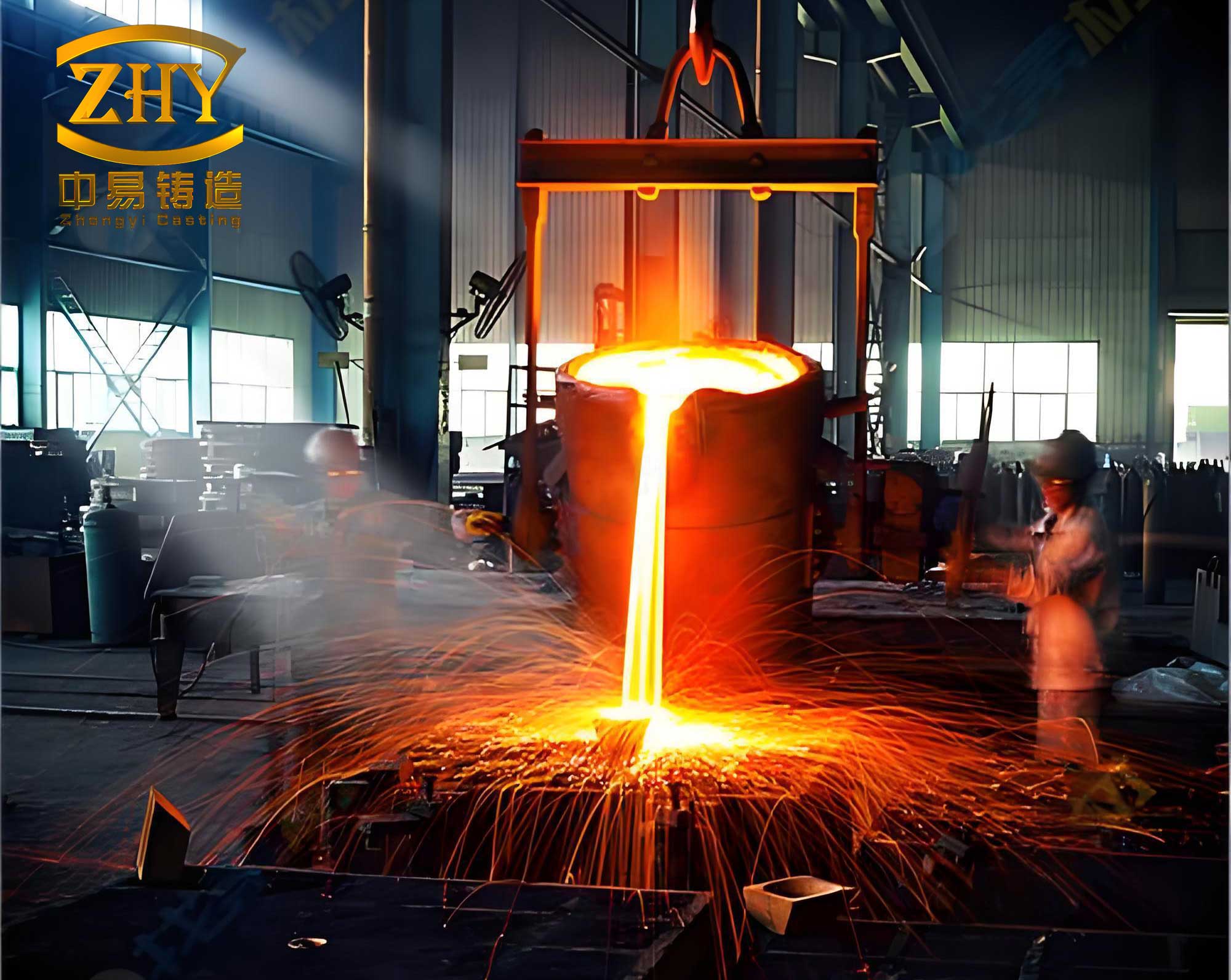
The implementation of these improvements requires a holistic approach to casting parts manufacturing. For shot blasting, I suggest using a graded mix of steel shot with diameters ranging from 1.0 mm to 2.5 mm to achieve a balanced surface finish. The table below summarizes the recommended shot blasting parameters for casting parts:
| Shot Type | Diameter Range (mm) | Shape | Expected Rz Reduction | Applicability to Casting Parts |
|---|---|---|---|---|
| Steel Shot | 1.0–2.5 | Spherical | High | High |
| Wire Cut Shot | 2.0–2.5 | Cylindrical | Moderate | Low (Not Recommended) |
Furthermore, the adhesion of particles to casting parts surfaces can be described by the adhesion force \(F_a\), which depends on surface energy and roughness: $$F_a = \gamma \cdot A \cdot f(Rz)$$ where \(\gamma\) is the surface energy, \(A\) is the contact area, and \(f(Rz)\) is a function of surface roughness. By reducing Rz through shot blasting optimization and paint coating, \(F_a\) decreases, making it easier to remove particles during cleaning steps. This principle is central to improving the cleanliness of casting parts.
In conclusion, through systematic analysis and targeted improvements, the particulate matter on casting parts surfaces can be effectively reduced. By defining particle morphologies, tracing sources to casting and machining processes, and implementing measures such as shot blasting optimization, surface painting, and process flow enhancements, the cleanliness of casting parts is significantly elevated. These efforts not only mitigate the risk of engine failures but also boost the overall quality and performance of casting parts in demanding applications. As manufacturing evolves, continuous monitoring and adaptation of these strategies will be essential for maintaining high standards in casting parts production. The integration of quantitative metrics, as shown through formulas and tables, provides a robust framework for ongoing improvement in the casting industry.