
In my extensive experience with foundry operations, addressing casting defects is a fundamental challenge that directly impacts product quality and cost. One particularly persistent issue encountered in the production of large, high-integrity components is the formation of hot tears. This analysis delves into a comprehensive investigation of hot tearing defects observed during the sand casting of a specific high-strength aluminum bronze alloy component. The insights and methodologies developed through this case study offer broadly applicable principles for improving the reliability of sand casting processes for complex geometries.
The component in question was a large worm wheel, a critical power transmission part. The alloy used was ZQAl9-4, a copper-based aluminum bronze known for its excellent wear resistance and mechanical properties. Its nominal composition is detailed in the table below.
| Element | Cu | Al | Fe | Mn | Other |
|---|---|---|---|---|---|
| Weight % | Balance | 8.0-10.0 | 2.0-4.0 | 1.0-2.0 | < 1.0 |
The original production process for this worm wheel was a classic green sand casting operation. The mold was created manually. To manage the solidification of the large, relatively thin web section (approximately 100mm thick with a diameter nearing 1000mm), a sophisticated chilling system was employed. Both the inner and outer circumferential edges of the wheel were lined with multiple shaped chills, each approximately 45mm thick. The gating system was a bottom-fed rain-style design to promote smooth, controlled filling. Several open-top risers were placed on the upper surface to compensate for solidification shrinkage. A schematic of this initial setup would show a wheel mold with distinct chill segments spaced evenly around its inner and outer perimeters.
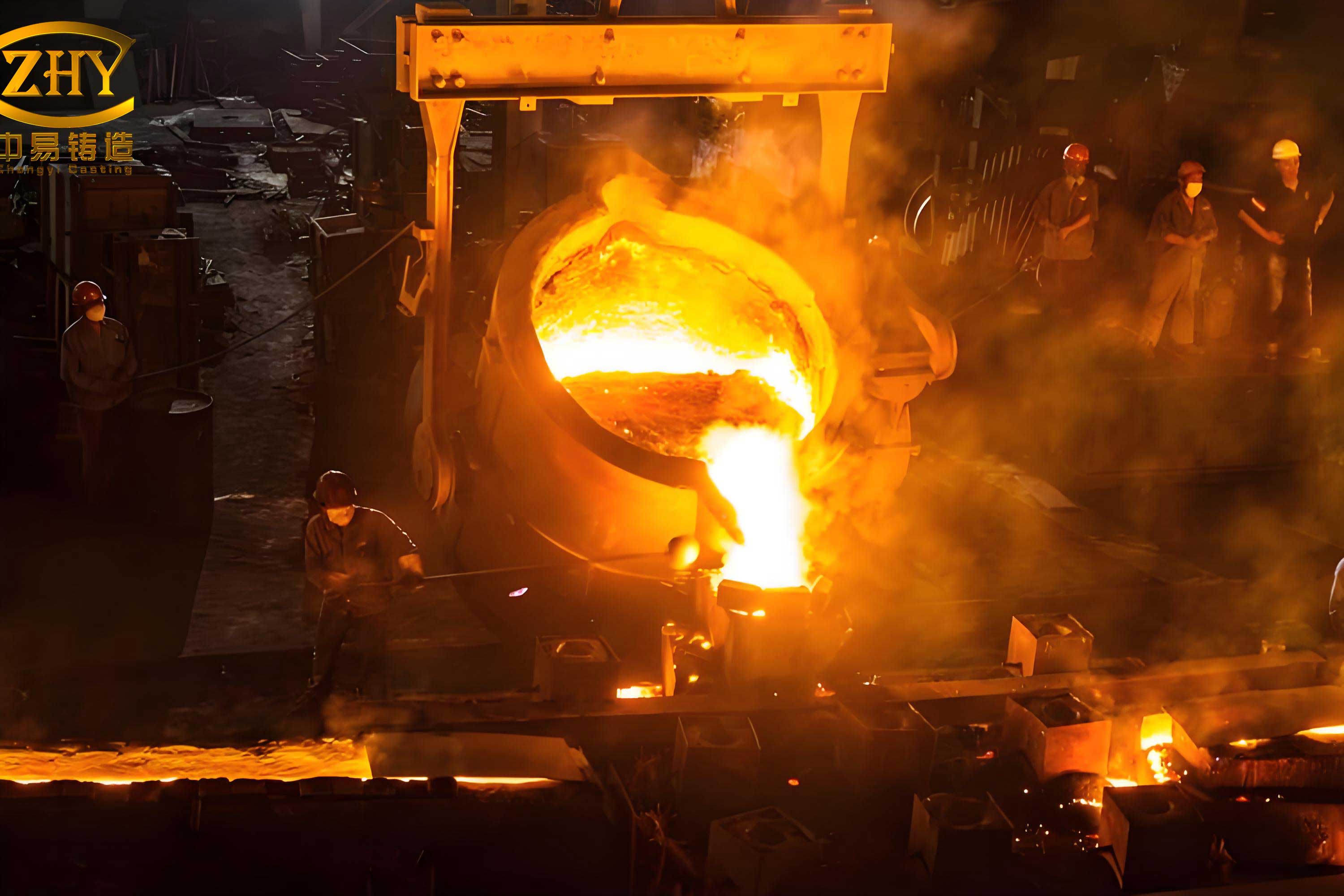
Despite this careful planning, a significant defect rate emerged. After shakeout, continuous linear cracks were consistently found in the castings. These cracks ran parallel to the wheel’s axis and were located precisely in the gaps between the discrete chill blocks around the outer rim. They were particularly severe in areas adjacent to the risers. The cracks had a clean, often oxidized fracture surface, characteristic of a hot tear formed while the metal was still in a semi-solid or just-solidified state. This presented a major quality and yield problem, necessitating a root-cause analysis.
Multifaceted Analysis of Hot Tear Formation
The formation of hot tears is rarely attributable to a single factor. In this sand casting scenario, a confluence of metallurgical, thermal, and mechanical factors created the perfect conditions for failure.
1. Metallurgical Susceptibility: The “Slow-Cool Embrittlement”
The ZQAl9-4 alloy’s inherent solidification behavior is the primary metallurgical culprit. To understand this, we must consider the phase transformations during cooling. From the Cu-Al-Fe ternary phase diagram, an alloy with ~9% Al will undergo a eutectoid transformation upon slow cooling through approximately 565°C. The high-temperature β phase decomposes into a mixture of α phase and the intermetallic γ₂ (Cu₉Al₄) phase, often accompanied by κ-phase (iron-rich) particles.
$$ \beta \xrightarrow[565^\circ C\text{ (Slow Cool)}]{} \alpha + \gamma_2 + \kappa $$
This eutectoid transformation product, particularly the brittle γ₂ phase, is detrimental to high-temperature strength and ductility. The phenomenon is termed “slow-cool embrittlement.” The severity is directly linked to cooling rate: slower cooling allows more complete transformation of the β phase, resulting in a larger volume fraction of the brittle eutectoid structure. In our sand casting setup, the regions between chills were precisely where cooling was slowest, creating localized zones of maximum embrittlement.
2. Thermal Gradient and Stress Analysis
The use of chills creates an intense thermal gradient. The metal in direct contact with the chills solidifies rapidly, developing high strength early. Meanwhile, the metal in the sand gaps between chills solidifies much more slowly. This differential cooling creates a state of non-uniform contraction. As the overall casting contracts during cooling, the rapidly solidified, strong sections (under the chills) resist contraction. This puts the slower-cooling, weaker sections (in the sand gaps) under tensile strain. The stress ($\sigma$) in these regions can be conceptually related to the temperature difference ($\Delta T$), the alloy’s elastic modulus ($E$), and coefficient of thermal expansion ($\alpha$) by a simplified relation:
$$ \sigma \propto E \cdot \alpha \cdot \Delta T $$
A higher $\Delta T$ between chilled and unchilled areas leads to higher stress. Furthermore, ZQAl9-4 has a relatively high linear shrinkage rate (approximately 2.49%), which amplifies the magnitude of the contraction-induced strains. The stress concentration was most pronounced at the outer rim due to its larger circumference and greater restraint, and near risers because these sections remain hotter longer, further reducing their localized strength during the critical solidification range.
3. Synergistic Failure: The Perfect Storm
The crack formation mechanism is a classic synergy of material weakness and applied stress. The table below summarizes the contributing factors in the problematic zones:
| Factor | Condition in Chill Gaps | Consequence |
|---|---|---|
| Cooling Rate | Very Slow | Coarse microstructure; Maximum “slow-cool embrittlement” |
| Microstructure | High % of brittle (α+γ₂+κ) eutectoid | Low elevated-temperature strength & ductility |
| Thermal Stress | High tensile strain due to restraint from chilled zones | Imposition of tensile stress on weak material |
| Location Factor | Outer rim & near risers | Greatest restraint and highest temperature gradient |
When the localized tensile stress, arising from differential contraction, exceeds the fragile, high-temperature strength of the slowly-cooled material in the gap, a tear initiates and propagates. The clean fracture surface confirms failure occurred along interdendritic or grain boundaries while a liquid film was still present or just after solidification.
Investigation of Corrective Measures
Addressing this issue required breaking the synergy described above. The initial focus was on directly manipulating the cooling rate in the defect-prone zones.
Initial Solution: Accelerated Cooling via Water Spraying
The first corrective action involved installing a water spray system in the mold. Channels were cut into the mold’s upper surface, connecting directly to the sand gaps between the outer chills. The process sequence was modified as follows:
- Pouring at a slightly reduced temperature (1080-1140°C).
- Waiting 3-5 minutes post-pour for initial solidification.
- Spraying water continuously for 10-15 minutes through the mold channels.
- Allowing the casting to cool in air before shakeout.
This method aimed to forcibly increase the cooling rate ($\frac{dT}{dt}$) in the gap zones, pushing it from the “slow-cool” regime into a faster-cooling regime. The objective was to suppress the eutectoid transformation, retaining more of the stronger β phase (or its transformation products) and refining the microstructure. The relationship can be thought of as moving past a critical cooling rate $R_c$:
$$ \text{If } \frac{dT}{dt} \ge R_c \rightarrow \text{Suppress eutectoid, retain metastable $\beta’$ (martensitic) or fine $\alpha$+$\kappa$} $$
$$ \text{If } \frac{dT}{dt} < R_c \rightarrow \text{Full eutectoid transformation, brittle structure} $$
Additionally, 1% crystalline manganese was added to the melt. Mn is known to stabilize the β phase and enhance solid solution strengthening, providing an additional metallurgical lever to reduce brittleness.
Result: This method was successful in eliminating hot tears, proving that cooling rate was the dominant controllable variable. However, it introduced significant practical drawbacks for production sand casting:
- Process Control Complexity: Timing was critical. Spraying too early risked water intrusion causing explosions or shrinkage defects. Spraying too late would be ineffective.
- Non-Uniform Cooling: Manual spraying led to uneven cooling, potentially creating new stress concentrations.
- Impracticality: It was a messy, operator-dependent step unsuitable for standardized production.
A more robust, design-based solution integrated into the sand casting pattern was needed.
Final Robust Solution: Geometric Modification via Reinforcement Ribs
The breakthrough came from rethinking the geometry of the casting itself, specifically the problematic sand gap. Instead of treating the sand as a passive insulator, the mold cavity in the chill gaps was actively modified. Small, thin reinforcement ribs were added to the pattern in the wheel’s web section, aligned with and filling the sand gaps between chills.
These ribs, approximately 15-20mm wide and 10mm high, served multiple critical functions, fundamentally altering the thermal and mechanical dynamics of solidification. Their impact is analyzed below:
| Feature of Rib | Mechanism of Action | Beneficial Effect |
|---|---|---|
| Reduced Local Section Thickness | Creates a localized thin section within the thick web. | Dramatically increases cooling rate in the exact defect-prone location, suppressing brittleness. |
| Improved Thermal Connectivity | Provides a “thermal bridge” of solid metal connecting the chilled zones. | Promotes more uniform temperature distribution, reducing the thermal gradient ($\Delta T$). |
| Mechanical Reinforcement | Adds material and geometric stiffness to the web in the gap region. | Increases the localized strength and resistance to tensile strain during the vulnerable solidification period. |
The introduction of the rib changes the effective modulus and thermal profile of the region. We can model the stress reduction by considering how the rib lowers the average temperature of the gap zone ($T_{gap}$) closer to the temperature of the chilled zone ($T_{chill}$).
$$ \Delta T_{new} = T_{gap, new} – T_{chill} $$
$$ \Delta T_{new} < \Delta T_{original} $$
$$ \sigma_{new} \propto E \cdot \alpha \cdot \Delta T_{new} < \sigma_{original} $$
Furthermore, the rib solidifies quickly, gaining strength early and helping to carry the tensile load that develops, preventing it from concentrating sufficiently to initiate a tear in the adjacent web material. This is an elegant example of using casting design to manage solidification stress within the sand casting process itself.
Result: Implementing this simple pattern modification, while maintaining the lowered pouring temperature and Mn addition, resulted in a 100% elimination of hot tearing defects in subsequent production runs. The solution was reliable, required no extra process steps, and was seamlessly integrated into the existing sand casting workflow.
Generalized Principles for Sand Casting Design
This case study yields several universally applicable guidelines for preventing hot tears in complex sand casting designs, particularly those employing chills:
- Manage Metallurgical Sensitivity: Understand the phase transformations of the alloy. For alloys prone to slow-cool embrittlement, the primary goal is to avoid prolonged residence in the critical temperature range through design or process control.
- Avoid Abrupt Changes in Cooling Rate: Discrete chills create severe local variations. Where possible, transition zones should be designed. Adding features like ribs in sand gaps is a direct method to create a thermal transition, making cooling more uniform.
- Design for Uniform Strength Development: The casting geometry should aim for all sections to develop strength at a similar rate. Thin ribs or webbing can strengthen slow-cooling sections without adding significant mass.
- Minimize Restraint During Contraction: Analyze how the mold (including cores and chills) restrains the casting. Strategic geometry changes can sometimes redirect or accommodate contraction strains away from vulnerable areas.
- Synergistic Process-Design Optimization: The most effective solutions combine alloy chemistry adjustments (e.g., Mn addition), process parameter control (e.g., lower pour temp), and intelligent geometric design (e.g., reinforcement ribs).
Conclusion
Through systematic investigation, the root cause of hot tearing in these large aluminum bronze worm wheels was identified as the synergistic effect of metallurgical “slow-cool embrittlement” and high thermal stress concentrations in sand gaps between discrete chills. The initial proof-of-concept solution, forced cooling via water spraying, validated the critical role of cooling rate but was industrially impractical. The ultimate, highly effective resolution was achieved through a fundamental modification of the casting’s geometry. By integrating thin reinforcement ribs into the pattern at the precise locations of the former sand gaps, the sand casting process was intrinsically improved. This change simultaneously increased the local cooling rate to suppress brittle phase formation, reduced thermal gradients to lower stress, and added mechanical reinforcement to resist strain. This case underscores that in sand casting, many defect challenges are best solved not by adding complex external process controls, but by innovating within the design of the casting itself, leveraging geometry to master the physics of solidification and contraction.